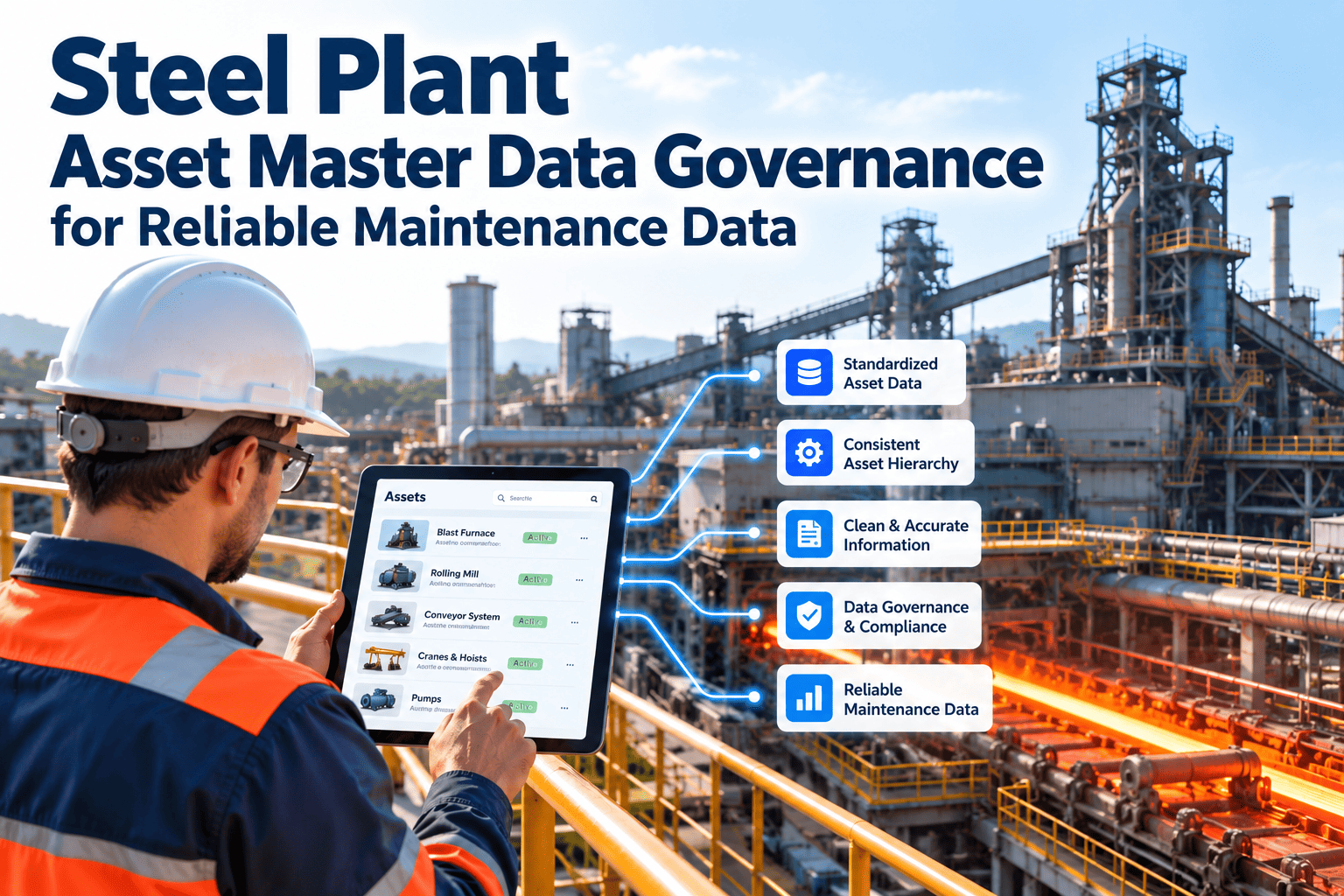
Predictive analytics depends on maintenance data that people trust. In many steel plants, that trust is missing because nobody owns the asset list, failure codes change from shift to shift and sensor tags drift away from the equipment they describe. A data governance framework fixes this with clear ownership, shared standards and routine checks. This guide lays out a practical framework for maintenance and reliability teams, without turning governance into a paperwork exercise. Plants building their records can start with Oxmaint maintenance management software as the working system for assets, inspections and work orders.
Steel Plant Maintenance Data Governance Framework for Predictive Analytics
Define who owns maintenance data, what standards it follows and how quality is checked, so analytics and AI projects start from records the plant can rely on.
What Governance Means in a Maintenance Context
Governance is the set of decisions about who may create, change and use maintenance data, and to what standard. It is closer to good housekeeping than to IT policy.
Symptom
Two engineers pull different downtime figures for the same mill.
Root cause
No agreed definition of downtime, or no rule on when a stop is logged.
Governance fix
A written definition, an owner and a required field in the work order.
Why predictive analytics raises the stakes
Reports tolerate small errors because people read them critically. Models do not. They learn from whatever the records say, including mistakes.
Five Pillars of the Framework
Every data domain needs a named owner: asset register, failure codes, inspection forms, spare parts, sensor tag mapping. Owners approve changes and answer quality questions.
Agree on asset naming, hierarchy levels, units, failure modes, causes and priority definitions. Reference frameworks such as ISO 55000 for asset management and ISO 14224 for reliability data help.
Write measurable rules, such as required fields at closure and valid ranges for readings, then check them on a schedule.
Control who can edit asset records, close critical work orders and change codes. Everyone should be able to read what they need.
Define how assets are added, renamed or retired, how history is kept and how code lists change without breaking old records.
Who Decides What: A Simple Responsibility Table
Adapt the roles to your organization. The point is that every decision has one accountable person.
| Data Domain | Accountable | Maintains | Consulted |
|---|---|---|---|
| Asset register and hierarchy | Reliability lead | Maintenance planner | Operations, engineering |
| Failure and cause codes | Reliability engineer | Maintenance supervisors | Technicians, OEM support |
| Work order quality | Maintenance manager | Planners and supervisors | Technicians |
| Sensor tag mapping | Automation or controls lead | Controls engineers | Reliability lead |
| Spare parts and BOMs | Stores or materials lead | Storekeepers | Planners |
| Analytics datasets | Reliability or data lead | Data analyst | All domain owners |
Put Clear Rules Behind Every Work Order
Use structured assets, required fields and consistent inspection forms to keep maintenance records analytics-ready.
Data Standards That Predictive Analytics Needs
| Standard | Rule | Example Approach |
|---|---|---|
| Asset naming | One unique ID and one description pattern | Area, line, equipment type, number |
| Hierarchy depth | Fixed levels from plant to component | Plant, area, line, equipment, component |
| Failure mode list | Controlled list, reviewed yearly | Bearing failure, leak, overheating, electrical fault |
| Cause list | Separate cause from symptom | Lubrication loss, misalignment, contamination |
| Priority definition | Written criteria for emergency and urgent | Safety, production stop or quality impact |
| Timestamps | Single time zone and format | Start, stop and completion recorded at the asset |
| Units | One unit per measurement type | Defined for temperature, pressure and vibration |
Data Quality Rules You Can Check Weekly
Pick a small set of rules and report them openly. Visibility changes behavior faster than policy documents.
Closed work orders include failure mode, cause, labor time and parts used.
Dates are logical, readings fall within possible ranges and codes come from the approved list.
No duplicate assets, tags or open work orders for the same fault.
Work is recorded close to when it happens, not weeks later.
Asset IDs and units match between maintenance, controls and spare parts systems.
Governance Lifecycle for Maintenance Data
Create
New assets and codes follow the standard from day one.
Use
Technicians and planners record work with required fields.
Check
Quality rules run on a schedule with results shared.
Correct
Owners fix records and coach the people who created them.
Change
Code lists and hierarchy updates go through approval.
Retire
Decommissioned assets are closed while history is kept.
Governance Maturity: Where Is Your Plant Today?
| Level | Description | Analytics Readiness |
|---|---|---|
| Ad hoc | Each team keeps its own lists and spreadsheets | Low. Data must be rebuilt for each project |
| Defined | Standards written, applied unevenly | Limited. Pilots possible on a few assets |
| Managed | Owners named and quality rules measured | Good. Models can use critical asset data |
| Optimized | Findings feed back into codes and tasks | High. Continuous improvement of models and plans |
Do and Do Not: Practical Governance Habits
Do
- Start with critical assets and expand gradually
- Review failure codes with technicians who use them
- Publish quality results to supervisors weekly
- Document every change to code lists
- Link governance goals to uptime and planning outcomes
Do Not
- Create hundreds of codes nobody can remember
- Rely on one person to clean data annually
- Allow free-text-only closure on critical assets
- Edit history to make reports look better
- Treat governance as a one-off project
How Oxmaint Helps Enforce the Framework
Standards only work when daily tools make them easy to follow. Oxmaint provides the maintenance workflow side.
- Asset management to keep one hierarchy and equipment history
- Work order templates with required details for consistent closure
- Preventive maintenance schedules that standardize recurring tasks
- Inspection checklists with fixed fields instead of free text
- Role-based access to control who edits records
- Inventory links between assets and spare parts
- Dashboards and reports to monitor quality and backlog
Setting Up a Governance Council and Meeting Rhythm
Governance needs a regular forum with decision power. Keep it small, short and focused on results.
| Forum | Frequency | Participants | Typical Agenda |
|---|---|---|---|
| Data quality review | Weekly | Planners, supervisors | Incomplete work orders, duplicates, overdue closures |
| Standards working group | Monthly | Reliability, controls, stores | Code list changes, hierarchy updates, new asset onboarding |
| Governance council | Quarterly | Maintenance manager, operations, IT, reliability lead | Quality trends, priorities, resources and policy decisions |
| Annual standards review | Yearly | All domain owners | Failure codes, definitions, retention and access rules |
Write Down Your Metric Definitions
Many analytics disputes come from undefined terms. Publish definitions once and apply them everywhere.
| Term | Decision to Document | Why It Matters |
|---|---|---|
| Downtime | Does it include planned stops, startup losses and waiting for operations? | Changes availability and loss figures |
| Failure | Loss of function, degraded performance or any unplanned repair? | Defines the label for predictive models |
| Mean time to repair | Measured from fault report or from work start, and to handover or to restart? | Affects comparison between teams |
| PM compliance | On time, within a window or completed at all? | Changes how performance is judged |
| Backlog | Which statuses count and how are deferred jobs treated? | Drives staffing and planning decisions |
| Criticality | Which factors score an asset and who approves changes? | Controls where monitoring effort goes |
Cleaning Up Legacy Maintenance Data
Most plants carry years of inconsistent records. Clean them in priority order rather than trying to fix everything at once.
Rank by criticality
Fix records for assets whose failure stops production or creates safety risk first.
Merge duplicates
Combine repeated assets and retire the extras while preserving history.
Recode failures
Reclassify vague entries from the past two to three years with technician help.
Mark uncertain records
Flag history that cannot be verified so analysts can exclude it.
Lock the standard
Apply required fields so new records do not repeat old problems.
Report progress
Share cleanup status by area so teams see the improvement.
Governing Sensor and Time-Series Data
Predictive analytics depends as much on signals as on work orders. Apply governance to both.
Each sensor tag links to one asset, one measurement type and one unit, with an owner for changes.
Record calibration and replacement dates so shifts in readings can be explained.
Document sampling intervals and compression settings that affect analysis.
Keep status flags for faulty, substituted or interpolated values.
Record when tags, scaling or ranges change to avoid false trends.
Training and Onboarding for Good Data Habits
People create data every shift. Short, practical training does more than long policy documents.
- Teach technicians why failure cause matters, using examples of how past records helped planning
- Give supervisors a simple weekly report showing their team's record quality
- Include data standards in onboarding for new technicians and contractors
- Provide quick reference cards for code lists and priority definitions
- Recognize teams with consistent, complete records
- Collect feedback on codes that are confusing and revise them
Audit and Compliance Readiness
Steel plants face safety, environmental and quality audits. Well-governed maintenance records make them easier.
Records auditors expect
- Inspection history for lifting equipment, pressure systems and safety devices
- Completed preventive maintenance with dates and signatures
- Corrective actions linked to the original finding
- Calibration records for critical instruments
Governance practices that help
- Immutable history with timestamps and user names
- Defined retention periods by record type
- Controlled access to editing and approval
- Reports that can be produced without manual rebuilding
Measuring Governance Success
Track a few indicators that show whether data is becoming more reliable and more useful.
Share of closed work orders with valid failure mode and cause.
Duplicate assets or work orders found per review cycle.
Average delay between work finished and work recorded.
Number of reports and models built without manual data cleanup.
Requests from analysts to correct or explain maintenance records.
Governance Roadmap for the First Six Months
Start with a focused scope and build momentum before extending rules plant-wide.
Assess
Review current asset lists, codes and reports, and name domain owners.
Define
Agree on naming, hierarchy, code lists and metric definitions for critical assets.
Apply
Set required fields in work orders and inspection forms and train supervisors.
Measure
Publish weekly quality results and start the review meetings.
Clean
Correct priority legacy records and merge duplicate assets.
Extend
Use the cleaned data for a first analytics pilot and expand rules to the next area.
Common Governance Failures and Fixes
No clear owner
Fix: name an accountable person for each data domain and publish the list.
Rules ignored on shift
Fix: make key fields required and show supervisors their team results weekly.
Code lists too long
Fix: reduce to a manageable list and review misuse with technicians.
Why Governance Pays Off for Predictive Analytics
Good governance rarely looks exciting, but it removes the problems that cause analytics projects to fail.
- Analysts spend less time cleaning data and more time answering maintenance questions
- Models train on consistent failure labels, which improves trust in the results
- Reports agree across departments because definitions are shared
- New assets and sensors are onboarded in a repeatable way
- Audits and reviews draw on complete, traceable records
The practical test
If a new analyst could pull a clean failure history for any critical asset within an hour, governance is working.
Frequently Asked Questions
Where should governance start?
Begin with the asset register and failure codes for critical equipment, since every analytics use case depends on them.
Who should lead it?
A reliability or maintenance lead with authority across areas, supported by operations and controls teams.
How often should standards be reviewed?
Review code lists and hierarchy at least yearly, and sooner after major equipment changes.
Can a CMMS enforce these rules?
Yes, through required fields and roles. See it in Oxmaint.
Can we walk through our setup?
Yes, book a demo to discuss your data standards.
Build Maintenance Data Your Analytics Team Can Trust
Set ownership, standardize codes and keep every asset record consistent from the shop floor to the dashboard.