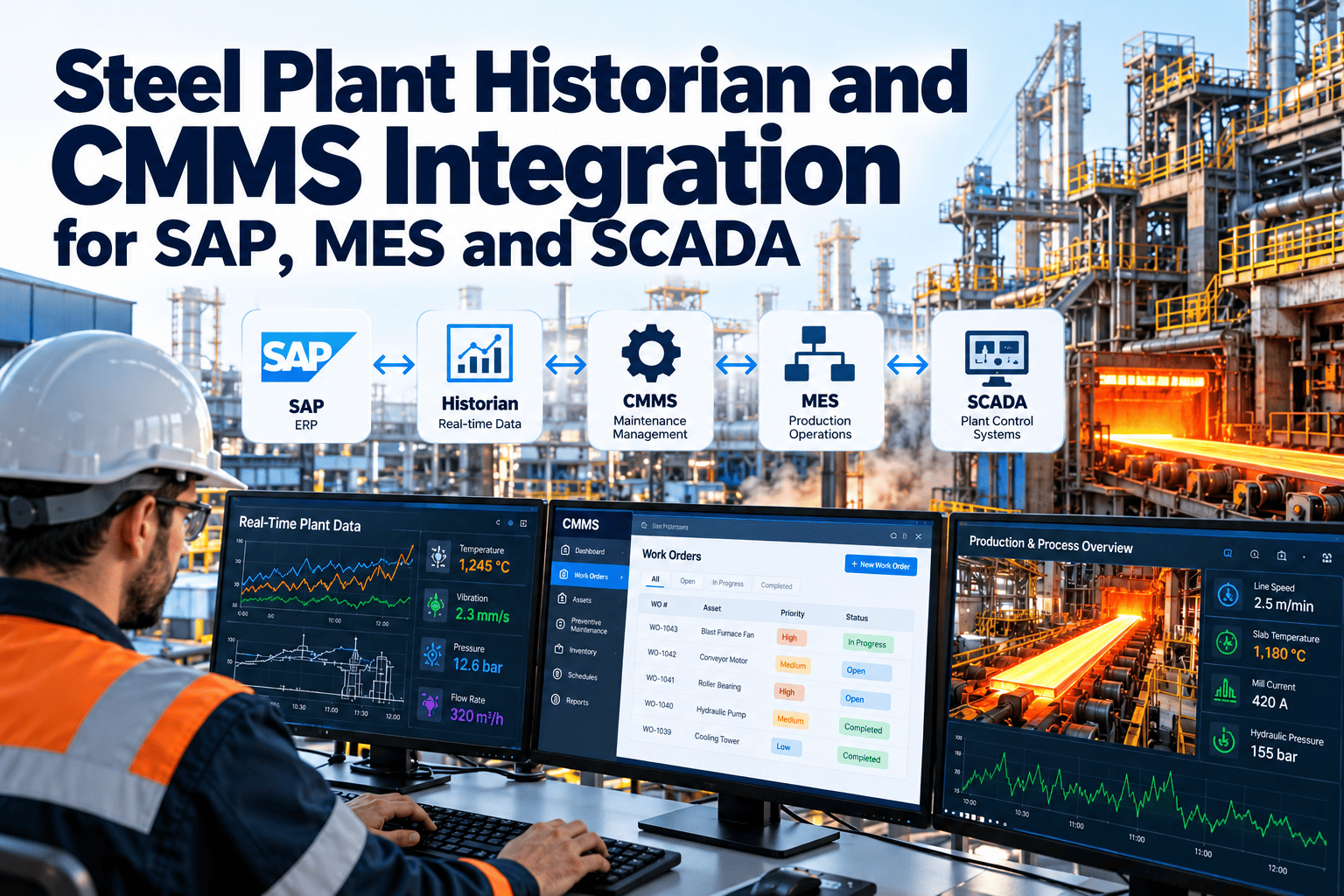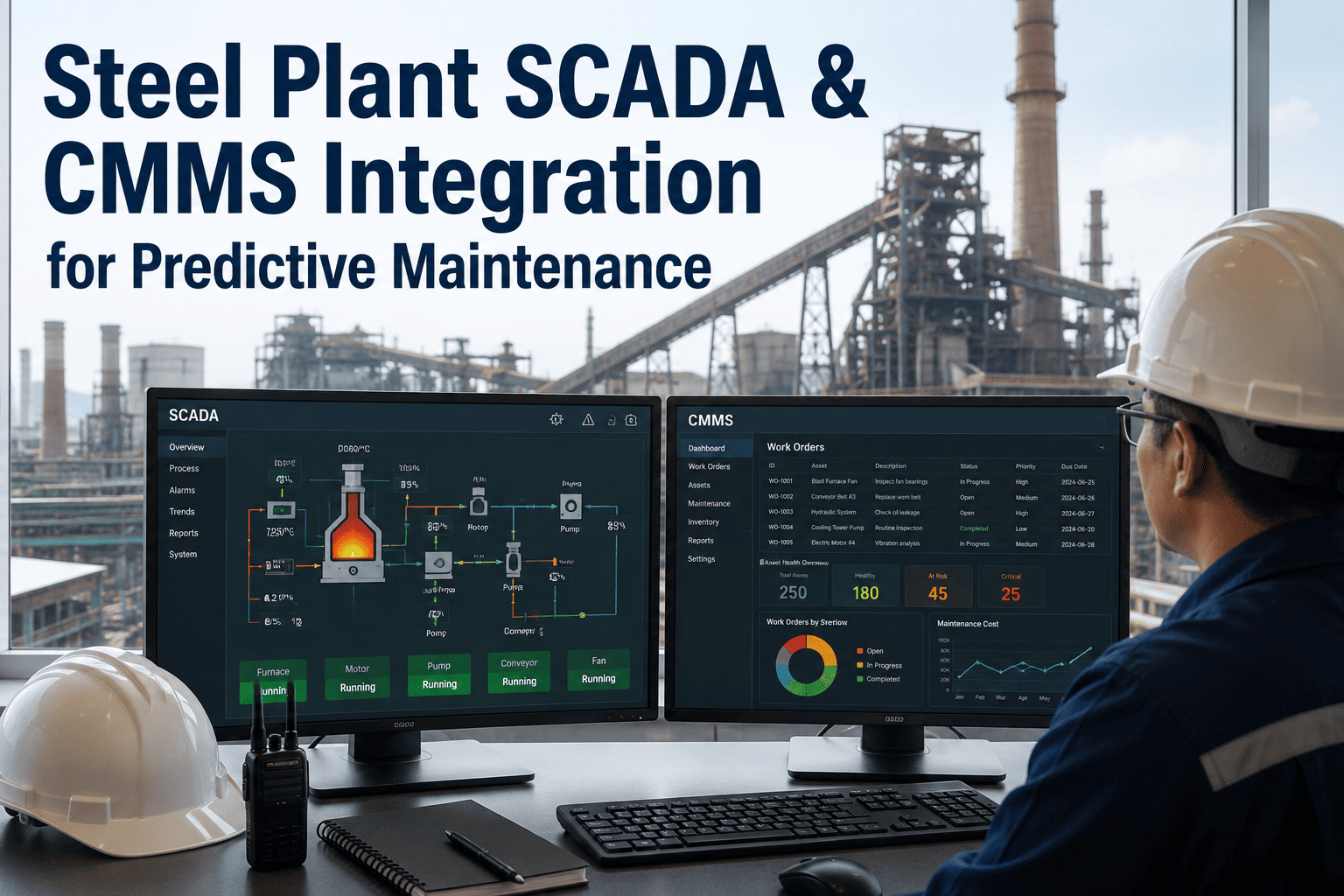
Steel plant SCADA CMMS integration is the bridge that turns real-time process data into scheduled maintenance action — connecting OPC-UA tags, PI System historians and blast furnace alarms directly into your work-order workflow so failures are predicted, not just reacted to. A well-architected SCADA-to-CMMS pipeline can cut unplanned downtime 25–40 percent and extend asset life by thousands of operating hours, yet most mills still rely on clipboard rounds and spreadsheet-based tracking. OxMaint makes that integration turnkey: alarm thresholds auto-generate work orders, predictive analytics flag bearing degradation before catastrophic failure, and reliability engineers gain a single pane of glass across every asset. Ready to modernize? You can Start Free Trial or book a 30-minute demo with our team.
SCADA × CMMS INTEGRATION GUIDE
Turn every process alarm into an automatic work order — before the furnace fails.
Steel plants lose over $50B a year to unplanned downtime. OxMaint connects your PI System, OPC-UA tags and blast-furnace SCADA directly into a predictive CMMS — so alarm thresholds trigger qualified work orders in seconds, not shifts.
THE INTEGRATION GAP
Why steel plants need SCADA-CMMS integration for predictive maintenance
Most steel plants already invested heavily in SCADA and process historians — yet 70 percent of maintenance work is still reactive, costing an average of $50,000 per hour of unplanned blast-furnace downtime.
The problem is the gap between visibility and action. SCADA systems monitor thousands of process tags — bearing temperatures, hydraulic pressures, motor currents, vibration levels — but those data points rarely translate into maintenance work orders until a phone call is made or an operator notices smoke. By the time the clipboard is picked up, the window for planned intervention has closed. True SCADA predictive steel strategies require the historian data to flow directly into the CMMS, where AI models and rules can classify urgency, auto-generate work orders and assign the right technician with the right parts — all before equipment fails.
| Metric | SCADA Without CMMS | SCADA + OxMaint CMMS |
|---|---|---|
| Alarm-to-work-order time | 2–8 hours (manual) | Under 15 minutes (automated) |
| Unplanned downtime / yr | ~120 hours per line | 40–70 hours per line |
| Maintenance backlog | 30–45 open WOs | 5–12 open WOs |
| Mean time to repair (MTTR) | 4.5 hours | 2.1 hours |
| Spare-parts stock-out rate | 18% | 4% |
STEP-BY-STEP PLAYBOOK
How to integrate PI System and OPC-UA tags with a CMMS
A reliable steel plant PI System to CMMS pipeline takes 4–8 weeks to deploy and pays for itself in under 14 months. Here is the phased rollout most mills follow.
Map critical assets to SCADA process tags
Catalog every blast furnace, rolling mill, caster, crane and motor in OxMaint, then link each asset record to its corresponding OPC-UA node or PI System tag. A typical integrated steel plant maps 8,000–15,000 tags across 300–600 maintainable assets.
Define alarm-to-work-order rules
Configure OxMaint rule engines against each tag — e.g., bearing temperature above 85°C for 10 minutes generates a Priority 2 work order; vibration RMS exceeding 7.1 mm/s triggers a Priority 1 inspection. Rules can reference ISO 10816 vibration limits and OEM-recommended thresholds.
Train AI models on historical process data
OxMaint ingests 12–24 months of historian data to train predictive models for each asset class. Models learn baseline operating signatures so deviations — a 2°C creep in stave-cooling temperature, a 3% rise in fan-motor current — are flagged as anomaly precursors, not just binary alarms.
Go live with closed-loop work-order automation
SCADA alarms now auto-create, prioritize and dispatch work orders with the correct spare parts, procedures and technician assignments. Reliability engineers see live OEE dashboards; maintenance managers get shift-end summaries; operators get acknowledgment feedback in the HMI.
REAL-WORLD IMPACT
Blast furnace SCADA integration: a worked example
A 2.8 MTPA integrated steel mill was spending $4.2M annually on unplanned blast-furnace downtime — averaging 96 hours per campaign across two furnaces.
Before: reactive maintenance
- Stave-cooling temperature alarms reviewed manually during shift handover — average 6-hour lag.
- Hot-blast motor vibration exceeded ISO 10816 Zone D three times before catastrophic bearing seizure.
- Spare-parts stock-out for critical refractory slides caused 14 additional hours of delay per quarter.
- OEE hovered at 71% — well below the 82% world-class benchmark for integrated mills.
After: OxMaint + SCADA pipeline
- Stave-cooling deviations now auto-generate Priority 1 work orders within 8 minutes of threshold breach.
- Predictive vibration model flagged bearing degradation 11 days before failure — repair scheduled during planned tap-hole change.
- Parts auto-reserved against each work order — stock-out rate dropped from 19% to 3%.
- OEE improved to 79% within 9 months — saving $1.3M in avoided downtime costs.
ROI & PAYBACK
What does SCADA-CMMS integration cost — and what is the payback?
For a typical mid-size steel plant with 400 assets and 10,000 process tags, the integration investment pays back in 9–14 months. Here is the breakdown.
Annual ROI Formula
ROI = (Downtime Cost Avoided + Spare-Parts Savings + Labor Efficiency Gain − Software & Integration Cost) ÷ Software & Integration Cost × 100
| Investment Line | One-Time | Annual | Payback Period |
|---|---|---|---|
| OxMaint CMMS license (400 assets) | — | $72,000 | — |
| OPC-UA / PI System connector setup | $18,000 | $8,000 | — |
| Tag mapping & rule configuration | $5,000 | — | — |
| Predictive model training | $8,000 | $5,000 | — |
| Total investment | $31,000 | $85,000 | ~11 months |
HOW OXMAINT HELPS
How OxMaint makes SCADA data actionable for steel reliability teams
OxMaint is an AI-powered CMMS and EAM platform built to close the gap between process data and maintenance execution. Four capabilities deliver measurable outcomes for steel plants.
Alarm-to-work-order automation
SCADA alarm thresholds and PI System deviation events auto-generate qualified work orders — complete with priority, parts list, procedure and technician assignment — in under 15 minutes.
Cuts alarm-response time by 85%Predictive analytics on historian data
OxMaint AI models continuously analyze vibration, temperature, pressure and current signatures from your process historian — detecting anomaly precursors days or weeks before failure.
Predicts 70% of critical failures 5+ days earlySpare-parts inventory sync
Every auto-generated work order reserves required spares against real-time inventory. Min-max levels auto-adjust based on consumption trends and predictive failure forecasts.
Eliminates 80% of stock-out delaysOEE & reliability dashboards
Live dashboards blend SCADA availability data with CMMS work-order history, giving reliability engineers real-time OEE, MTBF, MTTR and maintenance cost-per-ton visibility.
Improves OEE 6–8 points within 12 monthsSee OxMaint on your steel plant assets — book a 30-minute demo
Watch a live SCADA alarm generate a work order, reserve parts and dispatch a technician — all in one screen. Our team will map your PI System tags and OPC-UA architecture to a predictive maintenance plan.
FREQUENTLY ASKED
Steel plant SCADA CMMS integration — your questions answered
How does SCADA integrate with a CMMS in a steel plant?
SCADA integrates with a CMMS through OPC-UA gateways or direct PI System Web API connections. Process tags — temperature, vibration, pressure, motor current — are mapped to asset records in the CMMS. When a tag crosses a configured threshold, the CMMS rule engine automatically generates a qualified work order with priority, parts and technician assignment. OxMaint supports both real-time OPC-UA streaming and batched historian pulls, so integration works whether your SCADA is modern or legacy.
What is the PI System and why does it matter for steel maintenance?
The PI System (OSIsoft PI) is the most widely used process historian in steel plants — it archives millions of tags from SCADA, DCS and PLC systems at second-level resolution. For maintenance, it is the richest source of trend data for predictive models. Connecting PI to a CMMS like OxMaint lets reliability engineers query 12–24 months of operating history, train AI failure-prediction models and set condition-based maintenance triggers far more accurate than time-based schedules.
How long does SCADA-to-CMMS integration take for a steel plant?
A typical 400-asset steel plant with 8,000–12,000 process tags can go live in 4–8 weeks. Weeks 1–2 cover asset-tag mapping and OPC-UA connector setup. Weeks 3–4 configure alarm-to-work-order rules. Weeks 5–6 train predictive models on historian data. Weeks 7–8 run closed-loop automation in shadow mode before full go-live. OxMaint provides dedicated integration engineers — book a demo to get a project timeline scoped to your plant.
Can OxMaint connect to existing blast furnace SCADA and legacy systems?
Yes. OxMaint connects to any SCADA system that exposes OPC-UA, OPC-DA, Modbus TCP or a REST API. For legacy blast-furnace control systems that only output to a PI historian, OxMaint pulls batched data via the PI Web API. We have integrated with Siemens PCS 7, ABB 800xA, Emerson DeltaV and GE iFIX — as well as proprietary Japanese and German furnace-control systems.
What is the ROI of SCADA predictive maintenance in steel manufacturing?
Steel plants implementing SCADA-driven predictive maintenance typically see a 25–40% reduction in unplanned downtime, a 15–20% decrease in maintenance spend and a 6–8 point OEE improvement. At an average downtime cost of $50,000 per hour, a single avoided blast-furnace trip can save $200,000–$500,000. Most OxMaint steel clients achieve full payback in 9–14 months. Start a free 14-day trial to model your plant's specific ROI.
Stop reacting to alarms. Start predicting failures.
Join the steel plants using OxMaint to turn SCADA data into maintenance intelligence — cutting downtime 40%, extending asset life and hitting OEE targets month after month.
Free 14-day trial · No credit card required