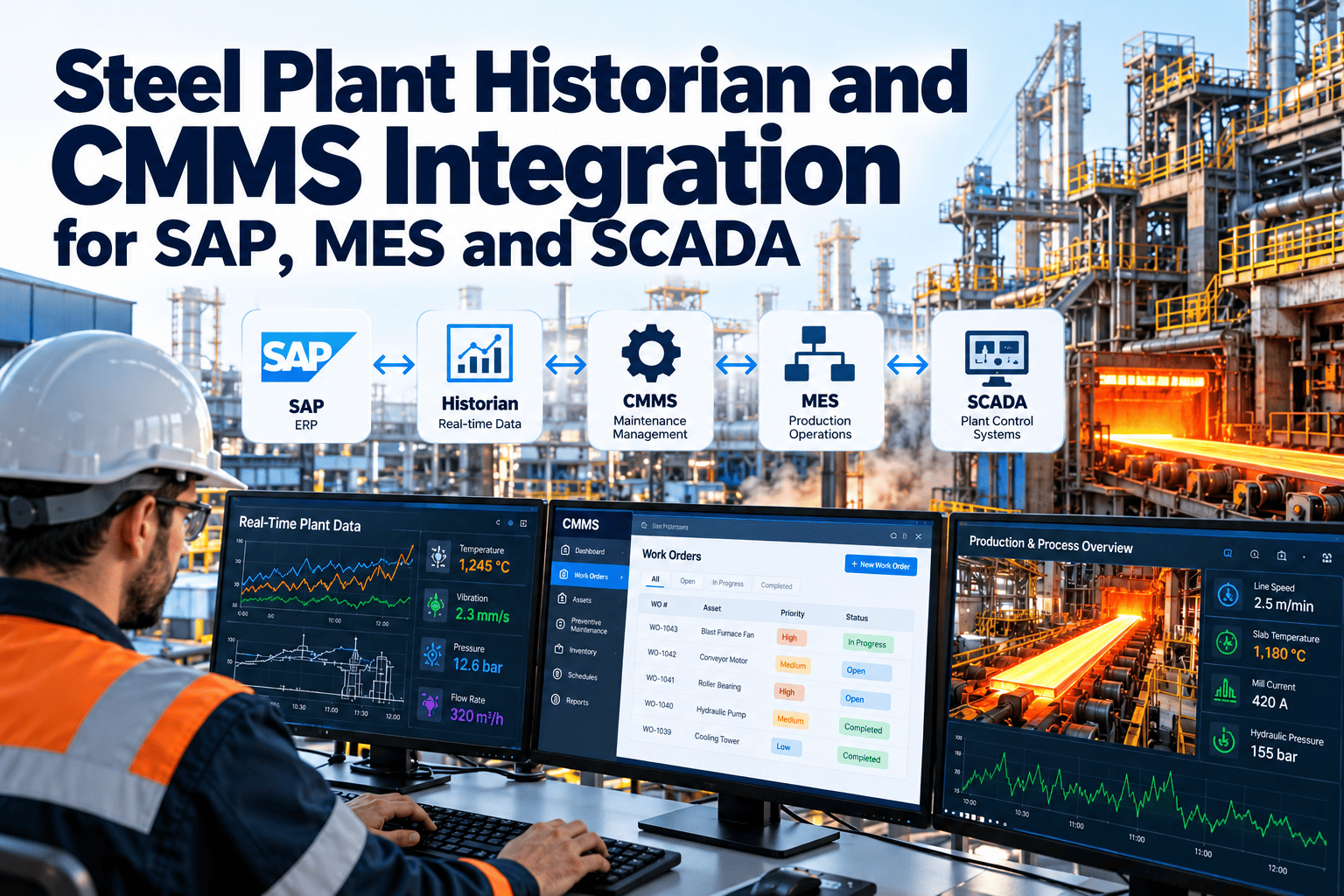
In a steel plant, the maintenance department and the operations control room speak different languages, use different systems, and often discover the same problem at different times. A SCADA system detects a blast furnace cooling pump vibration spike at 2:14 AM. The operator notes it in the shift log. At 6:30 AM, the day-shift maintenance planner sees a verbal note saying "pump sounds rough." By 9:00 AM, a technician is dispatched to investigate — nearly 7 hours after the SCADA system first flagged the anomaly. In those 7 hours, the bearing degraded further, the repair that would have been a 2-hour bearing swap became a 12-hour pump rebuild, and the blast furnace ran with marginal cooling — risking a $2M cooling plate failure. This gap between detection and action exists in every steel plant that runs SCADA and CMMS as separate, unconnected systems. The global SCADA market reached $14.2 billion in 2024 (Fortune Business Insights), while the CMMS market hit $1.8 billion — yet fewer than 15% of steel plants have meaningful real-time integration between the two (ARC Advisory Group, 2024). Plants with CMMS-SCADA integration achieve 35% faster response to equipment anomalies, 28% reduction in unplanned downtime, and 40% improvement in condition-based maintenance effectiveness compared to plants operating these systems independently (LNS Research, 2024).
Connecting SCADA operational data to CMMS maintenance workflows means transforming sensor readings into automatic work orders, equipment alarms into prioritized maintenance tasks, and operational trends into predictive maintenance triggers — without human re-entry, delay, or interpretation error. Oxmaint CMMS integrates with plant SCADA, DCS, PLC, and historian systems to receive real-time equipment data, auto-generate condition-based work orders, populate equipment records with operational context, and close the loop between what operations sees and what maintenance does.
The Data Flow: From Sensor to Work Order
In an integrated system, data flows automatically from field instruments through SCADA/DCS to the CMMS — triggering maintenance actions without human re-entry or delay. Here's the complete signal path for a steel plant:
Field Sensors
Vibration probes on BF cooling pumps, thermocouples on caster segments, pressure transmitters on hydraulic systems, current transformers on mill drives, flow meters on gas lines, level sensors on lubrication reservoirs.
SCADA / DCS / PLC
Collects, processes, and displays real-time data. Applies alarm thresholds. Stores historical trends in data historian (OSIsoft PI, Wonderware, GE Proficy). Operators monitor and respond to process conditions.
Integration Layer
Middleware (OPC-UA, REST API, MQTT) translates SCADA data into CMMS-compatible events. Applies maintenance-specific logic: alarm persistence filtering, severity classification, equipment ID mapping, duplicate suppression.
CMMS Work Order Engine
Receives maintenance events, auto-generates work orders with equipment ID, alarm description, severity, sensor readings, and recommended action. Dispatches to qualified technician. Tracks through completion. Records in equipment history.
Close the Gap Between Detection and Action — Automatically
Oxmaint connects to your SCADA, DCS, PLC, and historian systems via OPC-UA, REST API, and MQTT — turning equipment alarms into prioritized work orders in seconds, not hours.
Integration Points Across the Steel Plant
Every production area generates SCADA data that maintenance needs — but each area has different signal types, alarm frequencies, and maintenance response requirements:
Blast Furnace
Steel Making (BOF/EAF)
Continuous Caster
Rolling Mills (Hot & Cold)
The Five Integration Failures That Disconnect Maintenance From Operations
Most steel plants have both SCADA and CMMS. What they lack is the bridge between them. Five systemic failures keep these systems operating as isolated islands:
The Human Re-Entry Bottleneck
An operator sees an alarm on the SCADA screen, writes it in a shift log, tells the shift supervisor verbally, who tells the maintenance coordinator by phone, who creates a work order manually in the CMMS — possibly 4-8 hours after the original alarm. Each handoff introduces delay, interpretation error, and information loss. The CMMS work order says "pump problem" — the SCADA alarm said "Pump 4A vibration 11.2 mm/s, bearing temperature 92°C, trend rising 3°C/hour for past 6 hours." The rich diagnostic data that enables smart maintenance decisions is lost in translation.
The Alarm Flood Problem
A typical steel plant SCADA system generates 5,000-50,000 alarms per day. Most are nuisance alarms, process fluctuations, or transient conditions that resolve themselves. Sending all of them to the CMMS would create thousands of meaningless work orders and bury real maintenance needs in noise. Without intelligent filtering between SCADA and CMMS, maintenance teams either ignore the integration (too many false work orders) or the integration is never implemented (fear of alarm flood). The result is the same: no connection between detection and action.
The Operating Hours Disconnect
CMMS preventive maintenance is typically scheduled by calendar (every 30 days, every quarter). But equipment wear is driven by operating hours, not calendar days. A BF cooling pump that ran 720 hours last month needs different maintenance timing than one that ran 400 hours because the furnace was on reduced production. Without SCADA feeding run-time hours into the CMMS, PM schedules are either too frequent (wasting resources when equipment is idle) or too infrequent (missing wear-driven maintenance windows during heavy production periods).
The Context-Free Work Order
A technician receives a work order: "Check pump — reported vibration." They arrive at the pump with no data on current vibration level, historical trend, whether the alarm is still active, what operating conditions exist, or whether similar alarms occurred before. They spend 30-60 minutes recreating diagnostic information that already exists in SCADA. If the pump is currently running normally (intermittent issue), they may close the WO as "no fault found" — only for the alarm to return 48 hours later when the same intermittent condition recurs.
The One-Way Data Flow
Even plants with some integration typically only flow data from SCADA to CMMS. But operations also needs to know what maintenance is doing. An operator sees an alarm clear and assumes the problem is fixed — when actually the technician temporarily bypassed the alarm to work safely. A production scheduler plans a high-tonnage campaign not knowing that a critical hydraulic pump is scheduled for overhaul. Without CMMS data flowing back to operations, maintenance and production make conflicting decisions.
One Plant. One Picture. Maintenance and Operations Finally Connected.
Oxmaint integrates bidirectionally with SCADA, DCS, and historian systems — auto-generating context-rich work orders from equipment alarms while pushing maintenance status back to operations dashboards.
Integration Architecture: Protocols, Logic, and Data Mapping
The technical architecture of CMMS-SCADA integration involves four layers — each one critical for reliable, maintainable, and scalable operation:
Communication Standards
Intelligent Filtering & Classification
Equipment & Data Alignment
CMMS Work Order Generation & Feedback
What the Integrated CMMS Must Deliver
A CMMS capable of meaningful SCADA integration must excel across four technical dimensions:
Frequently Asked Questions
What protocols are used to connect SCADA systems to CMMS in steel plants?
Four primary protocols enable SCADA-CMMS integration in steel plants, each suited to different scenarios: OPC-UA (Unified Architecture) is the industry standard for plant-to-enterprise communication. It's platform-independent, supports complex data structures (not just simple values, but structured alarm objects with timestamps, severity, and context), and provides built-in security (encryption, authentication, authorization). OPC-UA is the preferred choice for new integration projects connecting Siemens, ABB, Rockwell, or Yokogawa SCADA/DCS systems to cloud or on-premise CMMS platforms.
How do you prevent alarm flooding from overwhelming the CMMS with work orders?
Alarm flood prevention is the most critical design challenge in CMMS-SCADA integration. A steel plant SCADA system can generate 5,000-50,000 alarms daily — routing all of them to the CMMS would create an unmanageable workload and render the system useless.
What data should SCADA feed into the CMMS for each equipment alarm?
The value of auto-generated work orders depends entirely on the richness of data they contain. A work order that says "alarm on pump" is barely better than a phone call. A work order with full operational context enables the technician to diagnose and prepare before arriving at the equipment. Essential data per alarm event: Equipment identification — CMMS asset ID (mapped from SCADA tag), equipment name and location, equipment criticality rating. Alarm details — alarm type (vibration high, temperature high, pressure low, current overload), alarm threshold that was breached, actual value at time of alarm, alarm severity/priority.
How does bidirectional integration benefit operations and maintenance?
Most integration projects focus on one direction — SCADA to CMMS. But the highest-value implementations are bidirectional, with maintenance data flowing back to operations. SCADA → CMMS (alarm-to-action): Equipment alarms auto-generate work orders. Operating hours feed PM scheduling. Process conditions provide maintenance context. Trend data enables predictive maintenance. CMMS → SCADA/Operations (status-to-awareness): Equipment under active maintenance is flagged on operator HMI screens — preventing operators from attempting to start or load equipment that's being worked on.
What ROI can a steel plant expect from CMMS-SCADA integration?
CMMS-SCADA integration ROI comes from four primary sources, with typical payback periods of 6-14 months: 1. Faster anomaly response (35% improvement): Reducing the average time from equipment anomaly detection to maintenance action from 4-8 hours (manual communication chain) to minutes (auto-WO generation) prevents escalation of developing failures. A bearing vibration alarm caught and addressed in 1 hour instead of 8 hours is the difference between a $2,000 bearing swap and a $50,000 pump rebuild — because 7 additional hours of degraded operation accelerates damage exponentially. With 50-100 such events annually on critical equipment, the savings range from $500,000-$2,000,000 per year. 2. Operating-hour-based PM optimization: Switching from calendar-based to operating-hour-based PM scheduling (enabled by SCADA run-time data feeding CMMS meters) typically reduces PM task volume by 15-25% while improving coverage — equipment running hard gets maintained more frequently, idle equipment less frequently.
Connect Your SCADA to Your CMMS. Connect Detection to Action.
Join steel plants already using Oxmaint to bridge the gap between operations and maintenance — with auto-generated work orders, real-time equipment context, operating-hour-based PM, and bidirectional status visibility.