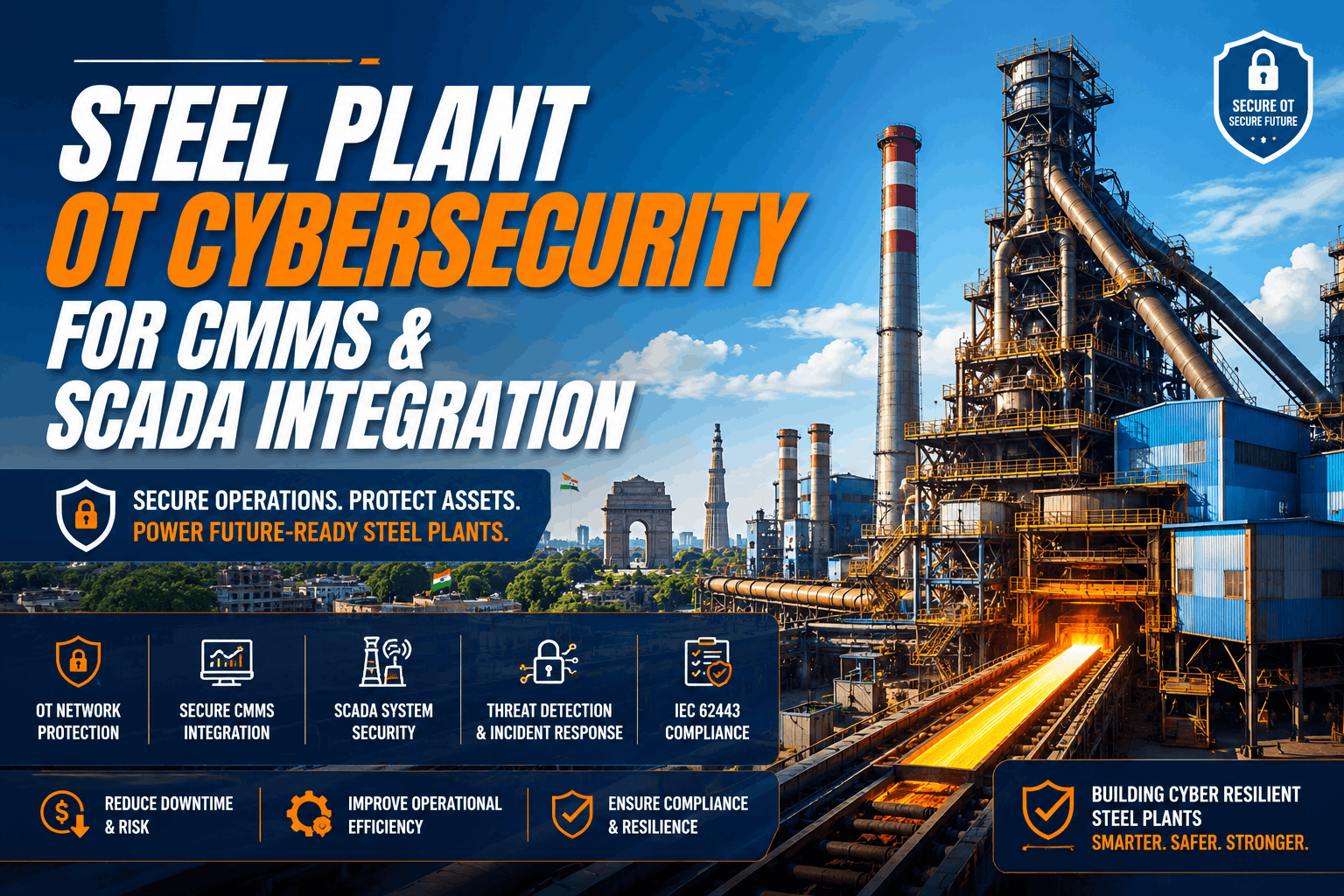
In June 2022, a ransomware attack shut down a major European steel producer for over two weeks. Blast furnaces that require continuous operation were forced into emergency shutdown—a process that damages refractory linings worth $2M–$5M each and takes 10–15 days to safely restart. Total estimated loss: $40M–$80M in production, equipment damage, and recovery costs. That attack didn't target the steel plant's email servers or financial systems. It penetrated the operational technology network—the SCADA systems, PLCs, and HMIs that control blast furnaces, rolling mills, continuous casters, and energy management. And it succeeded because the OT environment had the same vulnerability that exists in 78% of steel plants today: insufficient segmentation between IT and OT networks, unpatched industrial control systems running software from 2008, and zero visibility into what's actually happening on the plant floor network. Steel production is uniquely vulnerable to OT cyberattacks because the consequences of disruption aren't data loss or website downtime—they're physical destruction of multi-million-dollar equipment, molten metal safety emergencies, environmental releases, and production losses measured in $500,000+ per day. The threat isn't theoretical. Nation-state actors, ransomware gangs, and industrial espionage operations are actively targeting steel and metals producers. The only question is whether your OT security posture will stop them when—not if—they attempt to breach your operational network.
Steel Industry Cyber Threat Level: Elevated
78%
Of steel plants lack adequate IT/OT segmentation
$40M+
Average cost of a successful OT ransomware attack on integrated mills
340%
Increase in cyberattacks on manufacturing OT networks since 2020
Why Steel Plants Are Prime OT Cyber Targets
Steel production combines every characteristic that makes an industrial operation attractive to cyber adversaries: high-value continuous processes that cannot tolerate interruption, aging control systems with known vulnerabilities, extensive connectivity between enterprise and operational networks, and physical consequences severe enough to justify multi-million-dollar ransom demands. Facilities that sign up to centralize their OT asset visibility and maintenance tracking are taking the first critical step toward understanding what's connected to their operational network—and what's exposed.
Critical Threat
Ransomware on OT Networks
Attackers traverse from IT to OT via flat networks, encrypting HMI workstations and SCADA servers. Result: loss of process visibility and control, forcing emergency shutdowns of blast furnaces, casters, and rolling mills.
Impact: $20M–$80M per incident including equipment damage, lost production, and recovery
Critical Threat
Safety System Manipulation
Nation-state actors target Safety Instrumented Systems (SIS) that prevent catastrophic events—overriding emergency shutdowns on furnaces, disabling gas detection, or manipulating cooling system parameters to cause physical damage.
Impact: Equipment destruction, personnel safety emergencies, environmental releases
High Threat
Industrial Espionage
Competitors and state-sponsored groups exfiltrate proprietary process data—alloy formulations, rolling schedules, quality parameters, and customer specifications—from process historians and MES systems connected to the OT network.
Impact: Competitive advantage loss, IP theft, contract violations
High Threat
Supply Chain Compromise
Malicious code embedded in vendor software updates, remote access tools, or third-party maintenance connections. Equipment vendors with VPN access to PLCs become the attack vector into your most critical control systems.
Impact: Persistent backdoor access to control systems, undetected for months
The Steel Plant OT Attack Surface
Understanding where your vulnerabilities are requires mapping the complete OT attack surface—every system, connection, and access point that an adversary could exploit to reach your process control network. Most steel plants significantly underestimate their attack surface because they inventory control systems without accounting for the dozens of lateral pathways, remote connections, and legacy integrations that create unmonitored entry points.
Level 5
Enterprise Network
Email, ERP (SAP), corporate applications, internet access. Primary entry point for phishing and initial compromise. Attackers establish foothold here first.
▼
Level 3.5
DMZ / IT-OT Boundary
Data historians, MES interfaces, remote access gateways. The critical segmentation point—if this boundary is weak or bypassed, everything below is exposed.
▼
Level 3
Plant Operations / SCADA
SCADA servers, process historians, HMI workstations, engineering workstations. Controls visibility across BF, BOF, caster, rolling mill, and utility operations.
▼
Level 2
Control Systems
PLCs, DCS controllers, RTUs, VFDs, motor control centers. Direct interface with physical equipment. Compromising this level means controlling the process.
▼
Level 0–1
Physical Process & Safety
Sensors, actuators, safety instrumented systems (SIS), field instruments. The physical reality—temperature, pressure, flow, position. Manipulation here causes equipment damage, safety events, and environmental incidents.
OT Security Framework for Steel Operations
Protecting steel plant OT environments requires a defense-in-depth approach specifically engineered for industrial control systems—not IT security tools repurposed for the plant floor. Each layer of defense addresses a different attack vector, and the combined architecture creates multiple barriers that an adversary must overcome to reach process-critical systems.
01
OT Asset Discovery & Inventory
You can't protect what you can't see. Passive network monitoring identifies every device on the OT network—PLCs, HMIs, switches, historians, engineering laptops—without disrupting operations. Most steel plants discover 30–40% more connected devices than they knew existed.
Key action: Build a complete, real-time OT asset inventory with firmware versions, communication patterns, and vulnerability status
02
Network Segmentation & Zoning
Implement the Purdue Model with enforced boundaries between enterprise IT, DMZ, plant operations, control systems, and safety systems. Industrial firewalls and unidirectional gateways ensure data flows out of the OT network but attacks cannot flow in.
Key action: Deploy industrial-grade firewalls at every Purdue level boundary with application-aware rule sets
03
Continuous OT Network Monitoring
Deep packet inspection of industrial protocols (Modbus, OPC, EtherNet/IP, Profinet) detects anomalous commands, unauthorized configuration changes, and lateral movement that IT security tools cannot see. Behavioral baselines for each control system flag deviations in real time.
Key action: Deploy OT-specific intrusion detection with protocol-aware alerting tuned to your process environment
04
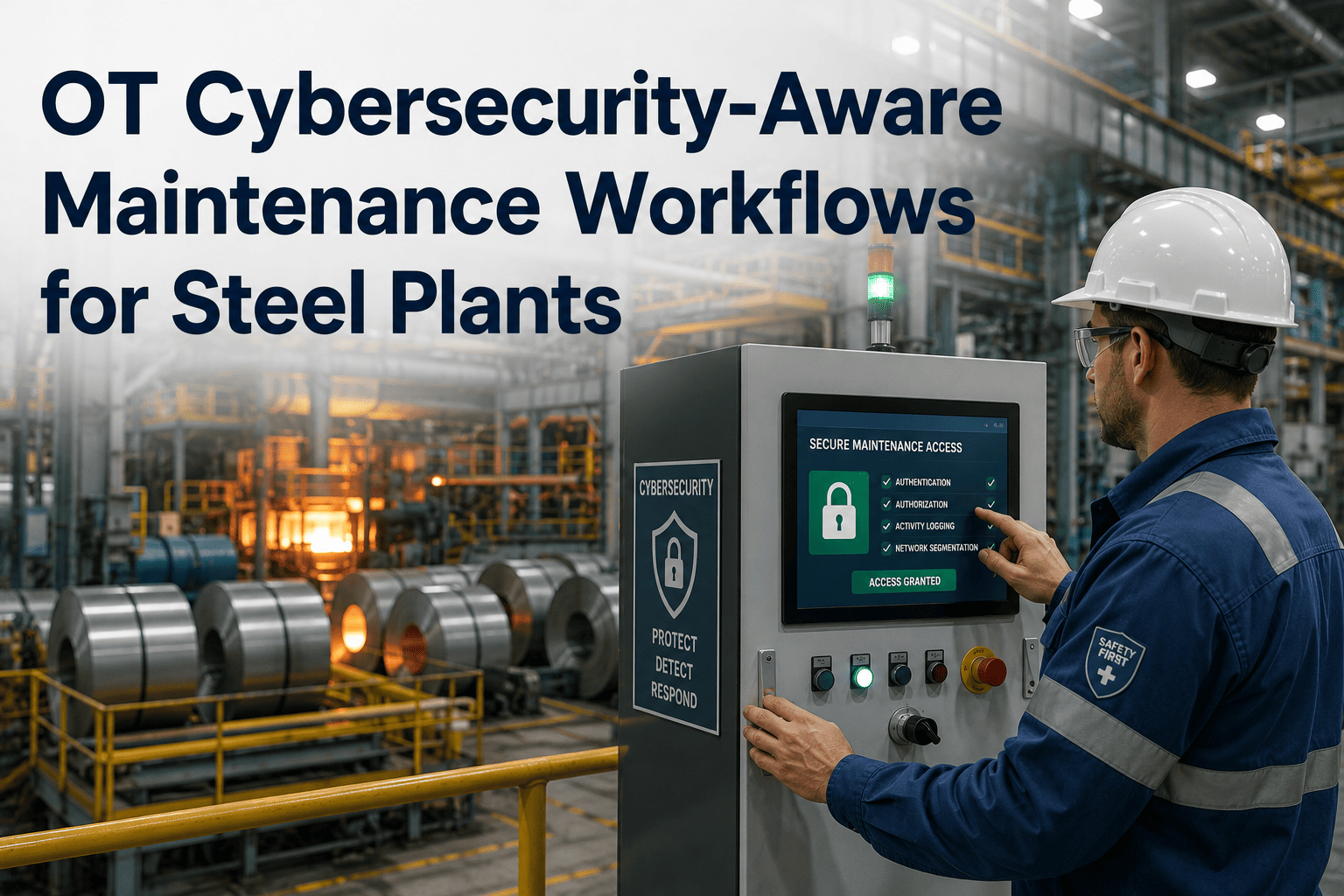
Secure Remote Access
Vendor remote access to PLCs and DCS systems is the #1 unmanaged risk in steel plant OT. Replace persistent VPN connections with zero-trust remote access that requires multi-factor authentication, session recording, and time-limited access windows with explicit approval.
Key action: Eliminate all persistent vendor VPN connections and implement session-based, audited remote access
05
Vulnerability & Patch Management
OT systems can't be patched like IT endpoints—production uptime constraints, vendor approval requirements, and legacy OS dependencies demand a risk-based approach. Prioritize vulnerabilities by exploitability and process impact, compensate with network controls where patching isn't feasible.
Key action: Maintain a living vulnerability register tied to OT asset inventory with compensating controls documented for unpatched systems
06
Incident Response & Recovery Planning
OT incident response is fundamentally different from IT. You can't just reimage a PLC. Recovery plans must include validated backups of every controller program, tested failover procedures for safety systems, and process-specific shutdown sequences that prevent equipment damage during a cyber event.
Key action: Develop and tabletop-test an OT-specific incident response plan with process engineering involvement
Track Every OT Asset, Every Vulnerability, Every Maintenance Action
OxMaint provides the asset visibility foundation that OT cybersecurity requires—complete equipment inventories, firmware tracking, maintenance histories, and work order management for every connected device in your plant.
Steel-Specific OT Vulnerabilities: What Attackers Target
Generic OT security guidance misses the attack vectors unique to steel production. The process-specific systems that run your blast furnaces, casters, and mills have vulnerabilities that require domain knowledge to identify and defend. Here's what sophisticated adversaries are targeting in steel plant environments—and what most security assessments overlook.
These vulnerabilities exist because steel plant control systems were designed for reliability and process performance—not cybersecurity. Many of the PLCs controlling your most critical processes were installed 15–25 years ago, before OT cybersecurity was a recognized discipline. Facilities that sign up to maintain a complete OT asset registry with firmware and patch status tracking gain the foundational visibility needed to prioritize remediation efforts based on actual risk rather than generic vulnerability scores.
OT Security Maturity: Where Does Your Plant Stand?
Most steel plants fall into the first two levels of OT security maturity—relying on IT-centric perimeter defenses that provide minimal protection for operational technology. Advancing from Level 1 to Level 3 typically takes 18–36 months with a structured program and delivers measurable risk reduction at each stage.
Level 1
Reactive / Ad Hoc
No OT asset inventory. Flat network between IT and OT. Vendor VPN access unmanaged. No OT-specific monitoring. Incident response plan doesn't address OT scenarios. Security posture discovered only after an incident.
Estimated position: 45% of steel plants
Level 2
Foundational
Basic IT/OT segmentation via firewall. Partial OT asset inventory. Some vendor access controls. IT security tools monitoring OT perimeter but not internal OT traffic. Incident response plan exists but untested for OT-specific scenarios.
Estimated position: 33% of steel plants
Level 3
Proactive / Managed
Complete OT asset inventory with vulnerability tracking. Purdue Model segmentation enforced. OT-specific network monitoring with behavioral baselines. Zero-trust remote access. Tested OT incident response plan. Regular tabletop exercises with operations and engineering.
Estimated position: 18% of steel plants
Level 4
Optimized / Resilient
Continuous threat intelligence integration. Automated response playbooks for OT-specific scenarios. Regular red team exercises against OT infrastructure. Validated controller backup and recovery procedures. Cyber-informed engineering integrated into process design.
Estimated position: 4% of steel plants
ROI of OT Cybersecurity Investment
OT cybersecurity investment in steel plants is justified by a single metric: the cost of a successful attack vs. the cost of prevention. When one ransomware event can exceed $40M in damages and a comprehensive OT security program costs $1M–$3M annually, the math is unambiguous.
$40M+
Avoided Ransomware Impact
Single prevented OT ransomware event—production loss, equipment damage, recovery costs
$3.5M
Reduced Insurance Premiums
Cyber insurance premium reductions of 15–30% with documented OT security controls
$2.1M
Operational Continuity Protection
Prevented minor cyber incidents (4–6/yr) that would cause partial production disruptions
$850K
Regulatory Compliance Value
Avoided penalties from NERC CIP, TSA Security Directives, and emerging OT regulations
The insurance argument alone often justifies OT security investment. Cyber insurance underwriters are increasingly requiring documented OT security controls as a condition of coverage—and facilities without them face policy exclusions that leave them self-insured for the $40M+ exposure that a successful OT attack represents. Facilities that book a free demo to see how asset visibility and maintenance tracking support OT security compliance can demonstrate the foundational controls that insurers require.
Expert Perspective: Building OT Cybersecurity in Steel Environments
"
The biggest mistake steel plants make with OT cybersecurity is treating it as an IT problem. IT security teams apply enterprise security thinking to the plant floor—and it doesn't work. You can't deploy endpoint agents on a PLC. You can't reboot a blast furnace controller for a patch. You can't force password rotation on a 20-year-old DCS without risking a process trip. OT security requires a fundamentally different approach that starts with understanding the physical process, identifying the safety and production consequences of each attack vector, and building controls that protect availability first—because in steel, losing control of the process doesn't just cost money. It can kill people. The plants that get this right embed OT security into their engineering and maintenance culture, not just their IT department.
Start with OT asset visibility—you can't protect what you can't see on your network
Segment IT and OT networks with industrial firewalls—flat networks are an open invitation
Eliminate persistent vendor VPN access—it's the #1 unmanaged OT attack vector
Involve process engineers in OT security—they understand what controller compromise means physically
Build the Asset Visibility Foundation for OT Cybersecurity
OxMaint provides complete OT asset inventory, firmware tracking, maintenance history, and work order management—the foundational data layer that every OT cybersecurity program requires. Know what's connected, what's vulnerable, and what's been maintained.
Frequently Asked Questions
What makes steel plant OT cybersecurity different from general industrial cybersecurity?
Steel production has unique characteristics that require specialized OT security approaches. The physical consequences of cyberattacks are extreme—manipulating blast furnace controls can cause refractory damage costing $2M–$5M, caster speed changes can cause breakout events with molten steel release, and gas system interference creates explosion and toxicity risks. Steel plants also operate legacy control systems that are 15–25 years old with no native security features, no ability to install endpoint protection, and vendor-specific protocols that IT security tools cannot inspect. The continuous nature of steel production means you cannot simply shut down systems for patching—BF campaigns run 15–20 years between relines. OT cybersecurity for steel must prioritize process safety and production availability while building layered defenses that work within these operational constraints.
How do we protect OT systems that can't be patched or updated?
Compensating controls are the standard approach for unpatchable OT systems. These include network segmentation to isolate vulnerable systems behind industrial firewalls with strict access control lists, application whitelisting on HMI and engineering workstations that only allows approved executables to run, removal of unnecessary network services and ports on control system devices, implementation of unidirectional security gateways that allow data to flow out of the OT network for monitoring while preventing any inbound traffic, monitoring of all communications to and from unpatchable devices to detect anomalous behavior, and physical security controls that restrict access to control system cabinets and network infrastructure. The key principle is reducing the attack surface around the vulnerable system rather than trying to fix the system itself.
What does an OT cybersecurity program cost for a steel plant?
Annual OT cybersecurity program costs for steel plants typically range from $1M–$3M depending on facility size, complexity, and current maturity level. Initial assessment and architecture design runs $200K–$500K. OT network monitoring deployment costs $300K–$800K for an integrated mill. Network segmentation improvements range from $400K–$1.5M depending on existing infrastructure. Ongoing monitoring, vulnerability management, and incident response retainer costs $500K–$1.2M annually. These costs protect against risk exposure of $40M+ per ransomware event, $500K+ per day of production disruption, and increasing regulatory penalties. Most facilities achieve meaningful risk reduction within 12–18 months of program initiation, with full maturity reached in 24–36 months.
How do we manage cybersecurity for vendor remote access to our control systems?
Vendor remote access is the single most common attack vector into steel plant OT networks. The solution is replacing persistent VPN connections with managed, session-based remote access that includes multi-factor authentication for every vendor connection, explicit approval workflow before access is granted, time-limited sessions that automatically disconnect after the approved window, full session recording with video and keystroke capture for audit trail, least-privilege access that restricts vendors to only the specific systems they need, and real-time monitoring with automatic disconnection if unauthorized actions are detected. No vendor should have always-on access to your control systems. Every remote session should be requested, approved, recorded, and reviewed. The cost of implementing managed remote access ($50K–$150K) is trivial compared to the risk of an unmanaged vendor VPN being compromised.
What regulations apply to OT cybersecurity in steel manufacturing?
While steel manufacturing does not yet face the prescriptive OT cybersecurity regulations that apply to electric utilities (NERC CIP) or pipelines (TSA Security Directives), the regulatory landscape is tightening rapidly. The SEC cybersecurity disclosure rules (effective December 2023) require publicly traded steel companies to report material cyber incidents within four business days and describe their cybersecurity risk management processes annually. The NIST Cybersecurity Framework and IEC 62443 provide the voluntary standards that most steel producers align to—and that cyber insurance underwriters increasingly require. EPA enforcement around environmental control system integrity is expanding. Several steel-producing states have introduced industrial cybersecurity legislation. And the EU's NIS2 Directive applies mandatory OT security requirements to steel producers operating in Europe. The trend is clearly toward mandatory OT security controls for heavy industry.