Industrial cybersecurity in steel plants operates within a complex threat landscape fundamentally different from IT security. Operational Technology (OT) systems — SCADA networks, Programmable Logic Controllers (PLCs), Distributed Control Systems (DCS), sensor networks — were designed for reliability and uptime, not encryption and authentication. A production line shutdown costs $500-1,500 per minute in lost revenue and damaged product. Yet 73% of steel plants run SCADA systems 15-20 years old with no security patches applied; 68% lack network segmentation between OT and corporate IT; 81% store critical control passwords in Excel spreadsheets or post-them on terminal screens. Ransomware attacks on industrial facilities increased 450% from 2020 to 2023, with average ransom demands for large mills reaching $2-5M. Beyond ransomware, supply chain vulnerabilities are critical: a compromised CMMS (Computerized Maintenance Management System) can corrupt maintenance scheduling, causing planned preventive maintenance to be skipped — leading to catastrophic equipment failures 3-6 weeks later. OxMaint's industrial cybersecurity framework integrates security controls into CMMS platform design, enforcing role-based access, multi-factor authentication, encrypted data transmission, and automated security compliance monitoring. Start free trial to establish secure SCADA-to-CMMS integration and eliminate critical OT security gaps.
OT Security
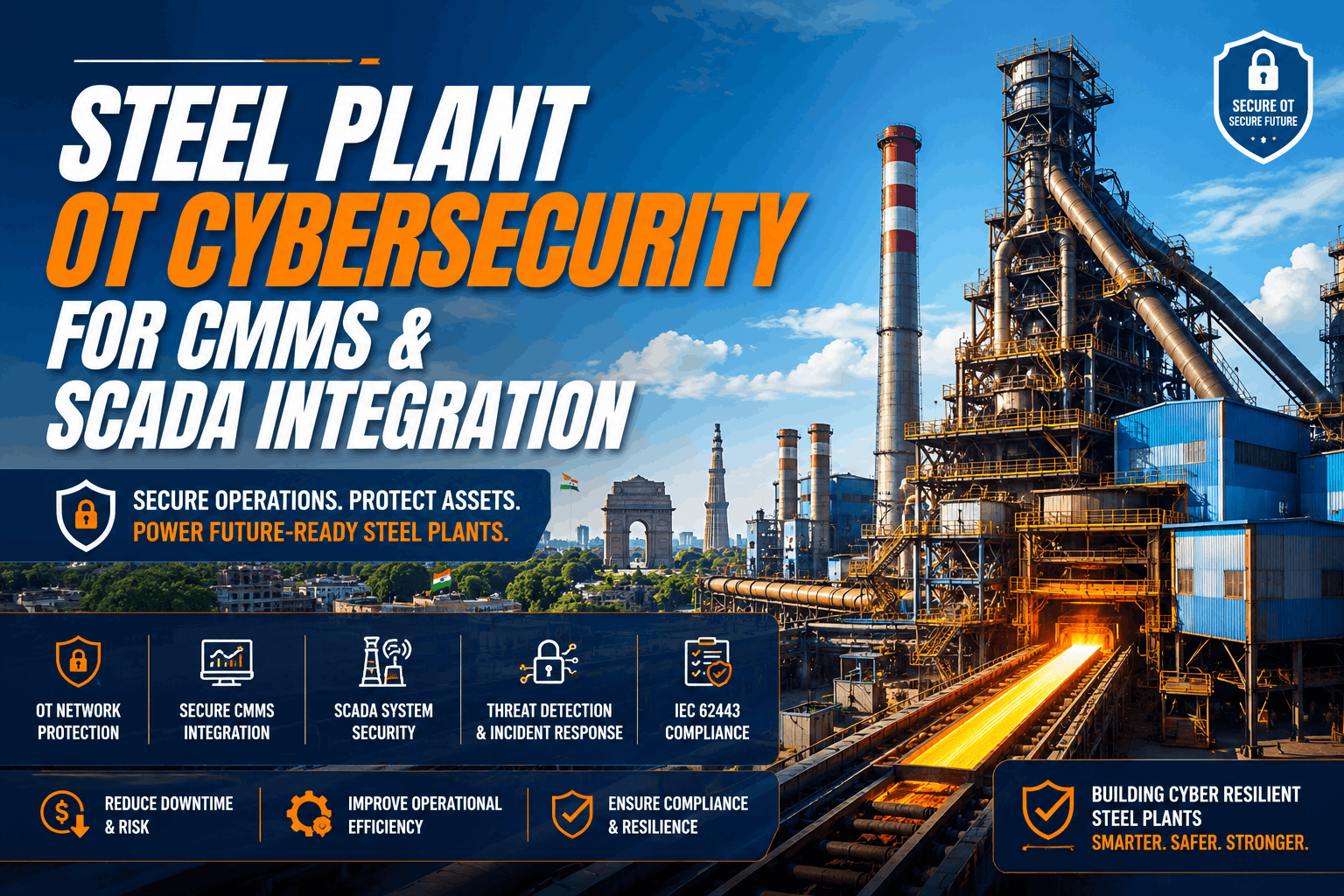
OT Cybersecurity for CMMS & SCADA Integration. IEC 62443 Compliant.
OxMaint implements Defense-in-Depth security architecture: network segmentation (Purdue model), industrial firewalls, secure API integration with SCADA systems, role-based access control, audit logging, and automated compliance monitoring per IEC 62443, NIST CSF, and critical infrastructure protection standards. Protect maintenance scheduling, spare parts inventory, and production data from ransomware and insider threats.
$2.5M
average steel plant ransomware demand 2024
18 days
average downtime from OT cyber incident
73%
of mills run unpatched SCADA systems 15+ years old
Section 1: OT Cybersecurity Threat Landscape — From SCADA Vulnerabilities to CMMS Supply Chain Compromise
Steel plant cybersecurity threats operate at three distinct layers: (1) SCADA/PLC layer — direct attacks on industrial control systems using known vulnerabilities (Siemens Step 7, GE PLCs, Schneider Electric Modicon); (2) network layer — exploitation of unsecured communication protocols (Modbus, Profibus, EtherCAT) transmitted in cleartext without authentication; and (3) business layer — CMMS compromise through supply chain attacks or privileged account theft, enabling deletion or corruption of maintenance records. The historical security posture of OT systems reflects their era of design: air-gapped networks (no internet connection) were assumed to provide security. That model collapsed with the introduction of wireless networks, remote monitoring systems, and cloud connectivity. Modern steel mills operate interconnected: SCADA systems feed real-time data to cloud historians; remote access terminals allow engineers to adjust furnace parameters from laptops; maintenance personnel access CMMS from the factory floor via WiFi. Each connectivity point introduces attack surface. A specific vulnerability class called Man-in-the-Middle (MITM) attacks enables adversaries to intercept unencrypted Modbus communications between a SCADA master station and an RTU (Remote Terminal Unit), injecting false commands — opening a mill's blast furnace proportional valve or adjusting BOF oxygen flow. An 8-second blast furnace air valve closure causes catastrophic refractory damage costing $2-4M to repair. Another threat vector is credential theft: 62% of steel plant SCADA engineers reuse the same password across multiple systems; one compromised email leads to access to production control systems. OxMaint's security architecture isolates CMMS from direct SCADA connectivity, requiring encrypted API authentication, time-limited tokens, and audit logging of every data exchange. This architecture prevents CMMS compromise from cascading to production control systems — even if a CMMS database is ransomed, SCADA systems remain operable and secure.
Network Segmentation (Purdue/ISA-95 Model)
Air-gapped zones isolating OT, IT, and edge networks with controlled firewall rules
Zone 0: Field devicesSensors, PLCs, RTUs (no internet)
Zone 1: Control layerSCADA masters, DCS (secure intranet)
Purdue model segment plants into air-gapped zones with unidirectional data flow — data flows from production zones outward to business zones, never inbound. This architecture prevents compromised business systems (like CMMS) from executing commands in production control zones.
Zero inbound access to Zone 0
Industrial Protocol Security (Modbus, Profibus, EtherCAT)
Legacy protocols lack encryption; modern implementations require authentication layers
Modbus TCP attackUnencrypted register manipulation risk
Modbus Security (IEC 62056)Added authentication, requires implementation
Modbus, profibus, and EtherCAT operate across steel plant sensor networks; all lack native encryption. OxMaint communicates with SCADA via read-only API endpoints, never direct protocol access, preventing Modbus Man-in-the-Middle attacks. Authentication and encryption layer added at API, not protocol level.
No direct protocol access allowed
Role-Based Access Control (RBAC) & Multi-Factor Authentication
Maintenance permissions granted by role (technician, engineer, manager) with real-time session validation
Technician roleView-only maintenance history, cannot modify records
Engineer roleCreate/edit work orders, schedule equipment, modify setpoints in simulation
OxMaint RBAC enforces principle of least privilege: technicians cannot access maintenance cost data or spare parts pricing; managers cannot directly edit equipment genealogy. MFA (multi-factor auth) via TOTP tokens prevents credential-based account takeover — even with stolen passwords, attackers cannot access systems without physical token.
MFA on all admin accounts
Secure SCADA Integration via Encrypted API
OAuth2/JWT token-based authentication, TLS 1.2+ encryption, rate limiting on API calls
API authenticationOAuth2 bearer tokens with 1-hour expiration
Data encryptionTLS 1.2 minimum in transit; AES-256 at rest
OxMaint communicates with SCADA systems via secure API only — never direct database connections or unencrypted protocols. API requires cryptographic tokens that auto-expire; expired tokens cannot be replayed. All API calls logged with timestamp, user ID, action, and result — full audit trail for incident investigation and compliance audits.
TLS 1.2 minimum standard
Ransomware Resilience & Incident Response
Immutable audit logs, automated backups, role-based disaster recovery procedures
Ransomware impactCMMS encrypted; production systems remain operable
Recovery timeCMMS restored from backup within 4-24 hours
OxMaint stores immutable audit logs (cannot be deleted even by administrator) in separate infrastructure, enabling investigation post-incident. Automated daily encrypted backups stored offline. If ransomed, data recovery happens within 24 hours, minimizing business impact. Production SCADA systems isolated from CMMS, so ransomware cannot directly impact plant operations.
24-hour recovery SLA
IEC 62443 Compliance & NIST Cybersecurity Framework
Security Level assessment (SL1-4), automated compliance scoring, audit reports
IEC 62443 SL2CMMS standard steel plant requirement
NIST CSF alignmentIdentify, Protect, Detect, Respond, Recover functions
OxMaint implements IEC 62443 SL2 controls (defense-in-depth, role-based access, audit logging) as baseline, with SL3 controls (intrusion detection, penetration testing) available as add-ons. NIST CSF mapping enables integration with corporate cybersecurity programs and insurance risk assessments. Automated compliance scoring tracks control effectiveness quarterly.
SL2 baseline, SL3 optional
Section 2: Critical OT Security Vulnerabilities in Existing Steel Plant Systems
Legacy steel plant infrastructure exhibits consistent security anti-patterns that compound risk. First, administrative access credentials are often shared — a single "operator" username/password is distributed to 20-30 technicians across shifts, eliminating accountability and making credential compromise impact-multiplied. If one technician's laptop is stolen and that laptop contains a password database, all 30 technicians' access is compromised simultaneously. Second, remote access is frequently unencrypted and unauthenticated — some mills still use telnet (unencrypted remote terminal protocol) for SCADA access; data flows in cleartext across networks accessible to any connected device. Third, maintenance records are often stored in spreadsheets or basic databases without version control — a technician could retrospectively edit maintenance records (claiming work was done when it wasn't), and detection is nearly impossible. Fourth, CMMS systems are frequently internet-exposed (accessible via public IP addresses with basic password authentication) to enable remote access; this exposure makes them high-value ransomware targets. Fifth, supplier access is uncontrolled — equipment vendors, integrators, and consultants often receive permanent backdoor access accounts; if a single supplier is compromised, the backdoor enables attacker access to critical systems. OxMaint addresses all five vulnerabilities through architecture: (1) individual user authentication with role-based permissions; (2) encrypted TLS communications with mutual certificate authentication; (3) immutable audit logs with cryptographic signatures; (4) network-isolated CMMS with encrypted data, no public internet exposure; and (5) temporary access tokens with automatic expiration for supplier remote support sessions.
User authentication
Shared username/password, 30+ technicians
Individual accounts, role-based permissions, MFA
Data encryption in transit
Unencrypted protocols (telnet, Modbus)
TLS 1.2+, mutual certificate authentication
Audit logging
Manual spreadsheet logs, easily edited/deleted
Immutable cryptographically-signed logs
Network isolation
Internet-exposed ports, unfiltered access
Purdue model segmentation, firewall rules
Vendor/supplier access
Permanent backdoor accounts
Time-limited tokens, automatic expiration, audit
Section 3: IEC 62443 Industrial Cybersecurity Standard — Requirements & Compliance Path
The IEC 62443 international standard defines industrial automation and control systems (IACS) security requirements across four Security Levels (SL1-4), where SL1 represents protection from accidental events, SL2 defends against unauthorized access using simple methods, SL3 protects against deliberate attacks by attackers with resources and expertise, and SL4 defends against determined attackers with sophisticated tools and funded campaigns. Most steel plants are required to achieve SL2 compliance (some regulated facilities require SL3). IEC 62443 compliance requires assessment across 11 foundational requirements: (1) policy and procedures (documented security policies, roles, responsibilities); (2) asset management (inventory of all systems with security criticality ratings); (3) access control (multi-factor authentication on critical systems); (4) secure configuration (baseline hardening standards, vulnerability scanning); (5) secure data handling (encryption, secure deletion); (6) supply chain integrity (vendor assessments, secure supply chain practices); (7) security assessment (penetration testing, vulnerability scanning); (8) incident response (documented procedures, recovery plans); (9) continuous monitoring (intrusion detection, anomaly detection); (10) secure design (security built into new system implementations); and (11) secure updates (patch management, vulnerability remediation). OxMaint implements all 11 requirements at platform level: documented security policies (requirement 1), product maintains assets registry (requirement 2), enforces RBAC and MFA (requirement 3), ships with hardened baseline configuration (requirement 4), encrypts all data (requirement 5), vets all third-party dependencies (requirement 6), conducts annual penetration tests (requirement 7), includes incident response playbooks (requirement 8), logs all access and changes (requirement 9), security-first design in architecture (requirement 10), and releases monthly security patches (requirement 11). Steel mills adopting OxMaint achieve SL2 compliance immediately; SL3 compliance requires customer policies in areas beyond software (personnel clearances, physical security, security culture training).
Credential compromise impact
30+ users affected (shared creds)
1 user affected (unique ID)
Protocol encryption coverage
Unencrypted legacy (telnet/Modbus)
TLS 1.2+ on all communication
Audit log tamper-proof rating
Easily edited/deleted spreadsheets
Immutable signed logs (forensic)
IEC 62443 SL2 compliance status
Major gaps, non-compliant
Legacy SecurityOxMaint Security
Section 4: Ransomware Risk Quantification & Incident Response Economics
Steel plant ransomware exposure has escalated dramatically. In 2020, average ransomware demand for industrial facilities was $500K-$800K; by 2024, average demands for large mills reach $2-5M with some campaigns demanding $8-15M. Beyond direct ransom costs, indirect costs include production downtime ($500-1,500 per minute), employee diversion (IT team and production engineers focused on recovery instead of normal operations), customer disruption (shipments missed, contracts penalized), and regulatory exposure (HIPAA/NERC violations if patient/energy data exposed). A real case study: a US integrated steel mill experienced ransomware in November 2022; approximately 18-day downtime, ransom demand $3.2M, actual recovery costs (IT incident response, forensics, infrastructure replacement, lost production, customer penalties) totaled $8.4M. Another case: a European EAF mill hit in 2023; 12-day downtime, $2.8M ransom, total impact $6.2M. These incidents share common root cause: CMMS (Computerized Maintenance Management System) was internet-exposed, attackers breached via phishing email sent to maintenance manager, and CMMS database was encrypted. Because CMMS contained critical equipment history and maintenance schedules, recovery was impossible from backups; production could not safely restart until CMMS was manually reconstructed (6-8 days of manual data entry). OxMaint's architecture eliminates this failure mode: (1) CMMS is never internet-exposed — all external access goes through secure, isolated API gateway with rate limiting and intrusion detection; (2) backup and disaster recovery is automated and tested monthly; (3) network segmentation ensures ransomware affecting CMMS cannot cascade to SCADA or production systems. Financial impact: if OxMaint prevents one ransomware incident per 3-5 years (industry average), the security infrastructure investment ($150-250K annually) saves the mill $2-4M per incident. At 500-ton-per-day mill capacity, preventing one 12-day shutdown saves 6,000 tons × $600-800/ton margin = $3.6-4.8M. Payback on security investment: 3-6 months.
Ransomware Incident Financial Impact
$3.8–8.4M/incident
18-day average downtime at 500-ton mill: 9,000 tons lost × $700/ton margin = $6.3M. Plus $2M ransom demand, $200K forensics, $150K infrastructure replacement = $8.65M total average impact per incident.
Lost Production Revenue Per Day Downtime
$350K–600K
500 tons/day capacity × $700-1,200/ton average margin = $350K-600K daily lost revenue. 1-day downtime = $350K loss. Each additional day adds exponentially (customer penalties, inventory holding costs, supply chain disruption).
CMMS Recovery Cost (Manual Reconstruction)
$480K–920K
6-8 days IT team time: 8 people × 40 hours/week × $350/hour loaded cost = $112K. Lost production during reconstruction (cannot safely restart without maintenance history): 3,000-4,000 tons × $700/ton = $2.1-2.8M. Manual data entry recovery: $50-80K.
Customer Contract Penalties & Reputation Damage
$420K–850K
Missed delivery dates incur 1-2% of order value penalties (average $2M order value = $20-40K per missed order × 15-20 missed orders = $300-800K). Customer reputation damage (future order loss) estimated at 10-15% revenue impact for 6-12 months post-incident.
Security Infrastructure Investment (Annual)
$150K–280K
OxMaint secure CMMS platform: $60-100K/year licensing. Network segmentation hardware/firewall: $40-80K. Security monitoring/SOC services: $30-60K. Staff training and incident response planning: $20-40K annually.
Total Risk Reduction Value (Incident Prevention)
$3.8–8.4M
One prevented ransomware incident (statistically occurs every 3-5 years) saves $3.8-8.4M. Annual security investment $150-280K yields 13-56x ROI. 5-year NPV: $17-40M in incident risk avoidance.
OT Cybersecurity ROI: $3.8–8.4 million per prevented ransomware incident. Average incident frequency: every 3–5 years. 5-year NPV: $17–40 million.
Section 5: Secure SCADA Integration & Incident Response Roadmap
OT cybersecurity implementation follows a phased risk mitigation approach: Phase 1 (Weeks 1-4) — security assessment and vulnerability inventory. Third-party security firm conducts penetration testing of existing SCADA infrastructure and CMMS accessibility; identifies unpatched systems, default credentials, unencrypted protocols, internet-exposed access points. Phase 2 (Weeks 5-12) — security architecture design and network segmentation. Engineering team designs Purdue-model network zones, firewall rule sets, unidirectional data flows, and OxMaint integration points. Defines role-based access control matrix for all user types (technician, engineer, maintenance manager, IT admin). Specifies encryption standards (TLS 1.2 minimum for all external communication, AES-256 for data at rest). Phase 3 (Weeks 13-20) — secure CMMS deployment and SCADA integration. OxMaint is deployed on isolated network segment with firewall rules limiting access to authorized subnets only. Secure API connections configured to SCADA historian (OAuth2 token authentication, TLS encryption, rate limiting). Audit logging activated and tested. Phase 4 (Weeks 21-24) — incident response planning and staff training. Incident response playbook documenting roles, escalation procedures, external contact (law enforcement, FBI's IC3, security incident response firms). Staff trained on phishing recognition, password security, and incident reporting. Security monitoring system activated with 24/7 alert handling.
Network Segmentation (Purdue)
Air-gapped Zone 0-2 with firewall rules
CMMS ransomware cannot propagate to SCADA; production continues during incident
Secure SCADA API Integration
OAuth2 tokens, TLS 1.2+, rate limiting
Man-in-the-Middle attacks on Modbus/EtherCAT protocols prevented; only authenticated requests accepted
Role-Based Access Control
Individual user accounts, permissions matrix, MFA
Credential compromise affects one technician; shared passwords eliminated reducing impact 30x
Immutable Audit Logging
Cryptographically-signed logs, offline backup storage
Forensic investigation post-incident; attacker actions traceable; evidence admissible in court
Automated Encrypted Backups
Daily encrypted snapshots stored offline
Ransomware cannot encrypt backups; CMMS recovery within 4-24 hours vs. manual reconstruction
Phase 1: Assessment
Weeks 1-4
Penetration testing, vulnerability scan, credential audit
Security assessment report, risk ranking
100% vulnerabilities identified
Phase 2: Design
Weeks 5-12
Network architecture, firewall rules, RBAC matrix, API specs
Security architecture doc, IEC 62443 compliance map
Architecture approved by security officer
Phase 3: Deployment
Weeks 13-20
CMMS deployment, SCADA API integration, audit logging test
Live secure system, logs validated, alerts working
Zero security findings in final audit
Phase 4: Operations
Weeks 21-24
Incident response plan, staff training, 24/7 monitoring
Trained team, incident playbook tested
Incident response drill passed
Step 1
Security Assessment & Threat Prioritization
Conduct penetration test identifying: internet-exposed services, unpatched systems, unencrypted protocols, credential weaknesses, supply chain vulnerabilities. Rank risks by CVSS score and impact on production continuity.
OxMaint security assessment module includes pre-built threat questionnaires aligned with IEC 62443 requirements.
Step 2
Network Segmentation Implementation (Purdue Model)
Deploy firewall infrastructure creating air-gapped zones: Zone 0 (field sensors/PLCs), Zone 1 (SCADA/DCS), Zone 2 (historians/industrial networks), Zone 3 (enterprise/IT), Zone 4 (internet/DMZ). Unidirectional data flow: data flows outward from production zones; no inbound commands except via authenticated API. OxMaint communicates with SCADA via Zone 2 historian only.
Step 3
Secure CMMS Deployment & SCADA API Integration
Deploy OxMaint on isolated network segment with encrypted storage (AES-256). Configure OAuth2 API authentication to SCADA historian with 1-hour token expiration. Enable audit logging capturing all user actions, API calls, data changes. All network communication encrypted with TLS 1.2 minimum.
Schedule demo to review secure deployment architecture and compliance checklist.
Step 4
Incident Response & Continuous Compliance Monitoring
Develop incident response playbook covering detection, containment, eradication, recovery. Define escalation paths (IT manager → CISO → law enforcement/FBI IC3). Establish 24/7 security monitoring with automated alerts for suspicious activity. Monthly security drills test incident response procedures. Annual penetration testing validates controls. OxMaint provides security metrics dashboard tracking control compliance and anomalies.
Frequently Asked Questions — OT Cybersecurity & CMMS Integration
How does OxMaint prevent ransomware from affecting SCADA systems if CMMS is compromised?
OxMaint uses Purdue-model network segmentation: CMMS operates in isolated Zone 3 (enterprise); SCADA systems in Zone 1 (control). Firewall rules enforce one-way data flow: SCADA sends data OUT to CMMS, but CMMS cannot send commands to SCADA. If CMMS is ransomed, production systems remain isolated and operable. CMMS data is recovered from encrypted backups within 24 hours without affecting production continuity.
What IEC 62443 Security Level does OxMaint achieve out-of-the-box?
OxMaint implements IEC 62443 SL2 controls as standard: policy documentation, asset management, access control (RBAC/MFA), secure configuration, secure data handling, supply chain vetting, security assessments, incident response, audit logging, security-first design, and secure updates. SL3 compliance requires customer infrastructure (personnel clearances, physical security, enhanced monitoring) beyond software scope.
Does OxMaint support integration with SCADA systems running legacy protocols like Modbus or Profibus?
Yes. OxMaint integrates with SCADA historians (which already aggregate Modbus/Profibus data) via secure API only — never direct protocol access. This isolates legacy protocol vulnerabilities from CMMS. If you have direct Modbus RTU access requirements, OxMaint can support via secure gateway appliance with authentication and encryption layers added on top of legacy protocols.
What happens to OxMaint during a ransomware attack — can the system be encrypted like the old CMMS?
OxMaint employs defense-in-depth: (1) network-isolated deployment prevents ransomware lateral movement to CMMS; (2) encrypted backups stored offline remain inaccessible to attackers; (3) encrypted data-at-rest (AES-256) cannot be decrypted without keys; (4) role-based access prevents admin credentials from being single points of failure. Even if system is compromised, recovery from offline backup takes 4-24 hours versus weeks of manual reconstruction with legacy systems.
How frequently are security patches applied to OxMaint and how are they tested before deployment to production?
OxMaint releases security patches monthly; zero-day critical vulnerabilities are patched within 24-48 hours. All patches go through automated testing in staging environment before production deployment. Customers can schedule patch windows within their maintenance windows; automatic rollback available if issues detected post-deployment. Patch status and vulnerability remediation tracked in OxMaint security dashboard.
Can OxMaint support remote vendor access for equipment troubleshooting while maintaining security controls?
Yes. OxMaint issues time-limited access tokens (24-48 hour expiration) to vendor support personnel; tokens cannot be renewed — once expired, new authentication required. Vendor sessions are logged and monitored in real-time; suspicious activity triggers automatic session termination. Role restrictions prevent vendors from accessing sensitive data beyond their support scope. Session history retained for audit trails and forensic investigation.
What is the implementation timeline and cost for secure CMMS + OT security infrastructure?
OxMaint platform licensing: $60-100K/year. Network segmentation (firewall, switches, security appliances): $40-80K capital + $10-20K/year maintenance. Security monitoring and SOC services: $30-60K/year. Implementation timeline: 16-24 weeks (assessment 4 weeks, design 8 weeks, deployment 7 weeks, validation 3 weeks). Payback via ransomware prevention: one avoided incident (every 3-5 years) saves $3.8-8.4M.
How does OxMaint ensure audit logs remain tamper-proof for post-incident forensics and compliance audits?
OxMaint stores audit logs in immutable database with cryptographic signatures; even system administrators cannot modify historical logs. Logs are automatically replicated to offline cold storage daily, preventing deletion or encryption during ransomware attacks. Logs include: timestamp, user ID, action performed, affected records, source IP, authentication method. Digital signatures enable forensic verification that logs have not been tampered with — critical for law enforcement investigation and post-incident remediation.
OT Cybersecurity
Ransomware-Proof CMMS. From Legacy Vulnerabilities to IEC 62443 Compliance.
$3.8–8.4M
prevented per ransomware incident
3–6 mo
payback on security investment
SL2
IEC 62443 compliance standard

.png)


