
In 2021, a hacker accessed a water treatment plant in Florida through its remote access system and attempted to increase sodium hydroxide to dangerous levels. In 2022, ransomware shut down a German steel plant's blast furnace control systems, causing physical equipment damage. Steel plants are no longer just physical security challenges — their SCADA systems, OT networks, and CMMS platforms are active attack targets. The moment your maintenance software connects to the internet, it becomes a potential entry point. See how Oxmaint's security architecture protects your operation.
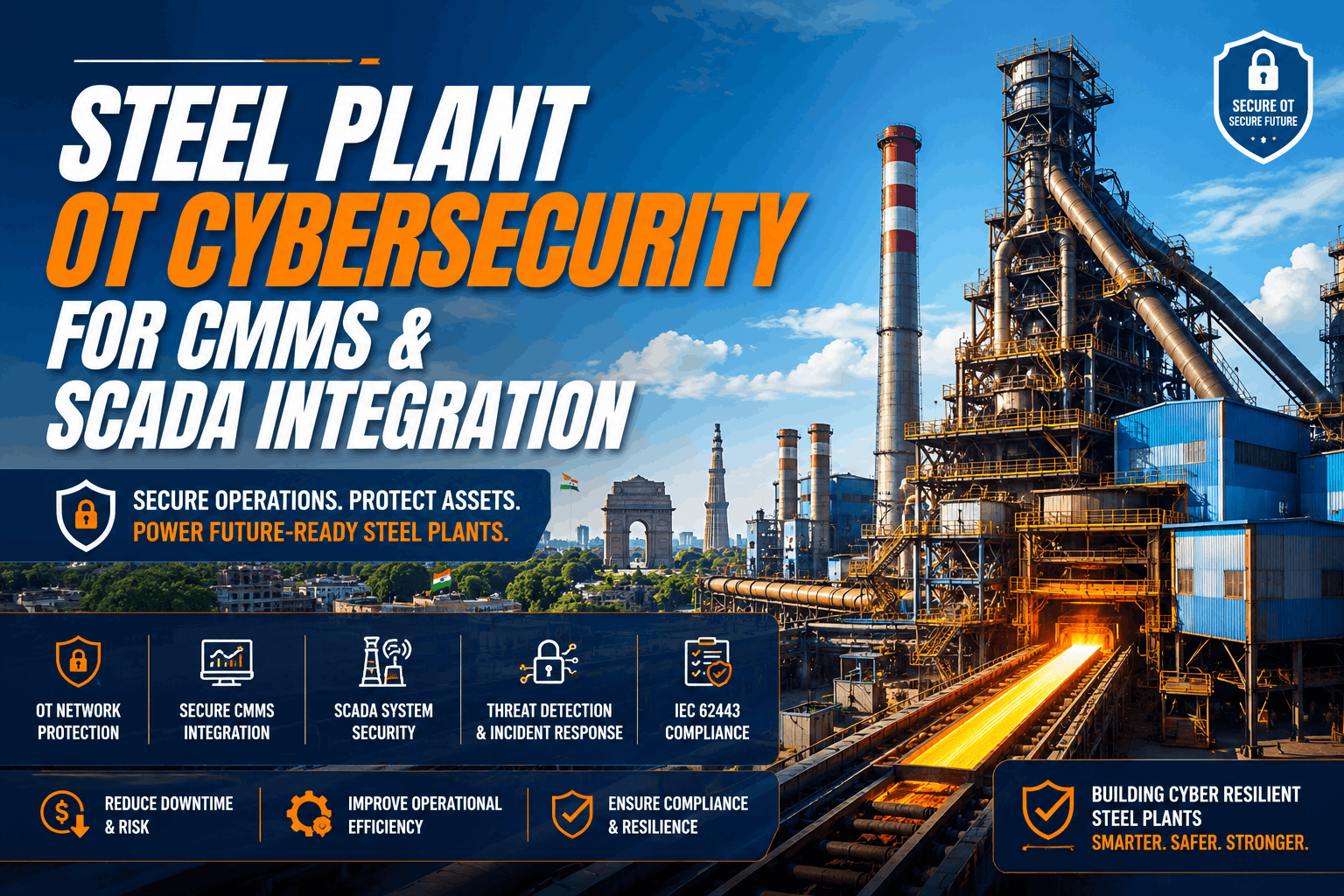
Steel Plant Cybersecurity: Securing CMMS, OT & SCADA Systems
A practical guide for plant engineers, IT/OT managers, and safety directors on defending industrial control systems against modern cyber threats — with real attack examples and actionable controls.
Why Steel Plants Are a Cybersecurity Target
Steel production facilities sit at an uncomfortable intersection: aging OT infrastructure built for reliability — not security — now connected to modern IT systems for data analytics, remote monitoring, and CMMS integration. Every connection between the enterprise network and the plant floor creates a pathway that attackers can exploit. And the consequences of a successful OT attack in a steel plant are not just financial — they are physically dangerous.
Attacker gains entry through phishing email to maintenance supervisor, compromised contractor VPN credentials, or unpatched remote desktop protocol (RDP) exposure on the IT network.
Malware moves from the IT network to the OT network through unprotected IT/OT boundaries. Flat network architecture allows the attacker to reach SCADA historian servers and CMMS databases.
Attacker reaches Level 2 control systems — engineering workstations, HMI terminals, or DCS servers. At this point, the attacker has visibility into or control of physical process parameters.
Ransomware encrypts both IT and OT systems, or process manipulation causes equipment damage. The German steel plant incident involved unauthorized changes to blast furnace control parameters — causing physical damage impossible to remotely undo.
The IT/OT Convergence Problem
Ten years ago, steel plant OT networks were air-gapped by design. Today, business pressure to access production data in real time has pushed OT systems into direct or indirect connection with enterprise IT networks. This convergence creates efficiency gains — but also opens attack paths that did not exist before. See how Oxmaint's secure API architecture handles IT/OT data exchange without exposing your OT network directly.
7 Cybersecurity Controls Every Steel Plant Needs
These controls are drawn from NIST Cybersecurity Framework, IEC 62443 (the international standard for industrial security), and documented attack patterns targeting steel and metals facilities. Implementing all seven creates a defense-in-depth posture that makes your plant a significantly harder target. Sign into Oxmaint to see which controls are already active in your CMMS configuration.
Separate your OT network from IT using the Purdue Reference Model — five levels from physical sensors at Level 0 to enterprise IT at Level 4. Each level communicates only with adjacent levels through controlled, monitored conduits. A blast furnace PLC should never be reachable from the corporate email server, and never directly from the internet.
Password-only access to SCADA HMIs, CMMS platforms, and engineering workstations is no longer acceptable. Single compromised credentials — through phishing, password reuse, or brute force — can give an attacker direct access to control systems. MFA on every remote session, every contractor VPN, and every CMMS login eliminates the most common initial access vector.
Maintenance technicians need access to work orders for their assigned assets. They do not need access to SCADA configuration parameters, financial data, or other users' maintenance records. Role-based access control (RBAC) limits each user to exactly the data and functions their job requires — so a compromised technician account cannot be used to reach control system configurations. Oxmaint implements granular RBAC with role inheritance and time-limited elevated access for contractors.
Standard IT SIEM tools do not understand Modbus, PROFINET, or OPC-UA traffic — the protocols industrial devices speak. OT-aware network monitoring tools (Claroty, Dragos, Nozomi Networks) passively observe OT traffic and alert on behavioral anomalies: unexpected polling patterns, configuration changes, new device connections, and communication attempts between segments that should not interact.
Ransomware attacks on OT systems are designed to encrypt both operational data and backup systems simultaneously. The Oldsmar water treatment attack, the Colonial Pipeline incident, and the German steel plant attack all shared one characteristic: the attackers encrypted backup systems before triggering the main payload. Air-gapped, immutable backups that ransomware cannot reach are your last line of defense.
Every login, every configuration change, every work order modification, and every API call in your CMMS should be logged with timestamp, user identity, and action detail — and stored where it cannot be altered by a compromised account. Audit logs serve two purposes: detecting attacks in progress and reconstructing what happened after an incident for forensic investigation and regulatory reporting.
Traditional VPN models assume that once connected, a user can be trusted. Zero trust replaces this assumption with continuous verification: every access request — from inside or outside the network — is authenticated, authorized, and logged. For contractors accessing CMMS or SCADA systems remotely, zero trust means session-specific tokens, device health checks, and automatic session termination at job completion. See Oxmaint's zero trust access controls for contractor sessions.
Compliance Framework Mapping: NIST and IEC 62443
Steel plants operating in regulated markets or supplying critical infrastructure sectors increasingly face formal cybersecurity compliance requirements. NIST CSF 2.0 and IEC 62443 are the two dominant frameworks for industrial security — understanding how your controls map to each is essential for audit readiness. Book a demo to see how Oxmaint's security features map to your compliance requirements.
| Security Control | NIST CSF 2.0 | IEC 62443 | Oxmaint Feature | Status |
|---|---|---|---|---|
| Multi-Factor Authentication | PR.AA-01, PR.AA-02 | SR 1.1, SR 1.2 | MFA on all logins and API access | Included |
| Role-Based Access Control | PR.AA-05, PR.AC-4 | SR 2.1, SR 2.2 | Granular RBAC with role inheritance | Included |
| Audit and Accountability Logging | PR.PT-1, DE.CM-3 | SR 6.1, SR 6.2 | Full audit trail — tamper-evident log export | Included |
| Secure API Integration | PR.DS-2, ID.AM-3 | SR 3.1, SR 4.1 | OAuth 2.0, rate limiting, IP allowlisting | Included |
| Data Encryption in Transit | PR.DS-1, PR.DS-2 | SR 4.1, SR 4.2 | TLS 1.3 for all data transmission | Included |
| Network Segmentation | PR.IR-01 | SR 5.1, SR 5.2 | Handled at plant infrastructure level | Plant-side |
| OT Threat Detection | DE.CM-1, DE.CM-6 | SR 6.1, SR 7.3 | Handled by specialist OT monitoring tools | Plant-side |
How Oxmaint Secures Your Maintenance Data
Your CMMS contains sensitive operational data: equipment configurations, maintenance schedules, technician credentials, and API connections to OT data sources. A compromised CMMS is not just a data breach — it is a reconnaissance tool for attackers mapping your industrial environment. Oxmaint is built with industrial security requirements as a foundation, not an afterthought.
MFA enforced on all user logins, admin sessions, and API authentication flows. Supports TOTP authenticator apps and hardware security keys. Phishing-resistant MFA available for high-privilege accounts.
Granular RBAC with five default roles (Technician, Supervisor, Administrator, Auditor, Contractor) and custom role creation. Least-privilege enforced — users see only assets and work orders within their assigned scope.
Every login attempt, work order modification, asset record change, and API call is logged with timestamp, user identity, source IP, and action detail. Logs are tamper-evident and exportable to external SIEM systems. Retained for 24 months by default.
All OT data connections via OAuth 2.0 with scoped token permissions, rate limiting, and IP allowlisting. API traffic is TLS 1.3 encrypted in transit. Read-only integration modes prevent write access to OT data sources from the CMMS layer.
Ransomware Defense: The Steel Plant Playbook
Ransomware targeting industrial facilities has evolved from opportunistic IT attacks to precision OT campaigns. The Hive ransomware group, ALPHV/BlackCat, and Lockbit 3.0 have all targeted steel and metals facilities specifically. Their playbooks share common characteristics — and common countermeasures stop all of them.
The 2022 attack on the German steel plant was a watershed moment. It demonstrated that cyber attacks on industrial systems are no longer theoretical — they can cause physical equipment damage and create safety hazards. Steel plant OT security is now a board-level concern, not just an IT department issue.
Protect Your Maintenance Data Without Slowing Down Your Team
MFA, role-based access, immutable audit logs, and encrypted API integration are built into Oxmaint's platform — not bolted on as optional add-ons. Your security team can verify every control. Your maintenance team never feels the friction.

.png)


