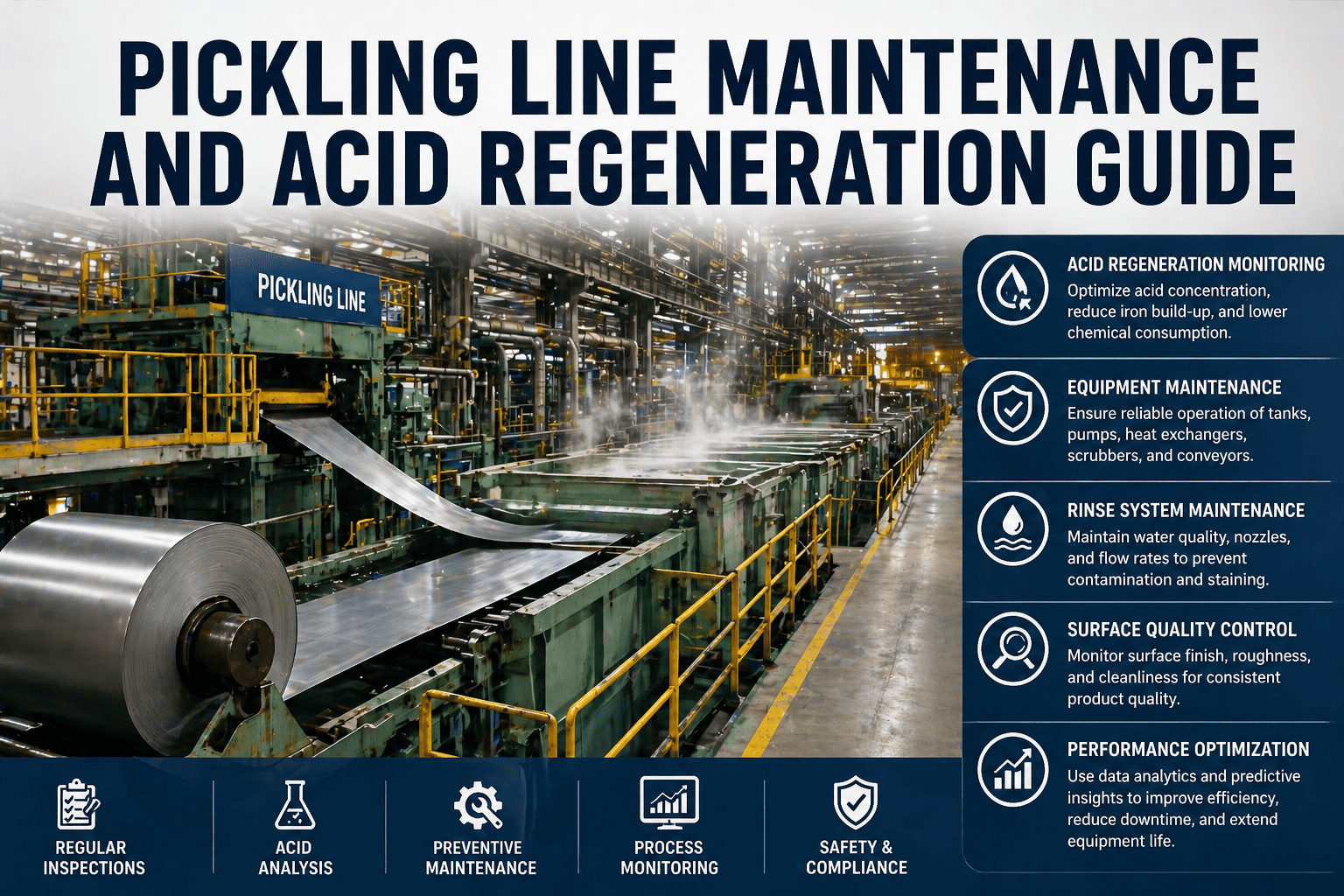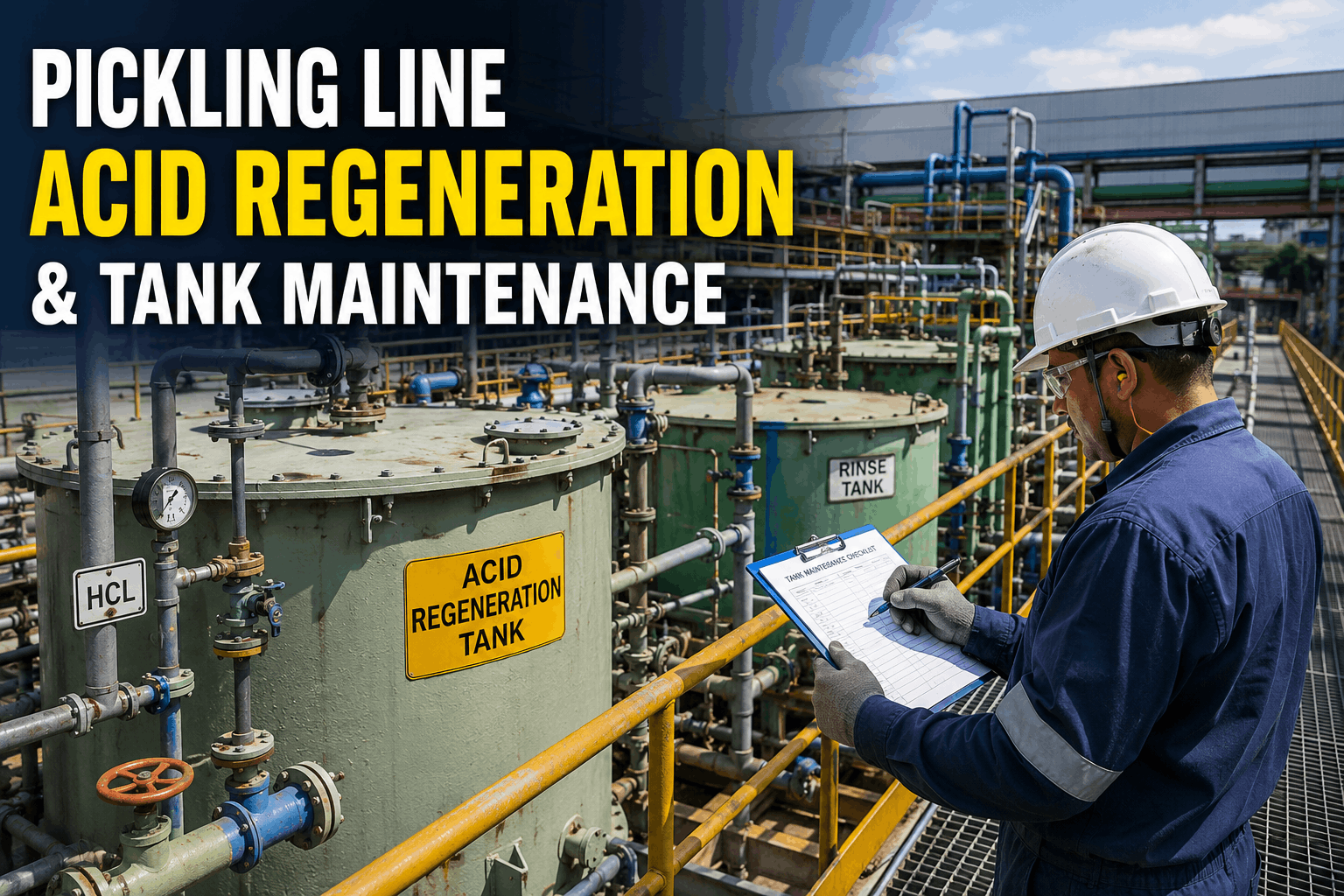
The pickling line is one of the most chemically aggressive operating environments in a steel processing facility — hydrochloric acid (HCl) concentrations of 10–18%, sulfuric acid (H2SO4) solutions at elevated temperatures, iron chloride and iron sulfate byproduct accumulation, rubber-lined tank surfaces subject to thermal cycling and chemical attack, and acid fume scrubber systems under constant EPA National Emission Standards for Hazardous Air Pollutants (NESHAP) compliance scrutiny. A pickling line maintenance program that runs on paper logs and calendar schedules cannot adequately manage the inspection frequency, rubber lining condition tracking, acid concentration monitoring, and regulatory documentation that U.S. pickling operations require in 2026. This guide covers every major pickling line acid regeneration and tank maintenance discipline — HCl and H2SO4 tank inspection, rubber lining lifecycle management, rinse station condition, spray roaster and fluid bed regeneration equipment PM, scrubber system compliance records, and the CMMS framework that keeps it all audit-ready. Sign Up Free and configure your pickling line asset hierarchy in Oxmaint today.
SEO META BLOCK (hidden)Pickling Line Maintenance — Tank Records, Rubber Lining Scores, and EPA NESHAP Documentation in One CMMS
Oxmaint tracks acid tank rubber lining condition, rinse station PM schedules, spray roaster/fluid bed regeneration equipment, and fume scrubber compliance records — all with audit-ready photo-documented completion and NESHAP export capability.
Pickling Line Process Overview — Why Every Section Has Critical Maintenance Requirements
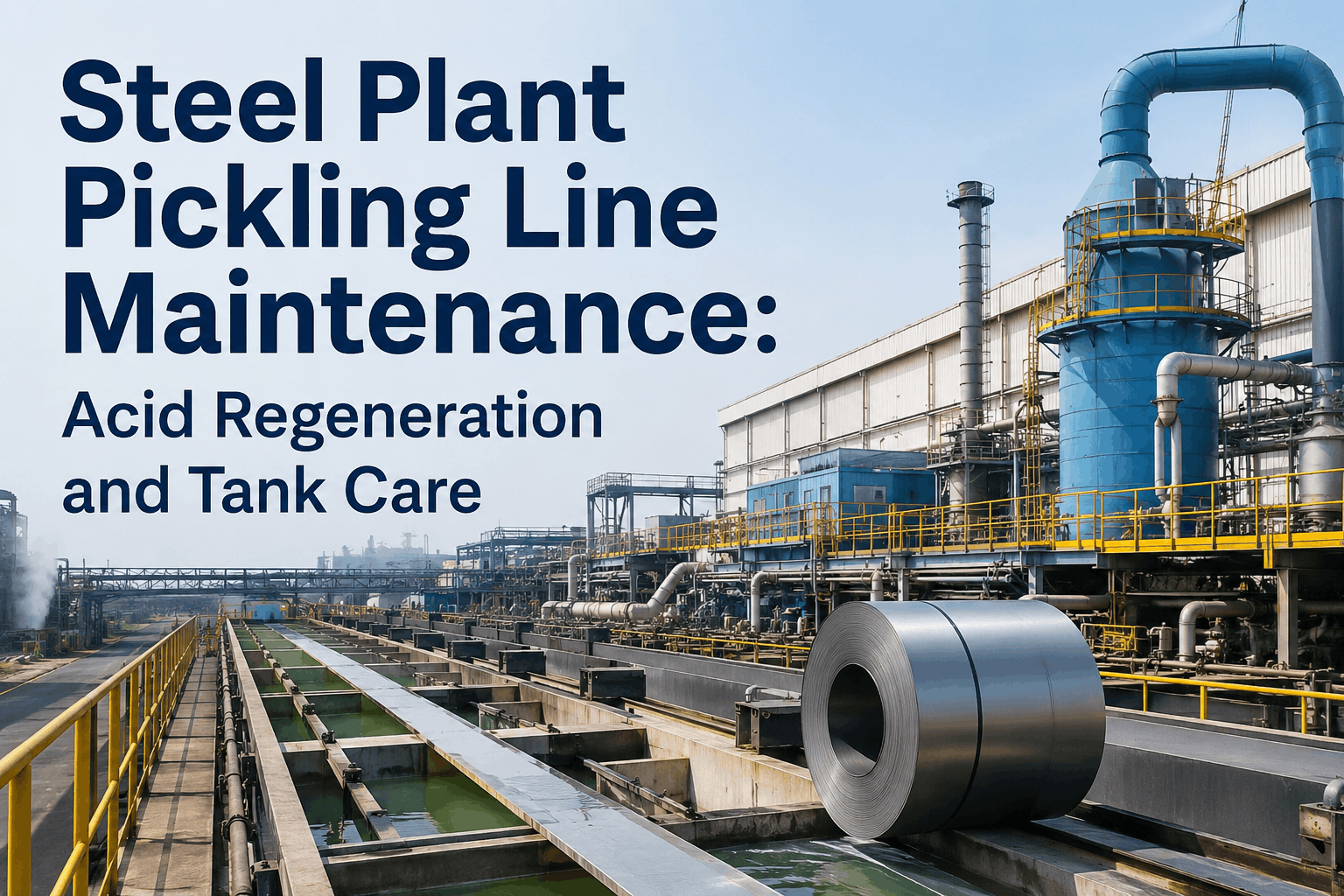
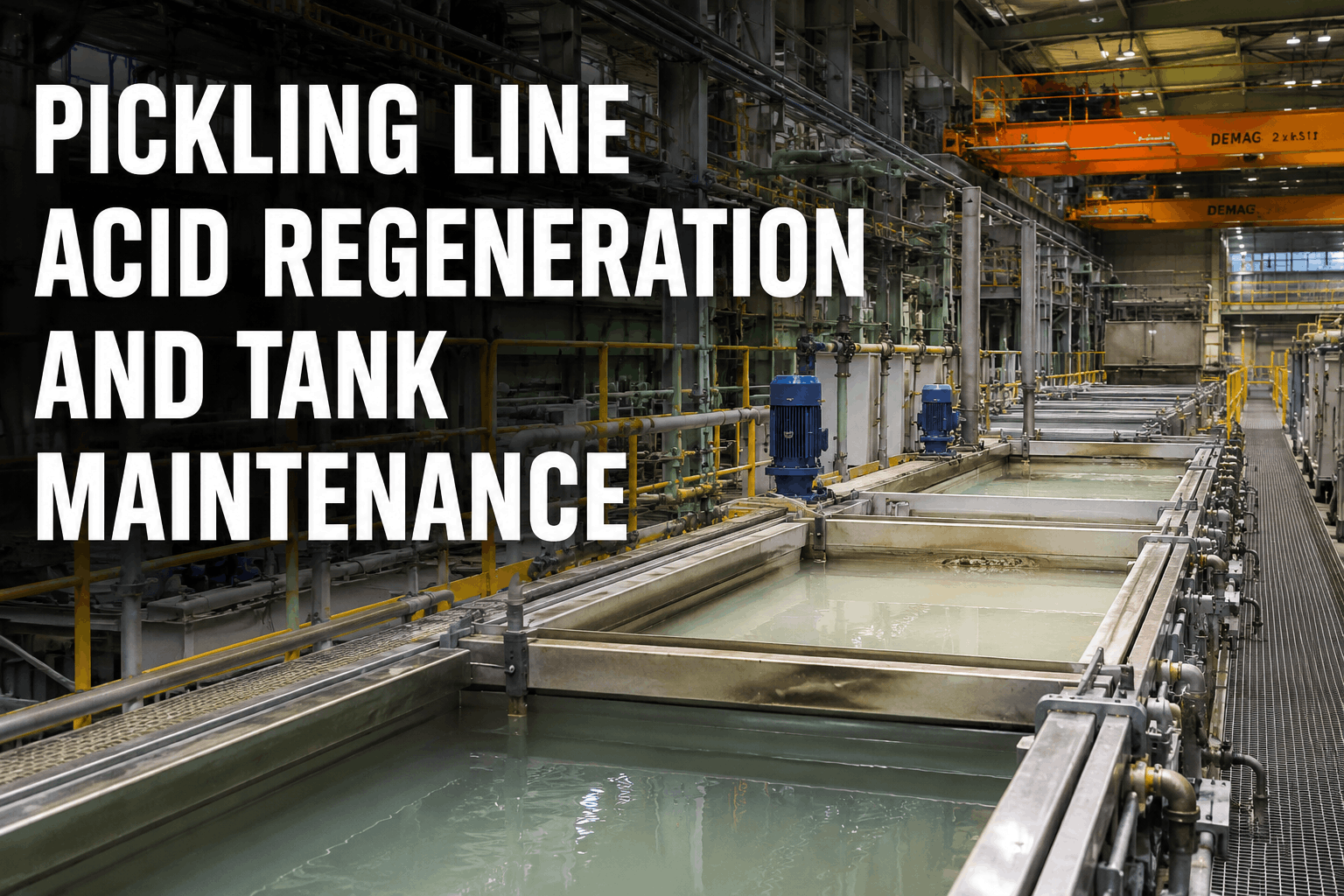
A carbon steel pickling line HCl or H2SO4 process removes the iron oxide scale formed during hot rolling — producing the clean, oxide-free surface required for cold rolling, galvanizing, or direct dispatch. In a modern continuous pickling line (CPL) or push-pull pickling line (PPL), the strip passes through 3–5 acid tanks in series, followed by multi-stage rinse stations, dryer, and then exits to the next processing stage or coiling. The acid regeneration plant — spray roaster or fluid bed reactor — recovers hydrochloric acid from spent FeCl2 pickle liquor, recovering up to 98% of the acid for reuse and producing iron oxide byproduct for ferrite magnet or pigment applications. Each of these systems has specific maintenance requirements — and the combination of chemical aggressiveness, EPA regulatory oversight, and production criticality makes the pickling line CMMS architecture more demanding than almost any other cold rolling complex asset group. Book a demo to see how Oxmaint's asset hierarchy handles every pickling line section with section-specific PM logic.
Section-by-Section Pickling Line Maintenance Framework
Acid Tank Rubber Lining Inspection and Campaign Management
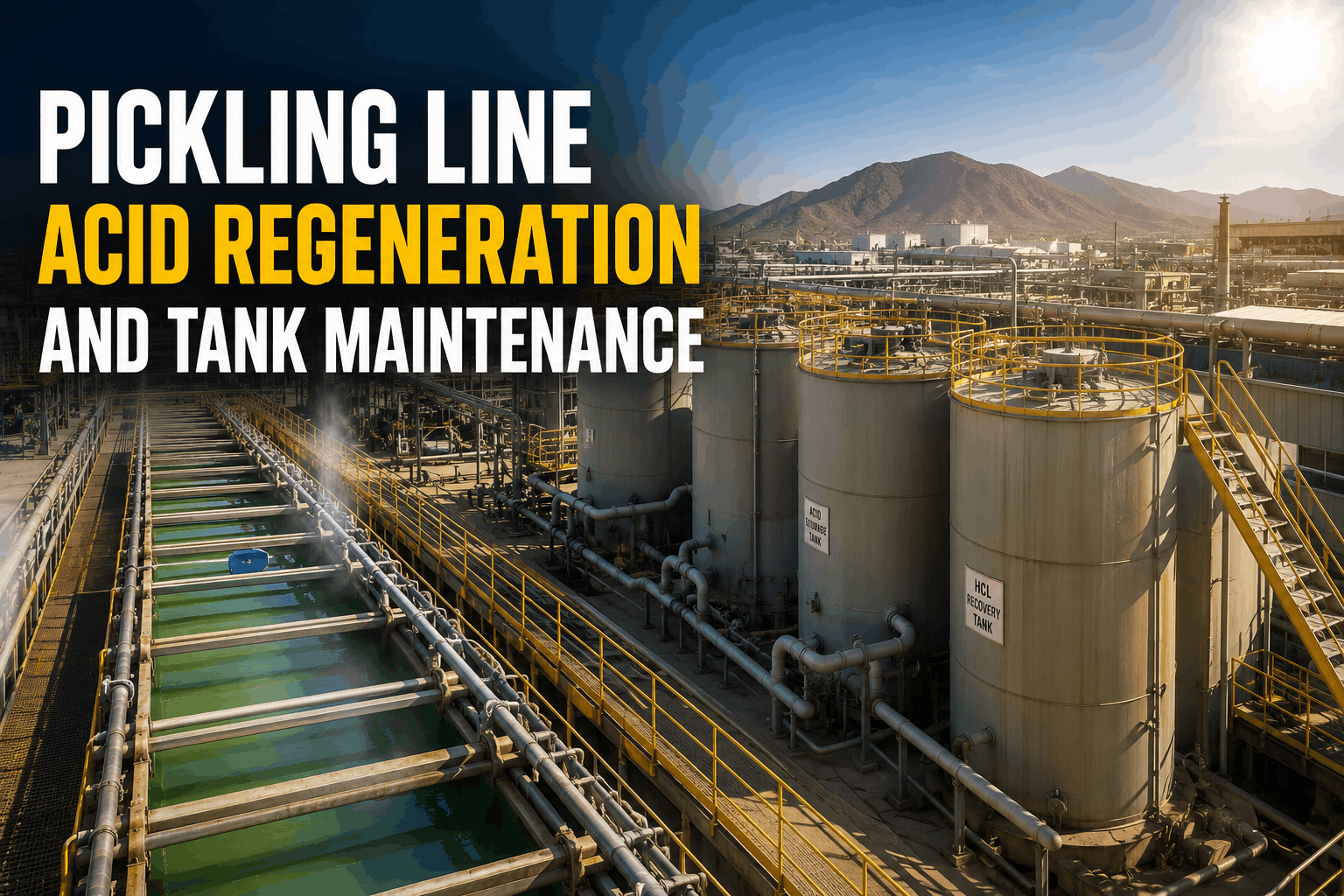
The rubber lining of HCl and H2SO4 pickling tanks is the most critical maintenance item in the pickling section — and its failure is one of the most serious events in a cold rolling complex. Rubber lining failure exposes the concrete or steel tank structure directly to concentrated acid, causing rapid structural degradation that can result in acid releases requiring environmental emergency response, EPA reporting under 40 CFR Part 302 (CERCLA), and potentially plant-wide evacuation. The inspection program must cover: spark testing of all weld seams and field-applied patches at every planned tank drainage, hardness testing per ASTM D2240 to assess lining age and acid absorption, holiday (pinhole) detection survey across the full tank surface, and joint and seam condition assessment for delamination and lifting. Oxmaint creates an individual asset record for each tank's rubber lining, tracking: installation date, lining material and thickness specification, spark test result per inspection, hardness readings per measurement point, and the campaign life projection based on inspection findings. When any tank lining reaches condition threshold — typically a combination of hardness below 50 Shore A and multiple identified pinholes — a planned reline work order generates before the tank continues operation. Configure your tank lining campaign in Oxmaint today.
Acid Concentration Monitoring and Tank Chemistry Records
Maintaining acid concentration within the process specification — typically 10–18% HCl for carbon steel pickling or 15–25% H2SO4 at 60–80°C — is essential for both pickling quality and equipment protection. Pickling at acid concentrations above specification accelerates attack on the rubber lining and stainless steel components in the tank internals. Pickling below specification produces underpickled strip with residual scale that causes cold rolling roll damage and surface quality rejections. Oxmaint manages acid concentration sampling as scheduled work orders at defined intervals — typically every 4–8 hours on a running line — with measurement values recorded directly in the work order and trended automatically against specification limits. When concentration drifts outside specification, an automatic alert goes to the process control team for acid addition or liquor draw-off action before quality impact occurs. See process chemistry tracking in Oxmaint.
Rinse Station PM — Nozzle, Pump, and Water Treatment
The rinse section removes residual acid from the strip surface immediately after pickling — and rinse effectiveness directly determines whether carry-over acid onto the cold mill stand causes roll pitting or corrosive attack on mill housings. Rinse nozzle blockage from iron hydroxide precipitate accumulation is the most common failure mode — clogged nozzles create unrinse areas on the strip that transfer acid carry-over to the exit section. Oxmaint schedules rinse station PM at tonnage-based intervals: nozzle inspection and clear/replace, pump seal inspection and flow rate verification, rinse water pH measurement records, squeegee roll condition assessment, and rinse tank drain and internal inspection at campaign intervals. Each rinse station is a separate Oxmaint asset with its own maintenance history — enabling the maintenance planner to identify which station is consistently causing rinse quality issues and prioritize its inspection interval accordingly.
Acid Fume Scrubber — NESHAP Compliance and Mechanical PM
The acid fume scrubber is simultaneously a critical process asset and an EPA compliance system — and its maintenance record is one of the first documents an EPA inspector requests during a NESHAP compliance audit. Under 40 CFR Part 63 Subpart CCC, U.S. steel pickling facilities using HCl must maintain scrubber performance records, document outlet HCl emission measurements, and retain all monitoring data for at least two years in accessible format. Oxmaint manages scrubber maintenance as a dual-purpose program: mechanical PM work orders (packing inspection, recirculation pump maintenance, liquid distribution system inspection, makeup water flow verification) and compliance inspection work orders (emission monitoring record, outlet HCl measurement, performance test documentation). All compliance records are stored in the scrubber's permanent asset history, exportable as EPA-ready PDF documentation within minutes of a regulatory request. See NESHAP compliance record management in Oxmaint.
Acid Regeneration Plant — Spray Roaster or Fluid Bed Reactor
The acid regeneration plant is the economic engine of the pickling operation — recovering 97–98% of the hydrochloric acid from spent FeCl2 pickle liquor through thermal decomposition in a spray roaster or fluid bed reactor. At current HCl prices of $200–$400/tonne, a U.S. carbon steel pickling line consuming 50 tonnes of HCl per month saves $120,000–$240,000 annually through acid regeneration versus fresh acid purchase and spent liquor disposal. Spray roaster maintenance — combustion burner inspection, refractory lining condition, cyclone and dust collector servicing, absorber tower packing condition, feed pump seal replacement — requires a rigorous PM program because regeneration plant downtime forces either expensive fresh acid emergency purchases or pickling line production interruption. Oxmaint tracks spray roaster and fluid bed reactor maintenance at component level, with burner campaign hours, refractory inspection records, cyclone wear measurement, and absorber packing replacement intervals all managed as individual asset PM schedules. Schedule a demo to see regeneration plant asset tracking in Oxmaint.
Pickling Line Asset Condition Scoring — Rubber Lining Framework
Inspired by Image 2 (FMCG Asset Condition Scoring) — rebuilt as pickling-specific SVG tableEPA NESHAP Compliance — What the Regulations Require and How Oxmaint Delivers It
The EPA National Emission Standards for Hazardous Air Pollutants under 40 CFR Part 63 Subpart CCC apply to every U.S. steel pickling operation using hydrochloric acid as the primary pickling solution and every hydrochloric acid regeneration plant. The regulation requires: continuous emission monitoring or periodic performance testing for HCl emissions from the scrubber system, operational monitoring of scrubber liquid recirculation rate and pH, records of all monitoring data retained for a minimum of 2 years in accessible format, and excess emission reporting within 10 days of exceedance. For a typical U.S. HCl pickling operation, maintaining full NESHAP compliance documentation requires generating, storing, and organizing approximately 8,760 scrubber monitoring data points per year — plus performance test reports, calibration records, and excess emission reports. Most U.S. pickling lines currently manage this documentation in a combination of paper logs, Excel files, and email chains — creating audit vulnerability and a 15–25 staff-hour annual preparation burden for each EPA compliance review. Oxmaint converts every NESHAP-required inspection and monitoring activity into a structured digital work order that auto-populates the retention database — ready for EPA export at any moment without a single day of pre-audit preparation. See EPA NESHAP documentation management in a live Oxmaint demo.
Pickling Line PM Intervals — What Oxmaint Schedules Automatically
Daily / Per-Shift Inspections
Acid concentration check per tank and adjustment record. Rinse water pH log per station. Scrubber recirculation rate and outlet pH check. Squeegee roll visual inspection for wear or damage. Entry/exit pinch roll surface check for buildup. Strip edge inspection for underpickling signs (residual scale).
Weekly Maintenance Tasks
Tank heating coil inspection and temperature calibration. Acid metering pump seal and valve check. Rinse nozzle flow and pattern inspection. Fume scrubber packing visual condition check. Acid storage tank level and vent system inspection. Drive rolls and strip guide maintenance and lubrication.
Monthly and Quarterly Tasks
Spray roaster burner combustion analysis. Acid pump bearing condition and vibration check. Rubber lining visual inspection on accessible areas. Iron concentration monitoring in spent liquor. Absorber tower liquid distribution check. Emergency acid neutralization system verification. Compliance emission measurement per NESHAP schedule.
Planned Tank Drainage Inspections
Full rubber lining spark test and hardness survey. Internal mechanical inspection: coil condition, distribution headers, supports. Condition score update in Oxmaint per 1–5 framework. Tank structural inspection for lining-through attack evidence. Weld seam inspection of tank steel structure. Photographic record of full lining condition at drainage.
Annual Compliance Reviews
EPA NESHAP performance test documentation assembly. Annual acid regeneration plant inspection and refractory assessment. HCl/H2SO4 storage tank integrity inspection per API standards. Emergency response plan and spill containment system annual test. All OSHA process safety records review for PSM-applicable facilities. RCRA hazardous waste generation documentation review.
Campaign-End Reline Scope
Complete rubber lining removal and surface preparation. Steel structure inspection and remediation before re-lining. Full relining per ASTM D1751/D3325 application standards. Post-installation spark test of all seams and field-applied sheets. Cure time verification before acid service recommissioning. All records stored in Oxmaint tank lining history with sign-off.
Acid Regeneration Plant — Why Its Maintenance ROI Justifies Any CMMS Investment
The acid regeneration plant transforms what would be an environmental liability — 20,000–50,000 liters per day of spent FeCl2 or FeSO4 pickle liquor at $0.30–$0.80 per liter disposal cost — into a production asset that generates 97–98% acid recovery, reducing fresh acid procurement by the same proportion. The economics are straightforward: a U.S. HCl pickling line consuming 60 tonnes of acid per month at $300/tonne saves $18,000/month in fresh acid cost from regeneration — plus $15,000–$25,000/month in avoided spent liquor disposal cost. Total regeneration plant economic benefit: $33,000–$43,000 per month, or $396,000–$516,000 annually. Against that backdrop, a spray roaster burner failure that shuts down the regeneration plant for 3 days costs $33,000–$43,000 in lost acid recovery plus emergency fresh acid purchase premium of $5,000–$8,000. Maintaining the regeneration plant at greater than 98% availability is not a maintenance department aspiration — it is a financial obligation. Oxmaint tracks spray roaster burner campaign hours, refractory condition scores, cyclone wear measurements, absorber packing replacement intervals, and feed pump condition — generating predictive replacement work orders before failures occur. See regeneration plant tracking in Oxmaint's live environment.
SVG bar chart: Pickling line cost drivers & impact of PMOSHA and EPA Compliance — What Pickling Line Records Must Be Documented
HCl scrubber outlet emission measurement records, operational monitoring data (recirculation rate, pH), performance test documentation, and excess emission reports must be retained for 2 years and produced within hours of an EPA inspector's request. Oxmaint stores all scrubber monitoring data as timestamped work order records, auto-building the NESHAP retention file continuously from daily maintenance operations — no separate compliance database required.
Facilities storing HCl above OSHA PSM threshold quantities (15,000 lb for aqueous HCl) must maintain written mechanical integrity inspection records for all equipment in HCl service. Oxmaint stores tank inspection records, rubber lining condition reports, valve inspection records, and pump service history as permanent asset documentation — satisfying the mechanical integrity documentation requirement that OSHA auditors specifically request during PSM compliance inspections.
Spent pickle liquor from non-regenerating H2SO4 lines is a listed hazardous waste under RCRA (F006). Facilities generating F006 waste must maintain generator status records, waste characterization documentation, and manifests for all off-site disposal. Oxmaint tracks spent liquor generation volumes, disposal contractor records, and manifest numbers as work order-linked records — simplifying the RCRA annual report that most U.S. pickling operators find time-consuming to compile from paper logs.
An HCl release above 5,000 pounds triggers mandatory notification under CERCLA Section 103 and EPCRA Section 304. Facilities with strong preventive maintenance records — documented rubber lining inspections, tank integrity records, and spill containment system test history — consistently demonstrate to EPA and state agencies that the release resulted from unforeseen failure rather than maintenance neglect, substantially reducing enforcement exposure and civil penalty calculation. Oxmaint's maintenance records are the documentation baseline that makes this case.
"We had a NESHAP compliance audit in April 2025 — and for the first time in the 12 years I've managed this pickling line, we were completely ready. Every scrubber monitoring record, every performance test report, every excess emission notification — all in Oxmaint, all timestamped, all exported as a PDF package in 20 minutes. The EPA inspector who showed up spent 45 minutes and left with no findings. Previously, preparing for a NESHAP audit took 3 weeks and two full-time people doing nothing but pulling paper records. The rubber lining condition scoring system alone has saved us one emergency reline event in 18 months — our tank inspection history in Oxmaint showed Tank 3 declining from condition 4 to condition 2 over 6 months. We relining it during a planned campaign stop for $85,000 instead of dealing with a substrate exposure event that would have cost $400,000 in cleanup, emergency reline, and production loss."
Deploy NESHAP-Compliant Pickling Line Maintenance Records in 3–5 Days
Tank rubber lining condition scoring, scrubber compliance records, spray roaster PM, rinse station scheduling, and full EPA documentation export — all live in Oxmaint within your first week, with no IT project and no production disruption.
Frequently Asked Questions: Pickling Line Maintenance and Acid Regeneration
Full inspection — spark test, hardness survey, and visual condition scoring — should be performed at every planned tank drainage, typically every 6–12 months depending on acid concentration and operating temperature. Interim visual inspections are recommended quarterly for tanks in conditions 3 or below on the Oxmaint 5-point scoring scale.
40 CFR Part 63 Subpart CCC (NESHAP) requires scrubber operational monitoring, emission measurement records, performance test documentation, and excess emission reporting with 2-year record retention for all HCl pickling lines and acid regeneration plants. Oxmaint manages all required documentation as structured work orders with auto-generated retention records.
Early warning signs include Shore A hardness readings declining below 50, pinhole detection on spark testing, seam edge lifting or softening, and acid discoloration of the tank external surface near seam locations. In Oxmaint's 5-point condition scoring system, any tank reaching condition 2 (below 40 Shore A hardness, widespread pinholes) requires immediate reline scheduling before continued operation.
A mid-size HCl pickling line consuming 60 tonnes of acid per month saves $396,000–$516,000 annually through regeneration versus fresh acid purchase and spent liquor disposal. Each day of regeneration plant downtime costs $1,100–$1,400 in lost recovery value plus emergency fresh acid premium, making spray roaster PM one of the highest-ROI maintenance investments in the cold rolling complex.
Yes — spent pickle liquor from non-regenerating H2SO4 pickling lines is listed as F006 hazardous waste under RCRA, requiring generator status registration, waste characterization, and hazardous waste manifest for all off-site disposal. HCl lines with functional acid regeneration plants typically avoid F006 generation by recovering acid for reuse rather than disposing of spent liquor.
Oxmaint stores tank inspection records, rubber lining condition reports, valve inspection records, pump service history, and all maintenance documentation for equipment in HCl service as permanent digital asset records — satisfying the written mechanical integrity documentation requirement that OSHA PSM compliance audits specifically request for facilities above the HCl threshold quantity.
Burner combustion analysis and tip inspection (monthly), refractory lining condition scoring at planned stops (quarterly), cyclone wear measurement (semi-annually), and feed pump seal and bearing condition monitoring (continuous via vibration trending) are the four highest-impact PM categories for spray roaster availability in U.S. steel pickling operations.
Yes — every NESHAP-required scrubber monitoring activity and performance test documentation in Oxmaint is stored as a timestamped, technician-signed digital record. These records export as PDF compliance packages within seconds of an EPA request, eliminating the 15–25 staff-hour annual audit preparation burden that most U.S. pickling operators experience with paper-based NESHAP documentation systems.
Start Your Free Oxmaint Trial — Pickling Line Records, EPA Compliance, and Tank Condition Tracking Live in Days
Deploy Oxmaint across your pickling line without disrupting production. Your first NESHAP-compliant work orders go live this week and your rubber lining condition scores start building from your first inspection.