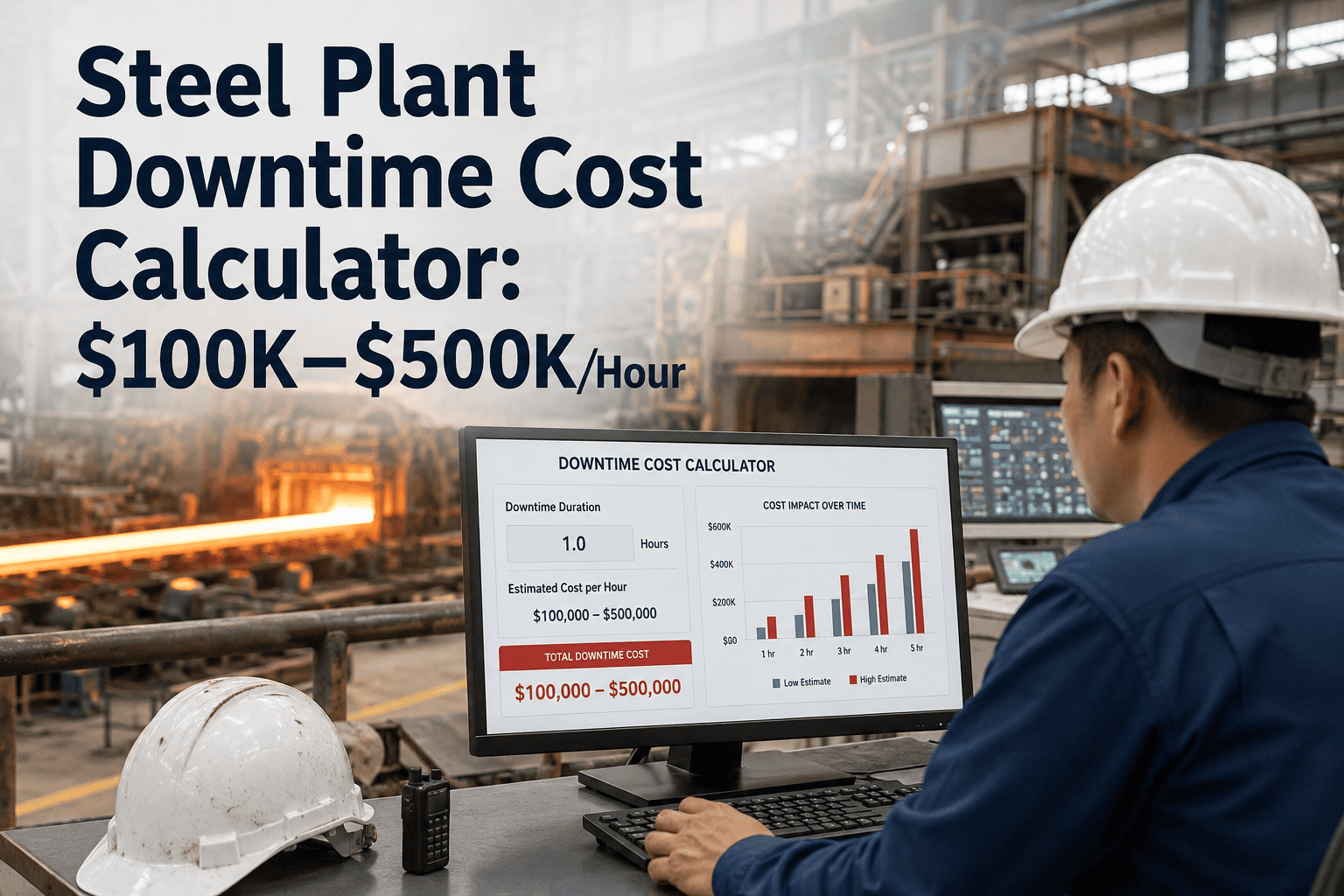
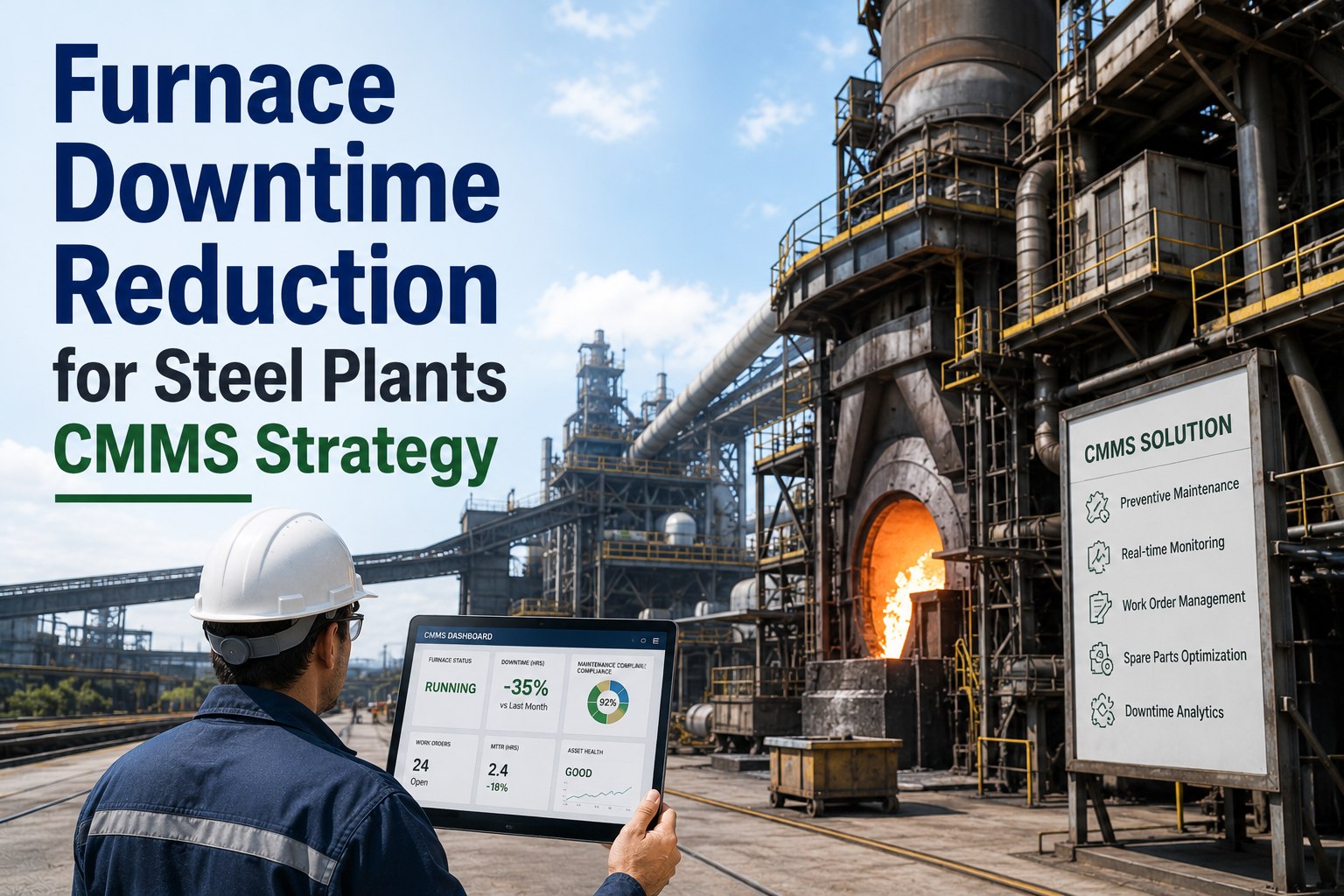
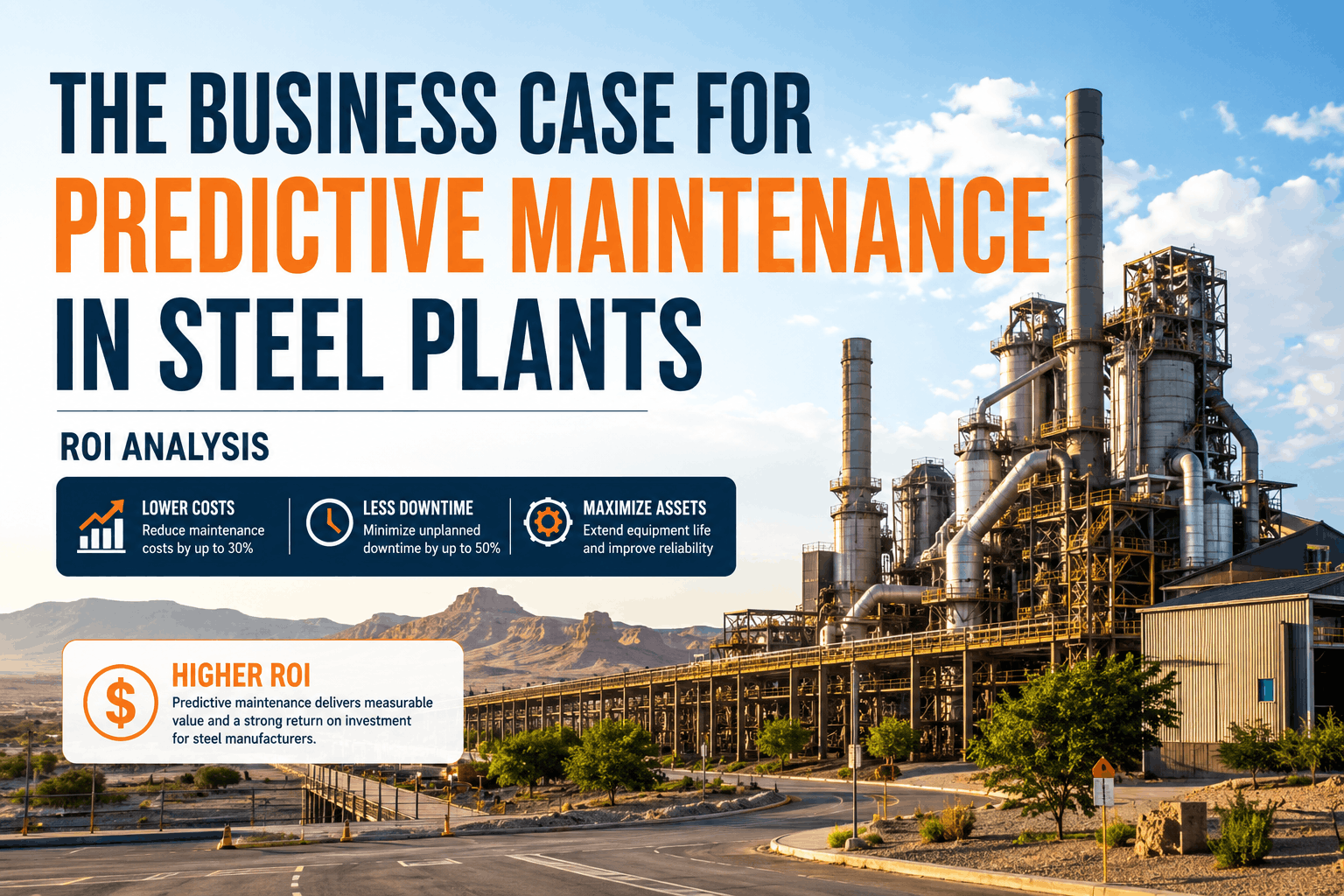
A reliability manager presents a $2.4 million predictive maintenance investment proposal to the CFO — and gets one question back: "Show me the payback." Without documented cost avoidance data, failure frequency baselines, and production loss calculations tied to specific equipment, the proposal dies in committee for the third consecutive budget cycle. Meanwhile, the plant averages 14 unplanned shutdowns per year at $180,000–$850,000 each. Steel plants that build rigorous ROI cases for predictive maintenance programs demonstrate 10:1 to 25:1 return ratios within the first 24 months, reduce unplanned downtime by 35–50%, and extend critical asset life by 20–40%. A 3.2-million-ton-per-year integrated steel mill in the Great Lakes region documented $18.6 million in verified cost avoidance over 30 months after deploying a plant-wide predictive maintenance program — linking every avoided failure, extended oil drain, and deferred capital replacement directly to Oxmaint CMMS for auditable ROI tracking. This guide explains exactly how to build the financial case for predictive maintenance in steel operations, what metrics CFOs and plant directors actually approve, and how CMMS integration turns maintenance data into boardroom-ready ROI evidence.
3–5%
Maintenance as % of RAV
Average annual maintenance spending as a percentage of Replacement Asset Value in steel plants — top-quartile performers operate at 2–3% through predictive programs
$4.2M
Avg. Annual Unplanned Downtime Cost
Estimated production losses per year from unplanned equipment failures at a mid-size integrated steel mill running reactive maintenance strategies
72%
Reactive Maintenance Ratio
Percentage of maintenance work orders classified as reactive/emergency at steel plants without structured predictive programs — top quartile targets below 15%
Maintenance leaders ready to
Sign Up build auditable ROI cases by connecting every predictive finding, avoided failure, and cost avoidance event to structured asset records — creating the financial evidence trail that turns maintenance proposals into approved capital projects.
What Predictive Maintenance ROI Actually Means in Steel
Predictive maintenance ROI is not a theoretical calculation from a vendor brochure. It is the documented, auditable comparison of what your plant spent to detect and prevent failures versus what those failures would have cost if they occurred unplanned — including production loss, emergency repair labor, expedited parts, collateral equipment damage, quality rejections, and customer delivery penalties. For steel plants — where a single unplanned blast furnace blower trip can cost $500,000+ per day and a caster breakout can destroy $2 million in equipment — the ROI calculation is not abstract. It is the difference between a maintenance budget that shrinks every year and one that earns investment. The real value emerges when cost avoidance data connects to financial systems. Steel plants implementing Sign Up for Oxmaint establish the critical link — connecting every predictive finding to its avoided cost, equipment record, and maintenance action so that ROI evidence builds automatically with every work order closed.
5
Executive Reporting Layer
Board-ready dashboards showing cumulative cost avoidance, ROI ratios, downtime reduction trends, and predictive program performance against KPI targets. Monthly and quarterly reports generated directly from CMMS data — no manual spreadsheet compilation required.
Outputs: CFO budget presentations, board reports, capital request justifications, benchmark comparisons, insurance premium negotiations
4
CMMS Financial Integration Layer
Every cost avoidance event is tagged to a specific Oxmaint asset record with documented failure mode, estimated consequence cost, actual repair cost, and net savings. Financial data accumulates automatically across every predictive work order — building the ROI evidence base with every maintenance cycle.
Technologies: Oxmaint CMMS, cost avoidance tracking modules, ERP integration, asset criticality scoring, financial reporting APIs
3
Cost Avoidance Calculation Layer
Each predictive finding is assessed for avoided consequence: What would have failed? How long would production stop? What is the repair cost difference between planned and emergency? What collateral damage was prevented? Conservative, documented estimates — not optimistic projections.
Methods: Production loss modeling, emergency vs. planned repair cost differentials, OEM failure consequence data, historical failure records
2
Predictive Finding & Action Layer
Vibration analysis, oil analysis, thermography, ultrasound, and motor current analysis detect developing failures. Each finding generates a CMMS work order with severity, recommended action, and timeline — converting a detection into a documented planned repair event.
Technologies: Vibration analyzers, oil analysis labs, infrared cameras, ultrasonic detectors, motor circuit analyzers, online monitoring systems
1
Baseline Measurement Layer
Before PdM deployment, document current-state metrics: unplanned downtime hours, emergency work order percentage, maintenance cost per ton, mean time between failures for critical assets. Without a baseline, ROI cannot be calculated — every improvement must be measured against a documented starting point.
Technologies: CMMS historical data extraction, production loss records, maintenance cost reports, OEE calculations, MTBF/MTTR analysis
Critical Integration Point: Oxmaint operates at Layer 4, connecting every predictive finding to its financial consequence — so ROI evidence builds automatically with every avoided failure, extended asset life, and optimized maintenance action.
ROI Metrics: What Steel Plant CFOs Actually Approve
Plant directors and CFOs do not approve maintenance investments based on vendor case studies from other industries. They approve based on metrics tied to their plant's financial statements — production throughput, cost per ton, capital deferral, and insurance exposure. Understanding which ROI metrics resonate with financial decision-makers determines whether a predictive maintenance proposal gets funded or filed. Maintenance leaders building business cases can Book a Demo to see how Oxmaint generates the financial reports that turn predictive data into approved budgets.
The most compelling ROI cases combine 2–3 metrics that directly impact the plant's income statement — unplanned downtime reduction and maintenance cost per ton for operating savings, plus capital deferral for balance sheet impact. All metrics are generated from the same CMMS data structure through
Sign Up for Oxmaint.
Turn Maintenance Data into CFO-Ready ROI Evidence
Oxmaint links every predictive finding to documented cost avoidance, tracks maintenance cost per ton, and generates executive dashboards — so your ROI case builds automatically with every work order closed.
Cost Avoidance Categories: Where Predictive Maintenance Saves Money
ROI in steel plant predictive maintenance comes from six distinct cost avoidance categories. Each category has different magnitude, frequency, and documentation requirements. The strongest business cases quantify savings across all six categories rather than relying on a single headline number — giving financial decision-makers confidence that the ROI estimate is robust and conservative.
Production Loss Avoidance
The largest single ROI category. Every hour of unplanned downtime on a continuous process line — blast furnace, caster, hot strip mill — carries a production loss cost of $50,000–$350,000 depending on the line and product mix. Detecting failures before they cause trips eliminates these losses entirely.
Typical Steel Plant Impact: $2M–$8M/year in avoided production losses from 5–12 prevented unplanned shutdowns
Emergency Repair Cost Differential
Emergency repairs cost 3–8× more than the identical repair performed on a planned basis. Overtime labor, expedited freight for parts, crane mobilization without scheduling, and inefficient wrench time compound the cost gap. PdM converts emergency work to planned work.
Typical Steel Plant Impact: $800K–$2.5M/year in labor and parts cost reduction as reactive ratio drops below 20%
Collateral Damage Prevention
When a bearing fails catastrophically, it doesn't just destroy itself — it damages shafts, housings, seals, couplings, and sometimes adjacent equipment. A $3,000 bearing replacement becomes a $150,000 rebuild when the shaft, housing, and coupling are destroyed. PdM catches failures before collateral damage occurs.
Typical Steel Plant Impact: $500K–$2M/year in avoided secondary damage from early-stage failure detection
Lubricant & Consumable Optimization
Oil analysis-driven condition-based oil changes replace calendar-based schedules, extending drain intervals by 2–5× on systems with clean, serviceable oil while catching contaminated systems earlier. Filter change intervals, grease re-lubrication quantities, and coolant replacement are all optimized through condition data.
Typical Steel Plant Impact: $200K–$600K/year in reduced lubricant consumption and optimized consumable usage
Capital Deferral & Life Extension
Condition monitoring proves whether equipment actually needs replacement or can safely operate longer. A gearbox rated for 7-year life may operate 10+ years if vibration, oil analysis, and thermography confirm healthy condition — deferring a $2–$5M capital replacement by 3+ years.
Typical Steel Plant Impact: $1M–$4M/year in deferred capital expenditure on monitored critical assets
Safety & Environmental Risk Reduction
Catastrophic equipment failures create safety hazards — molten steel breakouts, hydraulic line ruptures, rotating equipment disintegration, electrical arc flash events. Preventing these failures reduces recordable injury risk, OSHA citation exposure, environmental release incidents, and insurance premiums.
Typical Steel Plant Impact: $300K–$1.5M/year in reduced insurance premiums, avoided regulatory fines, and lower workers' comp costs
Building the Business Case: Three ROI Presentation Approaches
How you present the ROI case matters as much as the numbers themselves. Different stakeholders require different framing — and the most successful predictive maintenance programs use the approach that matches their audience. The critical factor is ensuring that every number in the presentation traces back to documented CMMS data that can withstand financial audit scrutiny.
Pilot-Based Proof
Best for: First-time PdM proposals
Investment: $150K–$400K (6-month pilot)
Advantages
- Low initial investment risk for leadership
- Documented ROI from your own plant data
- Builds internal expertise before scaling
- Single avoided failure often pays for entire pilot
Considerations
- 6–12 months before ROI evidence matures
- Pilot scope may miss high-impact failures
- Requires discipline to document every finding
- Plant culture may resist data collection overhead
Recommended
Historical Failure Analysis
Best for: Plants with 2+ years CMMS data
Investment: ROI model built from existing records
Advantages
- Uses your plant's actual failure history
- CFO sees numbers from their own financials
- Identifies highest-ROI equipment targets
- Strongest credibility — no vendor projections
Considerations
- Requires accurate CMMS historical data
- Production loss values must be validated
- Needs finance team collaboration for cost data
- Incomplete records weaken the analysis
Industry Benchmark Comparison
Best for: New plants or limited data
Investment: Analysis based on published benchmarks
Advantages
- No internal data dependency
- Leverages proven industry results
- Quick to assemble for budget deadlines
- Useful for initial executive awareness
Considerations
- CFOs discount external benchmarks heavily
- Less credible than plant-specific analysis
- Does not identify specific target equipment
- Should transition to pilot-based proof quickly
Most successful predictive maintenance programs start with a historical failure analysis to secure initial funding, deploy a targeted pilot on 50–100 critical assets to generate plant-specific ROI evidence, then present documented cost avoidance results to justify full-scale deployment. All ROI data — regardless of methodology — feeds into the same Oxmaint reporting structure.
The CMMS Connection: Why Documented ROI Requires System Integration
A predictive finding without a documented cost avoidance record is an anecdote. A maintenance budget without auditable savings evidence is a cost center. The integration of predictive maintenance findings with CMMS financial tracking transforms both — giving every detection a dollar value and giving every budget request documented proof. This is where predictive maintenance investment compounds in credibility across every future budget cycle and capital request.
1
Predictive Detection
Vibration, oil analysis, thermography, or ultrasound identifies developing failure — CMMS work order auto-generated
→
2
Consequence Estimation
Analyst documents what would have failed, estimated downtime hours, production loss, and emergency repair cost if undetected
→
3
Planned Repair Execution
Repair performed during scheduled outage — actual labor, parts, and downtime costs documented in CMMS work order
→
4
Cost Avoidance Logging
Net savings calculated: estimated unplanned cost minus actual planned repair cost — tagged to asset record in Oxmaint
→
5
Executive Reporting
Cumulative ROI dashboards auto-generated from CMMS data — monthly, quarterly, and annual reports for CFO and plant director
Example Scenario 1: Hot Strip Mill Main Drive Gearbox
Vibration analysis detected a bearing inner race defect frequency on the output shaft bearing of a hot strip mill main drive gearbox — 14 months before the next scheduled overhaul. Oil analysis confirmed the finding with iron trending from 22 ppm to 68 ppm over three months. The maintenance team scheduled a bearing replacement during a planned 72-hour annual shutdown, completing the repair in 18 hours at a total cost of $42,000 (parts, labor, crane). Consequence estimation: unplanned gearbox failure would have caused a 5-day emergency shutdown at $1.8 million in lost production plus $380,000 in emergency repair costs with expedited bearing procurement. Documented cost avoidance: $2.138 million. The single finding paid for 3.5 years of the plant's entire vibration analysis program.
Example Scenario 2: Continuous Caster Hydraulic System
Monthly oil analysis on the caster segment hydraulic system detected water contamination rising from 85 ppm to 620 ppm over two consecutive samples, combined with a particle count increase from ISO 17/15/12 to ISO 20/18/15. The Oxmaint-generated critical alert triggered investigation that found a pinhole leak in an oil cooler allowing cooling water into the 6,000-liter hydraulic reservoir. Repair cost: $4,200 for cooler replacement plus $8,500 for oil filtration and partial fluid change — total $12,700. Consequence estimation: continued operation at 620 ppm moisture would have caused servo valve failures across 8 caster segments within 90 days — replacement cost of $340,000 for valves plus 36 hours of caster downtime at $125,000/hour = $4.84 million total consequence. Documented cost avoidance: $4.827 million.
Predictive Maintenance Finds the Problem. Oxmaint Proves the Savings.
Connect every predictive finding to documented cost avoidance, track maintenance cost per ton, generate executive ROI dashboards, and build the auditable evidence trail that turns maintenance from a cost center into a documented profit contributor.
Expert Perspective: Building the ROI Case for Steel Plant PdM
The first time I presented a predictive maintenance ROI case, I used industry averages and vendor projections. The CFO told me to come back with our numbers. That rejection was the best thing that happened to the program. I went back to three years of CMMS data and pulled every unplanned downtime event, every emergency work order, every expedited parts purchase. I calculated what each failure actually cost us — not what a textbook said it should cost. When I came back with a list of 23 specific failures that cost $7.4 million over three years and showed that 18 of them had detectable signatures months before failure, the conversation changed completely. The CFO approved a $600,000 pilot. Six months later, we caught a blast furnace turbo-blower bearing failure that would have cost $3.2 million in production losses. That single event delivered a 5:1 ROI on the pilot investment. The CMMS was the key — every finding, every cost estimate, every actual repair cost documented in the same system the finance team already trusts for budget reporting. No side spreadsheets, no unsupported claims. Just data.
Use Conservative Cost Estimates — Always
Overstating cost avoidance destroys program credibility with finance teams. Use the lower bound of production loss estimates, exclude soft costs unless specifically requested, and always show your calculation methodology. A conservative $5M ROI that survives audit is worth more than an aggressive $15M claim that gets dismissed.
Document Every Finding — Even Small Ones
A $3,000 bearing replacement that prevented a $45,000 emergency repair doesn't make the executive summary — but 200 of those findings per year add up to $8.4 million in cumulative cost avoidance. The small, frequent wins often contribute more total ROI than the rare headline saves. The CMMS must capture all of them.
Tie ROI to Production KPIs — Not Just Maintenance Metrics
CFOs care about cost per ton, OEE, and on-time delivery — not vibration velocity or oil particle counts. Translate every maintenance improvement into its production impact. "We reduced unplanned downtime by 340 hours" becomes "We produced an additional 42,000 tons worth $28M in revenue" — same fact, different audience.
Frequently Asked Questions
What is the typical ROI ratio for predictive maintenance in steel plants?
Documented ROI ratios for predictive maintenance programs in steel plants typically range from 10:1 to 25:1 within the first 24 months of full deployment. This means for every $1 invested in PdM technology, staff, and laboratory services, $10–$25 in cost avoidance is documented. The wide range depends on plant size, starting condition (plants with high reactive maintenance ratios see faster payback), and how rigorously cost avoidance is tracked. First-year ROI is typically lower (5:1–10:1) as the program establishes baselines and builds monitoring coverage. By year two, ROI accelerates as trend data matures and the program catches higher-consequence failures.
Book a Demo to model projected ROI for your plant's asset portfolio and failure history.
How long does it take for a predictive maintenance program to pay back its investment?
Most steel plant PdM programs achieve full payback within 6–12 months of deployment. Pilot programs targeting 50–100 critical assets frequently pay back within 3–6 months through a single avoided catastrophic failure. The key variable is asset criticality selection — targeting high-consequence equipment (mill drives, caster systems, blast furnace auxiliaries, turbo-blowers) accelerates payback because the cost avoidance from a single prevented failure on these assets can exceed the entire program investment. Plants that start with non-critical support equipment see slower payback because avoided failures carry smaller consequence values.
How do we calculate cost avoidance for a predictive finding?
Cost avoidance for each predictive finding is calculated as: (Estimated Unplanned Failure Cost) minus (Actual Planned Repair Cost) = Net Cost Avoidance. Estimated unplanned cost includes: production loss (downtime hours × hourly production value), emergency repair labor (overtime rates, contractor mobilization), expedited parts procurement (premium freight, markup), collateral equipment damage, quality losses during restart, and customer delivery penalties. Actual planned repair cost includes: scheduled labor at normal rates, standard parts procurement, and planned downtime during scheduled outage. The difference is documented in the CMMS work order and tagged to the asset record for cumulative tracking.
How does Oxmaint CMMS support predictive maintenance ROI tracking?
Oxmaint provides structured fields for cost avoidance documentation on every predictive maintenance work order — estimated consequence cost, actual repair cost, net savings, failure mode detected, and technology used for detection. These fields aggregate automatically into asset-level, department-level, and plant-level ROI dashboards. Monthly reports show cumulative cost avoidance versus program investment, trending over time. Integration with ERP systems pulls actual production loss values for validated calculations. Executive dashboards export directly to presentation formats for board reporting.
Sign Up to start building the ROI evidence base from your first predictive work order.
Should we start with a pilot or deploy plant-wide predictive maintenance immediately?
Targeted pilot deployment is strongly recommended. Start with a criticality assessment to identify 50–100 assets where unplanned failure carries the highest production and cost consequences. Deploy vibration monitoring and oil analysis on these assets first. Document every finding with full cost avoidance calculations in Oxmaint CMMS. After 6–12 months, present documented ROI from the pilot to plant leadership — typical pilot results include 3–8 avoided major failures with 5:1–15:1 ROI. Use pilot evidence to secure funding for phased expansion adding 100–200 assets per year. Full plant-wide coverage of 500–1,500 critical assets is typically achieved within 24–36 months through rolling deployment.