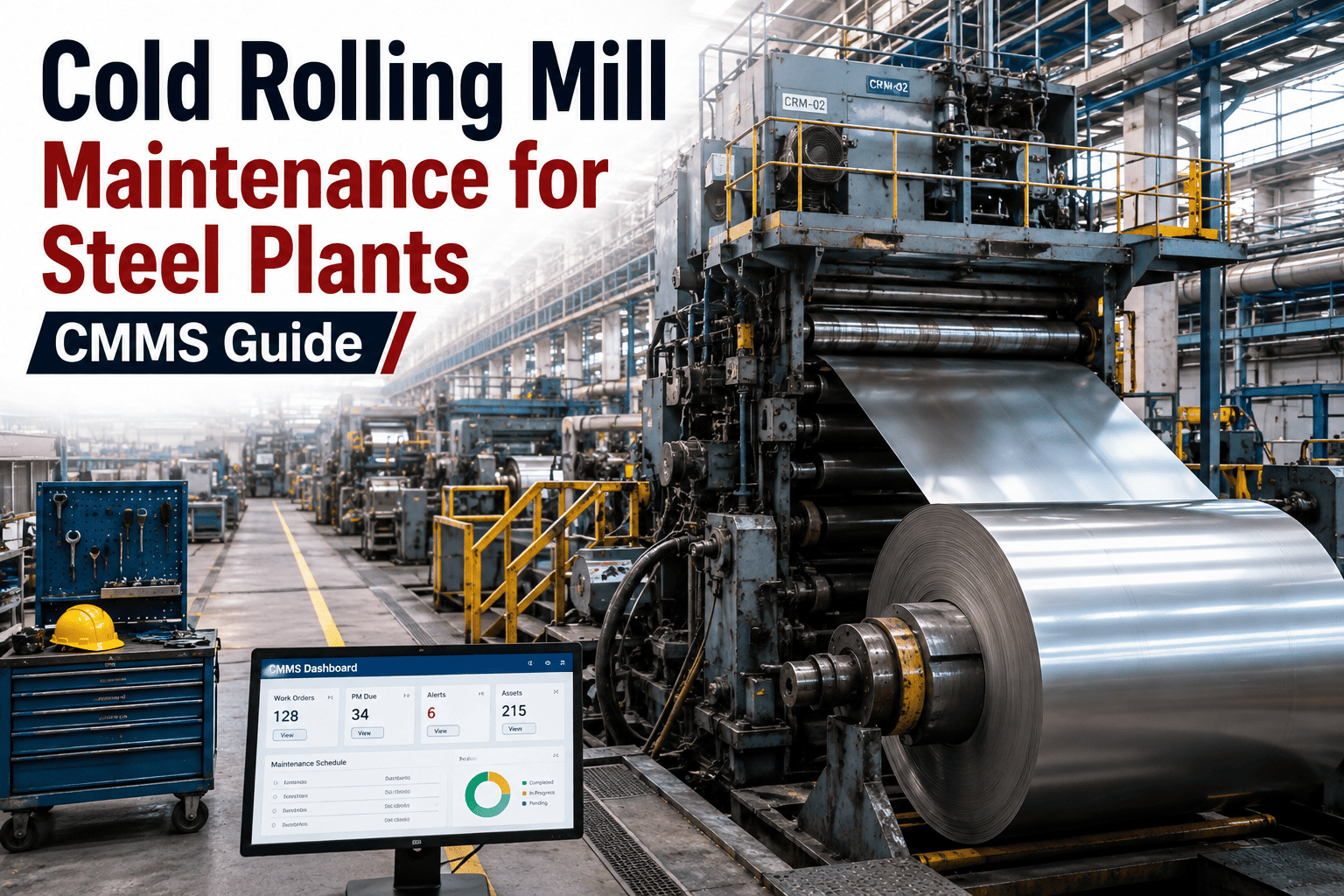
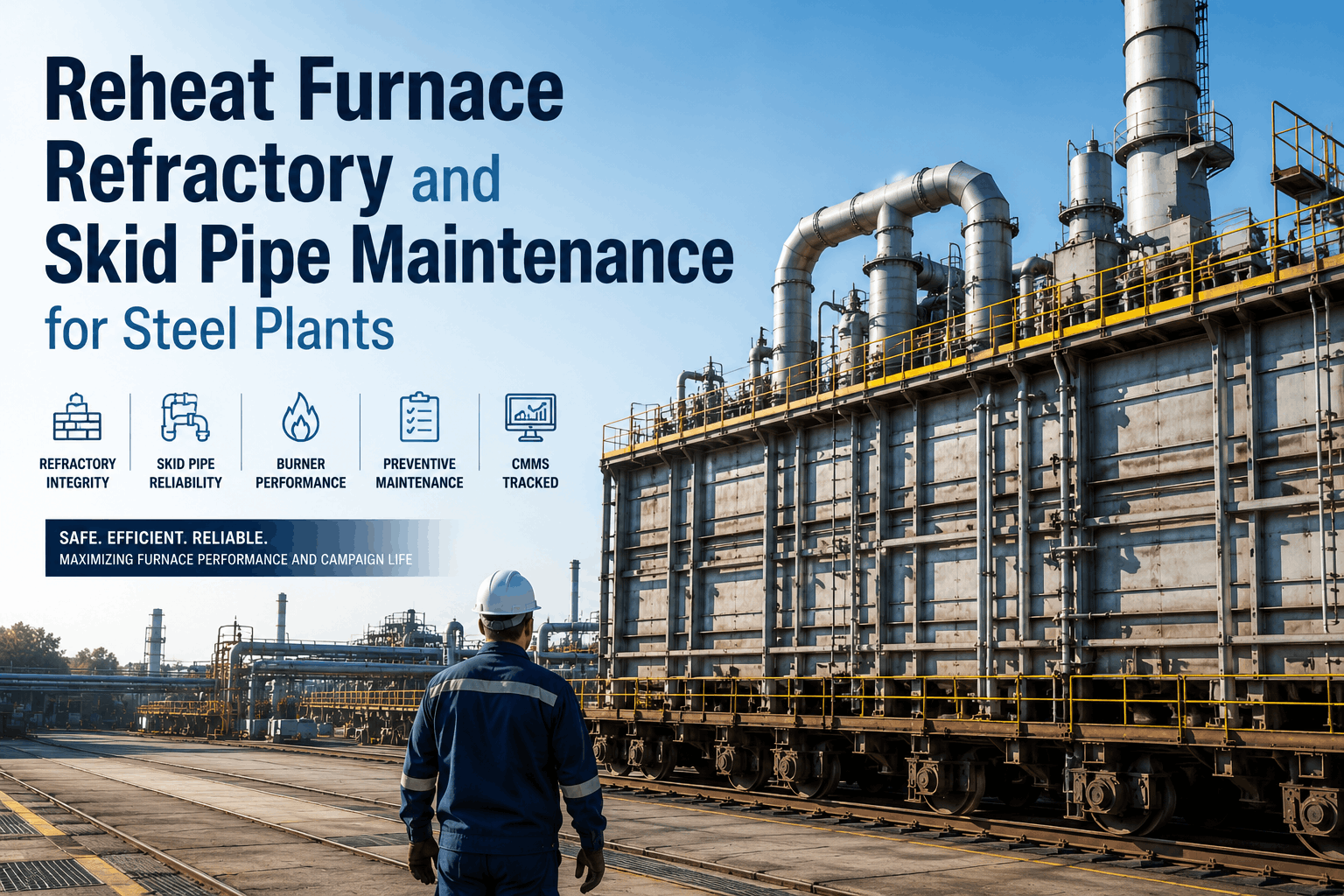
Reheat furnace availability is the single biggest lever on rolling mill throughput — every hour of unplanned downtime on a 150 t/h line can trap 60–80 billets in the heating cycle, starve the mill stands, and push energy intensity past 1.6 GJ/t of rolled product. For integrated and long-product mills running three shifts, that translates to six-figure monthly losses before you even count skid-pipe repairs, lost scale yield, or combustion efficiency drift. A structured preventive maintenance program covering burners, skid pipe refractory, walking beam hydraulics, and furnace door seals typically lifts furnace MTBF by 30–45% and recovers 4–8% of fuel rate within the first quarter. This guide breaks the PM plan into inspectable workstreams, with realistic frequencies, thresholds, and the CMMS workflow that keeps it auditable. Ready to operationalize it across your plant? Start Free Trial and deploy the reheat furnace PM template in under a day.
REHEAT FURNACE MAINTENANCE GUIDE
Every billet your mill rolls is rate-limited by the furnace that heats it.
A 150 t/h reheat furnace offline for 6 hours blocks roughly 90 tonnes of hot charge — and at $820/tonne margin, that single event erases nearly $74K before refractory cooldown even begins. Reactive maintenance is not a cost line; it is a throughput ceiling.
35%
Average Mill Throughput Lost per Furnace Outage
$74K
Single 6-Hour Downtime Cost at 150 t/h
1.6 GJ/t
Fuel Rate When Combustion PM Is Skipped
BURNER SYSTEM PM
Combustion performance decides your fuel bill by shift 3.
On a 6-zone walking-beam furnace with 24 regenerative burners, a 2% drift in air-fuel ratio adds roughly $11,400/month in natural gas at $4.20/MMBtu — and a single fouled nozzle can push zone temperature deviation past 18°C, triggering scrap-rate spikes on the next bar.
Burner Tuning & Air-Fuel Ratio
Weekly flue-gas O₂ check at each zone — target 2.5–3.5% excess oxygen. Re-tune when deviation exceeds ±0.5%. Calibrate combustion-air dampers monthly; validate regenerator valve sequencing every 30 days to prevent cross-leakage that silently inflates fuel rate.
Nozzle & Diffuser Inspection
Pull and clean gas nozzles each 90 days or after any flame-shape alarm. Inspect ceramic diffusers for cracking and carbon build-up; replace when throat erosion exceeds 1.5 mm. Document flame stability under low-fire, mid-fire, and high-fire conditions.
Igniter & Flame Scanner Loop
Test UV/IR flame scanners every shift change — a failed scan trips the safety shut-off valve within 3 seconds. Replace scanner lenses quarterly; verify igniter spark gap at 4 mm and confirm pilot gas pressure holds 1.8–2.2 kPa during cold-start sequence.
“
A 0.4% shift in excess oxygen across a 150 t/h furnace costs more than the entire annual salary of the technician who would have caught it.
— Typical finding from ISO 50001 energy audits in Indian long-product mills
SKID PIPE & REFRACTORY
Skid marks, scale loss, and tube rupture all start with insulation creep.
Skid pipe refractory wears fastest where billet sliding friction meets 1,250°C radiant heat. A 12 mm loss of castable insulation drives skid-mark depth past 6 mm on the finished bar and raises pipe-surface temperature to within 80°C of yield failure — a leading cause of unplanned water-leak shutdowns.
Skid Pipe Insulation Health
Ultrasonically measure castable thickness at every scheduled entry (every 8 weeks on top rails, 12 weeks on side rails). Reject below 25 mm nominal. Thermographically scan for hot spots weekly; any pipe reading above 380°C triggers a work order before the next campaign.
Inspect every 8 weeksCritical threshold: 380°C pipe surface
Hearth & Roof Refractory
Survey hearth, sidewall, and crown with thermal imaging during operations; log hot-face temperature anomalies exceeding 120°C above baseline. Tap-test castable and brickwork at every 8-week shutdown. Replace spalled areas exceeding 300 × 300 mm and re-anchor any exposed ceramic-fiber module.
IR scan weeklyReplace above 300×300 mm spall
WALKING BEAM & MECHANICAL
Hydraulic health keeps the furnace pacing the mill — not the other way around.
Walking-beam cycle time directly gates material flow: a 0.4-second lag in beam raise translates to 12–15 billets per shift not reaching discharge temperature, while accelerated wear on rider bars and skid buttons compounds into refractory damage within weeks.
01
Hydraulic Power Unit
Sample oil every 30 days for ISO 4406 cleanliness — target 18/16/13 for proportional-valve circuits. Change full-flow and return-line filters at 2,000 h or ΔP alarm, whichever comes first. Inspect accumulator pre-charge at 60-day intervals; nitrogen pressure must hold 60% of system relief setting ±5%.
02
Beam Rails & Skid Buttons
Inspect rider-bar wear patterns every 4 weeks; reject when wear exceeds 3 mm. Rotate skid buttons to alternate wear faces during any outage longer than 12 hours. Verify rail straightness with a laser alignment check each quarterly shutdown — tolerance ±1.5 mm over 6 m.
03
Lifting Cylinder Seals
Check for bypass leakage at full load every 2 weeks — drift greater than 4 mm over 10 minutes signals imminent seal failure. Replace rod seals proactively at 14,000 cycles, well before the typical 18,000-cycle burst point, to avoid a mid-campaign hydraulic dump that contaminates the entire HPU.
FURNACE DOOR SEALS & ENVELOPE
Every cold-air ingress is invisible fuel you are paying to heat twice.
Charge and discharge door seals degrade fastest in any reheat furnace — a 25 mm gap at the discharge end admits enough tramp air to drop zone-1 temperature by 30°C and inflate fuel consumption by 3.5–5% across the campaign. Sealing the envelope is the cheapest fuel-rate win available.
Charge & Discharge Doors
Inspect fiber rope and knife-edge seals weekly; replace when compressed to 60% of original cross-section. Verify door close-fit with a 0.5 mm feeler gauge around the full perimeter. Re-tension counterweights each monthly shutdown so dwell time under load is under 1.2 seconds.
Peephole & Access Ports
Install and replace high-temperature vision-port covers every 60 days. Re-seat plug plates with ceramic-fiber gasketing at each outage. Even a single 75 mm open peephole at 1,200°C pulls roughly 4 kW of radiant loss and admits cold air that distorts zone thermocouple readings.
Skid-Seal Penetrations
Inspect water-cooled skid pipe entry boots at each 8-week shutdown. Replace bellows-style seals when tearing or hardening is visible. Pack annular gaps with ceramic-fiber rope and verify with a smoke test under negative furnace draft of −15 to −25 Pa.
PM SCHEDULE AT A GLANCE
A consolidated reheat furnace inspection calendar.
The table below maps each maintenance task to its recommended frequency, owner, and the threshold that should auto-trigger a CMMS work order. Use it as the backbone of your furnace PM template.
| Workstream | Task | Frequency | Trigger Threshold | Owner |
|---|
| Combustion | Flue-gas O₂ check per zone | Weekly | ±0.5% drift from setpoint | Shift engineer |
| Combustion | Nozzle clean & diffuser inspect | 90 days | Flame-shape alarm or 1.5 mm erosion | Burner technician |
| Skid pipe | Castable thickness UT measure | 8 weeks (top rail) | Below 25 mm nominal | Refractory crew |
| Skid pipe | IR thermography of pipes | Weekly | Pipe surface above 380°C | Shift engineer |
| Walking beam | Hydraulic oil cleanliness sample | 30 days | ISO 4406 worse than 18/16/13 | Mechanical team |
| Walking beam | Cylinder drift / seal test | 2 weeks | Drift greater than 4 mm / 10 min | Mechanical team |
| Envelope | Door seal feeler-gauge check | Weekly | Gap greater than 0.5 mm | Shift engineer |
| Envelope | Smoke test under negative draft | 8 weeks | Visible leak at any penetration | Refractory crew |
Turn this PM calendar into live, auditable work orders.
Oxmaint ships a pre-built reheat furnace PM template — burners, skid pipes, walking beam, and envelope — ready to assign, schedule, and report against ISO 55000 in a single afternoon.
FAQ
Reheat furnace maintenance — what plant teams ask most.
How often should we inspect skid pipe refractory in a walking-beam furnace?
Top rails should be ultrasonically measured every 8 weeks and side rails every 12 weeks, with weekly infrared thermography in between. Any pipe surface reading above 380°C should auto-generate a work order — that threshold typically precedes castable spalling by 3–4 weeks and gives the refractory crew time to plan a targeted repair rather than a full campaign shutdown.
What is the single biggest fuel-rate win from preventive maintenance?
Combustion tuning — specifically holding excess oxygen between 2.5% and 3.5% across all zones. A 0.4% drift above setpoint on a 150 t/h furnace typically adds $9K–$12K per month in natural gas. Weekly O₂ checks, monthly damper calibration, and quarterly nozzle cleaning usually recover 3–5% of fuel rate within the first quarter of disciplined PM execution.
How does a CMMS like Oxmaint improve reheat furnace availability?
It converts every inspection reading into a trigger — when a thermography scan logs 395°C on a skid pipe, the system auto-creates a work order tied to the correct asset, spare, and craft. That closes the gap between detection and action, which is where most plants lose 6–10 hours of unplanned downtime per outage. You can
Start Free Trial and import the reheat furnace PM template the same day.
What hydraulic oil cleanliness target should we maintain for walking-beam circuits?
ISO 4406 code 18/16/13 is the practical target for proportional-valve circuits on walking-beam HPUs. Sample every 30 days and change full-flow filters at 2,000 hours or on differential-pressure alarm, whichever comes first. Contamination beyond this range is the leading cause of premature servo-proportional valve failure, which can cost $14K–$22K per valve and 8–12 hours of downtime.
How do we justify the cost of a structured furnace PM program to management?
Build the case around three numbers: recovered fuel (typically 3–5%), reduced scrap from skid marks (1–2% yield), and avoided unplanned downtime (one 6-hour outage on a 150 t/h line costs roughly $74K). Most mills recover the full annual cost of a CMMS-led PM program within the first 90 days. To walk through a worked ROI model for your plant,
Book a Demo and we will tailor the numbers to your furnace configuration.
DEPLOY IN A DAY
Stop treating the reheat furnace as the bottleneck. Start maintaining it as the asset that sets mill pace.
Pre-built PM templates for burners, skid pipes, walking beams, and envelope seals. Trigger-based work orders. ISO 55000-ready audit trails. Live in a single afternoon.
Free 14-day trial · No credit card