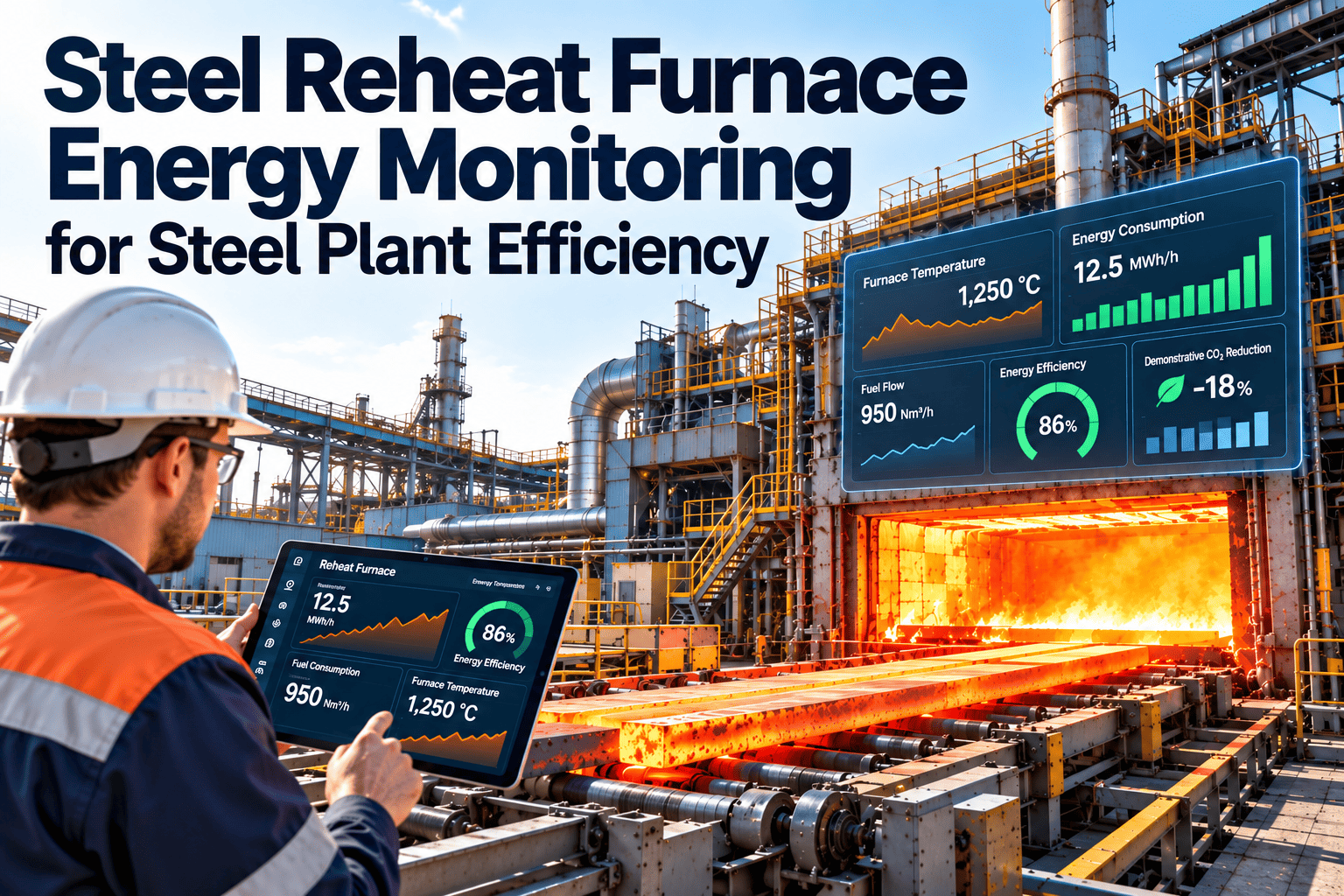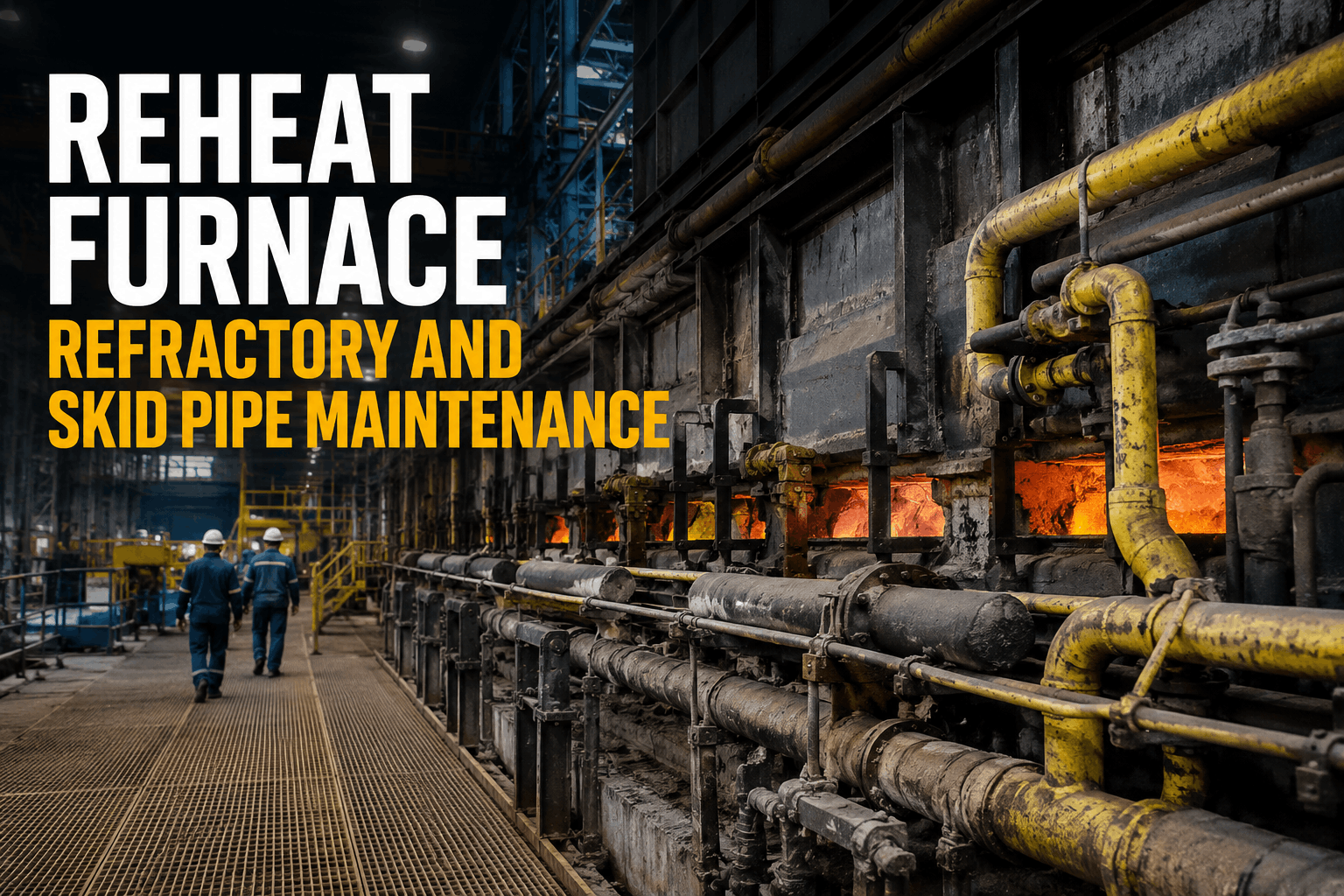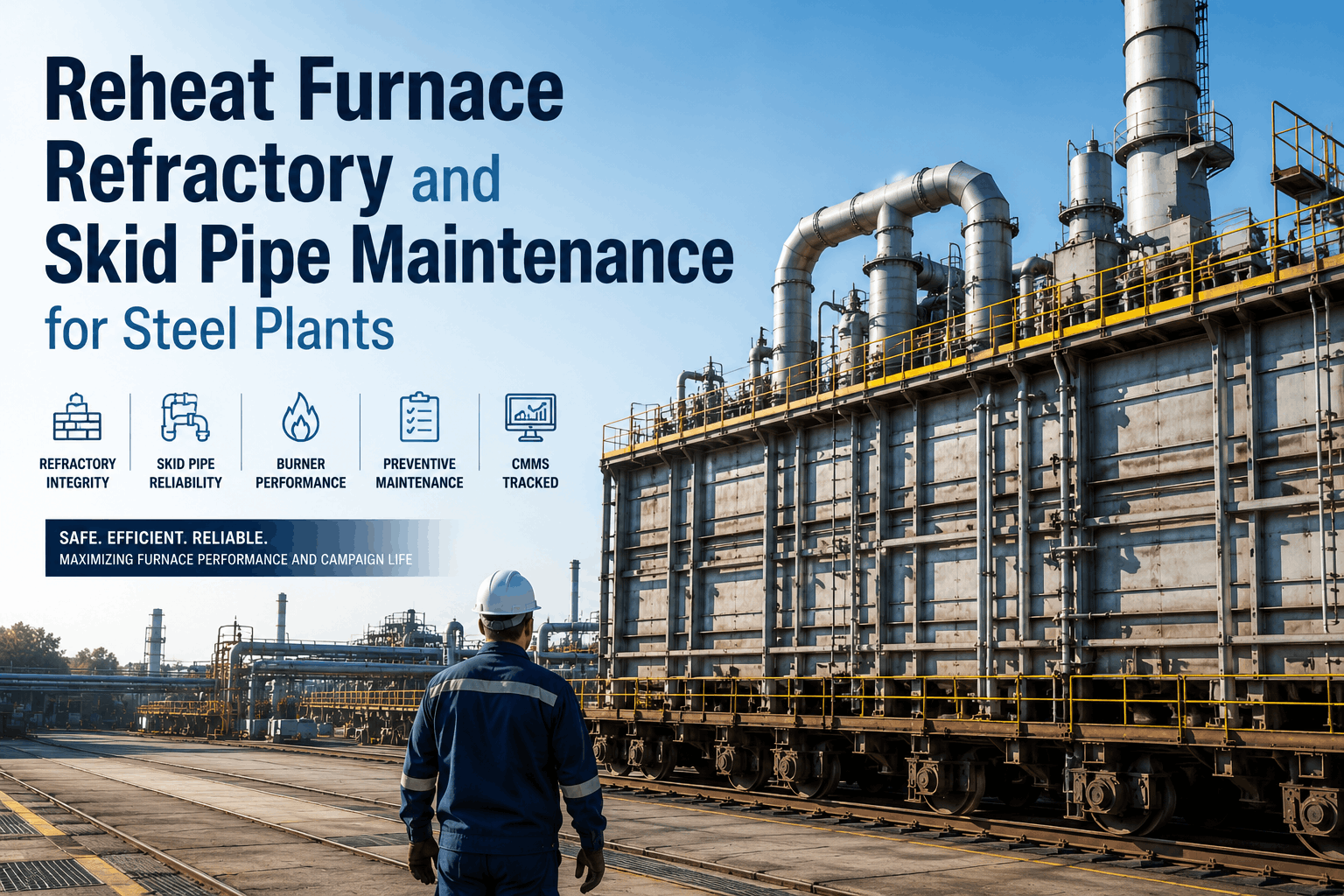
A reheat furnace is the energy consumer of the rolling mill — burning 800–2,000 cubic metres of natural gas per hour at 1,300°C to heat incoming slabs before they are hot-rolled into finished products. But every day the furnace operates, burner tips erode, refractory spalls, recuperator tubes foul with scale, and skid buttons oxidize — cascading into rising fuel consumption that can increase operating cost by $50,000–$200,000 per month without triggering any alarms. A plant operator running the furnace day after day sees only the setpoint temperature holding steady while invisible degradation compounds — until a refractory hotspot develops into a shell breach, or skid pipe cooling fails catastrophically and 1,500°C slabs begin rolling without thermal profile, damaging product quality. Daily burner and skid pipe walks — capturing fuel consumption trending, door seal condition, recuperator outlet temperature, and skid water flow — recorded in OxMaint's CMMS, transform passive observation into energy management intelligence that keeps fuel efficiency visible and prevents the unplanned shutdowns that cost rolling mills entire production campaigns.
Reheat Furnace Daily Burner and Skid Pipe Walk
Burner tip wear assessment, furnace door seal inspection, refractory lining condition monitoring, recuperator fouling detection, and skid pipe cooling system verification — structured for rolling mills where furnace energy cost is the largest controllable operating expense and 5–8% fuel consumption increases from deferred maintenance cost thousands per day.
Invisible Degradation Compounds Into Waste
A furnace running at 1,350°C with a 5–8% efficiency loss from deferred maintenance doesn't show up as "furnace failure" — it appears as rising fuel cost per tonne. Over a month, this compounds into $50K–$200K in preventable fuel waste. Over a year, $600K–$2.4M. Scheduled maintenance at the first sign of fuel consumption rise prevents this waste accumulation.
Burner Tip Condition and Combustion Efficiency
Burner tips erode from thermal cycling and oxidation — changing fuel spray pattern, air-fuel ratio, and flame shape. A burner running with eroded tip consumes 8–12% more fuel to achieve the same heating rate. Multiple eroded burners cascading this effect across a furnace with 8–12 burners can increase monthly fuel cost by $100,000–$300,000 without reducing furnace output.
Burner Flame Profile
Monitor flame color and shape — blue/dull = efficiency loss
Fuel Consumption Trending
Track consumption per tonne — flag rise >5%
Combustion Efficiency
Optimize air-fuel ratio monthly for 3–5% savings
Furnace Door Seal and Discharge System
The discharge door seals the drop-out slope between the furnace hearth and the rolling deck — preventing 1,500°C heat from radiating out of the furnace and into the mill environment. Seal deterioration allows radiation heat loss and combustion air infiltration — both degrading furnace efficiency by 5–8%. Daily door visual inspection and monthly seal condition assessment prevent seal degradation from compounding into major efficiency loss.
Recuperator Fouling and Heat Recovery Efficiency
The recuperator recovers waste heat from furnace exhaust gases — preheating combustion air from ambient to 400–600°C before entering burners. Scale and mineral fouling of recuperator tubes reduces heat recovery by 15–25% — increasing fuel consumption proportionally. Recuperator outlet temperature trending detects fouling before efficiency collapse forces expensive emergency descaling.
Skid Pipe Cooling System and Thermal Load
Skid pipes are water-cooled refractory supports that hold hot slabs inside the furnace — subject to 1,500°C radiant heat and thermal cycling. Skid pipe cooling water cools the pipes; skid buttons (ceramic insulators) on the pipes isolate heat and create skid marks on the bottom of slabs. Cooling failure, button deterioration, or water-side scale buildup creates loss of thermal isolation — damaging product quality and exposing furnace structure to excessive heat.
Daily Furnace Efficiency KPIs
| Metric | How to Measure | Target / Target Range | Frequency |
|---|---|---|---|
| Fuel Consumption per Tonne | Total gas volume ÷ slab tonnage | Baseline ±5% variance | Daily |
| Burner Flame Color | Visual observation during operation | Bright yellow-orange, crisp shape | Daily |
| Recuperator Outlet Temperature | Thermocouple at outlet | 400–550°C (design-dependent) | Daily |
| Preheated Air Temperature | Thermocouple after recuperator | 400–600°C (design-dependent) | Daily |
| Skid Pipe Water Delta-T | Inlet vs outlet temperature | 10–20°C normal range | Daily |
| Door Seal Pressure/Flow | Pressure gauge or flow meter | 2–3 bar or design-specific flow | Weekly |
| Recuperator Pressure Drop | Differential pressure transmitter | <500 Pa normal operation | Monthly |
Refractory Lining Health and Campaign Life Planning
Furnace refractory lining — crown brick, sidewall blocks, and hearth material — degrades from thermal stress, slag chemistry attack, and mechanical wear. Shell temperature survey and internal thermocouple trending identify where lining thickness has fallen below safe levels. Proactive reline planning scheduled during maintenance windows prevents the catastrophic lining failure that forces emergency shutdown.
"Before OxMaint, our furnace fuel cost was drifting up every month but we couldn't see the cause — was it burner wear, recuperator fouling, or operational drift? We started logging fuel consumption per tonne daily and tracking burner flame color. After three weeks of trending, we saw a clear 6% fuel consumption rise correlated with dimmer flame color on four burners. We pulled those burners, found tips eroded >2 mm, replaced them, and recovered 5% of fuel cost in two weeks. That single observation saved us $150,000 in one quarter. Now furnace maintenance is data-driven instead of reactive."
Frequently Asked Questions
How much fuel consumption increase does burner tip erosion typically cause, and why is it not caught by standard process control?
Eroded burner tip increases fuel consumption 8–12% to maintain furnace setpoint temperature — consuming more fuel to achieve same heating rate. Standard PLC control only monitors furnace temperature, not fuel efficiency — so 10% fuel waste remains invisible until manual trend analysis reveals rising cost-per-tonne.
What is the consequence of recuperator fouling, and how much heating efficiency loss can occur before it becomes obvious?
Scale fouling in recuperator tubes reduces heat recovery by 15–25% — increasing fuel consumption proportionally. Efficiency loss accelerates as fouling builds: 5% loss barely noticeable; 15% loss compounds into thousands per day in fuel cost; 25% loss forces emergency descaling. Daily outlet temperature trending detects fouling early.
How does door seal deterioration impact furnace efficiency and what is the monitoring method?
Poor door seal allows 1,500°C heat radiation to escape the furnace and combustion air to infiltrate — both increasing fuel demand 3–5%. Weekly visual inspection and monthly thermal imaging of furnace exterior door region detects seal degradation before efficiency loss compounds into major fuel waste.
Why is skid pipe cooling water delta-T (inlet to outlet temperature rise) a better indicator than absolute temperature for detecting cooling problems?
Delta-T directly reflects heat removal rate — independent of inlet water temperature variance. Delta-T >25°C indicates reduced flow (blockage); Delta-T <8°C indicates bypass or water loss. Absolute temperature can drift with ambient conditions but delta-T reveals actual system performance issues.
How does fuel consumption per tonne of slab differ from just tracking total furnace fuel consumption, and why is the per-tonne metric more useful?
Total furnace fuel varies with production rate — making it impossible to detect efficiency changes without normalizing for production. Fuel per tonne reveals actual furnace efficiency independent of mill speed — 5% rise in per-tonne consumption is genuine efficiency loss requiring investigation and corrective action.
What is the difference between skid marks on rolled product from button wear versus poor cooling water management?
Button wear: ceramic degradation, incomplete coverage. Poor cooling: reduced water delta-T, skid pipe overheating, buttons unable to insulate properly. Both create marks. Diagnosis: if delta-T is normal but marks persist, replace buttons; if delta-T is low, check cooling water flow and pressure.
How should OxMaint's daily fuel consumption trending integrate with rolling mill production planning to optimize energy cost?
OxMaint captures per-tonne fuel consumption daily linked to slab composition and size. Over time, data shows which grades and sizes are most fuel-efficient to process. Rolling mill planning can bias schedule toward fuel-efficient grades during peak-cost periods (peak electrical demand hours) — optimizing both energy cost and production.
What is the typical timeline from first sign of recuperator fouling to the point where descaling becomes mandatory, and how is urgency determined?
Fouling progression: baseline → 20°C outlet temperature drop (watch phase, 2–4 weeks) → 40°C drop (yellow flag, 1 week) → 60°C drop (red flag, immediate action). Mandatory descaling triggered when outlet temperature drops 50°C below target or pressure drop exceeds 500 Pa — typically 6–12 weeks from first sign depending on scale characteristics.
Every Burner Optimized. Every Temperature Trended. Every Efficiency Gain Captured.
OxMaint's daily reheat furnace walk captures burner flame condition, fuel consumption per tonne, recuperator outlet temperature, door seal integrity, and skid pipe cooling — with mobile timestamped sign-off — converting operator observations into energy management intelligence that reduces fuel consumption 5–8% ($50K–$200K monthly savings) and prevents the unplanned refractory failures that cost entire rolling campaigns.