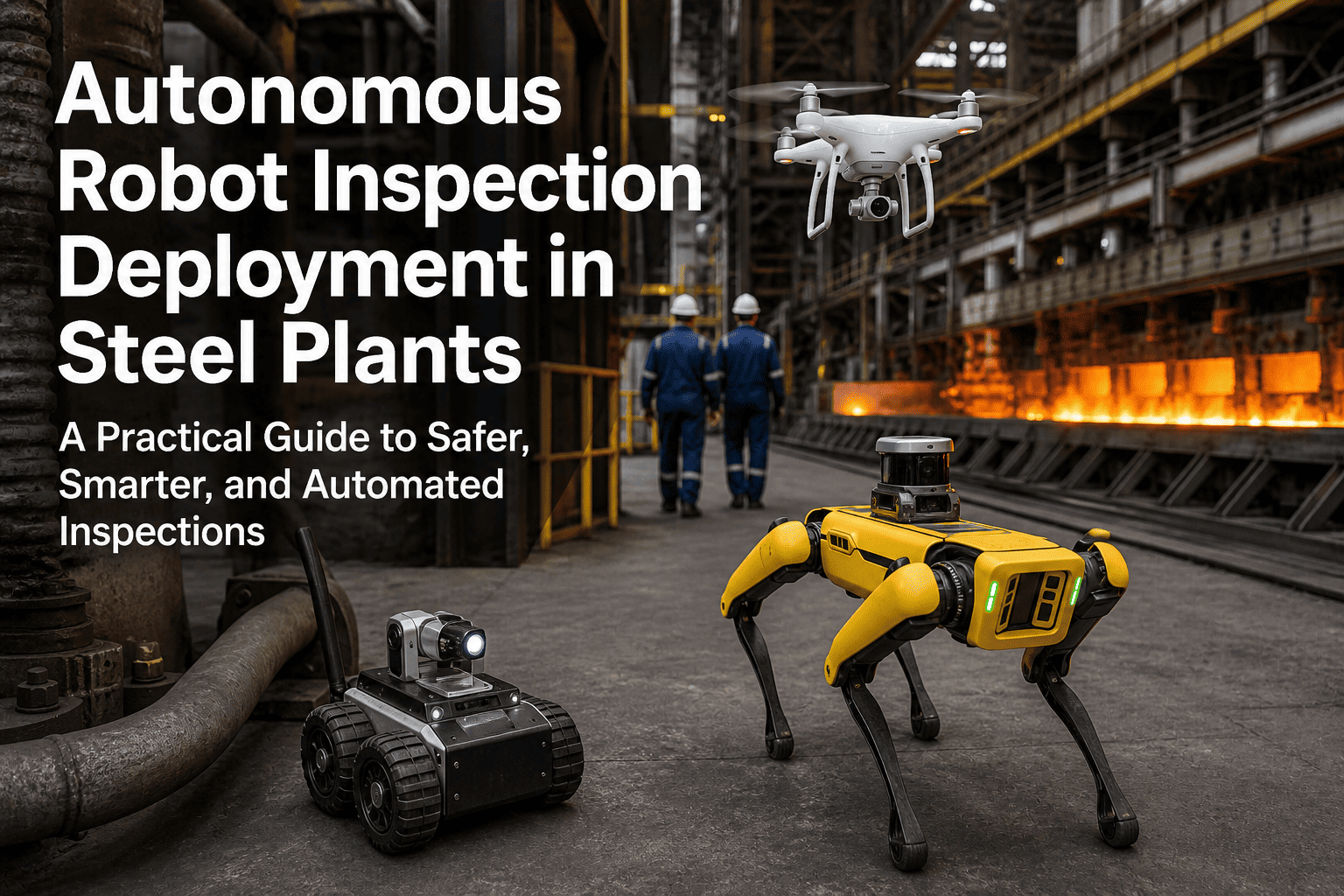
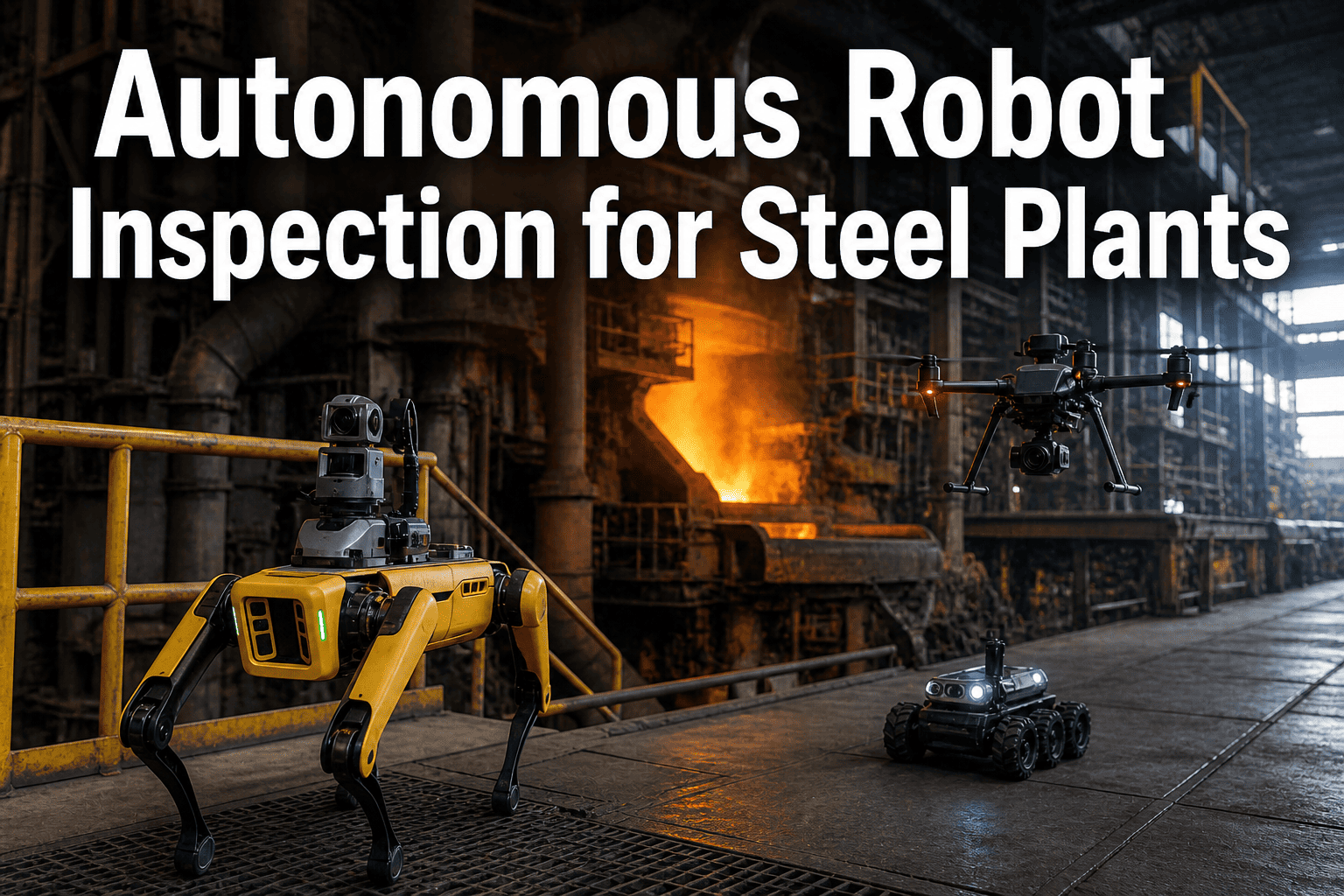
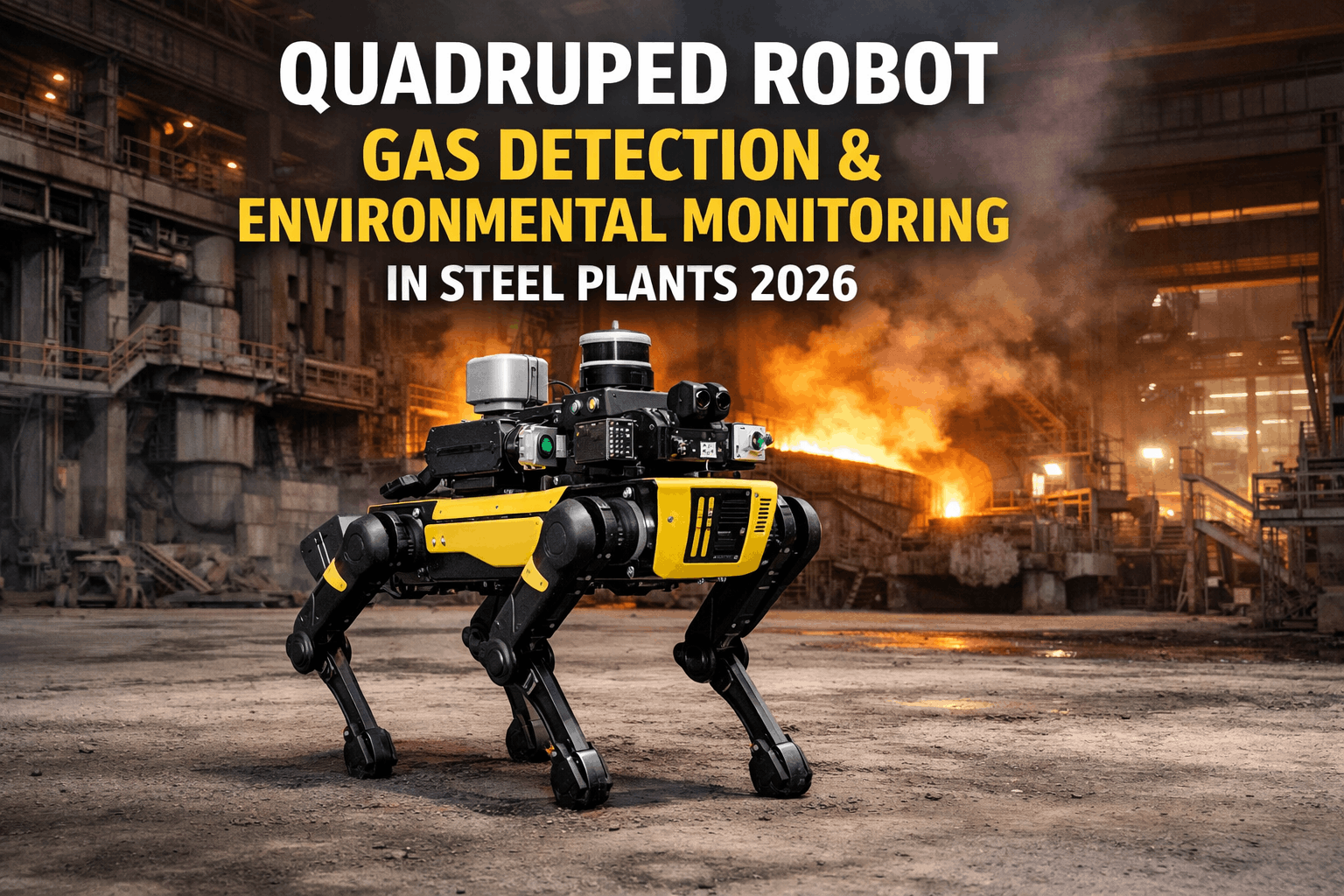
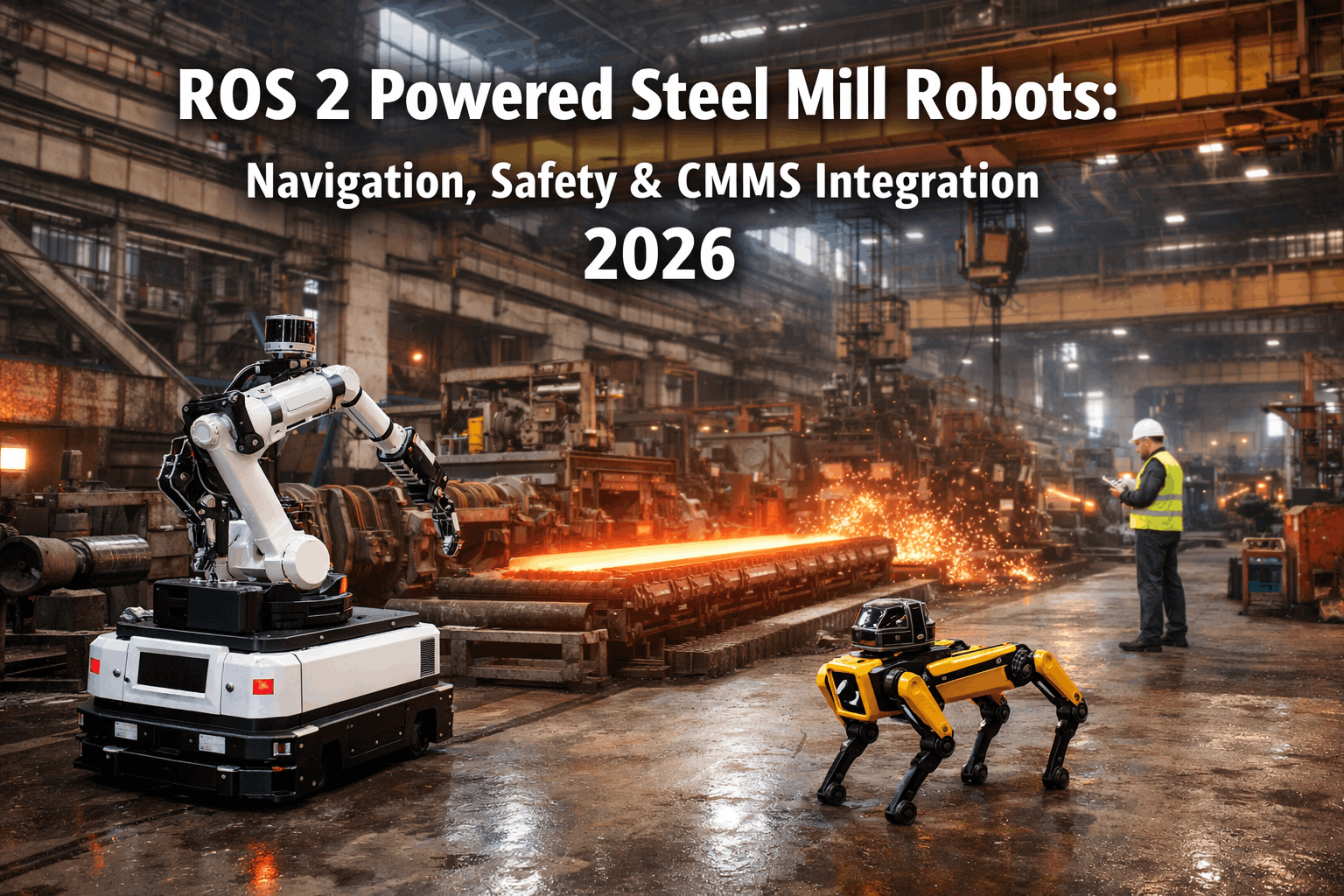
Steel plants cover areas measured in square kilometres, operate around the clock, and contain zones where no human should spend more time than absolutely necessary — blast furnace casting floors, coke oven batteries, gas main corridors, and high-voltage switchgear rooms. Autonomous Mobile Robots are changing what continuous patrol and hazardous area inspection means in these environments. Sign in to OxMaint to connect AMR inspection findings to your maintenance workflows, or book a demo to see the AMR console and AI anomaly detection integration.
Robotics & Automation / Steel Plant
Autonomous Mobile Robots for Steel Plant Patrol & Hazardous Area Inspection
How quadruped and wheeled AMRs equipped with gas detectors, thermal sensors, and vibration probes are replacing human rounds in the zones that steel plants cannot safely staff continuously — and how inspection findings flow directly into maintenance action.
The Inspection Gap That AMRs Close
Manual inspection rounds in hazardous zones are constrained by shift schedules, personnel safety requirements, and human endurance. A technician walking a defined route can inspect a fixed set of points, once per shift, for as long as conditions allow. An AMR patrol covers the same route continuously — on every shift, through every environmental condition, detecting anomalies that develop between human rounds. Manufacturing plants lose an estimated 800 hours per year to unplanned downtime where a significant portion is traceable to missed or delayed inspections. AMRs eliminate that blind spot.
H
Human Patrol
1–2inspection rounds per shift
30+min to complete a gas hazard route
Highvariability between inspectors
vs
R
AMR Patrol
Continuous24/7 autonomous patrol
Consistentsame route, same sensors, every cycle
Zeropersonnel exposure in hazardous zones
AMR Sensor Payloads for Steel Plant Hazard Zones
The capability of an AMR patrol programme is determined entirely by its sensor suite. Each sensor type answers a different inspection question — and each generates a different type of actionable data for the maintenance team.
GAS
Gas Detection
Electrochemical sensors for CO, H₂S, O₂ depletion, and hydrocarbons. Laser methane detectors for BF gas and natural gas leak localisation. AMRs with gas payloads patrol around gas mains, tapping areas, and coke oven batteries — zones where fixed sensors leave coverage gaps and where human presence is inherently limited. Real-time alerts are generated when concentration exceeds configurable thresholds, with precise GPS location of the exceedance.
THERM
Thermal Mapping
Radiometric infrared sensors on patrol AMRs capture thermal signatures of motors, gearboxes, electrical cabinets, and pipe surfaces on every route pass. Anomalies — a motor running 15°C above baseline, a bearing housing with a developing heat signature — are flagged automatically against stored thermal baselines. Unlike handheld thermal surveys, AMR thermal patrol generates trend data because the same asset is photographed from the same position at every patrol cycle.
VIB
Vibration Sensing
Contact vibration probes on robotic arms allow AMRs to stop at critical assets — pumps, compressors, gearboxes — and take structured vibration readings at defined measurement points. Combined with acoustic sensors that detect changes in machinery sound signatures without physical contact, this enables vibration trending between manned inspection rounds. Early-stage bearing faults are detectable 1–6 months before failure — an AMR vibration programme captures that window consistently.
VISUAL
AI Vision Inspection
High-resolution cameras with on-board AI vision detect oil leaks, valve position changes, gauge readings, warning indicator states, and structural anomalies. The AI model compares each captured image against a stored baseline for that checkpoint — a valve that was closed in the last 50 patrol cycles and is now open generates an automatic anomaly alert, regardless of whether a human would have noticed the change on a manual round.
Steel Plant AMR Deployment: Zone by Zone
| Zone |
Hazard Type |
AMR Payload |
Detection Capability |
Patrol Frequency |
| Blast Furnace Cast House |
Extreme heat, molten metal splash, CO |
Thermal + gas (CO) |
Taphole cooling anomaly, CO concentration above threshold, trough refractory degradation |
Every 2 hours |
| Coke Oven Battery |
H₂S, benzene, CO, high temperature |
Multi-gas + thermal |
Door seal leaks, offtake gas escape, battery crown temperature deviation |
Continuous |
| Gas Main Corridors |
BF gas, CO, explosion risk |
Laser methane + CO sensor |
Pipeline joint leaks, valve body seep, concentration trend above 20% LEL |
Every 4 hours |
| Pump & Compressor Halls |
Hydraulic fluid, noise, vibration |
Vibration probe + thermal + AI vision |
Bearing temperature rise, seal leaks, vibration frequency shift, gauge reading change |
Every shift |
| Electrical Switchgear Rooms |
Arc flash risk, high voltage |
Thermal + acoustic |
Panel overheating, partial discharge signature, cooling system failure |
Daily |
| Rolling Mill Floor |
Mill scale, water jets, moving machinery |
AI vision + vibration |
Coupling guard displacement, lubrication system leaks, roll chock temperature |
Every shift |
AMR Anomalies Become Work Orders Automatically in OxMaint
An AMR that detects a bearing anomaly but cannot trigger a maintenance work order is an expensive data logger. OxMaint closes the loop from robot detection to assigned technician to completed repair — every time.
Navigation: How AMRs Move Through Steel Plant Environments
Steel plant floors present navigation challenges that standard warehouse AMRs are not designed for — dynamic obstacles including forklifts, ladle cars, and personnel; oil-contaminated floors; metal grating; cable trays; and zone boundaries that change with production state. Inspection-grade AMRs for steel use SLAM (Simultaneous Localisation and Mapping) to build and continuously update a 3D map of the plant environment, enabling obstacle avoidance without pre-programmed waypoint adjustment every time a piece of equipment moves.
Wheeled Platforms
Lower cost, higher speed on flat floors. Best for pump halls, compressor rooms, electrical galleries, and process corridors with consistent floor surfaces. Limited on gratings, ramps, and uneven terrain common in cast houses and rolling mills.
Flat-floor zones
Quadruped Robots
Legged locomotion handles stairs, gratings, ramps, and obstacles that wheeled platforms cannot navigate. Higher cost but essential for multi-level inspection areas and rough terrain zones. ANYmal and Boston Dynamics Spot are the field-proven platforms in industrial inspection.
Complex terrain zones
Inspection Docking
Autonomous charging docks allow continuous multi-shift patrol without manual battery swap. A docked AMR resumes patrol automatically after reaching its charge threshold — no operator required between patrol cycles. Essential for 24/7 gas monitoring programmes.
Continuous operation
"
The robots that are working in steel plants today are not replacing maintenance technicians — they are replacing the moments when nobody is looking. A skilled technician on a shift round will catch 80% of what an AMR will catch, but only at the moment they walk past. Between rounds, nothing is watching a pump bearing that is developing a fault, a gas concentration that is creeping toward threshold, or a panel temperature that is trending upward. The AMR watches continuously. The technician then focuses on diagnosis and repair — the work that requires human judgment — rather than the surveillance that a robot does better. The integration point that matters is not the robot itself; it is how the robot's finding becomes a work order in the CMMS within minutes of detection, without anyone having to manually transfer the data.
AMR-to-CMMS Integration: Closing the Loop
1
AMR Detects Anomaly
Sensor reading exceeds configured threshold — gas concentration, temperature deviation, vibration amplitude, or AI vision anomaly flag. AMR timestamps, GPS-tags, and records the finding with sensor data and image attachment.
2
Alert Sent to OxMaint Console
AMR transmits structured finding via API to OxMaint — asset ID, location coordinates, anomaly type, severity score, and sensor data payload. Console displays live alert for supervisor review alongside all other active work orders.
3
Work Order Auto-Generated
For anomalies above the configured severity threshold, OxMaint auto-generates a corrective work order with the AMR finding pre-populated — no manual data entry. Critical gas alerts generate P1 work orders immediately; thermal and vibration anomalies generate P2 or P3 depending on deviation magnitude.
4
Technician Assigned & Dispatched
Planner or automated assignment sends the work order to the appropriate technician with the asset location, anomaly description, and AMR-captured sensor data and images. Technician arrives informed — not to investigate from scratch but to confirm and act on a specific finding.
5
Repair Completed & Trend Updated
Technician closes the work order with completion data. OxMaint updates the asset record. The AMR's next patrol pass over the same checkpoint confirms the anomaly is resolved — or flags persistence for follow-up. Trend data across patrol cycles feeds predictive maintenance models.
Your Steel Plant Has Blind Spots. AMRs Eliminate Them. OxMaint Acts on What They Find.
OxMaint's AMR console receives anomaly alerts, auto-generates prioritised work orders, and tracks every finding from robot detection to verified repair — giving your maintenance team continuous coverage without continuous staffing.
Frequently Asked Questions
Can AMRs operate in ATEX / explosion-rated zones in steel plants?
Select AMR platforms are ATEX Zone 1 or Zone 2 certified for operation in explosive atmosphere areas — these are typically wheeled or quadruped robots purpose-built for petrochemical and heavy industry environments. Standard commercial AMRs are not ATEX rated and cannot operate in blast furnace gas corridors or coke oven battery areas where explosive gas concentrations may be present. Before deploying any AMR in a classified zone, confirm the robot's ATEX certification category matches the zone classification at the specific deployment location.
Sign in to OxMaint to configure zone-specific deployment parameters and inspection routes for classified areas.
How does an AMR navigation system handle the dynamic obstacles common in steel plant environments?
Industrial inspection AMRs use LiDAR-based SLAM (Simultaneous Localisation and Mapping) to build and continuously update a 3D environmental model. Dynamic obstacles — moving ladle cars, personnel, forklifts — are detected in real time and routed around without stopping the patrol or requiring operator intervention. The robot's map is updated on every patrol cycle, so semi-permanent changes like repositioned equipment or temporary barriers are incorporated automatically. Sub-centimetre positioning accuracy at inspection checkpoints ensures the thermal or vibration sensor captures from the same geometry at every patrol pass — essential for valid trend comparison.
What is the realistic return on investment case for an AMR patrol programme in a steel plant?
The ROI case is built on three components: prevented failures caught by AMR patrol before developing into unplanned downtime events; reduced personnel exposure time in hazardous zones (which reduces occupational safety incident risk and associated costs); and inspection frequency gains — an AMR can complete more inspection cycles per shift than a human patrol team, generating trend data that improves predictive maintenance accuracy. Facilities deploying AMRs for hazardous area inspection report significantly reduced shutdown time attributable to late-detected defects, with AMR-detected anomaly-to-work-order workflows reducing mean time to repair versus defects found on manual rounds.
Book a demo to see how OxMaint structures AMR anomaly data into maintenance cost and downtime reporting.