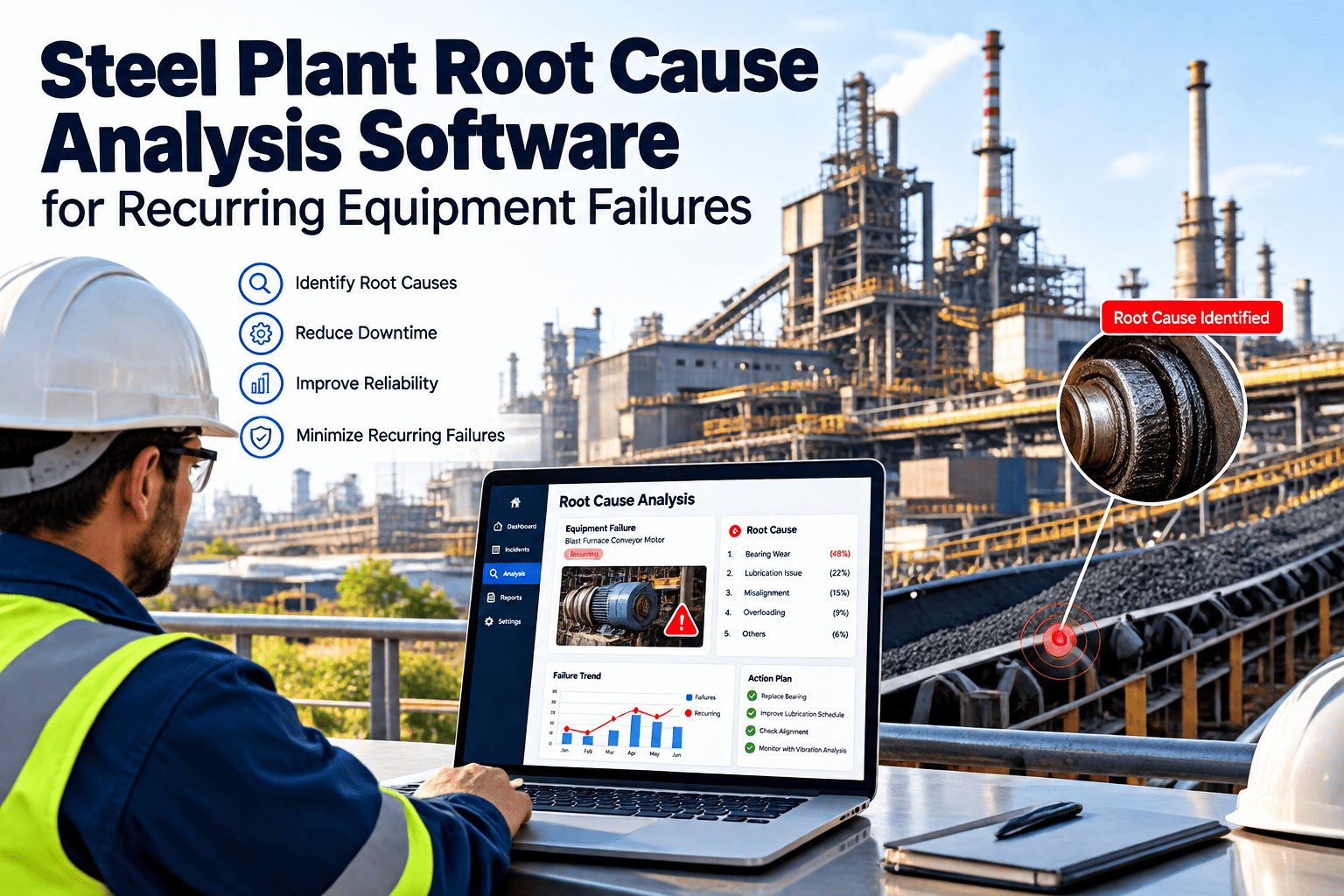
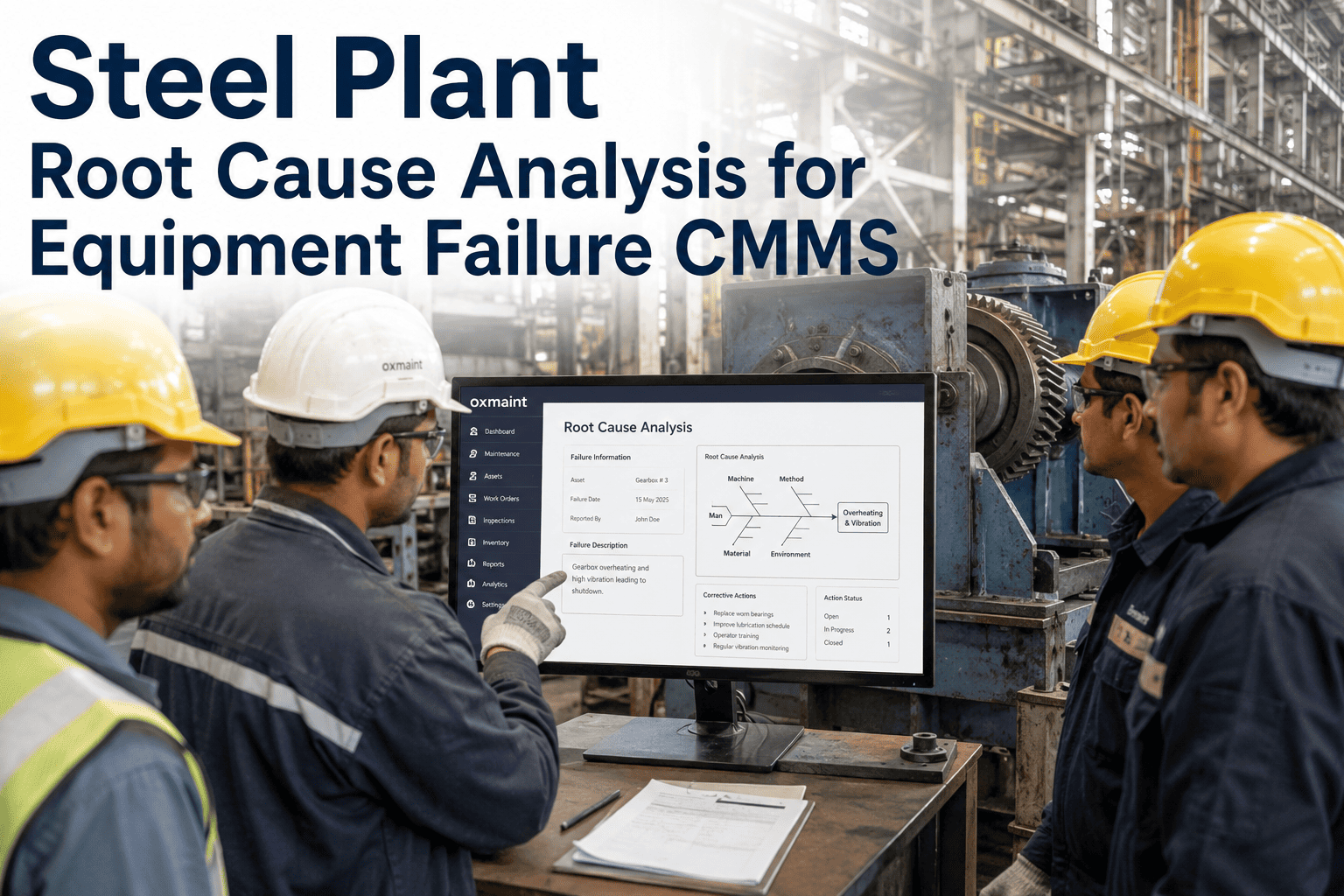
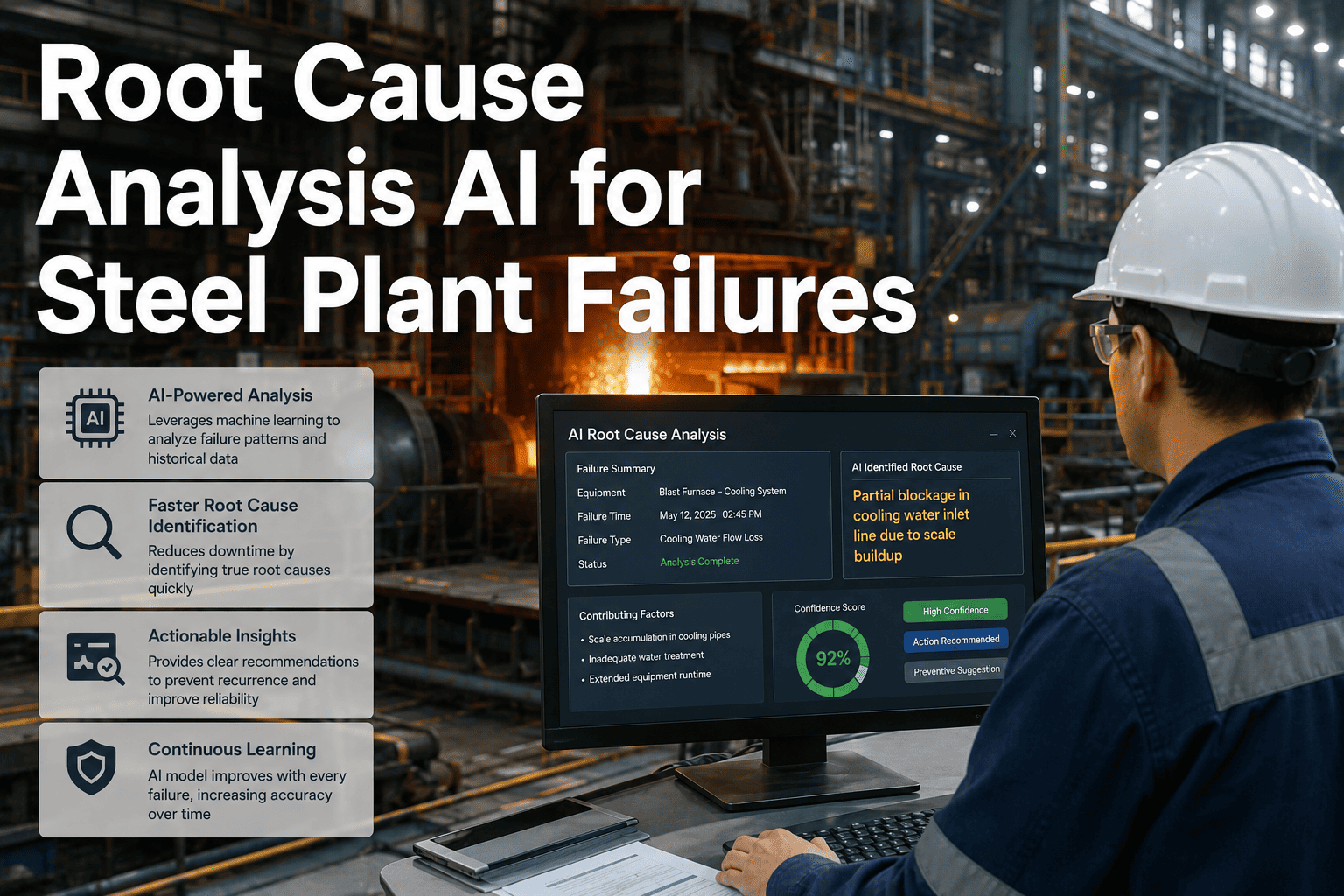
Steel plant equipment failures are rarely random — they follow patterns rooted in specific mechanical, operational, or systemic causes that repeat until someone identifies and eliminates the root cause. Without structured root cause analysis, maintenance teams fix the symptom (replace the failed bearing) while the actual cause (misalignment from foundation settling, contaminated lubrication, or overloading from upstream process changes) continues destroying the next bearing, and the next one after that. An integrated steel plant averaging 180–320 equipment failures per year spends $4–12 million annually on corrective maintenance — but CMMS data consistently shows that 35–45% of those failures are repeats with the same underlying root cause that was never identified or never corrected. Structured RCA built into the CMMS workflow converts every significant failure from a repair event into a learning event, building an institutional knowledge base that systematically eliminates the causes of failure rather than endlessly treating their symptoms.
35–45%
of equipment failures in steel plants are repeats — same equipment, same failure mode, same root cause never addressed
$1.8M
average annual savings when a steel plant implements structured RCA on its top 20 repeat failure modes
5 Whys
average depth required to reach true root cause — most teams stop at the first or second "why" and fix symptoms
The Fishbone: Six Categories Where Steel Plant Failures Originate
Every equipment failure in a steel plant traces back to one or more of six root cause categories. The fishbone framework ensures the investigation team examines all possible cause domains rather than defaulting to the most obvious one. CMMS data from past failures reveals which category is most frequently responsible — and it's rarely the one the maintenance team suspects first.
Mechanical Wear
28%
Bearing fatigue, seal degradation, roll surface wear, refractory erosion, corrosion, thermal fatigue cracking
Lubrication & Contamination
18%
Wrong lubricant grade, contaminated oil, insufficient grease interval, water intrusion, particulate contamination
Operational Overload
16%
Exceeding tonnage limits, thermal shock from process changes, speed beyond design, improper startup/shutdown
Maintenance Execution
15%
Incorrect torque specs, improper alignment, wrong replacement parts, skipped PM steps, poor welding procedures
Design & Installation
13%
Undersized components, inadequate cooling design, poor material selection, installation misalignment, foundation issues
Electrical & Controls
10%
Power quality issues, VFD faults, sensor drift, PLC logic errors, loose connections, insulation breakdown
The 5-Why Drill-Down: From Symptom to Root Cause
Most maintenance teams stop investigating at the first answer — "the bearing failed." But the bearing failure is the symptom, not the cause. Structured 5-Why analysis built into the CMMS work order workflow forces the investigation deeper through successive layers until the actionable root cause is exposed — the cause that, when corrected, prevents recurrence.
Failure Event
Hot mill finishing stand F3 work roll bearing seized during production. Mill stopped for 14 hours. 2,800 tonnes of lost production. Emergency bearing replacement cost $42,000.
Why #1
Why did the bearing seize?
The bearing overheated — operating temperature reached 148°C, well above the 95°C design limit. Lubrication film broke down, metal-to-metal contact destroyed the rolling elements.
Most teams stop here. Fix: Replace bearing. Result: Same failure in 4–6 months.
Why #2
Why did the bearing overheat?
Grease supply was insufficient. The automatic grease system was delivering 40% less grease than specified — bearing was running partially dry under high load.
Why #3
Why was grease delivery insufficient?
Three of the eight grease distribution lines to the F3 bearing housings were partially blocked. Flow meters showed 60% of design rate through these lines.
Why #4
Why were the grease lines blocked?
Water intrusion through a cracked protective conduit had caused grease to emulsify and harden in the lines. The conduit crack was documented 7 months ago during a PM inspection but categorized as "monitor" rather than "repair."
Why #5 — ROOT CAUSE
Why wasn't the cracked conduit repaired when discovered?
The PM checklist had no severity classification for conduit damage — the finding was documented as an observation with no follow-up work order generated. The CMMS had no escalation pathway for inspection findings that didn't match a predefined corrective action category.
Corrective Actions:
1. Add conduit integrity check with severity scoring to all lubrication system PM checklists
2. Modify CMMS workflow: any PM observation rated "monitor" auto-generates a follow-up work order within 30 days
3. Inspect all grease line conduits across F1–F7 stands — replace any showing cracking or water intrusion
Steel plants building RCA into their maintenance workflow should sign up to see how CMMS embeds 5-Why analysis directly into work order closure — ensuring every significant failure gets investigated to root cause, not just repaired at the symptom level.
Every Failure Investigated. Every Root Cause Found. Every Repeat Failure Eliminated.
OxMaint embeds structured root cause analysis into the maintenance workflow — 5-Why drill-downs linked to work orders, fishbone categorization across six cause domains, corrective action tracking with verification, and repeat failure dashboards that prove whether the fix actually worked.
The RCA Investigation Workflow: From Failure to Prevention
A root cause analysis that identifies the cause but doesn't track corrective action to verified completion is incomplete. The CMMS-integrated RCA workflow ensures every investigation produces corrective actions, every action has an owner and deadline, and every fix is verified by measuring whether the failure recurs.
Within 4 hours of failure
Maintenance team documents the failure in CMMS with photos, measurements, operating conditions at time of failure, recent maintenance history, and any alarms or sensor data leading up to the event. The scene is preserved before parts are replaced — photographs of the failed component in situ, oil samples collected, vibration data archived.
Owner: Shift maintenance supervisor
02
Investigation Team Assembly
Within 48 hours
RCA investigation team assembled based on failure significance. Minor failures (less than $10K impact): individual RCA by maintenance engineer using CMMS template. Significant failures ($10K–$100K): cross-functional team including maintenance, operations, and engineering. Major failures (greater than $100K or safety-related): full formal investigation with metallurgical analysis, external expertise if needed.
Owner: Maintenance engineering manager
03
Root Cause Identification
Within 14 days
Investigation team applies 5-Why analysis and fishbone categorization using CMMS historical data — past failures on same equipment, maintenance records, PM compliance history, spare parts used, operating parameters. Each potential cause is evaluated against physical evidence. Root cause is classified into one of six fishbone categories with supporting evidence documented.
Owner: RCA investigation lead
04
Corrective Action Planning
Within 21 days
Corrective actions defined at three levels: immediate (prevent recurrence on this specific equipment), systemic (apply the fix across all similar equipment), and procedural (update PM checklists, training, or operating procedures to prevent the same root cause category). Each action gets an owner, deadline, and success metric in CMMS.
Owner: Maintenance engineering + area supervisors
05
Verification & Closeout
90 days after corrective action
CMMS tracks whether the failure recurs within 90 days after corrective action implementation. If the same failure mode reoccurs on the same equipment, the RCA is automatically reopened with a flag indicating the corrective action was insufficient. The RCA is only closed when 90 days pass with zero recurrence — verified by CMMS failure data, not by human judgment.
Owner: Reliability engineering
Repeat Failure Dashboard: The Failures Costing You the Most
The highest-value target for RCA isn't the one-time catastrophic failure — it's the repeat failure that occurs 8, 12, or 20 times per year across multiple pieces of similar equipment. These repeat failures are individually modest ($5,000–$25,000 each) but collectively massive ($100,000–$500,000 per year per failure mode). Teams targeting repeat failures should book a free demo to see how CMMS automatically identifies and ranks repeat failure patterns.
Top 5 Repeat Failures — Ranked by Annual Cost Impact
#1
18 occurrences/year
Avg $26,800 per event
MTBF declining: 1,400 → 820 hrs over 2 years
RCA Finding: Water intrusion through secondary cooling spray overlap zones degrading grease in bearing housings. Spray alignment never verified after nozzle replacements. Fix: Add spray pattern verification to nozzle replacement procedure + install bearing housing water shields on all segments.
#2
12 occurrences/year
Avg $26,500 per event
Same failure mode: winding insulation breakdown
RCA Finding: Looper motors exposed to radiant heat from strip exceeding insulation class rating. Original motor spec designed for lower line speeds — throughput increase raised strip temperature in looper zone. Fix: Upgrade to Class H insulation motors + install radiant heat shields.
#3
6 occurrences/year
Avg $45,700 per event
Occurring during rapid changeover cycles
RCA Finding: Thermal shock during stove changeover — gas-to-cold-blast transition rate increased to improve hot blast temperature. Rate of temperature change exceeds refractory thermal shock resistance. Fix: Modify changeover logic to maintain transition rate within refractory spec + upgrade dome courses to thermal-shock-resistant grade.
#4
22 occurrences/year
Avg $8,900 per event
Lance tips lasting 60% of expected campaign life
RCA Finding: Cooling water flow rate to lance tip reduced due to scale buildup in supply headers. Water treatment program not adjusted after raw water source change 18 months ago. Fix: Descale lance cooling headers + revise water treatment chemistry + add flow monitoring with low-flow alarm to lance cooling circuit.
#5
4 occurrences/year
Avg $42,000 per event
Gear tooth pitting progressing to fracture
RCA Finding: Crane duty cycle increased 35% after caster throughput upgrade — gearbox operating above design duty classification. Original gearbox rated for M5 duty; actual measured duty is M7. Fix: Replace gearboxes with M8-rated units during next planned outage + install load monitoring system to track actual duty cycle.
Total annual cost of top 5 repeat failures:
$1,438,000
— All five root causes were identifiable from CMMS data. All five corrective actions combined cost less than $320,000 to implement.
Corrective Action Tracking: From Finding to Verified Fix
An RCA investigation without tracked corrective actions is just a document. The CMMS closes the loop — every corrective action assigned, tracked, and verified through recurrence monitoring. Plants building corrective action accountability should sign up to see how CMMS tracks every RCA corrective action from assignment through verified closure.
Corrective Action Status — Active RCA Portfolio
→
→
→
Verified (90-day)
88 actions
What Skipping RCA Actually Costs
The most common objection to structured RCA is time — "we don't have time to investigate every failure, we need to get production running again." This is true for the repair itself. But the investigation can happen after the repair, and the cost of not investigating dwarfs the cost of the investigation.
Without RCA — Repair & Repeat
First failure repair
$42,000
Same failure 5 months later
$42,000
Same failure 4 months later (worse)
$58,000
Same failure 3 months later (cascade)
$94,000
Production losses (4 events × avg 16 hrs)
$384,000
2-Year Total:
$620,000
With RCA — Find & Fix Root Cause
First failure repair
$42,000
RCA investigation (40 person-hours)
$3,200
Corrective action implementation
$18,000
Apply fix across similar equipment (5 units)
$22,000
Subsequent failures over 2 years
$0
2-Year Total:
$85,200
Expert Perspective: The Best Maintenance Organizations Don't Just Fix Failures — They Eliminate Them
I've led reliability engineering programs at three steel plants across 22 years, and the single metric that separates world-class maintenance organizations from average ones isn't response time or PM compliance — it's repeat failure rate. Plants with no formal RCA process see 35–45% repeat failure rates, meaning nearly half their corrective maintenance spend is going to failures that could have been permanently eliminated if someone had asked "why" five times instead of one. When I implemented structured RCA at my first plant — requiring every failure above $10,000 to complete a 5-Why investigation in the CMMS before the work order could close — the pushback was immediate. "We don't have time." "We already know what failed." "Just let us replace the part and move on." Within 12 months, repeat failures dropped from 41% to 18%. Within 24 months, total corrective maintenance work orders declined by 28%. The maintenance team that said they didn't have time for RCA suddenly had more time than they'd ever had — because they were fixing 28% fewer breakdowns. The lesson I share with every plant I work with now is this: you're going to spend the engineering hours either way. You can spend 40 hours investigating the root cause once, or you can spend 200 hours repairing the same failure five times. The RCA hours are an investment. The repeat repair hours are waste. And CMMS data makes this calculation visible — you can see exactly how much each uninvestigated failure mode is costing you every year in repeat repairs. Once the plant manager can see $1.4 million in annual repeat failure costs on a single dashboard, the "we don't have time for RCA" objection disappears permanently.
Start With the Top 10 Repeat Failures
Don't try to RCA every failure from day one. Pull the CMMS data, rank failure modes by annual cost, and investigate the top 10. These typically represent 60–70% of total repeat failure cost. Solve those first and the program proves its own value.
Require 5-Why Completion Before Work Order Closure
The most effective enforcement mechanism is simple: for any corrective work order above a cost threshold ($10K–$25K depending on plant size), the CMMS won't allow closure until the 5-Why fields are completed. This ensures investigations happen while the failure is fresh, not months later from memory.
Track the 90-Day Recurrence Metric
The only measure of RCA effectiveness that matters is recurrence rate. If you completed an RCA and the same failure happens again within 90 days, the investigation failed — either the root cause was wrong or the corrective action was insufficient. CMMS tracking makes this binary: recurrence yes/no, automatically measured.
Every Failure Investigated. Every Root Cause Tracked. Every Corrective Action Verified. Every Repeat Eliminated.
OxMaint builds root cause analysis into the DNA of your maintenance workflow — 5-Why drill-downs embedded in work order closure, fishbone categorization across six cause domains, corrective action tracking from assignment to 90-day verified closure, repeat failure dashboards ranking failure modes by annual cost, and the institutional knowledge base that ensures every lesson learned is captured permanently.
Frequently Asked Questions
What is root cause analysis for steel plant equipment failures?
Root cause analysis (RCA) is a structured investigation methodology that identifies the fundamental cause of an equipment failure rather than just documenting the symptom. In a steel plant context, RCA examines failures across six cause categories (mechanical wear, lubrication and contamination, operational overload, maintenance execution errors, design and installation deficiencies, and electrical and controls issues) using techniques like 5-Why analysis and fishbone diagramming. The objective is to identify the specific cause that, when corrected, prevents the failure from recurring. CMMS integration makes RCA practical at scale by embedding investigation templates directly into the work order closure workflow, providing historical failure data to support the investigation, tracking corrective actions from assignment through verified completion, and automatically monitoring whether the failure recurs within 90 days of the fix. Without structured RCA, steel plants typically see 35–45% repeat failure rates — meaning nearly half of all corrective maintenance spending goes to failures that could be permanently eliminated through proper investigation and corrective action.
How does the 5-Why method work for steel plant failures?
The 5-Why method works by asking successive "why" questions starting from the observed failure until the investigation reaches a root cause that is actionable and, when corrected, prevents recurrence. In a steel plant, a typical 5-Why sequence moves through hardware failure (Why #1: the bearing seized), operating condition (Why #2: the bearing overheated due to insufficient lubrication), mechanical cause (Why #3: grease delivery lines were partially blocked), environmental cause (Why #4: water intrusion through a cracked protective conduit emulsified the grease), and systemic cause (Why #5: the PM checklist had no severity classification for conduit damage, so the finding was documented but never generated a follow-up work order). The critical discipline is continuing past the first or second answer — most maintenance teams stop at "the bearing failed" and replace it, but the actual root cause (the systemic gap in the PM workflow) continues causing failures until identified. CMMS enforces 5-Why discipline by requiring all five levels to be completed before a work order can close for any failure above a defined cost threshold, and by providing the historical maintenance data that supports each level of investigation.
What percentage of steel plant failures are preventable through RCA?
Industry data from steel plants with mature RCA programs shows that 65–75% of equipment failures have identifiable, correctable root causes that, when addressed, prevent recurrence. The 35–45% of failures that are repeats represent the highest-value RCA targets because the root cause is, by definition, unidentified or uncorrected — otherwise the failure wouldn't be repeating. Within the repeat failure population, approximately 85% can be permanently eliminated through corrective actions at the systemic level (modifying PM procedures, upgrading materials, addressing design deficiencies, or changing operating parameters). The remaining 15% are reduced in frequency and severity through improved monitoring and earlier detection. Practical experience shows that a steel plant implementing structured RCA on its top 20 repeat failure modes typically reduces total corrective maintenance work orders by 25–35% within 24 months, saving $1.5–3.5 million annually depending on plant size and current failure rate. The key insight is that a small number of root causes (typically 15–25 distinct causes) are responsible for a large proportion of total failures — the Pareto principle applies strongly, making focused RCA programs highly effective.
How long does a root cause analysis investigation take?
RCA investigation duration scales with failure significance. Minor failures (under $10,000 impact) are investigated by a single maintenance engineer using a CMMS RCA template, typically completed within 3–5 working days and requiring 8–16 person-hours. Significant failures ($10,000–$100,000 impact) require a cross-functional team including maintenance, operations, and engineering representatives, typically completed within 10–14 days and requiring 30–60 person-hours including evidence collection, CMMS data review, team analysis sessions, and corrective action planning. Major failures (over $100,000 impact or safety-related) require formal investigation that may include metallurgical analysis, external expertise, and comprehensive review of operating conditions and maintenance history, typically completed within 21–30 days and requiring 80–160 person-hours. In all cases, the equipment repair happens immediately — RCA investigation is conducted in parallel and doesn't delay equipment restoration. The 40 person-hours invested in a typical significant failure RCA costs approximately $3,200 in engineering time but prevents repeat failures that would otherwise cost $200,000–$600,000 over the following 2 years — a return of 60–180× the investigation cost.
How does CMMS improve root cause analysis effectiveness?
CMMS improves RCA effectiveness through five mechanisms that transform it from an occasional, documentation-heavy exercise into a systematic, data-driven capability. First, investigation templates embedded in the work order closure workflow ensure every significant failure receives structured analysis — 5-Why fields, fishbone categorization, and corrective action planning are part of closing the work order, not a separate process. Second, historical data access gives investigators immediate visibility into past failures on the same equipment, maintenance history, PM compliance records, spare parts used, and operating parameters at time of failure — evidence that would take days to compile manually is available in minutes. Third, pattern recognition across the fleet identifies repeat failure modes automatically by analyzing failure codes, equipment types, and cause categories across all work orders — surfacing the top 10 or top 20 repeat failures ranked by annual cost impact. Fourth, corrective action tracking assigns every RCA corrective action to a specific owner with a deadline, tracks implementation status, and escalates overdue actions to management. Fifth, recurrence monitoring automatically tracks whether the same failure mode recurs within 90 days of corrective action implementation, providing objective verification that the root cause was correctly identified and the fix was effective — the RCA remains open until verified by CMMS data.