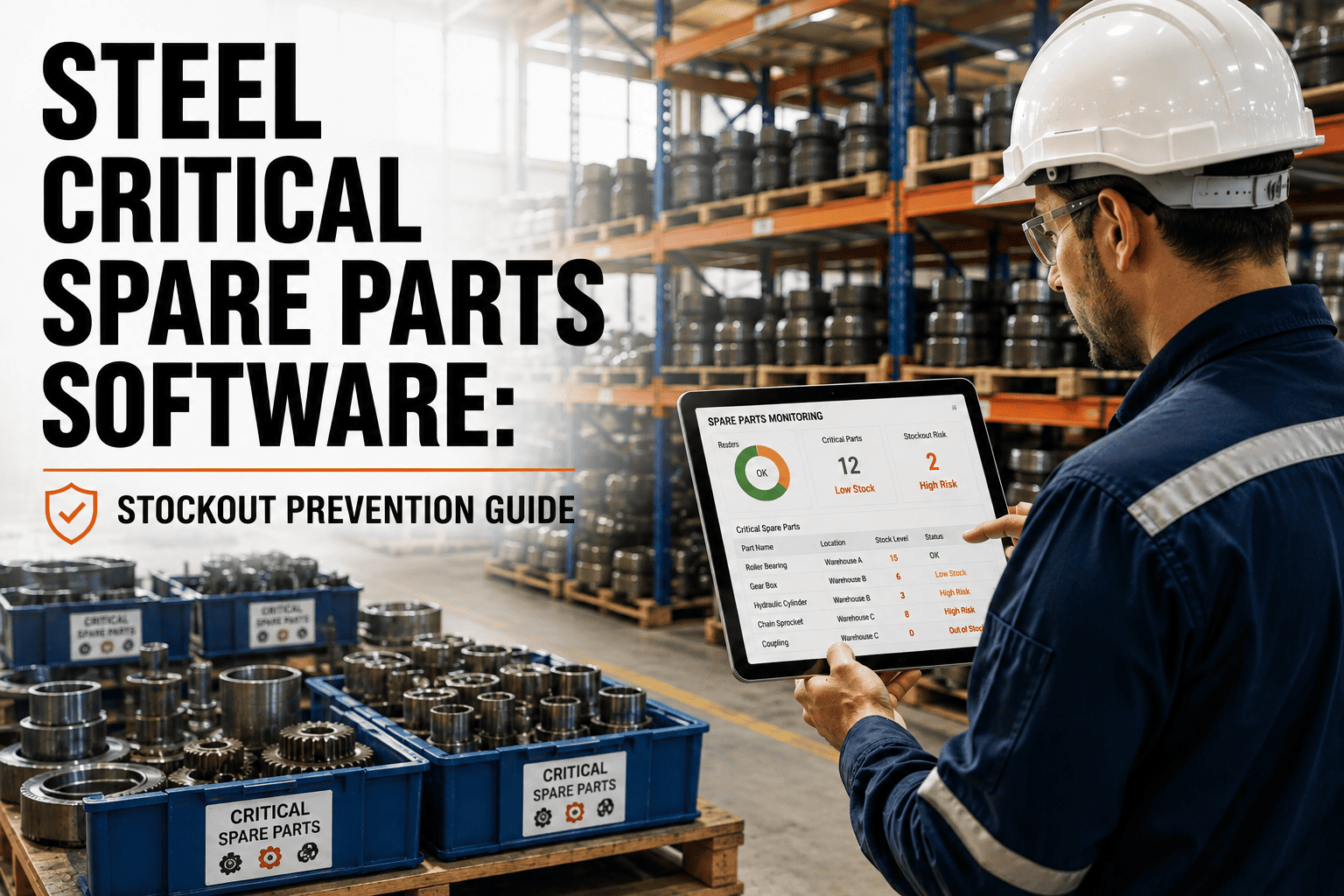
When a main drive gearbox or a servo valve fails in a steel plant, the repair is rarely the hard part. The hard part is discovering that the replacement is not on the shelf, or that it is on the shelf at another site no one knew about. Critical spare parts forecasting links what you will need to what you hold, and when you must order it. Done well, it cuts stockouts without burying capital in idle inventory. Here is how to plan it, and how a maintenance and inventory platform like Oxmaint supports the work.
MRO Inventory / Maintenance Planning
Steel Plant Critical Spare Parts Forecasting for Maintenance Planning
Know which spares protect the line, how fast they can be replaced and how much stock is justified, before the breakdown happens.
The Cost Of Being Wrong
Stockout versus overstock in a steel plant
Both errors are expensive. Most plants lean toward overstock after a painful outage, then pay for it in capital and storage.
- Extended downtime while waiting for an expedited or imported part
- Emergency freight and premium supplier pricing
- Cannibalizing parts from other equipment
- Safety risk from temporary repairs and workarounds
- Capital tied up in parts that never move
- Obsolete stock after equipment upgrades
- Storage, handling and deterioration, especially for rubber, electronics and bearings
- Poor visibility, so duplicates are bought across sites
Step One
Decide which spares are truly critical
Not every part deserves a forecast. Classify by what a missing part would do to the process and how long it takes to replace.
High impact, long lead time
Hold insurance spares. Review annually against failure history and condition data.
High impact, short lead time
Hold lean stock or secure vendor agreements for fast supply.
Low impact, long lead time
Order on demand. Plan ahead using scheduled work.
Low impact, short lead time
Use simple min and max rules or vendor-managed stock.
Examples
Spare parts that commonly deserve a forecast in steel operations
The list below is illustrative. Confirm each item against your equipment, supplier lead times and failure history.
| Spare category | Why it is critical | Main demand driver | Planning approach |
|---|---|---|---|
| Mill and drive gearbox components | Long lead time and large production impact | Condition trend, failure history | Insurance spare plus condition-based replacement |
| Variable frequency drives and control cards | Single failures can stop a line | Age, environment, failure history | Hold critical cards and standardize across plants |
| Hydraulic servo valves and pumps | Precision parts with specialist suppliers | Oil cleanliness, scheduled overhaul | Rotable spares with refurbishment tracking |
| Bearings and roll chock parts | Frequent use and mixed lead times | Planned changes, wear rate | Consumption-based min and max plus planned kits |
| Caster mold and segment components | Quality and safety critical, scheduled changes | Casting hours, scheduled maintenance | Plan from the maintenance calendar |
| Crane brakes, ropes and limit switches | Safety critical and regulated inspection | Inspection findings, duty cycle | Stock to inspection and statutory requirements |
| Refractory and wear items | High consumption, process dependent | Heats, campaign life | Forecast from production plan and wear records |
Plan Before The Breakdown
Connect spare parts to the assets and jobs that use them
Track stock, reorder levels and part usage by asset in Oxmaint so planners see risk early.
Method
Four ways to forecast demand for maintenance parts
Maintenance demand is lumpy. A single method rarely fits every part, so match the approach to how the part is consumed.
Consumption-based
Uses past issues per period. Works for regularly used items such as filters, seals and common bearings. Needs clean parts-issued records.
Schedule-driven
Builds demand from planned preventive work and shutdowns. Each task lists the parts it needs, so requirements are known ahead.
Condition-driven
Uses inspection findings and condition alerts to bring forward expected replacements for monitored assets.
Risk-based insurance stock
For rarely failing, high-impact parts, decide by consequence and lead time rather than by average usage.
The Math
Setting reorder points that match lead time
The basic logic is simple, and it only works with honest inputs for demand and supplier lead time.
Inputs to review each cycle
- Actual supplier lead time, including customs and inspection, not the quoted figure
- Demand from both scheduled work and unplanned repairs
- Safety stock sized by part criticality, not by habit
- Substitute or interchangeable parts that reduce the stock needed
Process
The forecasting loop for maintenance planners
What each step involves
- Link parts to assets through bills of materials so a failing asset shows which parts are needed
- Rank parts using criticality and lead time, then focus forecasting effort on the top group
- Gather demand from issue history, planned work, inspections and condition alerts
- Set minimums, maximums and reorder points, and record the reasoning
- Review stockouts, slow movers and expedited orders monthly, then adjust the rules
Multi-Site Thinking
Pooling critical spares across steel plants and lines
Groups with several sites can reduce total stock if parts are shared and visible. The condition is clear data on what each site holds.
Standardize part numbers
Identical items need identical records. Duplicates hide shared stock.
Agree transfer rules
Define who approves a transfer, how fast it ships and how the stock is replaced.
Assess shared risk
Pooling suits parts that fail rarely. Do not pool where two sites may need the part at once.
Performance
Inventory KPIs for critical spare parts
Using Oxmaint
How Oxmaint supports spare parts planning
Oxmaint connects inventory with assets and work orders, which gives forecasting a reliable data base. Forecasting rules remain a decision for your team.
Checklist
Before you trust a spare parts forecast
Data
- Parts issued against work orders
- Duplicate part records merged
- Real supplier lead times recorded
Rules
- Criticality set for each stocked item
- Minimum and maximum levels documented
- Approval path for emergency buys
Review
- Monthly exceptions meeting held
- Obsolete stock reviewed twice a year
- Rules updated after each major failure
FAQ
Critical spare parts forecasting: common questions
What makes a spare part critical?
A part is critical when its absence stops production or creates a safety risk and replacement takes a long time.
Can we forecast parts that rarely fail?
Usage history is weak for these. Decide stock using consequence, lead time and condition data instead of averages.
How does condition monitoring help?
Early warnings give time to order parts, which can reduce safety stock for monitored assets.
Can a CMMS manage MRO inventory?
Yes, by linking stock to assets and work orders. You can book a demo to see the workflow.
Where should we begin?
List parts for your top critical assets and record their lead times. You can start with Oxmaint to organize them.
Keep The Line Running
Make sure the right spare is there when the failure comes
See how Oxmaint ties inventory, assets and work orders together so steel plant planners can act before stockouts.