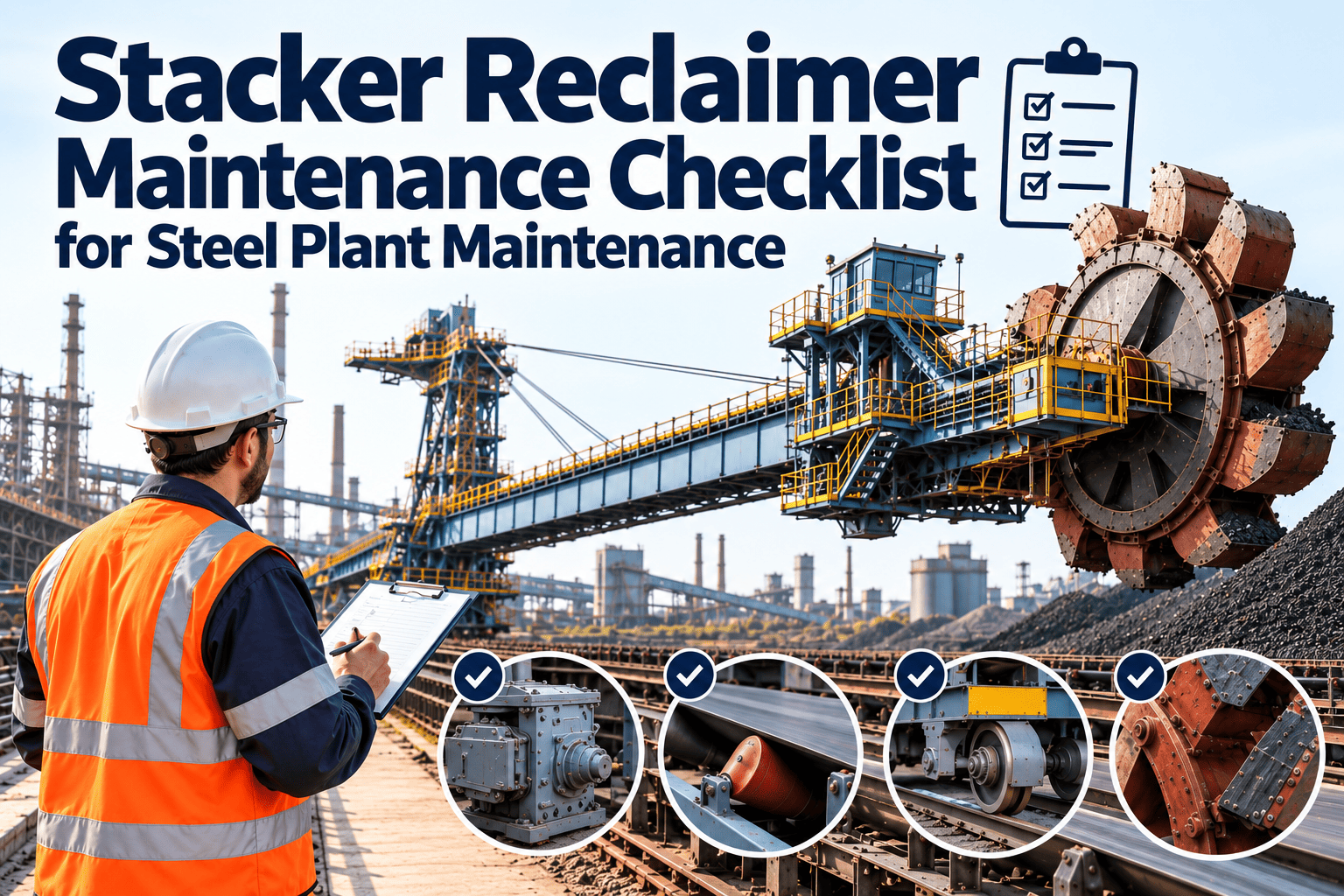
Stacker reclaimers sit at the front of the steel plant supply chain, building and drawing down the stockpiles of ore, coal, limestone and fluxes that feed sinter plants, coke ovens and blast furnaces. When one stops, the yard cannot stack or reclaim, blending suffers and downstream plants begin to run short. Most failures start small: a slew bearing bolt that loosens, a bucket wheel gearbox that runs warm, a belt scraper that stops cleaning. This walk-down checklist covers each major assembly of the machine, and when it is managed through steel plant maintenance software, every finding is recorded against the right asset and followed to closure.
Stacker Reclaimer Maintenance Checklist for Steel Plant Maintenance
Inspect drives, slew systems, buckets, conveyors, bearings, brakes and structure in a fixed walk-down order, so yard equipment stays available for sinter and blast furnace supply.
What Goes Wrong in a Raw Material Yard
Yard conditions that accelerate wear
- Abrasive ore and sinter fines wear buckets, chutes and liners
- Wet or sticky material builds up on scrapers and transfer points
- Dust enters bearings, gearboxes and electrical cabinets
- Wind loads affect boom stability and travel rail clamps
- Coal stockpiles can heat if left undisturbed for long periods
What this means for maintenance teams
- Visual checks alone miss early bearing and gearbox deterioration
- Access is difficult, so inspections get shortened under time pressure
- Defects are logged late because the machine is far from the workshop
- Planned downtime is scarce because the yard feeds continuous plants
Symptom and likely cause guide for the inspection round
| Symptom seen on the round | Likely cause | First inspection step |
|---|---|---|
| Belt running off to one side | Misaligned idlers, uneven loading or material buildup | Check tracking idlers, pulley lagging and chute loading |
| Bucket wheel gearbox hotter than usual | Low oil, overloaded drive or failing bearing | Check oil level, take temperature reading, compare with history |
| Knocking noise during slewing | Loose slew bearing bolts or pinion backlash change | Inspect bolts, grease flow and pinion contact |
| Boom drifts after luffing stops | Brake wear or hydraulic leakage | Check brake pads, cylinder seals and holding valves |
| Frequent travel drive trips | Rail debris, cable reel fault or drive overload | Check rails, sweepers, cable reel and motor current |
| Spillage under the boom conveyor | Worn skirts, scrapers or chute liners | Inspect skirts, belt cleaners and transfer point condition |
The Walk-Down Route: Seven Stops, One Machine
Follow the same sequence every round so nothing is skipped. Each stop lists the checks, with the usual frequency shown on the right.
Travel undercarriage and rails
- Rail clamps, storm anchors and buffer stops are secure and free of damage.Daily
- Travel wheels show no flange climbing, flat spots or cracked treads.Weekly
- Rail joints, sleepers and fastenings show no gaps, settlement or loose parts.Monthly
- Travel gearbox oil level is correct and there are no leaks at seals or breathers.Weekly
- Rail sweepers and cable reel or trailing cable move freely and are undamaged.Daily
Slew system
- Slew bearing bolts are present with no loosening marks, and torque checks follow the schedule.Quarterly
- Bearing lubrication reaches all points and seals show no grease starvation.Weekly
- Slew pinion and ring gear teeth show no pitting, scoring or abnormal contact pattern.Monthly
- Slew gearbox and motor show normal temperature, vibration and noise.Weekly
- Slew brake pads, discs and release function are within wear limits.Monthly
Luffing system, boom and tower structure
- Luffing ropes, sheaves or hydraulic cylinders show no wear, leaks or damaged anchor points.Weekly
- Pins, retainers and boom pivot bushings are secure with no abnormal movement.Monthly
- Boom, tower and counterweight welds are free of cracks, especially at known stress points.Quarterly
- Boom angle sensor reads the correct position and agrees with the control display.Weekly
- Walkways, handrails, ladders and access gates are intact and clear of material buildup.Weekly
Bucket wheel and wheel drive
- Buckets, teeth and cutting edges are measured for wear and checked for cracks or missing parts.Weekly
- Wheel shaft bearings are checked for temperature, noise and grease condition.Daily
- Wheel drive gearbox oil, coupling guard and fluid coupling are in good condition.Weekly
- Discharge chute liners are measured for wear and fixings are secure.Monthly
- Drive motor current during reclaiming is within the normal range for the material.Every shift
Boom conveyor and transfer points
- Belt tracking is central, with no edge damage, cuts or exposed splice problems.Daily
- Idlers turn freely and none are seized, missing or running hot.Weekly
- Pulley lagging, scrapers and belt cleaners are in contact and not worn beyond limits.Weekly
- Skirting rubber seals the loading zone and chutes are free of blockage or buildup.Daily
- Pull-cord switches, belt sway switches and speed sensors respond when tested.Monthly
Brakes, hydraulics and lubrication
- Service and holding brakes release fully and hold under test, with pad thickness recorded.Monthly
- Hydraulic oil level, temperature, filter indicators and hose condition are normal.Weekly
- Central lubrication reservoirs are filled and every distributor delivers grease.Weekly
- Gearbox oil samples are taken on schedule and the analysis results are reviewed.Quarterly
Electrical, controls and safety systems
- Emergency stops, limit switches and anti-collision devices operate and reset correctly.Weekly
- Cable reel, festoon and junction boxes show no abrasion, heat marks or water ingress.Weekly
- Drive fault history and motor temperature trends are reviewed for repeating faults.Weekly
- Dust suppression sprays, fire detection and extinguishers are available and working.Monthly
- Operator cabin controls, lighting, cameras and wind speed indicator work correctly.Daily
Give the Yard Crew a Route They Can Follow on a Phone
Load this walk-down as a mobile inspection, capture readings and photos at each stop and open a work order the moment something fails.
Frequency Plan: Who Checks What and When
| Assembly | Operator round | Weekly mechanical | Monthly or quarterly | Shutdown |
|---|---|---|---|---|
| Travel system | Rail clearance, cable reel, unusual noise | Gearbox oil, wheel condition | Rail joints and fastenings | Wheel and axle measurement |
| Slew system | Smooth rotation, alarms | Lubrication, gearbox condition | Bolt torque, gear contact pattern | Bearing clearance check |
| Bucket wheel | Drive current, spillage | Bucket and tooth wear | Chute liner measurement | Shaft and bearing inspection |
| Boom conveyor | Tracking, skirts, blockages | Idlers and scrapers | Safety switch test | Belt and splice survey |
| Luffing and structure | Boom movement, alarms | Cylinder or rope condition | Weld and pin survey | Non-destructive testing where needed |
| Electrical and controls | Cabin controls, indicators | Cable and enclosure condition | Interlock and stop tests | Thermography of panels |
From Inspection Finding to Closed Work Order
Before and After: Managing Yard Equipment Digitally
Without a CMMS
- Checklists are paper forms that return to the office days later
- Bucket and liner wear measurements are not trended
- Gearbox oil sampling dates depend on memory
- Spare parts are found after the breakdown starts
With Oxmaint
- Inspection results are saved the moment they are entered
- Wear measurements are stored by component and compared over time
- Oil sampling and torque checks are scheduled and reminders issued
- Linked inventory shows whether buckets, teeth and idlers are in stock
Condition Monitoring Opportunities on a Stacker Reclaimer
Vibration and temperature
Gearboxes, motors and bucket wheel bearings show wear first through vibration and heat, well before a visible failure.
Oil analysis
Wear metals and contamination in gearbox oil indicate internal damage and help set oil change intervals.
Drive load trends
Motor current during reclaiming reveals changes in material, bucket condition or mechanical drag.
Thermal imaging
Electrical panels, idler rolls and brakes show hot spots long before failure, so readings can trigger a work order.
Yard Safety and Reliability KPIs
| KPI | What it shows | How to use it |
|---|---|---|
| Machine availability | Share of planned operating hours the machine can stack or reclaim | Compare against yard supply demand |
| Planned versus reactive work | Balance between scheduled tasks and breakdown repairs | Aim to shift effort toward planned work |
| Mean time between failures | Time between stoppages for each assembly | Find the weakest assembly on the machine |
| Inspection completion rate | Walk-downs finished against those scheduled | Identify missed shifts or machines |
| Wear component life | Hours or tonnes handled per bucket, tooth or liner | Plan replacement before failure |
| Spare parts stockout rate | Jobs delayed because a part was unavailable | Adjust minimum stock levels |
Safety Points to Build Into Every Job
Managing Wear Parts Before They Stop the Machine
Measure instead of estimate
- Record bucket lip and tooth dimensions at the same points each time
- Measure chute liner thickness at the highest wear zones
- Log idler replacements by position so weak spots show up
- Note tonnes handled alongside wear so life is comparable between materials
Decide with set limits
- Define a replace-now limit and a plan-replacement limit for each part
- Raise a work order automatically when a reading crosses the plan limit
- Check stock for the part before the shutdown is scheduled
- Record the removed part condition to improve the next limit
Why this matters for sinter and blast furnace supply
Root Causes Behind Repeat Stacker Reclaimer Failures
| Root cause | How it appears | Preventive action |
|---|---|---|
| Lubrication gaps | Bearing heat, gear scoring, early gearbox wear | Scheduled greasing with confirmation and oil sampling |
| Loose fasteners | Noise, vibration, cracked brackets and guards | Torque checks and marking after each service |
| Material buildup | Spillage, belt wear, blocked chutes | Daily cleaning rounds and scraper adjustment |
| Delayed repair of minor defects | Small issues grow into stoppages | Every finding becomes a work order with an owner |
| Missing history | Same fault is repaired without finding the cause | Asset records that show past faults and repairs |
| Spare part shortages | Long wait after a known failure | Minimum stock levels for critical wear parts |
Oxmaint Capabilities for Yard Equipment Maintenance
Asset management
Build the machine as a hierarchy of travel, slew, boom, wheel and conveyor assets, each with its own history.
Preventive maintenance
Schedule lubrication, torque checks, oil sampling and brake inspections by calendar or operating hours.
Mobile inspections
Crews complete the walk-down on a phone, add photos and record readings even at the far end of the boom.
Work orders and inventory
Failed checks become corrective work orders linked to spare buckets, teeth, idlers and liners in stock.
Reporting
Dashboards show overdue inspections, repeat failures and planned versus reactive work per machine.
Condition-based workflows
Temperature, vibration or wear readings that pass a limit can trigger inspection or repair tasks.
Handover Notes the Next Shift Should Receive
Stacker Reclaimer Checklist FAQs
How often should a stacker reclaimer be inspected?
Operators check the machine every shift, mechanical crews weekly, and structural, torque and oil checks monthly to quarterly. Your OEM manual sets the final intervals.
Which components cause the most downtime?
Bucket wheel drives, conveyor components, slew and travel gearboxes and electrical faults are common causes. Use your own failure history in a CMMS to confirm yours.
What should be recorded on the slew bearing check?
Record bolt condition, torque results, lubrication, noise, temperature and any clearance measurement, then compare with the previous record for the same machine.
Can predictive maintenance work on yard equipment?
Yes. Vibration, oil analysis and drive current trends give early warning, and a demo can show how readings trigger work orders.
How do we plan around limited shutdown windows?
Group planned work by assembly, confirm parts and permits in advance, and use findings from the weekly rounds to decide what must be done in the window.
Keep Raw Material Supply Moving With Planned Maintenance
Bring stacker reclaimers, crushers and conveyors into one maintenance system and let inspections, wear trends and spare parts work together.