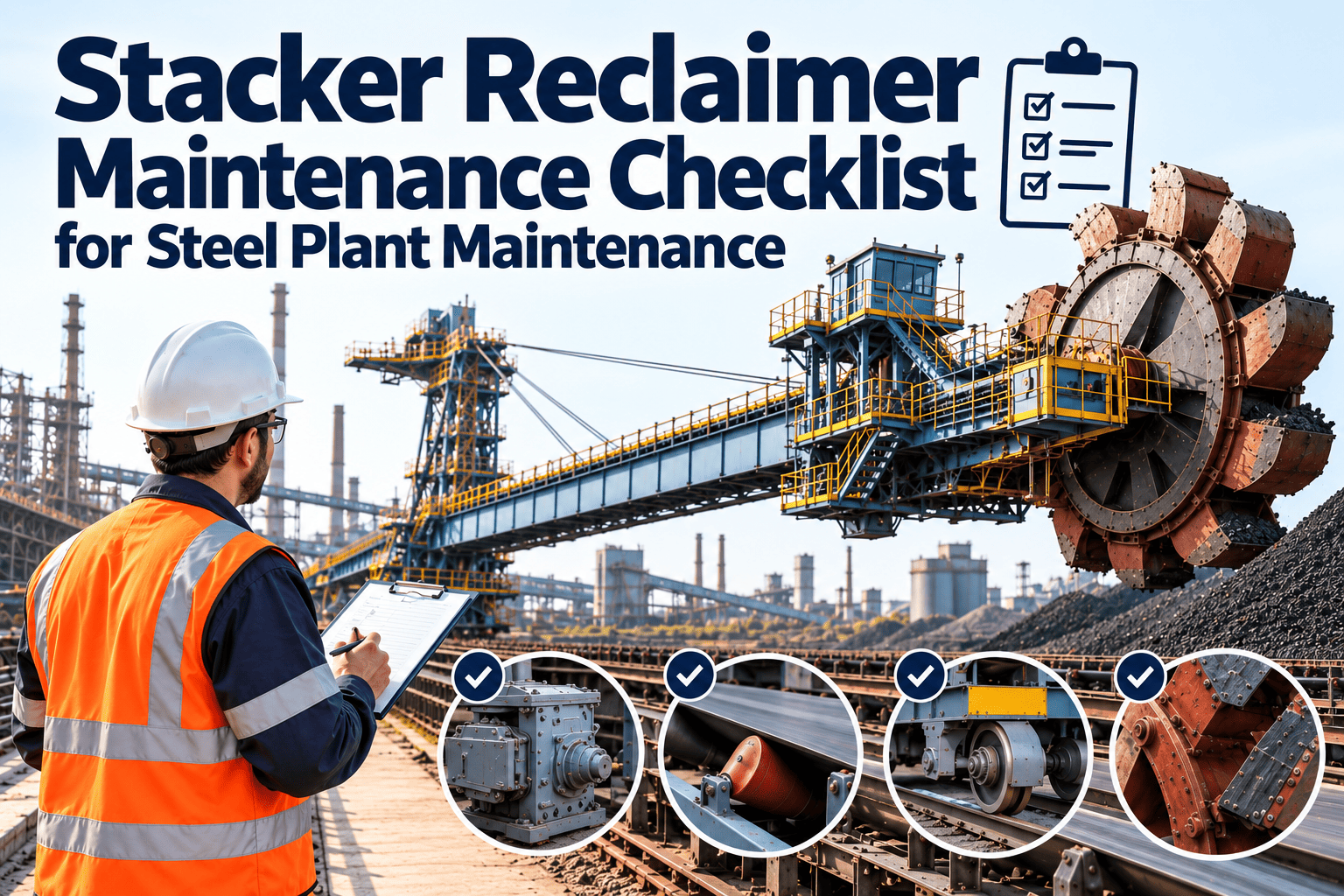
Every ton of ore, coal, and coke that reaches a blast furnace passes through a stacker reclaimer first — making this single machine the gatekeeper of the entire raw material yard. When a slew bearing seizes or a bucket wheel drive fails, the stockpile buffer starts draining immediately, and ironmaking feed interruptions follow within hours, not days. Steel plants that treat stacker reclaimer maintenance as a formality rather than a discipline discover the true cost only after an emergency crane, a fabrication shop, and a production shutdown are already involved. A structured PM program built around the machine's five load-bearing systems changes that outcome entirely. OxMaint's yard equipment maintenance module tracks every inspection, grease interval, and wear measurement for each stacker reclaimer in one asset record.
Raw Material Yard · Steel Plant Reliability
Stacker Reclaimer Maintenance: Protecting the Front Door of Your Feed Chain
Slew bearing wear, boom conveyor misalignment, and bucket wheel tooth loss build silently until a stockpile machine goes down mid-shift. This guide walks through the five systems that decide whether your yard runs on schedule or on emergency dispatch.
5Load-bearing systems that determine stacker reclaimer uptime
2/3Bucket tooth wear point at which digging efficiency and energy use both suffer
40°CTypical maximum temperature rise threshold for slew and travel drive gearboxes
HoursHow fast a stockpile buffer drains once a reclaimer goes down mid-shift
The Five Systems That Decide Yard Uptime
A stacker reclaimer is really five machines welded into one structure, and each carries a different failure signature. The slew bearing and ring gear absorb the full rotating weight of the boom and superstructure — grease starvation here shows up as axial play long before it shows up as noise. The boom conveyor takes every ton dropped from the bucket wheel or stacking chute, so belt tracking and idler condition determine whether material reaches the stockpile or spills onto the yard floor. The bucket wheel assembly does the physical digging, and its teeth, liners, and scraper plates are in constant abrasive contact with ore, coal, or coke. The travel drive moves the entire machine along the rail or crawler track, carrying loads that make flat spots and bearing wear a structural safety issue, not just a mechanical one. Luffing cylinders and hydraulic circuits raise and lower the boom under full working load, and a slow leak here often precedes a sudden drop. Treating these five systems as one undifferentiated "stacker reclaimer PM" schedule is how plants miss the specific inspection each one actually needs.
01
Slew Bearing & Ring Gear
Carries the full rotating weight of the boom. Grease on a strict interval, check for axial play, and run annual NDT on the mounting ring welds.
02
Boom Conveyor
Takes every ton dropped from the bucket wheel. Track belt tracking, splice condition, and idler rotation daily to prevent spillage and stoppages.
03
Bucket Wheel Assembly
Digs and lifts abrasive material continuously. Inspect teeth, liners, and scraper plates weekly; replace scraper plates at two-thirds wear.
04
Travel Drive & Rail System
Moves the full machine load along rail or track. Watch travel wheels for flat spots and bearing wear during scheduled runs.
05
Luffing & Hydraulic Circuits
Raises and lowers the boom under load. Inspect cylinder brackets, hoses, and fluid condition for early leak signs before a sudden drop.
Inspection Cadence: What to Check and When
Daily
Boom conveyor belt tracking, idler rotation, and visual check of the bucket wheel drive for unusual noise or vibration.
Weekly
Bucket teeth and scraper plate wear measurement, travel wheel condition, hydraulic hose and cylinder visual inspection.
Monthly
Slew ring grease weeping check, gearbox oil level and temperature log, electrical panel and contactor inspection.
Quarterly
Oil sample analysis on slew, travel, and bucket wheel gearboxes; alignment check on boom conveyor and drive couplings.
Annual
NDT on boom pivot welds and slew bearing mounting ring; full structural inspection of portal and slewing platform.
Stop Tracking Grease Intervals on a Whiteboard
OxMaint schedules every stacker reclaimer inspection, logs oil samples and wear measurements against each asset, and flags the exact machine falling behind — before it becomes an emergency dispatch.
Why Bucket Wheel and Travel Drive Wear Go Unnoticed Until It's Too Late
Bucket wheel wear is deceptive because the machine keeps working right up until it doesn't. As teeth and liners wear down, the wheel needs more torque to cut the same volume of material — energy consumption climbs quietly while digging rate falls, and most yards never connect the two until someone finally measures tooth wear directly. Scraper plates follow the same pattern: left in place past two-thirds wear, they let material reach the slot body itself, turning a low-cost plate swap into a structural repair. The travel drive carries a similar blind spot. Flat spots on travel wheels develop from long periods parked in one position under full load, and they don't announce themselves with noise until the flat has already deepened enough to cause vibration during every move. Central pivot and slew bearings fail the same way — dry running from a missed grease cycle accelerates wear across every rotating component the bearing supports, not just the bearing itself. None of these failure modes require exotic sensors to catch; they require someone recording wear measurements and grease intervals consistently enough to see the trend before it becomes an outage. That consistency is exactly what a whiteboard or a paper logbook struggles to deliver across a yard running three shifts.
Grease Weeping at Bearing Bolts
Early sign of slew ring seal wear — left unaddressed, contamination follows and accelerates bearing wear.
Rising Gearbox Temperature
Temperature climbing past normal baseline signals oil breakdown or bearing distress inside the housing.
Boom Conveyor Belt Drift
Persistent mistracking wears the belt edge and idlers unevenly, leading to splice failure under load.
Vibration During Slew or Luff
Often the first detectable sign of bearing wear or a developing crack at the boom pivot.
Reduced Digging Rate
Usually traced back to worn bucket teeth or liners increasing the torque needed per cycle.
Hydraulic Fluid Level Drop
A slow leak in luffing cylinders or hoses that can progress to a sudden boom drop under load.
What a Structured Program Changes
Fewer
Emergency dispatches for slew and bucket wheel gearbox failures
Oil sample trending and grease interval tracking catch wear during a scheduled window instead of mid-shift.
Longer
Service life on bucket teeth, scraper plates, and slew bearings
Replacing wear parts at the two-thirds mark protects the surrounding structure from secondary damage.
Faster
Root cause identification when a warning sign appears
A complete inspection and wear history per machine turns guesswork into a documented trend.
Steadier
Stockpile buffer protection across every shift and crew rotation
Standardized PM schedules travel with the asset, not with whichever technician is on shift.
Frequently Asked Questions
How often should the slew bearing be greased on a stacker reclaimer?
Follow the manufacturer's interval strictly since the slew bearing carries the full rotating load of the boom. Missing even one cycle can start dry-run wear.
Book a demo to see how automated reminders keep this on schedule.
When should bucket teeth and scraper plates be replaced?
Replace scraper plates once wear reaches roughly two-thirds of original thickness, before material contacts the slot body. Bucket teeth should be measured on the same weekly inspection cycle.
What causes flat spots on travel drive wheels?
Flat spots typically develop when the machine sits stationary in one position under load for extended periods. Rotating parked position and inspecting wheels regularly helps catch this early.
Why does gearbox temperature matter for stacker reclaimers?
A temperature rise beyond the normal baseline usually points to oil breakdown or early bearing distress inside the gearbox housing, well before an audible failure occurs.
How does a CMMS help manage stacker reclaimer maintenance?
It centralizes grease intervals, oil sample results, wear measurements, and NDT records per machine, and flags overdue tasks automatically.
Start a free trial to see the asset record in action.
Keep Your Raw Material Yard Feeding the Furnace on Schedule
OxMaint gives every stacker reclaimer its own maintenance record — grease intervals, oil analysis, wear measurements, and structural inspections in one place. Catch slew bearing and bucket wheel wear before it turns into a yard-wide production stop.