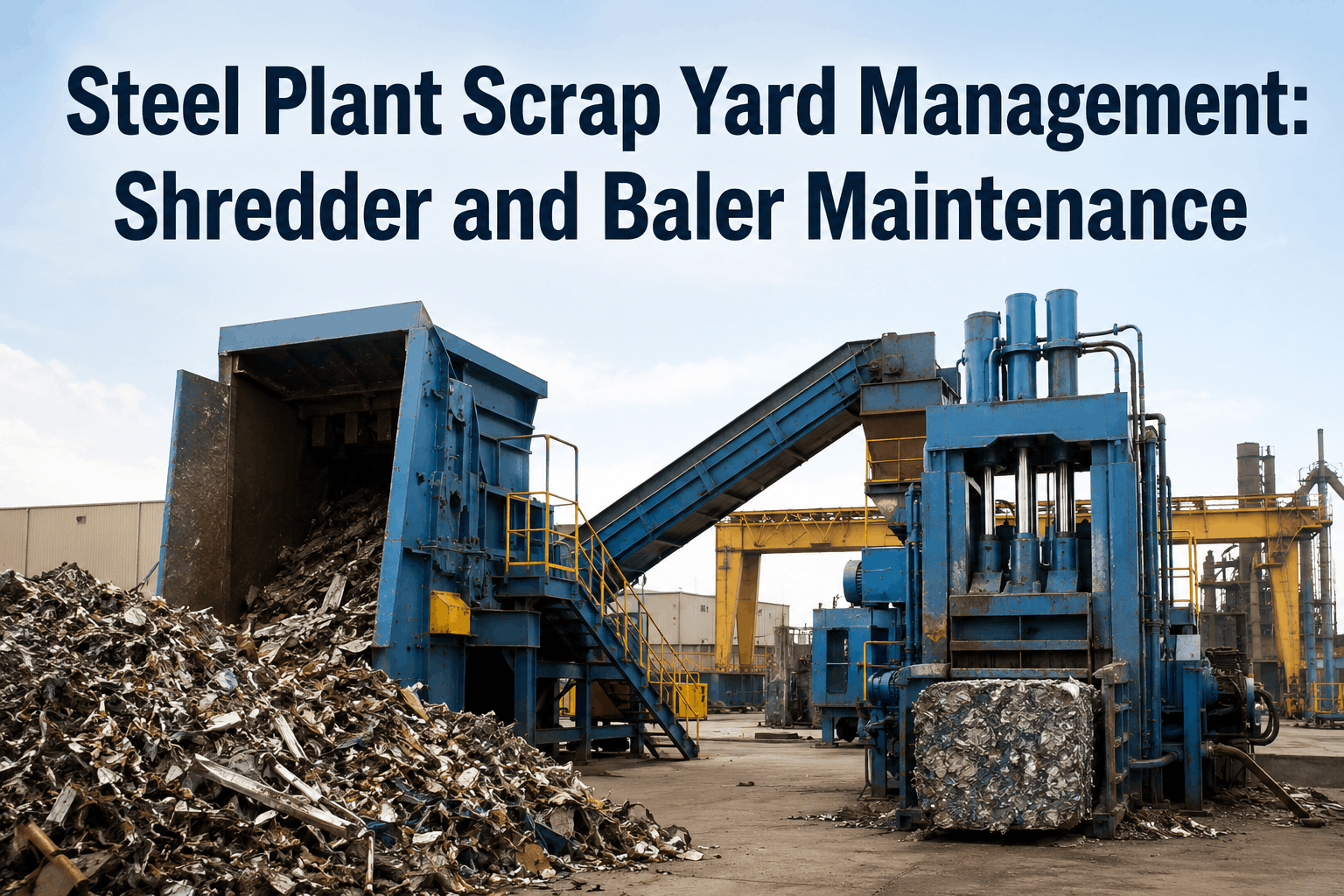
Scrap yard maintenance for EAF steel plants is the single biggest determinant of furnace feed-rate stability — because every minute a magnet crane, orange-peel grapple, or charging bucket is down, the electric arc furnace starves and tap-to-tap time balloons. EAF scrap handling equipment operates under the harshest duty cycle in the entire steel plant, with shock loads, abrasive shred, magnetic fines, and 24/7 charge schedules that punish deferred preventive maintenance. This guide covers scrap yard material handling maintenance at EAF steel plants — scrap crane PM, shredder and conveyor care, charging bucket inspection, mobile equipment reliability, and how a CMMS-driven scrap yard program protects furnace feed rate across every charge. If your team is still running scrap yard maintenance on spreadsheets or paper tickets, you can Start Free Trial of OxMaint and digitize your entire PM program in days, not months.
EAF Scrap Yard Maintenance Guide
Is your scrap crane downtime starving your EAF?
A single 4-hour magnet crane failure can delay 6–8 charges and cost over $180K in lost production. OxMaint's AI-powered CMMS predicts scrap handling failures before they happen — protecting feed rate, bucket integrity, and tap-to-tap cadence across every shift.
The Cost of Reactive Scrap Yard Maintenance
Why EAF scrap handling is the harshest duty cycle in the steel plant
EAF scrap yards feed the furnace continuously — and unlike BOF operations that rely on molten iron from a blast furnace, the EAF is 100% dependent on scrap logistics. When a magnet crane goes down, there is no buffer. Industry benchmark data shows that scrap yard equipment availability directly correlates with EAF productivity: plants sustaining above 95% scrap crane availability maintain tap-to-tap times under 55 minutes, while plants below 88% see cycle times stretch past 75 minutes and energy consumption per ton rise 8–12%.
Real-World Scenario
A 1.2M-ton EAF plant in the Midwest was losing 11 production hours per month to unplanned scrap crane failures — primarily magnet coil burnouts and hoist brake adjustments deferred past inspection intervals. After implementing OxMaint CMMS with condition-based PM triggers on magnet winding temperature and brake wear pins, the plant cut scrap crane unplanned downtime by 47% in the first 90 days, recovering an estimated $2.1M in annualized production. The payback period for the CMMS investment was under 6 weeks.
Scrap Crane PM Checklist
Scrap crane maintenance checklist for EAF steel plants
Magnet cranes and orange-peel grapples in the scrap yard demand the most rigorous PM program in the plant. Below is a tiered checklist organized by frequency — the same structure OxMaint uses to auto-generate work orders based on runtime hours, cycle counts, and condition-monitoring data.
- Inspect magnet coil cables for abrasion and kinking
- Check hoist brake function under load — measure drift
- Verify trolley rail clearance and wheel flange wear markers
- Test magnet lift capacity with calibrated test load
- Record crane operating hours and cycle count in CMMS
- Grease hoist rope and sheave pins per OEM spec
- Inspect rope for broken wires — condemn at 6 broken wires per lay
- Torque-check magnet electrical connections and junction boxes
- Measure magnet coil resistance — trend in CMMS dashboard
- Inspect orange-peel grapple tine tips — replace at 30% wear
- UT-thickness crane girder webs at high-stress weld zones
- Megger-test magnet generator and cabling insulation
- Inspect gearbox oil sample — particle count & water content
- Check rail alignment & clip tightness on crane runway
- Audit spare parts inventory for critical components
| Component | Failure Mode | PM Interval | CMMS Trigger | Risk if Deferred |
|---|---|---|---|---|
| Magnet Coil | Insulation breakdown / burnout | Weekly resistance trend | Temp + resistance threshold | $8K–$15K coil + 6 hr downtime |
| Hoist Brake | Brake fade / load drop | Daily drift test | Cycle count + drift measurement | Safety incident + 4 hr downtime |
| Wire Rope | Broken wires / strand failure | Weekly visual + monthly UT | Cycle count based | $3K rope + 3 hr downtime |
| Grapple Tines | Tip wear / bending fatigue | Weekly visual | Tonnes handled counter | Scrap spillage + feed delay |
| Gearbox | Bearing failure / gear pitting | Monthly oil analysis | Oil particle count + vibration | $12K–$25K rebuild + 12 hr |
Shredder & Conveyor PM
EAF material handling maintenance: shredders, conveyors and charging buckets
Beyond the cranes, the EAF scrap yard relies on shredders, vibratory conveyors, and charging buckets — each with distinct failure profiles. Shredder hammer wear accelerates with contaminated shred (refractory chunks, non-ferrous inclusions), while conveyor idler bearings fail from metal fines ingress. Charging buckets see thermal shock and mechanical fatigue from repeated furnace charging cycles.
Shredder Hammer Maintenance & Rotor Balance
Replace hammer sets at 40% wear or when rotor imbalance exceeds ISO 1940 G6.3. Trend motor amperage in the CMMS — a 10% rise above baseline signals dull hammers or tramp metal. Schedule rotor inspections every 500 operating hours and maintain a critical spare set in inventory with CMMS min-max alerts.
Conveyor Idler & Belt Maintenance
Inspect idler bearings weekly for noise and temperature rise. Install magnetic separators upstream to reduce metal fines ingress. Track belt alignment monthly and measure wear cover thickness — condemn at 2mm remaining. Use CMMS condition triggers based on vibration sensors on critical transfer points.
EAF Charging Bucket Inspection
Inspect charging bucket shell for cracking at the top lip and bottom cone junction every 50 charges. UT-measure wall thickness monthly — condemn at 60% of original. Check trunnion ring welds with dye penetrant every 200 charges. Log every inspection in the CMMS asset history for audit compliance and remaining-life prediction.
Mobile Equipment Reliability
Wheel loaders and mobile magnet handlers in the scrap yard require engine PM (250-hour oil changes), hydraulic fluid sampling (500 hours), and tire inspections (daily). OxMaint tracks engine hours automatically and generates FMCSA-aligned PM work orders — eliminating missed service intervals that cause 35% of mobile equipment failures.
ROI of CMMS in the Scrap Yard
How much does scrap yard downtime cost your EAF?
Quantifying the cost of scrap yard downtime requires understanding the chain reaction: when feed rate drops, the EAF either idles (wasting electrode and refractory life) or runs cold charges (increasing energy per ton). The formula below captures the primary production loss — real plants typically see total impact 1.5–2x higher when electrode damage and refractory wear are included.
Downtime Cost Formula
Annual Scrap Yard Downtime Cost = (Unplanned Downtime Hours/yr) × (Delay Multiplier) × (Lost Production $/hr)
Example: 11 hrs/month × 12 months × 1.5 delay multiplier × $11,000/hr = $2.18M/yr lost
| Metric | Reactive (Spreadsheet) | OxMaint CMMS | Improvement |
|---|---|---|---|
| Scrap crane availability | 88–91% | 96–98% | +7–10% |
| Unplanned downtime hrs/month | 10–14 hrs | 3–5 hrs | –60–70% |
| MTTR (scrap crane) | 3.2 hrs | 1.1 hrs | –66% |
| PM compliance rate | 55–65% | 94–98% | +35–40% |
| Spare parts stockout rate | 18–22% | 3–5% | –80% |
| Estimated annual savings | — | $1.5M–$2.5M | Payback < 8 weeks |
How OxMaint Helps
Scrap yard CMMS: how OxMaint protects EAF furnace feed rate
OxMaint is an AI-powered CMMS and EAM platform built for maintenance and reliability teams in heavy industry. For EAF scrap yard operations, OxMaint replaces paper work orders and spreadsheets with a connected, predictive maintenance system that ties every asset — cranes, shredders, conveyors, buckets, mobile equipment — into a single source of truth. Here is how OxMaint maps to your scrap yard maintenance challenges:
AI-Driven Predictive Maintenance
OxMaint's AI engine analyzes magnet coil temperature trends, hoist brake drift measurements, gearbox vibration data, and oil analysis results to predict failures 7–21 days before they occur — giving your team time to schedule repairs during planned outages instead of mid-charge.
Outcome: Cut unplanned scrap yard downtime 30–50%
Automated PM Work Orders
Auto-generate daily, weekly, and monthly PM work orders based on runtime hours, cycle counts, or calendar intervals — assigned to the right technician with checklists, safety procedures, and required parts pre-attached. No more missed inspections or deferred PMs buried in a spreadsheet.
Outcome: Achieve 95%+ PM compliance, eliminate paper work orders
Spare Parts & Inventory Control
Track critical spares — magnet coils, wire rope, hammer sets, bucket liners — with min-max thresholds and automatic reorder alerts. OxMaint links parts directly to asset records and work orders, so technicians never waste time searching for parts and stockouts drop to under 5%.
Outcome: Reduce parts stockouts 80%, cut search time per job by 25 min
Maintenance Analytics & OEE Dashboards
Real-time dashboards show scrap crane availability, MTBF, MTTR, PM compliance, and downtime cost by asset — aligned with OEE and ISO 55000 reporting standards. Export audit-ready reports for management reviews and compliance inspections with one click.
Outcome: Audit-ready compliance, data-driven reliability decisions
See OxMaint on your scrap yard assets — book a 30-min demo
We will walk you through a live EAF scrap yard setup: magnet crane PM schedules, charging bucket inspection tracking, predictive alerts, and downtime cost analytics — configured for your plant's equipment and charge cadence.
Frequently Asked Questions
Scrap yard maintenance for EAF steel: common questions
What is the most critical maintenance for EAF scrap yard cranes?
The highest-impact PM for EAF scrap cranes is weekly magnet coil resistance trending and daily hoist brake drift testing. Magnet coil burnouts are the leading cause of unplanned scrap crane downtime — costing $8K–$15K per event plus 6 hours of production loss. A CMMS like OxMaint auto-triggers these inspections based on cycle counts and flags resistance trends before failure.
How often should EAF charging buckets be inspected?
Charging buckets should be visually inspected every 50 charges for shell cracking at the top lip and bottom cone junction, with UT wall thickness measurement monthly and dye-penetrant testing of trunnion ring welds every 200 charges. Buckets should be condemned at 60% of original wall thickness. OxMaint tracks charge cycles automatically and generates inspection work orders at each threshold — see it in action when you Book a Demo.
How does a CMMS improve scrap yard maintenance for EAF steel plants?
A CMMS improves scrap yard maintenance by automating PM scheduling based on actual equipment usage (runtime hours, cycle counts, condition data) rather than calendar dates alone — eliminating missed inspections. It also centralizes asset history, tracks spare parts inventory with auto-reorder alerts, and provides real-time availability and downtime cost dashboards. Plants typically see 60–70% reduction in unplanned downtime within 90 days of implementation.
What is the ROI of implementing CMMS for scrap handling equipment?
For a mid-size EAF plant (800K–1.5M tons/year), implementing a CMMS for scrap yard maintenance typically delivers $1.5M–$2.5M in annual savings through reduced unplanned downtime, lower spare parts stockout costs, and extended equipment life. Most plants achieve full payback in under 8 weeks. The largest single contributor is preventing magnet crane failures, which average $45K+ per incident in lost production.
How long does it take to implement OxMaint CMMS in a scrap yard?
OxMaint can be deployed in a scrap yard operation in 2–4 weeks, including asset hierarchy setup, PM schedule migration from spreadsheets, spare parts import, and technician training. The AI predictive models begin producing actionable alerts within 30–45 days as baseline condition data is collected. You can Start Free Trial today and begin configuring your scrap yard assets immediately.
Stop losing production hours to scrap yard breakdowns
Join EAF steel plants using OxMaint to predict scrap handling failures, automate PM work orders, and protect furnace feed rate — every shift, every charge.
Free 14-day trial · No credit card