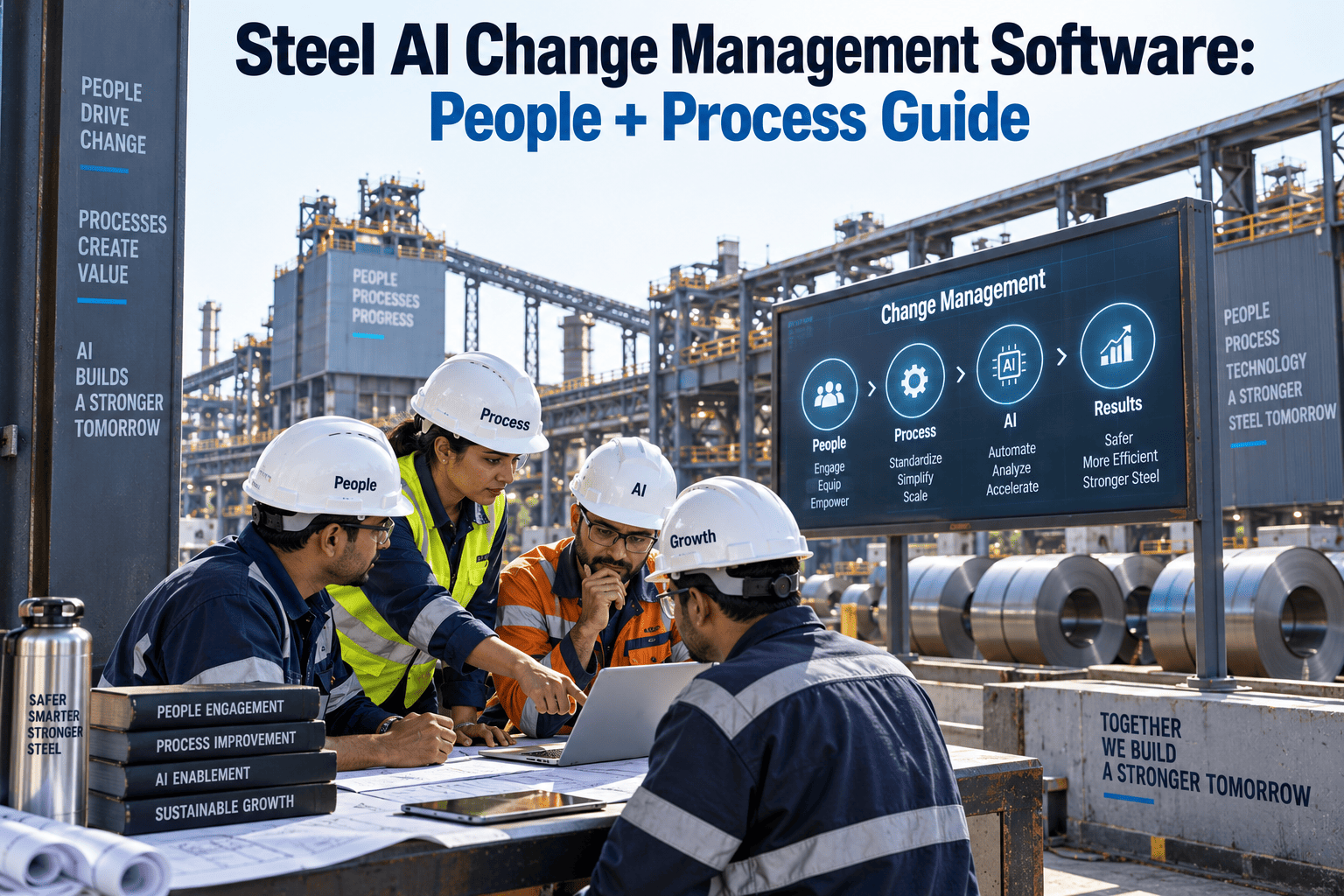
When a plant director tells the board that AI adoption has reached three use cases after eighteen months of investment, the follow-up question is rarely about the algorithm. Steel producers that study their own stalled rollouts keep finding the same root cause: nobody redesigned the daily routine around the new capability, so mechanics kept filling out the same paper tags and the model kept starving for structured outcome data. Operations that treat AI as an overlay bolted onto existing habits see adoption settle below a third of the workforce, while operations that rebuild the underlying workflow around the new tool report adoption above four in five within a single quarter. The distance between three pilot use cases and forty seven production use cases is a change management gap long before it is a data science gap, and most steel plants only recognize this after the second stalled rollout. Book a demo to see how a structured change management layer inside your CMMS turns isolated pilots into a repeatable scaling engine.
Steel AI Change Management Software: People + Process Guide
Every steel plant running an AI pilot has a model that works in the demo. Far fewer have the training cadence, work order discipline, and supervisor buy-in that lets that model survive contact with a real shift. This guide breaks down the people and process layer that separates plants stuck at three use cases from plants running forty seven of them in production, and shows where a CMMS becomes the connective tissue that holds the whole program together, long after the vendor who sold the pilot has moved on to the next account.
Why Steel AI Pilots Stall Before They Scale
The pilot itself is rarely the hard part. Vendors are happy to run a proof of concept on a single caster or a single finishing line, and the results are usually encouraging enough to fund a second phase. What derails momentum is what happens next, when the plant tries to move the same approach from one line to twenty, from one shift to three, and from one champion to an entire maintenance organization that never asked for the change in the first place and has plenty of reasons of its own to keep doing things the old way.
How The Change Lands Differently By Role
A single training deck rarely works for everyone on the floor, because the AI rollout asks something different of a technician than it does of a supervisor or a plant director, and treating all three the same way is one of the quieter reasons adoption plateaus. Breaking the change down by role gives each group a clear answer to the question they actually care about: what does this mean for how I spend my shift.
The Data Foundation A Scaling Program Needs
Before a second or third use case gets funded, most steel plants benefit from a short honesty check on their own data discipline. The list below is the minimum foundation that separates programs that scale smoothly from programs that spend months rebuilding trust after a rocky first rollout, and it is worth revisiting every time a new line or shift pattern joins the program.
Move From Pilot Fatigue To A Scaling Engine
Oxmaint gives your maintenance organization the structured work order backbone, mobile capture, and supervisor workflow that AI models need to keep improving after go-live, so the second use case ships faster than the first and the tenth ships faster still.
Pilot-Stage Habits vs Production-Ready Change Management
The table below lines up the habits that keep a program stuck at pilot stage against the practices that let the same program scale across an entire steel plant. Most plants recognize themselves somewhere in the left column before they recognize the cost of staying there.
| Dimension | Pilot-Stage Habit | Production-Ready Practice |
|---|---|---|
| Training | One-time launch session for a handful of volunteers | Role-based refresher cadence tied to shift rotation and new hire onboarding |
| Work Order Data | Free-text notes with no linked diagnosis or outcome | Structured cause, action, and result fields captured at the point of execution |
| Ownership | A single enthusiastic engineer champions the tool alone | Shift supervisors own adoption metrics as part of their standard reporting |
| Feedback Loop | Overrides go unrecorded and the model never learns from them | Every override is logged with a reason code that retrains the recommendation |
| Governance | Success is measured by whether the demo still runs | Success is measured by cost avoidance, downtime hours, and adoption rate together |
The Five-Phase Rollout That Actually Scales
Programs that move past three use cases tend to follow a disciplined sequence rather than a single big-bang launch. Each phase below builds the organizational muscle the next phase depends on, and skipping ahead is usually where the rollback requests start.
See Where Your Program Sits On The Maturity Curve
Most operations directors underestimate how close phase two is to phase four once the data foundation is in place. A short working session with our team maps your current state against the five phases above.
AI Change Management Maturity Scale
Use this five-point scale to place your own plant honestly. Most operations are lower than they expect on this scale, and that is normal for an industry that has only recently started treating AI adoption as an organizational discipline rather than an IT project.
We had the model working on paper within a month, but it took nearly a year before the crews trusted it enough to stop double-checking every recommendation on the old spreadsheet. What changed things was moving work orders onto mobile devices so the outcome of every recommendation was captured automatically, instead of asking technicians to write an extra report nobody read. Once the data loop closed itself, adoption stopped being something we had to push and started being something the shift supervisors asked for. Looking back, the biggest mistake was assuming the second line would be easier just because the first one worked, when really it just needed the same discipline repeated on purpose rather than assumed.
From Three Use Cases To Forty Seven, Without The Second Round Of Pilot Fatigue
The plants that eventually run dozens of AI use cases in production almost never describe a single dramatic turning point. What they describe instead is a slow accumulation of small, boring disciplines: a mobile form that replaced a paper tag, a supervisor who started asking about override reasons in the morning huddle, a training packet that got reused instead of rebuilt for the second line. None of it looks impressive on a slide, and none of it requires a bigger AI model than the one that was already running in the pilot.
What it does require is a system of record that makes those disciplines easy to keep instead of easy to skip. A CMMS that captures structured work order data, tracks adoption at the shift level, and gives supervisors a workflow they will actually use every day is what turns a promising pilot into an organizational habit. That habit, repeated across enough lines and enough shifts, is the entire difference between a plant that talks about AI in a strategy deck and a plant that runs forty seven use cases without anyone needing to remember why the program started in the first place.
Frequently Asked Questions
Turn Your Next AI Use Case Into A Repeatable Win
Oxmaint pairs structured work order data with a mobile-first workflow built for steel maintenance teams, so every AI recommendation has the training, trust, and traceability it needs to survive past the pilot and keep earning its place on the floor use case after use case.