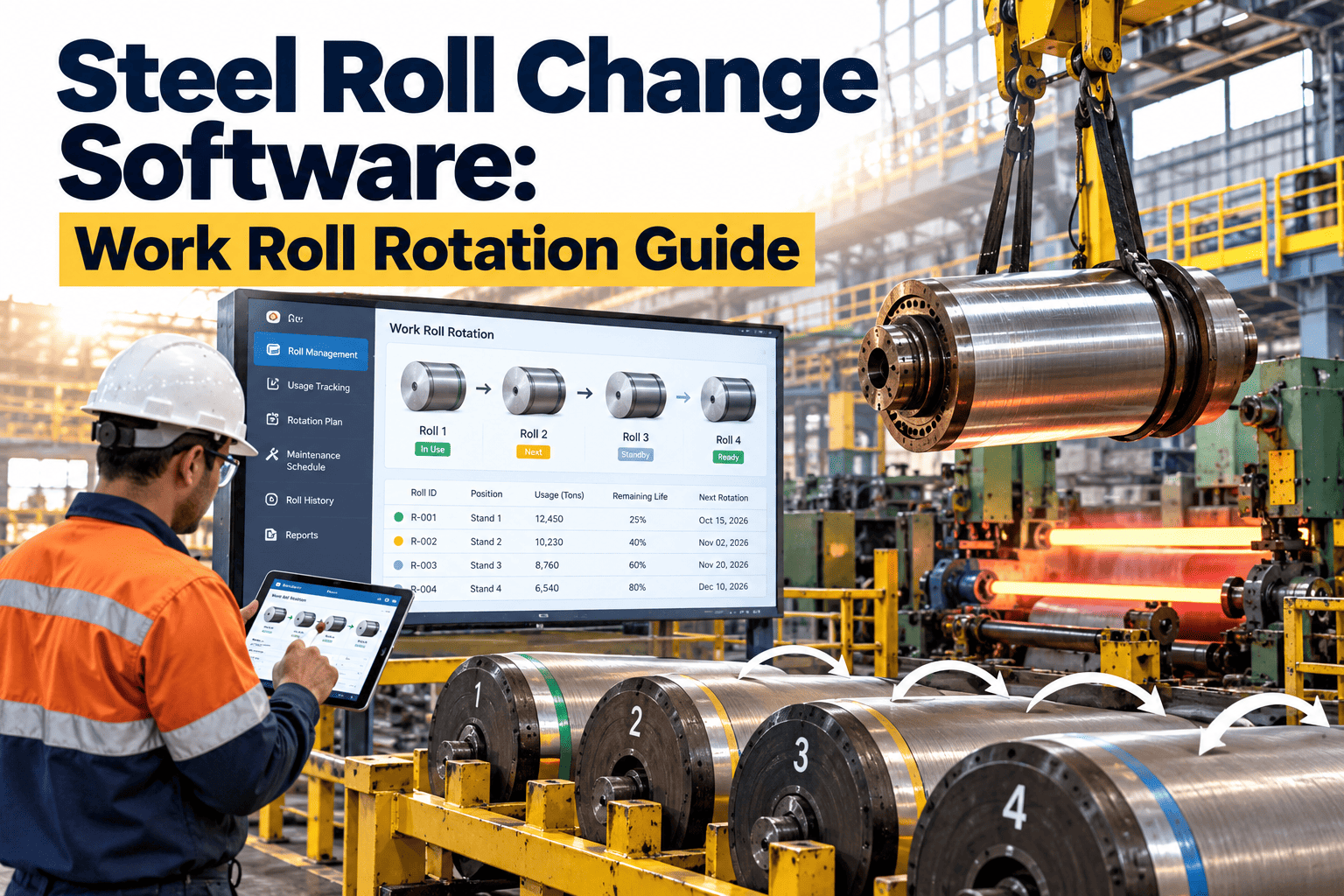
Work rolls touch the strip, so everything that happens to a roll shows up in the product. A rushed roll change, a missed grind, or a roll left in the mill for one campaign too long can print a defect on every coil that follows. Many mills still manage roll rotation with logbooks and spreadsheets that only the roll shop understands. A maintenance platform such as Oxmaint turns each roll, chock, and grind into a traceable record that planners, operators, and quality teams can use together.
Steel Roll Change Software: Work Roll Rotation Guide
Manage work roll rotation, grinding history, and campaign length in one system, so roll changes protect surface quality and mill availability instead of interrupting them.
Why the Roll Change Discipline Matters
A roll change is both a maintenance job and a quality decision. It stops production, consumes roll shop capacity, and sets the surface condition for the next campaign.
What goes wrong without records
- Rolls leave the mill on habit, not on measured condition
- Grinding history sits in a roll shop notebook
- Defects on strip cannot be traced to a specific roll
- Roll sets are mismatched or unavailable at change time
- Change durations vary and nobody knows why
What good records allow
- Rotation based on tonnage, length, and surface condition
- Full grind and diameter history for every roll
- Strip defects linked to roll ID, stand, and campaign
- Roll shop workload planned against the mill schedule
- Change time measured and improved step by step
The common thread is traceability. When each roll is an asset with a history, rotation decisions stop depending on memory.
Roll Types and What to Track for Each
Different mills use different rolls, and each type fails and wears in its own way. Set up the record structure to match.
| Roll type | Role in the mill | What drives a change | Records to keep |
|---|---|---|---|
| Hot strip work rolls | Contact the hot strip and set thickness and surface | Wear, thermal fatigue, surface defects, schedule | Tonnage, length, grind history, defects, stand |
| Backup rolls | Support work rolls and carry rolling load | Wear, spalling risk, bearing condition | Diameter, inspection results, bearing history |
| Cold mill work rolls | Control thickness, flatness, and strip finish | Roughness loss, marks, wear | Roughness readings, campaign length, grind and texture |
| Temper or skin pass rolls | Give final surface texture and flatness | Texture decay, surface marks | Texture values, coils rolled, inspections |
| Plate mill rolls | Roll heavy plate in reversing passes | Wear, surface damage, shape control | Tonnage, pass records, grind and profile |
Work Roll Rotation Schedule: What Triggers a Change
A rotation schedule uses several triggers together. Whichever threshold is reached first should create the roll change work order.
Give Every Roll a Record the Whole Mill Can Trust
Oxmaint tracks each roll as an asset, with meters, grind history, and work orders, so rotation decisions rest on data and not on memory.
The Roll Shop Workflow Step by Step
Between mill campaigns, every roll follows a repeatable path. Each step should create a time-stamped record against the roll.
Cool and clean
Visual inspection and measurement
Decide the grind
Grind to profile
Non-destructive testing
Match, store, and release
Anatomy of a Complete Roll Record
A roll record should answer three questions quickly: what is this roll, what has it done, and is it safe to use again?
- Identity
- Roll ID, type, material grade, supplier, and date received
- Dimensions
- Original diameter, current diameter, and minimum allowable diameter
- Condition
- Hardness readings, crown or profile, and surface roughness where relevant
- Campaign history
- Stand, position, dates, tonnage or length rolled, and hours in service
- Grinding history
- Number of grinds, stock removed each time, and grinder used
- Test results
- Eddy current and ultrasonic findings, with dates and technicians
- Defects and incidents
- Surface issues found, cobbles or accidents, and corrective action
- End of life
- Scrap date, final diameter, and the reason for retirement
Tracing Strip Surface Defects Back to the Roll
Quality teams often see a defect before maintenance hears about it. A roll record lets them check likely causes quickly. The table lists possibilities to investigate, not automatic conclusions.
| Strip observation | Possible roll-related cause | Record to check |
|---|---|---|
| Repeating marks at roll circumference | Surface damage or indentation on a roll | Roll ID, stand, inspection notes, recent incidents |
| Uneven wear pattern across the width | Wear profile from schedule or poor grind profile | Rolling schedule, grind profile, campaign tonnage |
| Fine cracking pattern on the roll surface | Thermal fatigue from heating and cooling cycles | Campaign length, cooling performance, inspection results |
| Surface loss after heavy use | Spalling risk or subsurface damage | Non-destructive test results, grind depth history |
| Chatter or vibration marks | Roll eccentricity, bearing or chock condition | Chock and bearing history, vibration records |
| Loss of surface finish in cold rolling | Texture or roughness decay over the campaign | Roughness readings, coils rolled since grind |
Campaign Length: Finding the Balance
Campaign length is a trade-off, and the right answer differs by stand, product, and steel grade. Records let you find the balance with evidence.
Longer campaigns
- Fewer roll changes and less lost rolling time
- Lower grinding and handling workload
- Higher risk of surface degradation late in the campaign
Shorter campaigns
- Better and more consistent strip surface
- More changes and more roll shop work
- Faster roll consumption and higher cost per tonne
Compare defect rates against campaign tonnage for each grade. The point where defects begin to rise is a practical limit for that product.
Treat the Roll Change as a Standard Job
A roll change involves heavy lifting, hydraulics, high temperatures, and moving machinery. A written standard job reduces both risk and duration.
- Time each phase so you can see where delays actually occur.
- Capture lockout confirmation on the work order before work starts.
- Record the roll IDs installed and removed, which keeps the roll record accurate.
Chocks and Bearings Deserve Their Own History
Roll quality depends on the chock and bearing assembly as much as on the roll body. Track both as assets in their own right.
Chock inspection
Bearing life
Seals and lubrication
KPIs for Roll Change and Rotation Performance
Choose measures that connect roll shop activity with mill output and strip quality.
- Roll change duration
- Total and per phase, by stand and crew, to find avoidable delay.
- Campaign tonnage or length
- Average and range by stand and grade, compared with defect rates.
- Roll consumption per tonne
- Diameter lost and cost per tonne rolled, by roll type.
- Stock removed per grind
- Shows whether grinding is removing more than the defect depth requires.
- Unplanned roll changes
- Count and cause, separating damage events from normal rotation.
- Roll-related defect rate
- Strip defects traced to specific rolls or campaigns.
- Roll set availability
- Percentage of changes where a ready, matched set was waiting.
Spreadsheet Roll Log Compared With a Maintenance System
| Topic | Spreadsheet or logbook | Maintenance management system |
|---|---|---|
| Roll history | Spread across files and notebooks | One record per roll with full history |
| Rotation triggers | Manual and dependent on individuals | Meter-based triggers create work orders |
| Defect tracing | Depends on memory and phone calls | Roll ID linked to stand and campaign |
| Change duration | Rarely recorded by phase | Time and steps logged on the work order |
| Spare roll visibility | Physical counts only | Inventory status and location shown |
| Audit trail | Limited and editable | Time-stamped records and sign-offs |
Safety and Compliance During Roll Changes
Roll changes combine suspended loads, stored hydraulic energy, hot surfaces, and tight working spaces. Safety steps belong inside the work order, not in a separate document that people may skip.
- Lockout and isolation confirmation recorded before the job can start.
- Lifting plan and crane inspection status checked for the roll and chock handling.
- Hydraulic and cooling water isolation verified and signed off.
- Exclusion zones agreed for the roll change area during crane movements.
- Post-installation checks completed before the stand is released to operations.
Who signs off
What gets stored
Why it helps
Roll Cost and Inventory Planning
Rolls are expensive, long-lived assets that are consumed slowly through grinding. Planning their inventory takes more than counting units on a shelf.
Common Roll Change Mistakes and Their Fixes
Most roll change problems repeat across plants. Each can be reduced with a clearer record or a simple rule.
How Oxmaint Supports Roll Change Management
Oxmaint maintenance management software handles the parts of roll management that depend on structured records and scheduling.
Steel Roll Change Questions Answered
How should a work roll rotation schedule be set?
What should a roll grinding record contain?
Can software link strip defects to specific rolls?
How do we shorten roll change time?
Should rolls be tracked as assets or inventory?
Make Every Roll Change a Recorded, Repeatable Job
Track rotation, grinding, and campaign length in one place, and connect roll decisions to strip quality. Oxmaint gives your mill that traceable record.