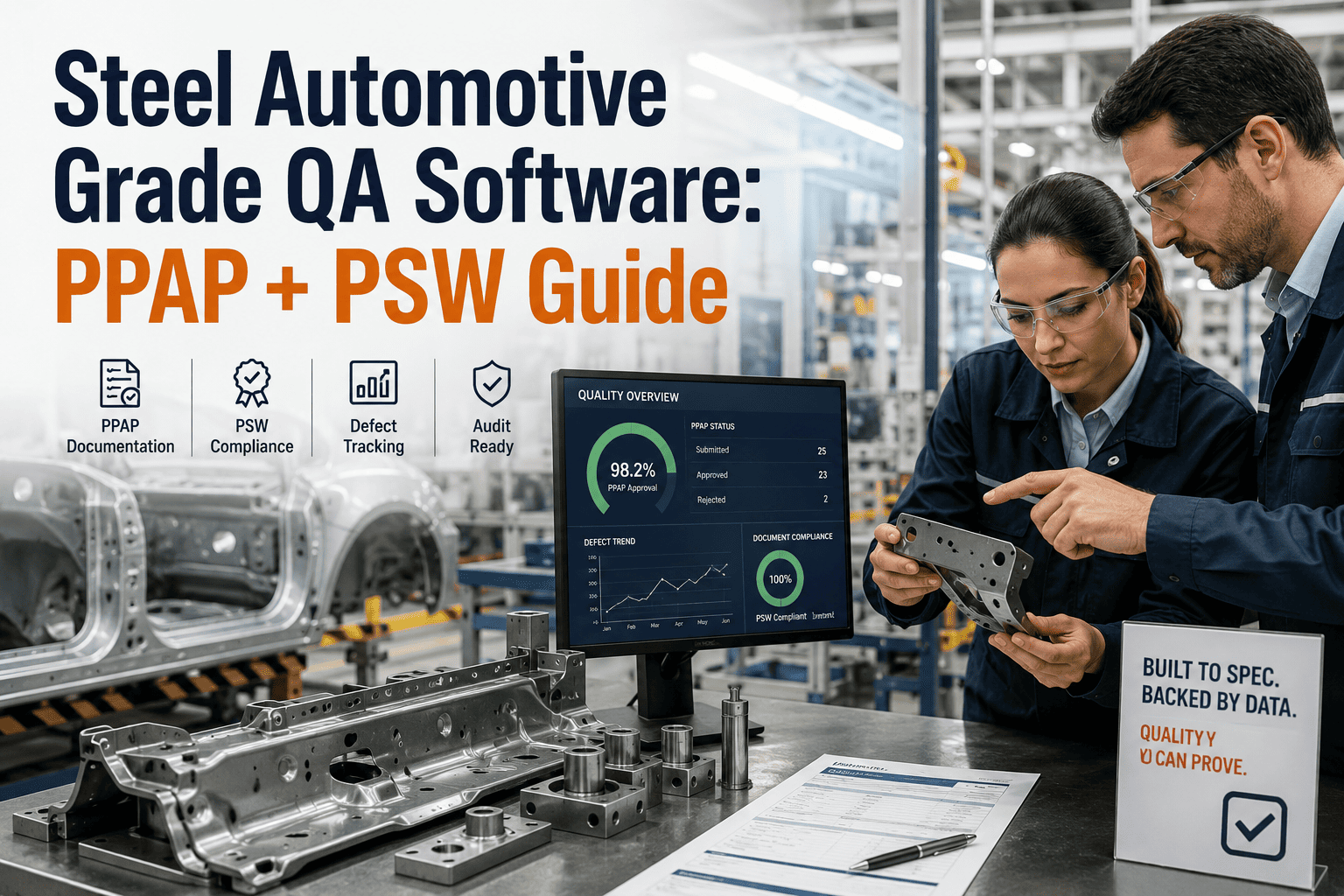
Automotive OEMs do not just buy steel — they buy a documented, repeatable process for making that steel, and PPAP is how a supplier proves the process exists. A single missing control plan revision or an FMEA that wasn't updated after a process change can stall an entire coil shipment at the OEM's receiving dock, regardless of how good the material actually is. Tier-1 suppliers run on PPAP and PSW cycles that touch APQP, control plans, MSA studies, and SPC data, and a missed submission deadline can suspend a supplier's shipping status overnight. Most steel plants still assemble these packages by pulling files from different departments under deadline pressure, which is exactly when a document goes missing. A structured automotive QA system keeps every PPAP element current and traceable long before the submission date arrives. Start a free OxMaint trial to build your first PPAP tracking workflow, or book a 30-minute demo with a specialist.
Steel Automotive Grade QA Software
Keep PPAP packages, PSW approvals, and IATF 16949 documentation audit-ready — without a last-minute scramble across five departments before every submission.
The Five PPAP Submission Levels — and What Each One Demands
Not every part or program requires the same submission depth. OEMs specify a PPAP level based on part risk and program history, and a steel supplier that treats every submission the same way either over-documents low-risk parts or under-documents the ones that actually need scrutiny.
Who Owns Each PPAP Element — and What Triggers a Resubmission
A PPAP package pulls documents from quality, process engineering, metallurgy, and the lab, and each element has its own trigger for when it must be refreshed. Losing track of any one of them is what turns a routine submission into a shipping hold.
| PPAP Element | Typical Owner | Required Document | Resubmission Trigger |
|---|---|---|---|
| Design Records | Process Engineering | Drawing / specification reference | Spec revision from customer |
| Process Flow Diagram | Quality Engineering | Mill process flow chart | Process route or stand change |
| Process FMEA | Quality Engineering | PFMEA worksheet | New failure mode identified |
| Control Plan | Quality Engineering | Control plan document | Inspection frequency or method change |
| MSA Studies | Metrology / Lab | Gauge R&R report | New or recalibrated instrument |
| Dimensional Results | Quality Lab | Inspection report | Every submission cycle |
| Material / Performance Test | Metallurgy Lab | Test certificates | Grade or chemistry change |
OxMaint keeps every PPAP element — FMEA, control plan, MSA, SPC data, and test certificates — current and linked to its owner, so a submission is a export, not a scramble across four departments the week it's due.
How OxMaint Manages Automotive Grade QA and PPAP Readiness
IATF 16949 compliance is not a once-a-year audit exercise — it is a daily discipline of keeping documentation current as processes, gauges, and specifications change. OxMaint is built to keep that discipline running without adding administrative load to quality engineers.
Every control plan, FMEA, and MSA study is version-tracked with a clear owner, so the current approved revision is always what gets pulled into a submission.
A process change, spec revision, or gauge recalibration automatically flags every linked PPAP document as due for review before the next submission.
Each part number shows its current PPAP level, last submission date, and approval status on one record, instead of scattered emails and shared drives.
Dimensional and process data feeding the control plan is captured directly against the part record, ready to export into the submission package.
A complete PPAP package — from design record through test certificates — exports in the sequence customers expect, cutting preparation time significantly.
Every document change is timestamped and attributed, giving auditors a clear trail without pulling quality engineers off the floor to reconstruct history.
Frequently Asked Questions
Can OxMaint track different PPAP levels for different customer programs on the same part?
Does OxMaint alert quality engineers when a control plan needs to be resubmitted?
Can OxMaint generate a complete PPAP package for export?
Is OxMaint suitable for IATF 16949 audit preparation?
Can multiple part numbers and customer programs be managed in one OxMaint instance?
A PPAP Package Is Only as Strong as Its Weakest Document. Keep Every One of Them Current.
OxMaint gives automotive steel suppliers version-controlled PPAP documentation, trigger-based review alerts, part-level submission tracking, and audit-ready exports — in one system built for the pace of tier-1 supply programs.