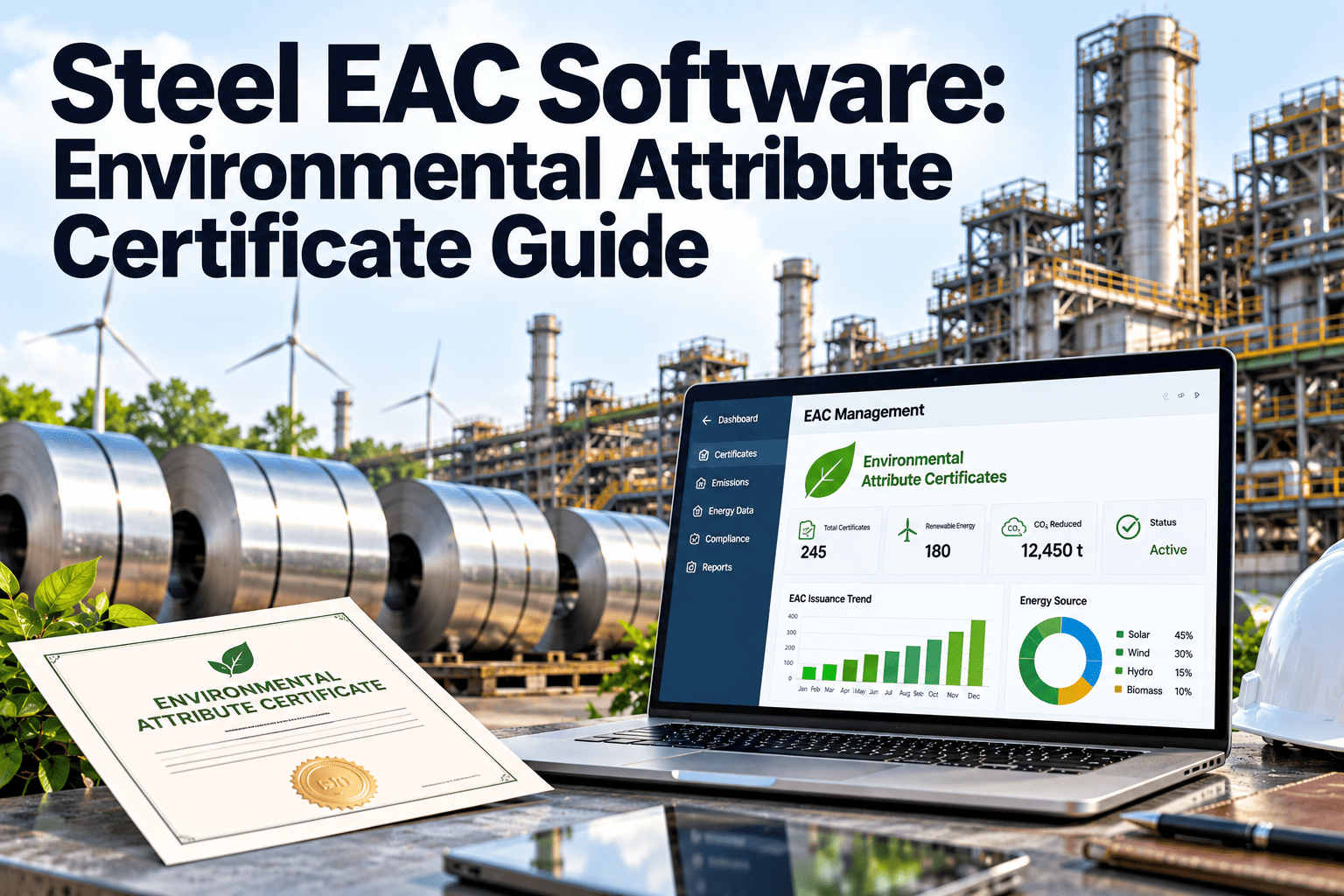
Low-carbon steel is increasingly sold in two parts: the physical product and the environmental claim attached to it. The claim travels as an Environmental Attribute Certificate, or EAC, and it is only as credible as the evidence behind the plant that produced it. This guide explains how EACs work for steel, what plant teams must keep on record, and how Oxmaint maintenance management software can hold the asset, calibration, and inspection evidence that supports verified production.
Steel EAC software and records: environmental attribute certificates explained
Understand book and claim for steel, track multi-year purchase agreements and buyer allocations, and keep the maintenance evidence that stands behind every certificate.
Simplified book and claim flow for explanation.
What an EAC is, in plain terms
An environmental attribute certificate is a market instrument that represents the environmental attributes of a product or service. In steel, one certificate typically stands for the green value of one tonne of verified low-emission steel.
Book and claim in one paragraph
Book and claim separates the environmental attribute from the physical steel. The producer sells certificates linked to verified production, and the buyer applies the attribute to its own emissions reporting, even if the steel itself went elsewhere.
Terms you will meet in EAC discussions
- Book and claim.A model where the environmental attribute is traded apart from the physical product.
- Issuance.The creation of a certificate in a registry after production and delivery are confirmed.
- Retirement.The permanent removal of a certificate from circulation once a buyer has used it for a claim.
- Vintage.The production period the certificate relates to.
- Chain of custody.The documented path that links a certificate to verified production.
- Non-prime steel.Steel that does not meet prime product specifications but can still be sold.
Keep terminology consistent
Use one agreed glossary across commercial, quality, and maintenance teams. Mixed terms create confusion in records and slow down every verification request.
Why steel buyers are turning to EACs
- Supply is limited.Near-zero emission steel is available in limited volumes and few locations, so many buyers cannot source it physically.
- Supply chains are long.Steel passes through intermediaries, which makes direct purchase hard for motivated buyers.
- Producers need revenue signals.Certificate sales can support decarbonization investments while physical delivery is not possible.
- Claims need discipline.Without strict rules, the same tonne could be claimed twice, which is why verification and registries matter.
The three building blocks of a credible framework
RMI has proposed a book and claim framework for iron and steel that rests on three parts. Plants should understand all three, because each one creates a data request.
Product certification
Third party verification that steel meets agreed environmental requirements.
Registry
A secure system to issue, transfer, and retire certificates so none is counted twice.
Claim guidance
Rules that help buyers report and communicate claims in their climate disclosures.
Trends shaping steel EACs
The market is still forming, so expect rules and tools to keep changing. Several developments are worth watching.
- Registry development.Stegra and partners, supported by RMI, announced work on a framework and registry for near-zero emission iron and steel certificates.
- Buyer demand beyond physical supply.Large buyers use certificates to address emissions from construction materials, including data center projects.
- Clearer claim guidance.Buyers need consistent rules for reporting claims in climate disclosures.
- More attention to evidence.As volumes grow, verifiers and buyers ask harder questions about measurement and records.
What this means for plant teams
Expect more requests for documented evidence, more detail about how measurements are controlled, and more interest in how process changes are managed. Plants with organized maintenance records answer faster.
Who does what inside the plant
| Team | Typical responsibility | Evidence they provide |
|---|---|---|
| Commercial | Agreement terms, buyer relationships, volumes | Contract and allocation records |
| Sustainability | Verification, registry, claim rules | Verification reports and registry status |
| Quality | Product status and eligibility | Heat and product group records |
| Maintenance | Reliability of equipment and measurement | Calibration, inspection, and work order history |
| Operations | Process control and production data | Production and process records |
Clear ownership prevents the common situation where everyone assumes another team holds the proof.
Lifecycle of a multi-year EAC purchase agreement
Many agreements run across several years with volumes that grow. Tracking each stage keeps both sides aligned.
- Agreement signedBuyer, producer, period, and annual volume ceilings are defined.
- Production and measurementThe plant produces steel and records the data needed for verification.
- VerificationAn independent party checks that the steel meets the certification rules.
- IssuanceCertificates are issued in the registry after the physical steel is delivered.
- AllocationCertificates are assigned to the contracted buyer for the period.
- Retirement and reportingThe buyer retires certificates and reports the claim.
- Renewal or step upVolumes for the next year are confirmed and prior records are reconciled.
Buyer allocation record: what to keep alongside the registry
The registry is the system of record for certificates. Plants still keep an internal view so commercial, quality, and reliability teams read the same facts.
| Field | Purpose | Example entry |
|---|---|---|
| Agreement reference | Links records to the contract | Internal contract number |
| Buyer | Identifies the certificate owner | Named customer entity |
| Production period | Defines which steel the certificates cover | Calendar year or quarter |
| Product group | Shows which steel is eligible | Defined grades or product family |
| Tonnes covered | Limits claims to verified volume | Agreed annual ceiling |
| Status | Tracks progress | Planned, verified, issued, allocated, retired |
Entries are generic examples of a record layout. Follow the rules of your chosen registry and certification scheme.
The maintenance evidence behind a claim
Verifiers ask whether measurements and process equipment can be trusted. The answer often lives in maintenance records.
| Claim element | What a verifier may ask | Maintenance record that helps |
|---|---|---|
| Energy and fuel inputs | Are meters accurate? | Meter asset records and calibration history |
| Production volume | Are scales and weighing systems reliable? | Scale verification and repair records |
| Process equipment | Did key equipment run as designed? | Inspection results and corrective work orders |
| Process changes | Were changes controlled? | Work orders showing modifications and approvals |
| Supporting documents | Can you produce certificates and manuals? | Documents attached to the asset |
What a CMMS does not do
A maintenance system does not issue, transfer, or retire certificates and does not replace a registry or verifier. Its role is to keep reliable evidence about the assets and measurements that the claim depends on.
From plant floor data to a certificate claim
Every certificate rests on a chain of data. A weak link anywhere reduces confidence in the whole claim.
- Instruments measureMeters, scales, and analyzers capture energy, material, and production data.
- Maintenance keeps them accurateCalibration, repair, and replacement are recorded as work orders.
- Operations and quality compile dataProduction and product status are tied to periods and batches.
- Verifier reviewsData and supporting records are checked against the certification rules.
- Registry records the certificatesIssuance, transfer, and retirement are logged centrally.
Why wording of claims matters
Buyers and producers should describe what a certificate does and does not mean. Avoid wording that suggests the physical steel itself carries the attribute when it has been sold separately.
Double counting and other risks to manage
Double counting
The same tonne is claimed by two parties. Controlled by separating the physical sale from the claim and using a registry.
Evidence gaps
A verifier cannot find calibration or inspection proof. Controlled by attaching records to assets.
Meter drift
Readings slowly deviate from true values. Controlled by scheduled calibration and tracked results.
Volume shortfall
Eligible production falls short of the contract ceiling. Controlled by early forecasts and clear allocation rules.
Ramp-up years and non-prime steel
Some producers apply book and claim to non-prime steel. Every mill makes some, and a new mill makes a larger share during ramp-up. That makes eligibility rules and product tracking especially important in early years.
- Define which product categories are covered before production starts
- Keep production and quality status records tied to batch or heat
- Document equipment commissioning and early reliability issues
- Review eligible volume against contract targets each quarter
Calibration and inspection tasks to schedule
Intervals depend on the instrument, the manufacturer, and your verification scheme. Treat the list as a starting set of recurring tasks.
| Asset type | Recurring task | Record to attach |
|---|---|---|
| Energy meters | Calibration or verification against reference | Calibration certificate and result |
| Gas and fluid flow meters | Accuracy check and condition inspection | Test report and technician sign-off |
| Weighing systems | Scale verification with test weights | Verification record |
| Analyzers and sensors | Calibration with reference gas or standard | Calibration log |
| Process data loggers | Functional check and time synchronization | Inspection checklist |
Link tasks to the claim period
If a meter failed a check mid-year, the verifier will want to know what was done and when. Work orders that show the finding, the fix, and the recheck answer that question directly.
Common mistakes in EAC evidence handling
- Treating records as a year end task.Evidence is easiest to collect when it is recorded as work happens.
- Missing mid-period changes.A replaced meter or modified process line needs a dated record.
- Unclear asset naming.Different names for one meter across systems slow verification.
- Overlooking small instruments.Minor sensors can still feed reported numbers.
Audit readiness checklist for EAC supporting records
- Meters and scales tied to the claim are listed as assets
- Calibration certificates are current and attached
- Calibration due dates are scheduled and tracked
- Critical process equipment has inspection history on file
- Modifications are recorded with approvals and dates
- Open corrective actions affecting measurement are visible and owned
- Documents can be retrieved quickly by asset or period
- Roles are assigned for registry reconciliation tasks
Compliance context
Rules on environmental claims differ by region and change over time. Confirm requirements with your compliance and legal teams and with the certification scheme you use.
A first quarter plan for evidence readiness
Map
List every meter, scale, and process asset linked to the claim and name an owner for each.
Schedule
Create recurring calibration and inspection tasks and attach current certificates.
Rehearse
Assemble an evidence pack as if a verifier asked, and fix the gaps you find.
Timing is a suggestion and should follow your verification calendar.
How Oxmaint supports EAC related records
Oxmaint organizes the maintenance side of the evidence chain. It does not manage certificates, so use it alongside your registry.
- Asset management. List meters, scales, and key process equipment with serial numbers, locations, and documents.
- Preventive maintenance. Schedule calibration and inspection tasks so due dates are not missed.
- Inspections. Capture checks with readings and photos from mobile devices.
- Work orders. Record corrective actions and modifications with sign-off.
- Compliance records. Keep history searchable by asset and by date for verifiers.
- Reporting. Show overdue calibration and open actions before an audit starts.
Buyer questions your records should answer
Sophisticated buyers increasingly ask for more than a certificate number. Be ready for practical questions about how the underlying data is controlled.
- How are the instruments that feed reported data calibrated and checked
- What happens when a meter fails or reads outside tolerance
- How are process changes reviewed before they affect reported figures
- Who is responsible for each stage of the evidence chain
- How quickly can supporting records be produced for a given period
Prepare once, reuse often
A well organized evidence set supports verifiers, buyers, customers, and internal audit alike. Building it inside the maintenance system avoids creating a separate set of files for each request.
KPIs for EAC supporting evidence
Frequently asked questions
Is an EAC the same as a carbon credit?
No. An EAC represents attributes of verified production, while a carbon credit represents an emission reduction or removal.
Does the buyer of physical steel get the claim?
Not when the attribute is sold separately. Contracts must prevent both parties claiming it.
Can a CMMS issue certificates?
No. It stores the maintenance evidence. You can set up asset records in Oxmaint to begin.
Which records matter most to verifiers?
Meter and scale calibration, equipment inspections, and controlled changes. Discuss your setup in a short demo.
Who owns the process?
Usually sustainability or commercial teams lead, with maintenance and quality providing evidence.