When an automotive OEM's stamping line rejects a shipment of high-strength steel coil, the supplier's cost is not the replacement material — it is the SCAR that follows, the potential PPAP re-submission, the customer audit visit, and the 18-month shadow on the supply relationship. IATF 16949:2016 exists because the automotive supply chain learned this lesson at scale: quality cannot be inspected into steel. It must be built in through documented, controlled, and continuously monitored manufacturing processes where every maintenance record, every SPC chart, and every calibration log contributes to the evidence that a surveillance auditor will trace from customer complaint back to root cause. Book a demo to see how OxMaint's Compliance Tracking connects CMMS maintenance records, SPC quality data, and PPAP documentation into an IATF 16949-aligned system for automotive steel plants.
Steel Product Quality · IATF 16949 · Compliance Tracking
Automotive Steel Quality Compliance with IATF 16949
PPAP documentation · MSA studies · SPC Cpk tracking · CMMS-quality linkage · corrective action evidence
IATF 16949 is not a certification event — it is a management system that must produce evidence every day. The steel plants that pass surveillance audits without findings are not the ones with the best quality system documents. They are the ones whose maintenance records, SPC data, and corrective actions are operationally integrated and continuously current.
Cpk >1.67
Process capability requirement for OEM-designated special and critical characteristics
<50 ppm
Typical automotive OEM customer rejection rate target for steel suppliers
18 elements
PPAP Level 3 submission requirements — each must be current and traceable at every surveillance audit
Clause 8.5.1.6
The IATF clause that directly connects CMMS maintenance records to automotive production compliance
IATF 16949 Clause Structure — What Each Area Demands from a Steel Plant
Clauses 4–6
Context, Leadership & Planning
Scope statement, stakeholder requirements, FM policy, quality objectives with measurable targets, and risk register covering process failures with quality impact. For steel plants: OEM Customer-Specific Requirements (CSRs) documented per customer; manufacturing scope defined and bounded.
Clauses 7–8
Support & Operations
Competence records, calibration system, APQP programme management, PPAP submissions, production process monitoring, control plans, and Clause 8.5.1.6 maintenance programme for production equipment. The highest documentation density and the most common audit finding source.
Clauses 9–10
Performance & Improvement
SPC monitoring, internal audit programme, management review, customer satisfaction measurement, and corrective action system. Auditors look for genuine KPI trending and corrective actions with verified root cause depth — not point-in-time compliance or symptom corrections.
PPAP — The 8 Most Audited Elements for Steel Suppliers
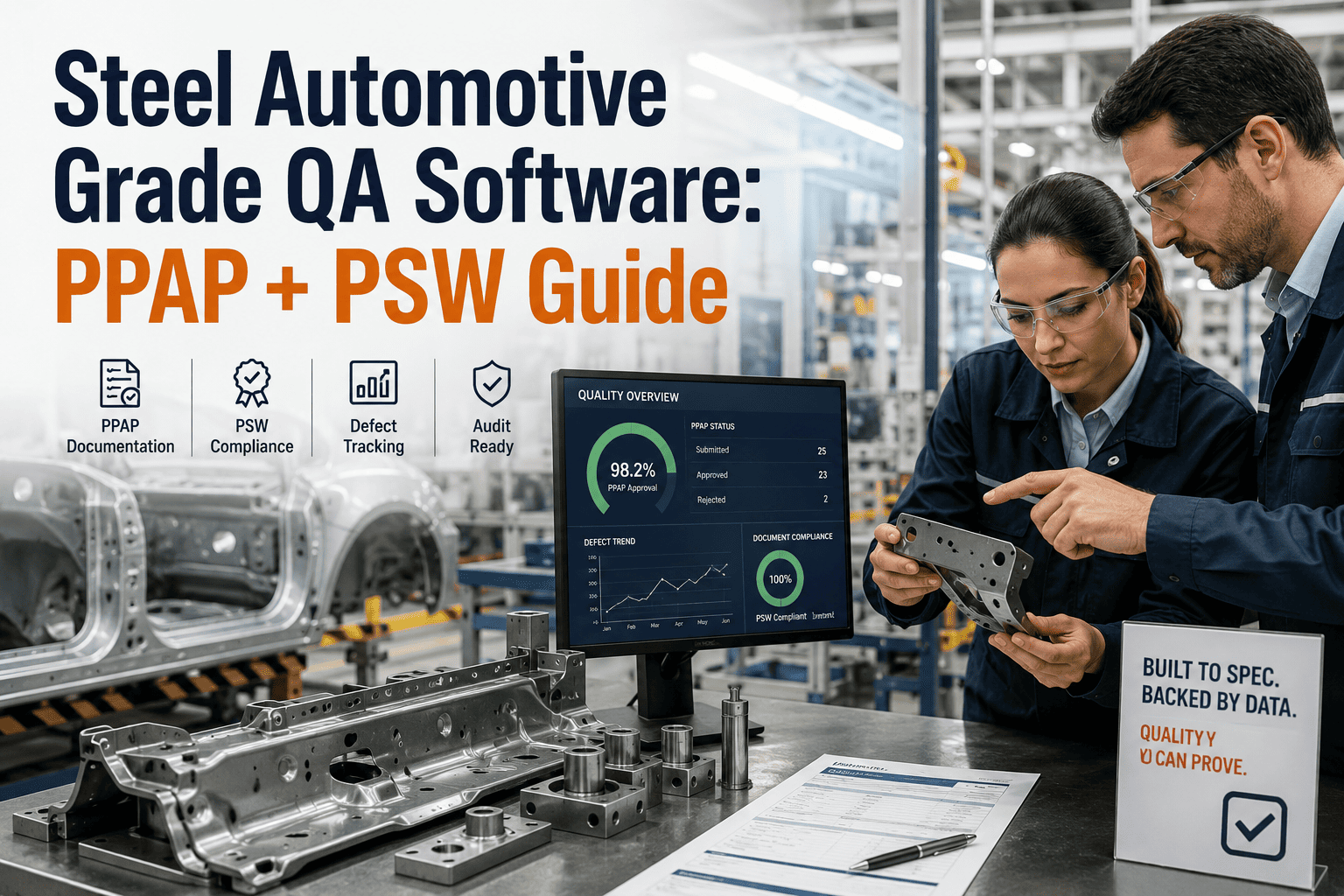
Production Part Approval Process Level 3 requires 18 documented elements submitted to and approved by the customer before first production shipment. The 8 elements below receive the most scrutiny during IATF surveillance audits of steel plants — because they are the elements most likely to be stale, incomplete, or disconnected from current manufacturing conditions.
| PPAP Element |
Steel Plant Application |
Re-submission Trigger |
OxMaint Evidence |
| Process flow diagram |
Process route from steelmaking to coil — each step with inputs, outputs, and controls |
Any change to process route or production location |
Asset hierarchy links each process step to equipment record |
| PFMEA |
Process FMEA for all significant failure modes — must be updated when process or equipment changes |
Equipment change, new failure mode identified |
Failure mode history and CA records feed PFMEA update evidence |
| Control plan |
Control methods and frequency for every critical characteristic — linked to monitoring equipment |
New characteristic, changed tolerance, or process change |
PM schedule validates control plan adherence continuously |
| MSA studies |
Gauge R&R for every measurement system on critical characteristics (<10% for critical) |
New gauge, repaired instrument, or annual re-evaluation |
Calibration records + MSA results stored per gauge asset |
| Initial process study |
Minimum 25 subgroups demonstrating Cpk >1.67 before first PPAP submission |
Any process change affecting critical characteristic |
SPC dashboard with Cpk per characteristic, exportable for PPAP package |
| Qualified lab documentation |
Accreditation or qualification evidence for all test equipment and labs used in PPAP testing |
Lab accreditation renewal; new test equipment |
Calibration and accreditation records per test equipment asset |
| Part submission warrant |
Signed declaration that all PPAP requirements have been met — countersigned by customer on approval |
Any re-submission event |
PSW stored with approval date and customer signatory in compliance module |
| Records of compliance |
Ongoing production records demonstrating continued compliance with PPAP-approved conditions |
Continuous — surveillance auditors sample current records |
SPC data, calibration logs, PM completion records — all current in OxMaint |
PPAP re-submission trigger: Any maintenance event that changes a production process parameter on a PPAP-approved finishing stand — including a roll change that alters crown profile — requires a customer change notification before shipping product made with the changed process. OxMaint generates automatic change notifications when qualifying PM work orders close on PPAP-linked assets.
MSA & SPC — The Measurement and Statistical Compliance Framework
MSA Requirements
Gauge R&R (GRR)
10 parts × 3 operators × 2 trials minimum. %GRR <10% for critical; 10–30% conditionally acceptable. Required for every measurement system on a designated special or critical characteristic.
Linearity & bias
Confirms gauge accuracy across the full operating range. Required where measurement range is wide relative to tolerance — common in thickness gauging across cold mill product portfolios.
Attribute MSA
Kappa statistic >0.75 for visual and go/no-go inspection systems. Surface inspection and flatness visual checks both require documented attribute MSA with defined agreement results.
Re-study schedule
Annual minimum or on any measurement system change. OxMaint schedules MSA re-study work orders per gauge asset and triggers immediate re-study on calibration failure events.
SPC Requirements for Automotive Steel
Cpk >1.67 target
Not 1.33 — IATF requires 1.67 for OEM-designated characteristics. Any characteristic with Cpk <1.67 requires a documented improvement plan with timeline and assigned owner.
All 8 Western Electric rules
All rules must be implemented, not just out-of-control points. Every rule violation requires documented investigation with root cause, corrective action, and effectiveness verification.
Reaction plans per chart
Documented response specifying who is notified, what containment activates, when product goes on hold, and when the customer is informed. Auditors check for specificity, not just existence.
Maintenance correlation
SPC alarm investigations must include maintenance record review. OxMaint's CMMS-SPC integration surfaces relevant PM history automatically when an alarm is raised.
Cpk >1.67 at PPAP Is Not Enough. You Need It at Every Surveillance Audit.
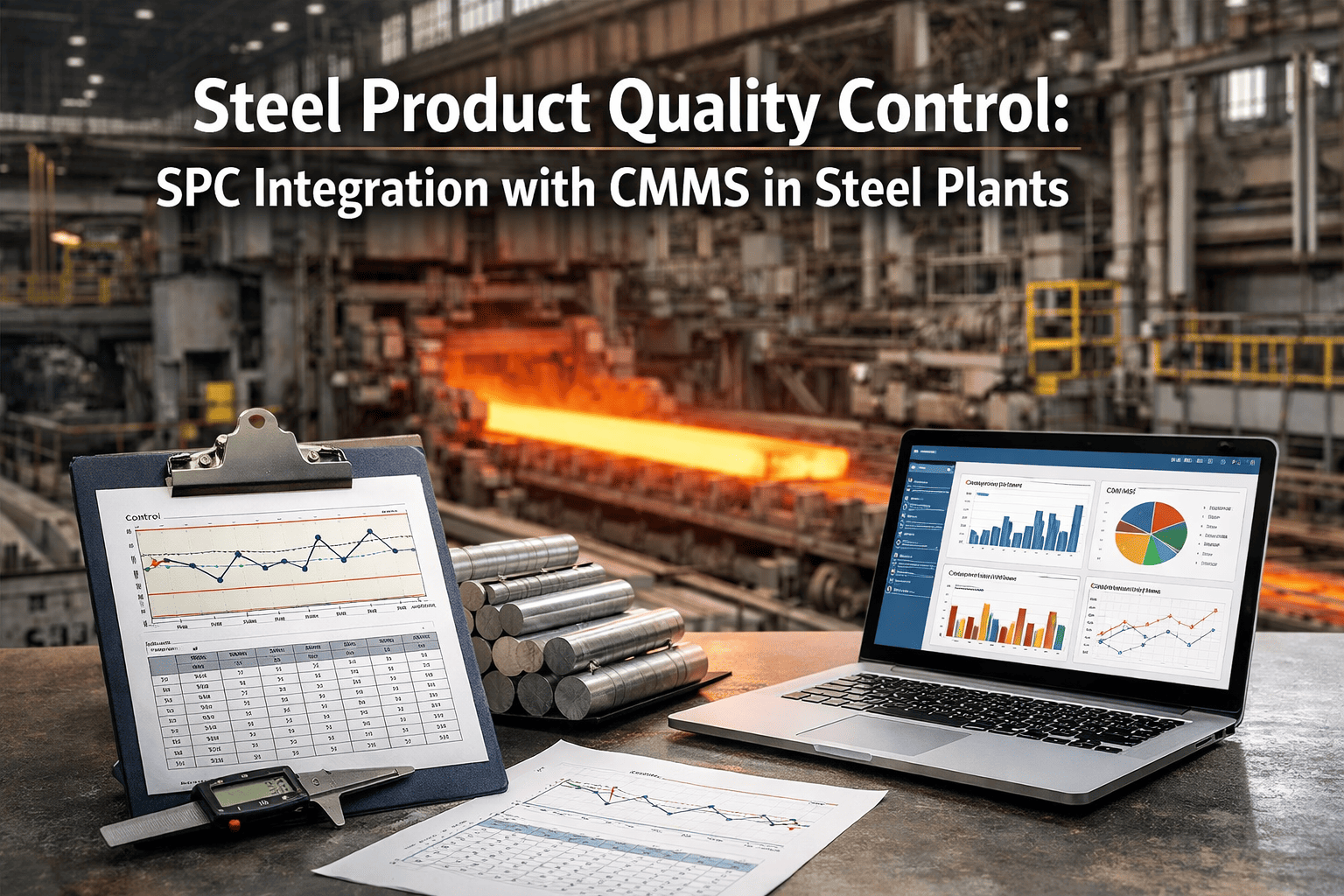
OxMaint tracks Cpk trends across roll campaigns, links SPC alarms to maintenance history, and generates the continuous evidence your IATF auditor needs without a pre-audit records sprint.
Clause 8.5.1.6 — The CMMS Compliance Connection
IATF 16949 Clause 8.5.1.6 requires documented evidence that production equipment is maintained to a written PM programme, with records showing actual vs planned maintenance, deviation management, and predictive maintenance for critical equipment. This is the clause that connects CMMS records directly to IATF compliance — and it is cited in the majority of finding reports when automotive auditors inspect steel plant maintenance management systems.
| Clause 8.5.1.6 Requirement |
What Auditors Examine |
OxMaint Evidence |
| Documented PM plan per asset |
Written schedule with tasks, frequencies, and responsible roles — not just a calendar date |
PM schedule per asset with task descriptions, intervals, and role assignments |
| PM completion records |
Evidence PM was performed — deferred PMs require documented reason and rescheduled date |
Work order timestamps, technician ID, actual vs planned date per asset |
| Predictive maintenance evidence |
Condition monitoring data feeding maintenance decisions on critical equipment |
Vibration, thermal, and oil analysis records per asset with PM trigger history |
| Maintenance-to-quality linkage |
Can the plant trace a quality deviation to a maintenance investigation? Do maintenance events trigger quality verification? |
CMMS-SPC integration — post-maintenance quality verification work orders auto-generated |
| Change notification for process modifications |
Equipment or process changes generate customer notifications before automotive product ships |
Change notification workflow triggered by PPAP-relevant maintenance scope categories |
Common IATF Finding Areas — Steel Plant Audit Intelligence
01
Calibration Gaps
Gauge in use on the production floor without a current calibration certificate — any single instance is a Major nonconformity. Auditors physically sample gauges against the calibration register. OxMaint alerts 30 and 7 days before expiry and prevents out-of-calibration gauges from appearing in inspection records.
02
Stale MSA Studies
PPAP-era MSA studies that have not been repeated after instrument repair, process changes, or annual review. The question is always: is this MSA current for the measurement system in service today? Auditors trace the MSA to the specific gauge serial number and calibration record.
03
Shallow Corrective Actions
The most frequent finding area. Corrective actions that address the symptom without documented 5-Why or Ishikawa root cause analysis, or that are closed by management sign-off rather than verified effectiveness re-measurement. OxMaint enforces root cause method selection and effectiveness verification before closure.
04
Maintenance-Quality Gap
Quality escape investigation that attributes the cause to equipment without reviewing maintenance records — and records that show PM was overdue at the time of the quality failure. The gap between CMMS and the quality system creates a systemic finding, not just a quality finding.
"
The IATF 16949 finding I raise most frequently in steel plant audits is not a process control failure — it is a maintenance record gap adjacent to a quality escape. The corrective action says "equipment malfunction" and the CMMS shows three consecutive missed PMs in the preceding quarter. That is not a quality problem; that is a management system problem. The maintenance programme and the quality programme must be one integrated system. Plants that run them in parallel, connecting them only when something goes wrong, will fail the same audit finding at every surveillance cycle until the integration is structural.
IATF 16949 Lead Auditor, Bureau Veritas
16 Years Automotive Supply Chain Auditing · Specialist: Steel and Metals Tier-1 Suppliers · 400+ IATF audits across flat-rolled, coated, and structural steel facilities in Europe, Asia, and North America
Frequently Asked Questions
What triggers a PPAP re-submission for a steel supplier after initial approval?
Any change to production process, equipment, tooling, material, or subcontractor that could affect a PPAP-approved characteristic. In steel plant practice: roll change on a PPAP-critical stand, furnace controller replacement, or acid concentration process change all require at minimum a customer change notification. OxMaint generates automatic notifications when qualifying PM work orders close on PPAP-linked assets.
See OxMaint's PPAP change notification workflow.
How frequently must MSA studies be repeated to maintain IATF 16949 compliance?
No fixed interval is mandated — studies must repeat when the measurement system changes or annual re-evaluation shows degraded performance. Best practice for automotive steel is annual re-evaluation for critical characteristics, with immediate re-study triggered by calibration failure events. OxMaint schedules MSA re-study work orders per gauge on the defined interval.
Book a demo to see MSA scheduling in OxMaint.
What is the difference between IATF 16949 base requirements and OEM Customer-Specific Requirements?
IATF 16949 is the minimum standard. Each OEM publishes Customer-Specific Requirements (CSRs) — VDA 6.3 from Volkswagen, Ford Q1, GM BIQS, Stellantis CSRs — that add requirements on top of the base. A steel supplier to multiple OEMs must satisfy every applicable CSR simultaneously. OxMaint's compliance module supports multi-customer requirement mapping per customer record.
Compliance Tracking · OxMaint · IATF 16949
IATF 16949 Evidence Is Built Every Day. Not Assembled the Week Before an Audit.
OxMaint's Compliance Tracking connects PPAP documentation, SPC Cpk trending, MSA study schedules, CMMS maintenance records, and corrective action management — producing the IATF 16949 audit evidence your surveillance auditor needs as a byproduct of daily operations.