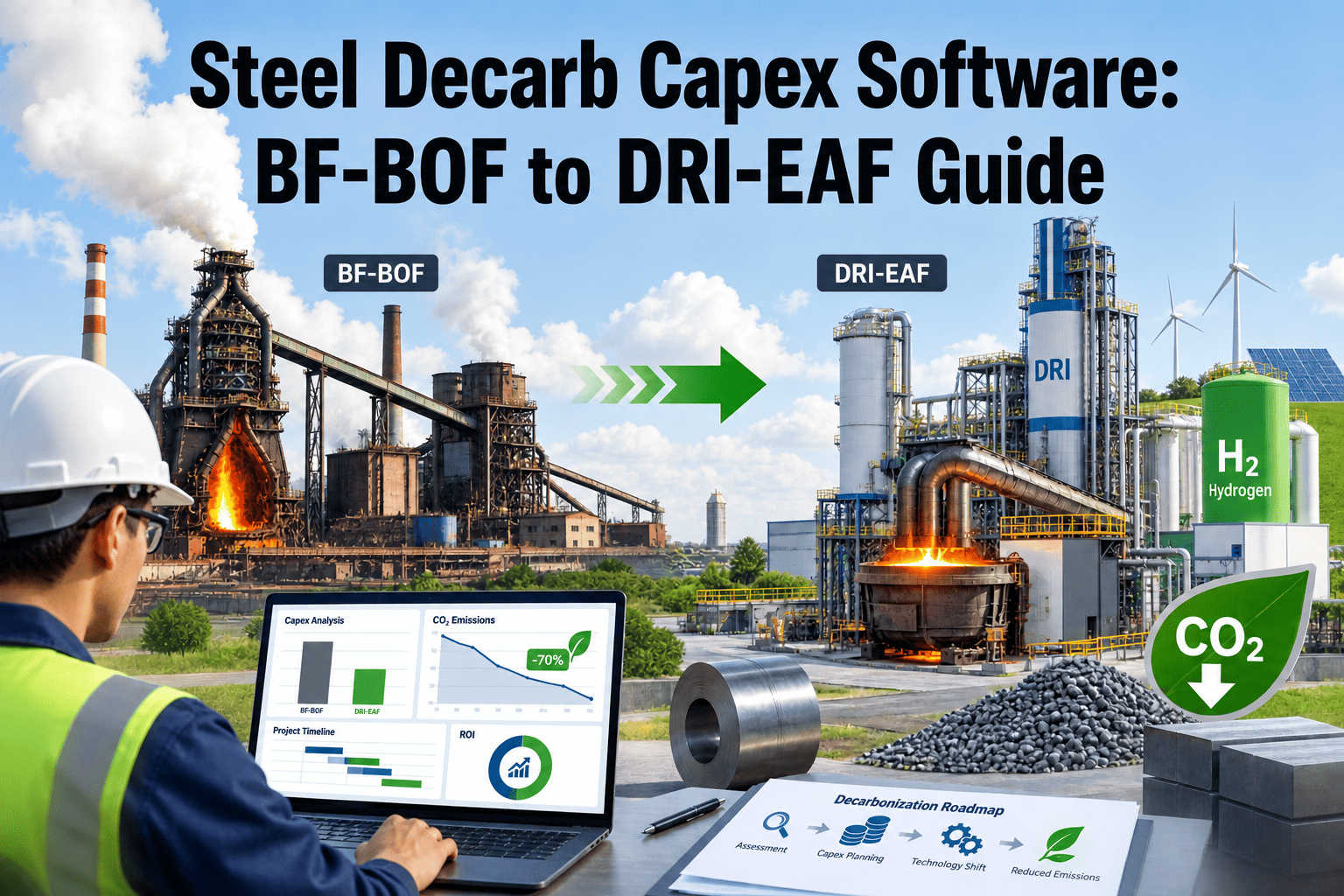
Converting an integrated steel mill from the blast furnace and basic oxygen furnace route to direct reduced iron and electric arc furnace production is a capital decision measured in hundreds of millions of dollars and years of sequencing, not a single project with a single go-live date. Get the sequencing wrong and a plant either strands a freshly relined blast furnace that locks in another fifteen to twenty years of coal-based production, or it rushes an EAF online without the grid capacity, scrap supply chain, or DRI and HBI import bridge to actually run it at rate. Get the sequencing right and the EAF commissioning lines up with the natural end of the blast furnace campaign, hydrogen-ready DRI infrastructure gets built in phases instead of all at once, and the capex curve tracks against real operating savings instead of stranded assets. This guide lays out the phase-by-phase capex sequencing discipline that separates a well-run BF-BOF to DRI-EAF conversion from an expensive stumble, and shows how a platform such as Oxmaint keeps both the old and new asset base under one maintenance and capital tracking system through the transition.
The Capex Trap Most Conversions Fall Into
A blast furnace reline is a fifteen to twenty year commitment disguised as a maintenance event. Any plant that relines a furnace within a few years of a planned DRI-EAF conversion effectively strands $200 to $400 million of capital that will never earn out its return. The plants that sequence conversion well work backward from the blast furnace's remaining campaign life, aim EAF commissioning at that natural end point, and build the DRI, HBI import, and grid infrastructure on a timeline that has the new iron unit supply ready before the old one goes cold. That backward planning is a capital allocation exercise as much as an engineering one, and it depends on accurate, current data about the condition of the existing blast furnace campaign.
Six Phases of a BF-BOF to DRI-EAF Conversion
Every conversion is different in scale and site constraints, but the sequencing logic below holds across most integrated mill transitions. Each phase gates the next — skipping ahead on capital commitment before a phase is closed out is where budgets slip.
Feasibility and Campaign Assessment
Assess remaining blast furnace campaign life, model financial case including capex, opex savings, and carbon credit value, and set a target conversion window.
Grid and Infrastructure Study
Commission a grid capacity study covering the 50 to 100-plus megawatts an EAF requires, plus flicker and harmonic analysis, and secure the interconnection agreement early since this often sets the critical path.
Scrap and Iron Unit Supply Chain
Evaluate scrap quality, quantity, and copper or tin contamination levels, and determine how much DRI or HBI virgin iron is needed to hit flat product quality targets.
HBI Import Bridge
Bridge the gap before on-site DRI capacity comes online by contracting imported hot briquetted iron, so EAF quality and yield are not compromised during ramp-up.
Permitting and Construction
Secure environmental approvals and permits in parallel with construction, and phase the build so EAF commissioning targets the blast furnace campaign end date identified in phase one.
Hydrogen-Ready DRI Scale-Up
Bring on-site DRI online running natural gas first with hydrogen blending capability designed in, so the plant can raise hydrogen content as supply and cost allow without another capital cycle.
Track Old and New Assets on One Capital Timeline
Oxmaint tracks blast furnace campaign condition alongside EAF and DRI commissioning milestones, so capital sequencing decisions are based on current asset data, not last year's inspection report.
BF-BOF vs. DRI-EAF — The Capital and Operating Picture
The financial case for conversion rests on comparing a known cost — relining and running the existing blast furnace — against a capital-intensive but lower-emission alternative. The table below frames the comparison a capital planning team typically builds for a single production line conversion.
| Factor | BF-BOF (Reline and Continue) | DRI-EAF (Convert) |
|---|---|---|
| Capital commitment | $200-400M reline, locks in 15-20 more years | $400-600M per Mtpa new EAF, plus DRI/grid infrastructure |
| Lifecycle CO2 vs. baseline | No material change | 90-95% lower on the hydrogen-ready DRI-EAF pathway |
| Grid dependency | Minimal incremental load | 50-100+ MW per furnace, plus flicker and harmonic mitigation |
| Iron unit flexibility | Fixed to coke and iron ore supply chain | Scrap, DRI, and HBI blend can flex with market price |
| Product quality path | Established for all flat product grades | DRI/HBI blending closes most contamination gaps; ultra-low carbon grades still developing |
Closing the Product Quality Gap
The historical objection to EAF-based flat product steel was contamination — copper and tin carried in scrap that segregates to the surface and shows up as defects in automotive-grade sheet. That gap has narrowed considerably. Blending DRI or HBI with scrap dilutes tramp element concentration, better scrap sorting technology keeps contaminated material out of the charge, and advanced ladle metallurgy cleans up what remains. Most automotive-grade steel grades are now routinely produced through the EAF route. The remaining quality-sensitive grades — ultra-low carbon and certain silicon steels — are the ones where capital planning teams still need to model a longer transition runway or a higher DRI blend ratio.
Where Conversion Budgets Actually Slip
Capex overruns on these conversions rarely come from the EAF vessel itself. They come from the supporting infrastructure that gets under-scoped in the feasibility phase.
Grid Interconnection Delays
Utility interconnection studies and upgrades frequently run longer than the EAF construction schedule itself, making this the most common critical-path slip.
Scrap Market Volatility
Long-term scrap supply contracts locked in during feasibility can look very different in price and quality by the time the EAF actually commissions years later.
HBI Import Logistics
Ports, storage, and shipping contracts for imported HBI need lead time most teams underestimate when treating it as a short-term bridge measure.
Overlapping Asset Maintenance
Running the old blast furnace and commissioning the new EAF in parallel doubles the maintenance workload for several years, straining teams that are not resourced or systemized for it.
Give Your Capital Planning Team Current Asset Data
Sequencing decisions are only as good as the data behind them. Oxmaint keeps blast furnace condition, EAF commissioning status, and DRI ramp-up all visible in one place.
Managing the Transition Asset Base in One Platform
During a multi-year conversion, a plant is effectively running two capital programs at once — sustaining the existing blast furnace and commissioning the new DRI-EAF assets. Tracking both in disconnected systems is how sequencing decisions get made on stale information.
Campaign Life Tracking
Monitor blast furnace shell temperature and lining condition trends to validate the campaign end date your conversion timeline depends on.
Commissioning Milestones
Track EAF, DRI plant, and grid interconnection commissioning milestones against the capital plan in one shared timeline.
Dual-Asset Work Orders
Manage preventive maintenance for BF-BOF assets being phased out alongside new EAF and DRI equipment being commissioned, without duplicate systems.
Capital and Opex Reporting
Roll up maintenance spend, downtime cost, and capital milestone status into reports built for the capital planning committee.
Vendor and Contractor Tracking
Keep construction contractors, HBI suppliers, and grid interconnection vendors documented against the milestones they are accountable for.
Emissions and Credit Documentation
Maintain the emissions reduction records that support the carbon credit value built into the original financial case.
Frequently Asked Questions
How long does a full BF-BOF to DRI-EAF conversion take?
Why does timing matter so much relative to the blast furnace reline schedule?
What role does HBI import play in the conversion?
How much grid capacity does an EAF conversion require?
How does Oxmaint support a multi-year decarb capex program?
Sequence Your Decarb Capex on Real Asset Data
Campaign tracking, commissioning milestones, and dual-asset work orders — all in one platform built for the BF-BOF to DRI-EAF transition.