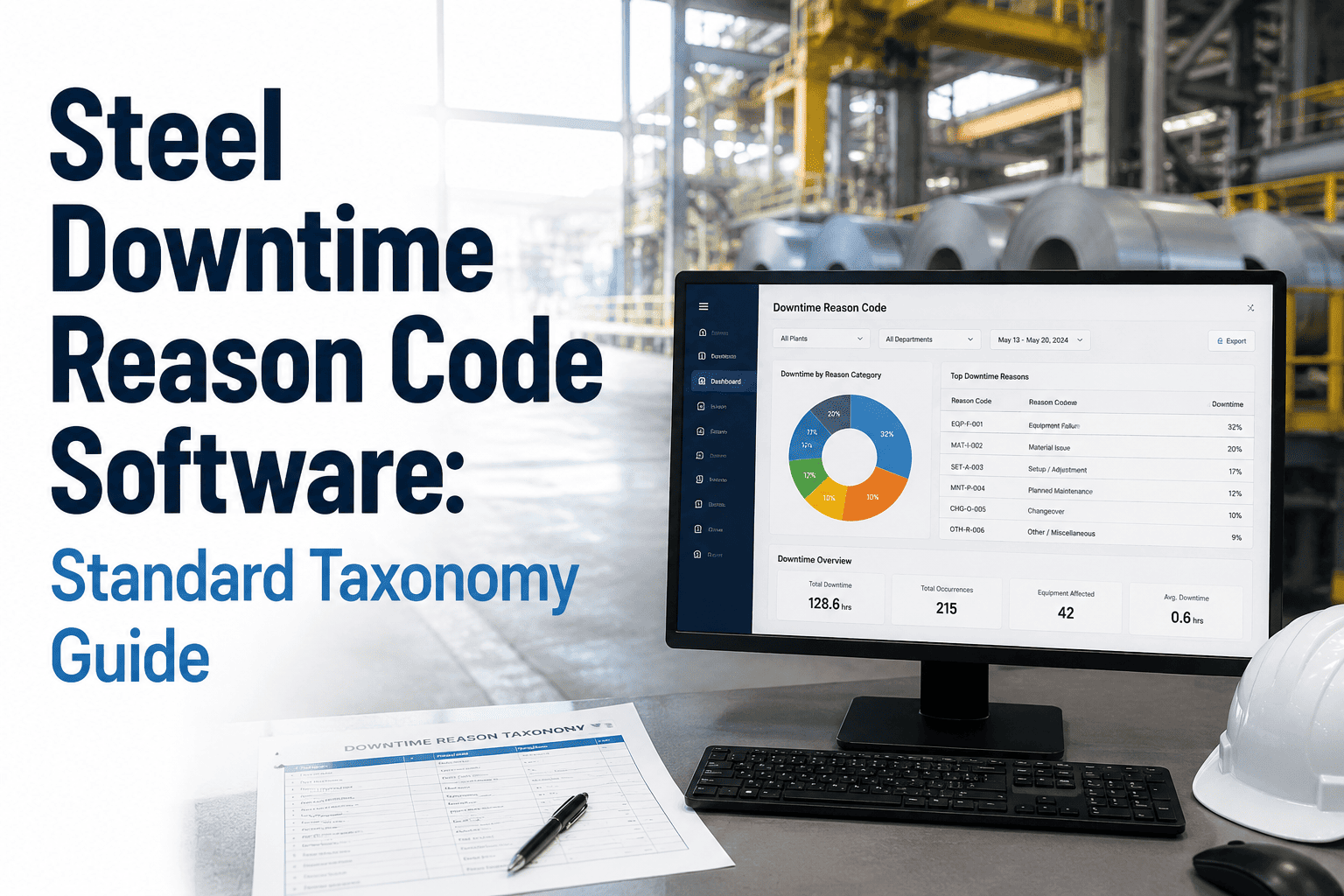
Ask five operators why the same caster stopped last Tuesday and you will likely get five different answers — "mechanical issue," "waiting on crew," "process delay," "material problem," and one honest "not sure." None of those labels tell a maintenance planner what actually happened, and none of them can be summed, ranked, or trended against next month's stoppages. This is the quiet failure sitting underneath most steel plant OEE numbers: the equipment is instrumented, the dashboards look sophisticated, but the reason codes behind every stoppage are inconsistent, free-text, or invented after the shift ends. A standard downtime reason code taxonomy fixes this at the source, turning every stoppage into structured, comparable, actionable data the moment it happens. Oxmaint builds that taxonomy into your CMMS reason code workflow so every operator, on every shift, across every production area, logs downtime the same way.
Standard Downtime Reason Code Software for Steel Plants
Replace guessed, free-text, end-of-shift downtime notes with a governed reason code taxonomy that every operator applies the same way — from blast furnace to cold mill.
Why "Mechanical Issue" Is Not a Downtime Reason Code
Every steel plant tracks downtime. Very few plants can trust the reason attached to it. When a hot strip mill stand stops, the operator is focused on restarting production, not typing a precise explanation — so the log gets a vague label, or nothing, and someone reconstructs the "reason" from memory at the end of the shift. Multiply that across three shifts, six production areas, and hundreds of stoppages a month, and the downtime log becomes a collection of opinions rather than a dataset. Two operators watching the identical failure will describe it two different ways, which means the same failure mode gets split across multiple labels and never surfaces as the recurring problem it actually is.
This is why plant managers routinely see OEE dashboards that look precise — decimal-point availability percentages, neat pie charts — built on top of a downtime reason field that is functionally noise. A blast furnace running at 65% OEE is losing more than a third of its production capacity, and if the reason codes underneath that number are vague, the loss stays invisible no matter how good the reporting software looks. The gap between an integrated mill running at 68% availability and one running at 85% is worth roughly a million dollars a year in a mid-size operation, and that gap cannot be closed by a dashboard — it can only be closed by knowing, specifically and consistently, what stopped the equipment.
There is a second, quieter cost to inconsistent reason coding: root cause work becomes guesswork by committee. When a reliability engineer pulls a Pareto chart to decide which failure mode deserves the next improvement project, a taxonomy full of "mechanical issue" and "process delay" cannot tell them whether the real driver is a worn guide bracket, a control loop tuning problem, or a scrap-charging bottleneck upstream. Improvement teams end up chasing whichever failure is most recent or most visible rather than the one that is actually costing the most tonnage, and the same recurring failure keeps reappearing under a slightly different label every time it happens.
The Three-Tier Structure Every Steel Reason Code Needs
A reason code taxonomy is not a long dropdown list — it is a hierarchy. Tier 1 sets a small number of mutually exclusive top-level categories so every stoppage belongs to exactly one bucket. Tier 2 breaks each category into the specific failure families your maintenance and process teams actually act on. Tier 3, used selectively, adds equipment-specific detail for high-frequency or high-cost failure modes. Steel plants that skip straight to a flat list of fifty codes end up with selection fatigue on the shop floor and a taxonomy that drifts within months.
How Reason Codes Feed OEE and ISO 22400
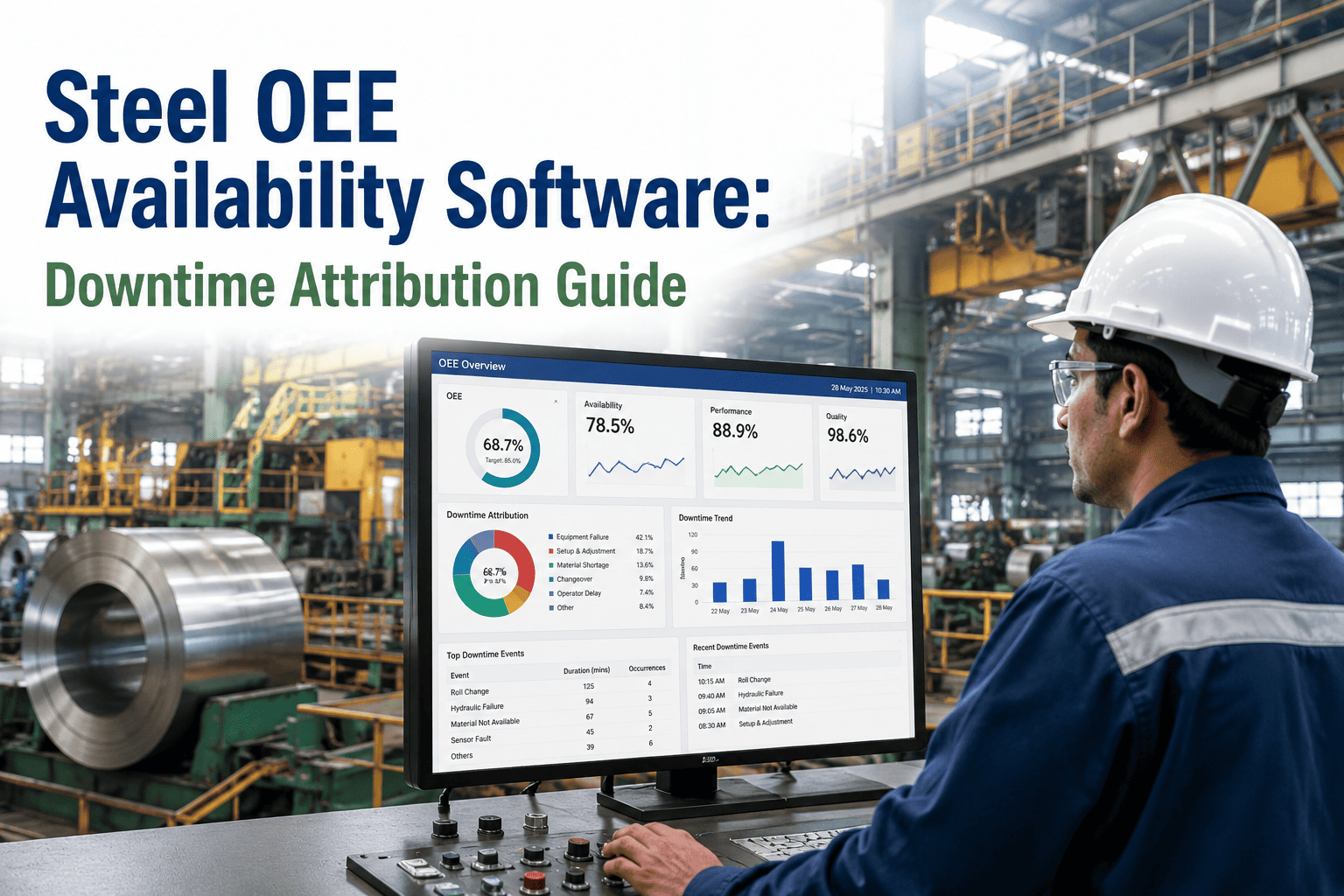
Overall Equipment Effectiveness is defined under ISO 22400, the international standard for manufacturing operations management KPIs, and it is built from three components: availability, performance, and quality. Downtime reason codes are what feed the availability calculation with meaning. An unplanned equipment stop, a changeover, and a scheduled reline all reduce uptime differently — one is a genuine availability loss, one may be excluded as planned time, and one belongs in a completely separate maintenance budget line. Without a taxonomy that separates these cleanly at the point of entry, the availability figure itself becomes unreliable, even though the arithmetic behind it is correct.
A well-built taxonomy also keeps performance and quality losses from bleeding into availability. Minor stops under a defined threshold, small speed reductions from an aging drive, and short quality holds should route to their own loss categories rather than being absorbed into a generic "downtime" bucket. Getting this separation right is what lets a single, consistent reason code log feed the availability number, the performance number, and the quality number at the same time — instead of three disconnected reports that never quite reconcile with each other in the monthly review.
Why Steel Downtime Coding Is Harder Than Discrete Manufacturing
Reason code taxonomies are common across manufacturing, but a steel plant presents a harder version of the problem than a packaging line or an automotive stamping cell. Steel processes are continuous and interdependent — a stoppage at the caster does not just cost caster time, it can force the melt shop to hold a heat, which forces the blast furnace to adjust burden flow. A single event often needs to be logged at multiple points in the process chain, and a taxonomy that treats each area in isolation loses the upstream and downstream relationship that actually explains why the stoppage happened.
Steel equipment also runs through extreme thermal and mechanical stress that produces failure modes rarely seen elsewhere — refractory burn-through, breakout risk, roll wear from scale and heat cycling, and hydraulic contamination from high-temperature environments. A generic, off-the-shelf reason code list built for discrete assembly lines simply does not have categories for these failures, which is why steel plants that try to adopt a one-size-fits-all taxonomy usually end up routing most of their stoppages into "other" within the first month.
Give Every Operator the Same Downtime Vocabulary
Oxmaint deploys a governed, hierarchical reason code list directly at the point of stoppage, so the code selected in the pulpit matches the code a planner sees in the report — every time, every shift, every area of the plant.
Sample Reason Code Sets Across a Steel Plant
A usable taxonomy is not identical across every production area — a caster fails differently than a cold mill, and a code list copied wholesale from one area to another will feel wrong to the operators using it within the first shift. The table below shows how Tier-1 categories translate into area-specific Tier-2 codes, giving you a starting reference before you validate the list with your own operators and Pareto data specific to your equipment history.
| Production Area | Top Availability Driver | Common Tier-2 Codes | Typical Tier-1 Count |
|---|---|---|---|
| Blast Furnace | Planned relines and cooling system stops | Reline, tuyere change, cooling leak, burden delay | 5 |
| BOF / EAF | Refractory and electrode maintenance | Refractory patch, electrode change, lance fault, scrap delay | 6 |
| Continuous Caster | Segment maintenance and mold changes | Breakout, nozzle clog, mold change, ladle wait | 5 |
| Hot Strip Mill | Roll changes and threading delays | Roll change, cobble, AGC fault, coil handling | 6 |
| Cold Mill | Strip threading and coil changeover | Threading delay, tension fault, coil change, surface reject | 5 |
| Utilities / Cranes | Cross-area material handling delays | Crane wait, ladle transport, hoist fault, power dip | 4 |
Notice that the Tier-1 count stays close across every area — four to six categories regardless of how mechanically different a blast furnace is from a cold mill. That consistency is intentional: it keeps a plant-wide Pareto readable even when you drill from a total-plant view down into a single production area, because the top-level structure of the taxonomy never changes, only the detail underneath it.
A Four-Step Roadmap for Building the Taxonomy
Standardizing reason codes is not a one-meeting decision — it is a short, structured project that most steel plants can complete in six to eight weeks if it follows a clear sequence rather than trying to design the perfect list on the first attempt. Trying to skip ahead to a finished, plant-wide taxonomy without this sequence is the single most common reason rollout projects stall or get quietly abandoned by frustrated operators.
Mine the History
Pull existing downtime logs, however messy, and identify the twenty to thirty failure modes that already account for most of the recorded time. This Pareto becomes the backbone of the new code list.
Draft the Hierarchy
Group the identified failure modes into three to five Tier-1 categories and organize the specific codes underneath them as Tier 2, keeping every entry mutually exclusive.
Validate on the Floor
Walk the draft list past experienced operators from each shift, asking whether each code is clear and whether anything important is missing before it goes live.
Pilot and Adjust
Run the list on one or two lines for four to six weeks, tracking entry time and "Other" usage, then refine before rolling it out across the full plant.
Six Rules for a Taxonomy That Survives the Shop Floor
Keep Tier 1 Small
Three to five top-level categories, mutually exclusive, so any operator can place a stoppage in exactly one bucket without hesitating.
Cap Tier 2 Near 20
Fifteen to twenty-five codes across all categories covers the overwhelming majority of events cleanly without causing selection fatigue.
Build From the Pareto
Identify the twenty to thirty failure modes that already account for most historical downtime and let those drive your initial code list.
Validate With Operators
Walk proposed codes past experienced crew from every shift before rollout — their real-world language catches gaps a desk exercise never will.
Pilot Before Plant-Wide
Run the list on one or two lines for four to six weeks, tracking entry time and "Other" usage before pushing it across the whole site.
Govern the Edit Path
Changing a code after the shift should require an approval trail, not a casual edit — otherwise your history quietly loses its meaning.
Mistakes That Quietly Corrupt a Reason Code Taxonomy
Most steel plants that abandon their reason code system do not fail because the initial list was wrong — they fail because small, well-intentioned decisions eroded it over the following year. A few patterns show up again and again across plants that have tried and struggled with structured downtime tracking, and recognizing them early is far cheaper than rebuilding the taxonomy from scratch after two years of unreliable data.
Letting "Other" Become a Category
A catch-all code is useful for genuinely novel events, but once it exceeds ten percent of entries it is absorbing failures that deserve their own code, and the taxonomy needs revisiting.
Adding Codes Without Removing Any
Every new failure mode tempts a team to add a new code, but a list that only grows eventually recreates the same selection fatigue the original taxonomy was built to prevent.
Allowing Post-Shift Edits
A reason code changed hours after the event, without an approval trail, is no more reliable than a free-text guess — it simply looks more structured on the report.
Free-Text Guesswork vs. a Governed Taxonomy
The difference between these two approaches rarely shows up as a dramatic single event — it shows up as a slow accumulation of untraceable time across a full quarter, then surfaces suddenly when a plant manager asks why availability has not improved despite two capital projects aimed at the "biggest" losses on a report nobody fully trusts.
Free-Text Downtime Log
Reason entered from memory at end of shift
Same failure logged under different labels by different crews
"Other" and "Unknown" dominate the report
No reliable Pareto — root cause work targets guesses
Reason codes can be edited with no audit trail
Oxmaint Governed Taxonomy
Reason selected at the point of stoppage, in real time
Fixed hierarchy applied identically across every shift
"Other" usage held under ten percent through active review
Live Pareto ranks losses by cost and frequency automatically
Every code change is timestamped, attributed, and reviewable
What Oxmaint's Reason Code Engine Actually Does
Mandatory Classification at Restart
A stoppage cannot be closed out without a Tier-1 and Tier-2 reason selected, so the data is captured while the event is fresh, not reconstructed later from memory at the end of a twelve-hour shift.
Area-Specific Code Sets
A caster operator never sees cold mill codes and a hot mill crew never sees blast furnace categories — each production area is scoped to only the codes relevant to its own equipment, cutting search time and keeping the decision fast and accurate.
Live Pareto and Trend Views
Every classified stoppage feeds a running Pareto by area, shift, and equipment, so the highest-cost failure mode is always visible on the dashboard, not buried in a monthly spreadsheet that is already stale by the time it is reviewed.
Governed Edit and Approval Trail
Reclassifying a stoppage after the fact requires role-based approval rather than a casual edit, and every change is timestamped, attributed to a specific user, and available for audit at any time.
"Other" Usage Monitoring
Dashboards flag areas or shifts trending toward overuse of catch-all categories, prompting a taxonomy review before the data quality erodes past the point of being useful for root cause work.
Direct OEE Integration
Reason codes map straight into availability, performance, and quality loss buckets aligned with ISO 22400, so the OEE number on the dashboard and the reason behind it always agree with each other.
What Changes Once the Taxonomy Is Standardized
Steel Downtime Reason Code FAQs
How many reason codes should a steel plant actually use?
Aim for five to six Tier-1 categories and fifteen to twenty-five Tier-2 codes overall. Fewer produces data too coarse to act on, more causes selection fatigue and a growing "Other" bucket. Start a free trial to load a validated starting taxonomy for your plant.
Should changeover time count as downtime?
That depends on your plant's OEE convention, but regardless of the classification, changeover needs its own distinct code kept separate from unplanned failure, or you lose the ability to see how much time is planned versus genuinely unplanned.
Can existing historical downtime data be reclassified?
Yes, though most plants find it more valuable to standardize going forward and treat the new taxonomy as the point where trustworthy history begins. Book a demo to discuss migration options for your existing logs.
Who should own the reason code list once it is live?
A single governance owner, typically a reliability or continuous improvement lead, working with a defined change-control process and shift representation. Casual, uncontrolled edits by multiple people are what cause taxonomies to drift within months.
How often should the taxonomy be reviewed?
Review shortly after launch using operator feedback and "Other" usage rates, then on a regular cadence afterward. Merge codes nobody uses and split any code that is absorbing too many different failure modes.
Turn Every Stoppage Into Usable Data
A reason code taxonomy is a small project with an outsized payoff — most plants recover the investment within a single quarter once the top repeat loss finally becomes visible instead of hiding inside an "other" category. Oxmaint deploys a governed, area-specific reason code taxonomy across your steel plant, enforces classification at the point of stoppage, and feeds a live Pareto so maintenance and operations always know what to fix first, on every shift, without waiting for a monthly report to tell them what already happened weeks ago.