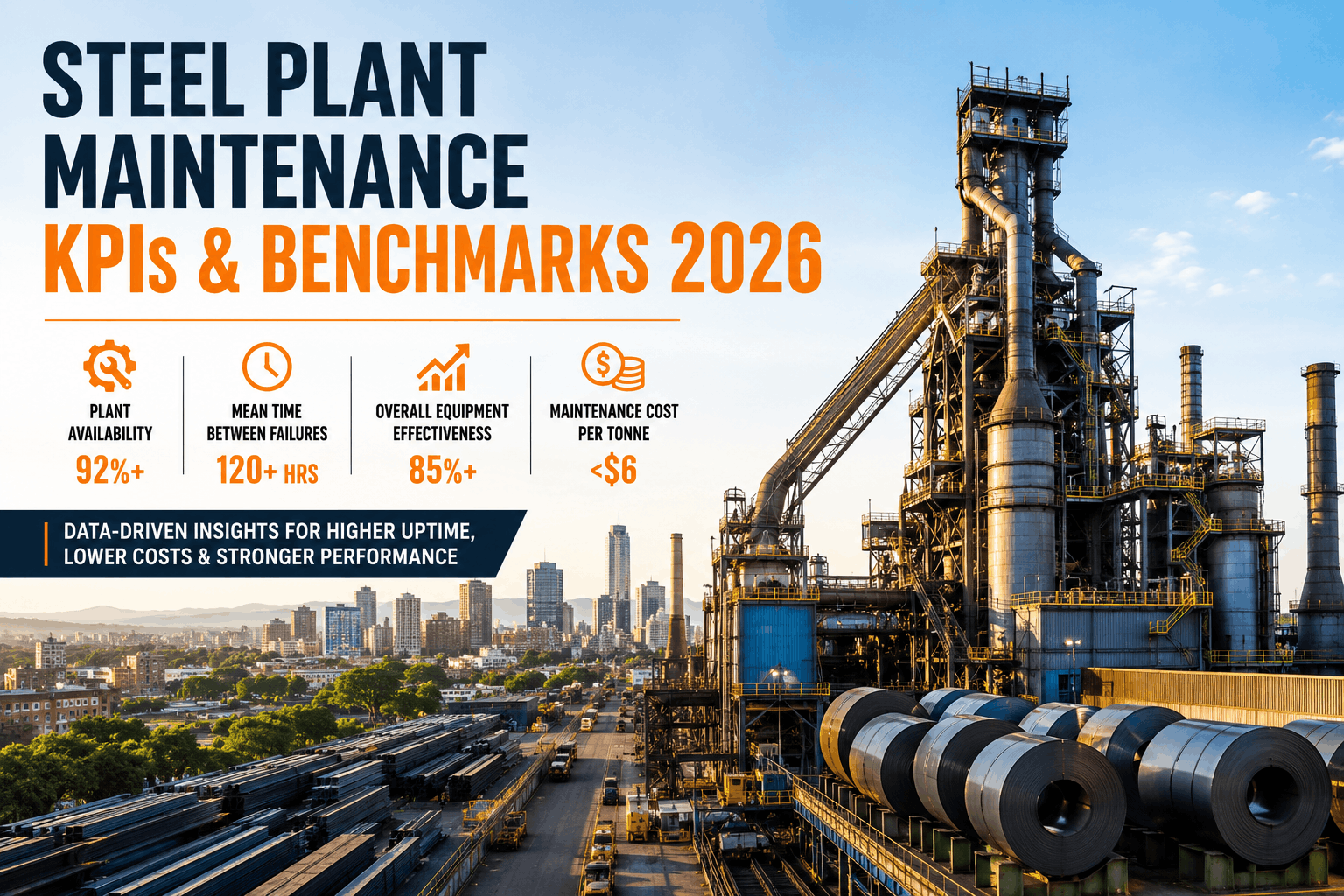
Steel plant maintenance managers frequently operate without clear visibility into how their performance compares against industry peers. Is 92% availability competitive or lagging? Does $18 per tonne maintenance cost represent efficiency or overspending? Without benchmark data, improvement initiatives lack direction and investment decisions lack justification. This 2026 benchmark report compiles performance data from over 200 steel facilities worldwide, establishing quartile benchmarks across cost, availability, compliance, and staffing metrics. Use these benchmarks alongside Oxmaint's benchmark analytics to identify where your facility stands and where improvement opportunities exist.
Steel Industry Maintenance Benchmark Report 2026: KPIs, Costs & Best Practices
Industry performance data from 200+ steel facilities to measure, compare, and improve your maintenance organization.
Methodology and Data Sources
This benchmark report aggregates anonymized performance data from steel facilities across North America, Europe, and Asia. Participating facilities include integrated blast furnace operations, electric arc furnace mini-mills, and specialty steel producers ranging from 500,000 to 8 million tonnes annual capacity. Data sources include industry association surveys, published academic studies, consulting firm assessments, and aggregated metrics from Oxmaint customers who opted into anonymous benchmark sharing. Quartile boundaries represent actual performance distribution—top quartile indicates the 75th percentile and above, while bottom quartile represents the 25th percentile and below.
Maintenance Cost Benchmarks
Maintenance cost metrics reveal significant variation across the industry. Top-quartile performers achieve maintenance costs below $12 per tonne of crude steel production, while bottom-quartile facilities exceed $24 per tonne—a 2x differential that translates to tens of millions of dollars annually for a typical 2-3 million tonne facility. Understanding where your costs fall helps identify whether spending represents inefficiency or appropriate investment in asset reliability.
| KPI | Top Quartile | Median | Bottom Quartile |
|---|---|---|---|
| Total Maintenance Cost per Tonne | <$12/t | $15-18/t | >$24/t |
| Maintenance as % of RAV | <2.5% | 3.0-3.5% | >4.5% |
| Corrective Work Percentage | <15% | 25-35% | >50% |
| MRO Inventory Turns | >2.5x | 1.5-2.0x | <1.0x |
| Contractor Spend Ratio | 20-30% | 35-45% | >55% |
The corrective work percentage metric deserves particular attention. Facilities with reactive maintenance exceeding 50% of total work orders typically experience 15-25% higher total maintenance costs than those below 15% reactive work. The correlation reflects both the premium cost of emergency repairs and the cascading failures that reactive environments generate. Schedule a consultation to analyze your corrective-to-preventive ratio.
Asset Availability Benchmarks
Equipment availability directly impacts production capacity and revenue. A 1% improvement in rolling mill availability at a 2 million tonne facility can represent $2-4 million in additional annual output value. Top performers achieve availability levels that many facilities consider unattainable—yet the data confirms these results are achievable with disciplined maintenance practices.
| KPI | Top Quartile | Median | Bottom Quartile |
|---|---|---|---|
| Overall Equipment Effectiveness (OEE) | >85% | 75-80% | <65% |
| BF/EAF Mechanical Availability | >96% | 93-95% | <90% |
| Rolling Mill Availability | >94% | 90-92% | <86% |
| Mean Time Between Failures | >720 hrs | 400-550 hrs | <250 hrs |
| Mean Time To Repair | <2.5 hrs | 4-6 hrs | >10 hrs |
MTBF and MTTR metrics reveal maintenance effectiveness more clearly than availability alone. Top-quartile MTBF exceeding 720 hours indicates equipment reliability—failures occur less frequently. Top-quartile MTTR below 2.5 hours indicates maintenance responsiveness—when failures occur, resolution happens quickly. Facilities achieving top-quartile performance in both metrics consistently achieve top-quartile availability. Start a free trial to track these metrics automatically.
Benchmark Your Facility Performance
Oxmaint's benchmark analytics automatically calculate these KPIs from your maintenance data and compare against industry quartiles. See where you stand and identify improvement opportunities with real-time performance dashboards.
PM Compliance Benchmarks
Preventive maintenance compliance correlates strongly with equipment reliability, but only when PM tasks address actual failure modes. High compliance on ineffective tasks produces paperwork without reliability improvement. Top performers combine high compliance rates with PM programs developed through reliability-centered maintenance analysis, ensuring completed tasks actually prevent failures.
| KPI | Top Quartile | Median | Bottom Quartile |
|---|---|---|---|
| PM Completion Rate | >95% | 85-90% | <75% |
| Schedule Compliance | >90% | 80-85% | <70% |
| Planned Work Percentage | >85% | 70-78% | <55% |
| PM to CM Hour Ratio | >4:1 | 2:1-3:1 | <1:1 |
| Work Order Backlog | 2-4 weeks | 4-6 weeks | >10 weeks |
Work order backlog deserves careful interpretation. Too little backlog (under 2 weeks) may indicate insufficient planned work identification—technicians complete assigned tasks but lack ready work when reactive demands subside. Excessive backlog (over 10 weeks) indicates resource constraints or planning failures that allow maintenance needs to accumulate faster than completion capacity. The 2-4 week range provides buffer without accumulating deferred maintenance that degrades equipment condition.
Staffing and Productivity Benchmarks
Staffing metrics reveal organizational efficiency beyond simple headcount. Top-quartile facilities achieve more with fewer people—not through understaffing that sacrifices reliability, but through better planning, reduced reactive work, and effective use of technology. The "wrench time" metric—actual hands-on work as a percentage of shift time—demonstrates this efficiency most directly.
| KPI | Top Quartile | Median | Bottom Quartile |
|---|---|---|---|
| Maintenance FTE per 100k Tonnes | <8 FTE | 10-14 FTE | >18 FTE |
| Wrench Time | >55% | 40-48% | <30% |
| Supervisor to Technician Ratio | 12-15:1 | 8-10:1 | <6:1 |
| Planner to Technician Ratio | 20-25:1 | 15-18:1 | <10:1 |
| Training Hours per Technician | >80 hrs | 40-60 hrs | <24 hrs |
Facilities with wrench time below 30% lose over 70% of paid technician hours to travel, waiting for parts, seeking information, administrative tasks, and other non-productive activities. Improving wrench time from 30% to 55% effectively increases maintenance capacity by 83% without adding headcount—equivalent to hiring 8 additional technicians per 10 currently employed. Book a consultation to identify wrench time improvement opportunities.
Technology and Digital Maturity Benchmarks
Digital transformation in steel maintenance has progressed significantly, with leading facilities leveraging CMMS, mobile technology, and predictive analytics to improve performance. However, adoption remains uneven—many facilities still rely on paper-based systems or underutilize installed technology. The gap between leaders and laggards continues widening as digital capabilities compound over time.
| KPI | Top Quartile | Median | Bottom Quartile |
|---|---|---|---|
| CMMS Work Order Compliance | >95% | 80-88% | <65% |
| Mobile Device Adoption | >90% | 60-75% | <30% |
| Condition Monitoring Coverage | >75% | 45-60% | <25% |
| Predictive Maintenance Adoption | >30% | 10-20% | <5% |
| Digital Documentation Coverage | >85% | 55-70% | <35% |
Predictive maintenance adoption above 30% of PM work orders indicates mature condition-based programs where maintenance timing derives from equipment condition rather than calendar intervals. These facilities avoid both premature maintenance (wasting resources) and delayed maintenance (risking failures). The technology investment required for predictive maintenance pays back through optimized maintenance timing and prevented failures. Oxmaint's analytics platform provides the foundation for predictive maintenance programs.
Track Your KPIs Automatically
Manual KPI calculation consumes hours weekly and often produces inconsistent results. Oxmaint's performance dashboards calculate benchmarks in real-time from your maintenance data—no spreadsheets required.
Best Practices of Top Performers
Analysis of top-quartile facilities reveals consistent practices that differentiate leaders from average performers. These practices aren't secrets—they're well-documented approaches that require sustained commitment rather than proprietary knowledge. The difference lies in execution discipline and organizational alignment around reliability objectives.
Formal RCM analysis completed for critical equipment identifying failure modes, consequences, and appropriate maintenance strategies. PM tasks derived from failure analysis rather than OEM recommendations or historical practice alone.
Structured RCA process for all significant failures with action tracking and effectiveness verification. Learning from failures prevents recurrence and drives continuous improvement in equipment reliability.
Documented standards for alignment, balancing, lubrication, and fastening with compliance verification. Defect-free maintenance execution prevents induced failures from improper installation.
Weekly planning meetings coordinate maintenance with production, ensuring resources align with equipment availability windows and minimizing conflicts between operational and maintenance needs.
Frequently Asked Questions
Start Benchmarking Today
Stop guessing how your maintenance organization compares. Oxmaint's benchmark analytics provide objective KPI measurement against industry standards with drill-down capability to identify specific improvement opportunities. Sign up free and see where you stand.