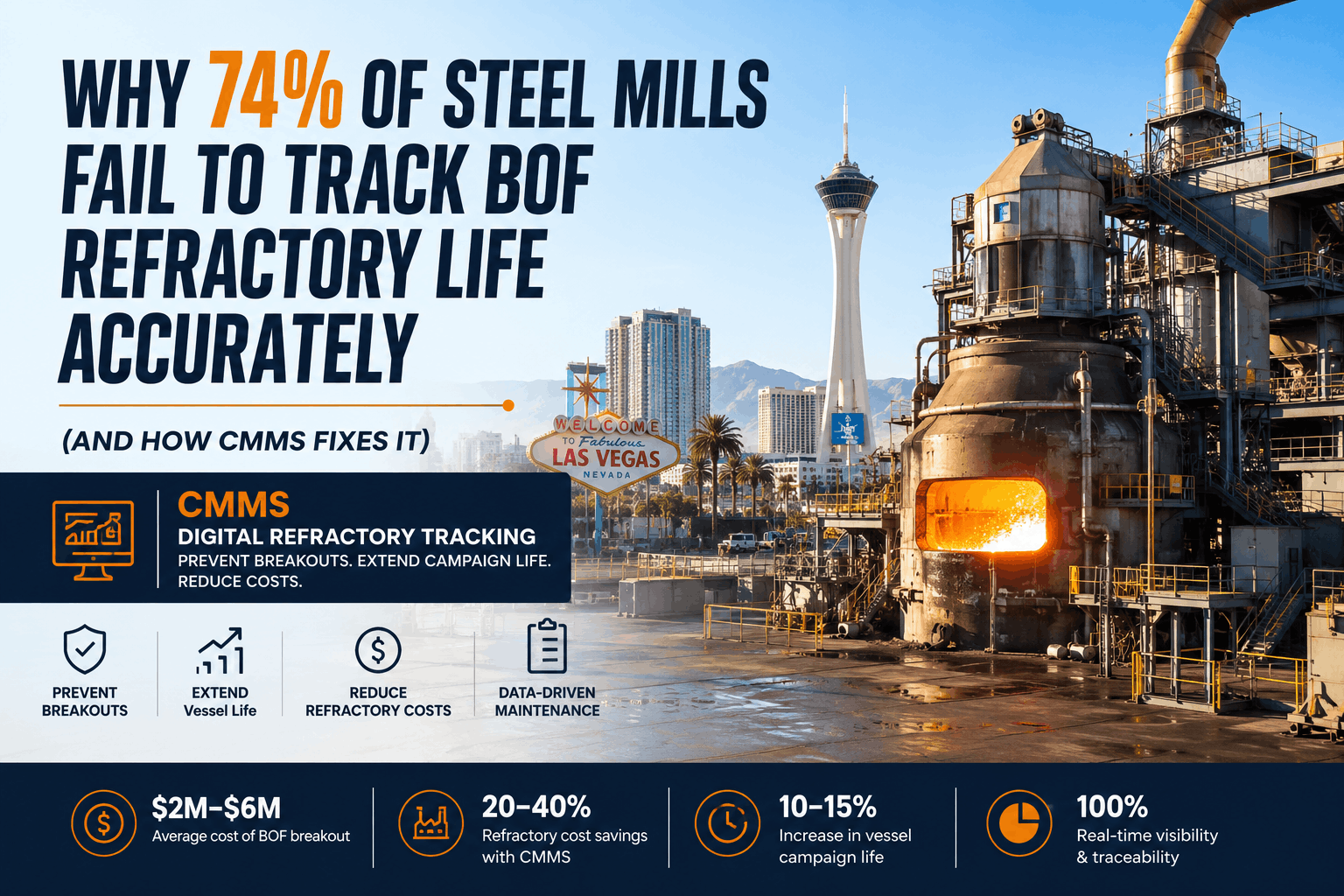
Accurate basic oxygen furnace (BOF) refractory life tracking is the single most critical operational discipline in modern steelmaking. When mills fail to monitor lining thickness, refractory consumption rates, and vessel campaign life with precision, catastrophic breakouts occur—and the costs spiral into millions. According to industry data, 74% of steel plants rely on manual spreadsheets and incomplete records to track BOF refractory condition, leading to unpredictable vessel failures, extended outages, and accelerated refractory consumption. Start Free Trial with Oxmaint's BOF maintenance module to digitize refractory tracking, monitor gunning quality in real time, and predict vessel life with precision—so you can schedule replacements before failure costs you production. Schedule a Demo to see how steelmakers extend BOF campaign life by 15–25% and reduce breakout risk through structured digital lining management. This comprehensive guide equips steel plant engineers and reliability managers with a framework to standardize refractory tracking, optimize gunning cycles, and eliminate the information gaps that lead to unexpected vessel failures.
Why BOF Refractory Life Tracking Directly Impacts Steelmaking Economics
The basic oxygen furnace is the economic heart of integrated steel production. Vessel campaign life—the period between relining operations—determines furnace availability, refractory cost per ton of steel, and unplanned downtime risk. When refractory condition is monitored with precision, campaigns extend 15–25%, refractory consumption per ton decreases, and breakout incidents drop to near-zero. When tracking is incomplete or manual, mills face cascading failures: gunning becomes inconsistent, hot spots develop undetected, breakouts occur during peak production windows, and emergency vessel replacement consumes 48–72 hours of lost production. Start Free Trial to build centralized BOF lining tracking that captures every gunning event, measures residual thickness through automated ultrasonic data logging, and forecasts vessel end-of-life with 3–6 month precision. Mills implementing structured BOF tracking reduce breakout frequency by 60–80%, extend campaign life by 12–24 months on average, and cut emergency outage costs by $500k–$2M annually.
Critical BOF Refractory Failure Modes and Early Warning Signs
Most BOF vessels fail predictably—yet many mills continue operating past safe lining limits because monitoring is fragmented across paper logs, operator notes, and incomplete ultrasonic records. Schedule a Demo to see how Oxmaint consolidates all refractory data and flags approaching failure thresholds weeks before breakout occurs.
Thickness loss or coating erosion creates localized thermal stress points. Without continuous thermal imaging or ultrasonic trending, hot spots remain invisible until shell temperature spikes and breakout occurs mid-campaign, forcing emergency stoppages.
Without shot-by-shot tracking and refractory material batch traceability, gunning quality varies. Poor coating adhesion or inadequate density allows corrosion to accelerate, shortening campaign life by 4–8 weeks.
Refractory wears gradually and unpredictably. Mills relying on quarterly ultrasonic scans miss accelerated wear trends between inspections, allowing thickness to drop below safe limits unnoticed.
Without consumption rate trending, mills cannot predict when campaign will end. Sudden breakouts force reactive replacements during high-demand periods, costing $50k–$150k in lost production per event.
Steel heel corrosion, slag line attack, and thermal cycling damage accumulate unmonitored. Without trend analysis of temperature spikes and corrosion patterns, damage progresses to critical levels before detection.
Inconsistent refractory application or poor density measurement leads to over-gunning (wasted material) or under-gunning (shortened life). Per-shot material tracking can reduce gunning costs by 8–12%.
BOF Refractory Management Framework: Key Tracking Metrics and Standards
Steelmakers implementing structured BOF lining management standardize data collection, establish predictive thresholds, and embed refractory tracking into daily operator discipline. The table below outlines critical BOF tracking elements, failure modes they prevent, and measurable production impact.
| Refractory Tracking Element | Common Failure Mode | Structured Management Practice | Measurement Frequency | Production Impact |
|---|---|---|---|---|
| Lining Thickness Trending | Silent wear masked until breakout | Automated ultrasonic data logging with thickness-to-campaign-life correlation models | Every 50–100 heats | 12–24 month campaign life extension; 60–80% breakout reduction |
| Gunning Quality Tracking | Inconsistent coating density and adhesion | Shot-by-shot material batch logging, density certification, and thermography post-gunning | Per gunning event | 8–12% reduction in refractory consumption; improved campaign predictability |
| Hot Spot Detection | Localized thermal failure undetected | Continuous shell thermocouple monitoring and real-time alert thresholds for temperature spikes | Continuous during operation | Early intervention before critical failure; zero unplanned breakouts from thermal stress |
| Slag Line Corrosion Monitoring | Accelerated wear at high-attack zone | Thermal imaging and post-campaign metallurgical analysis of slag line thickness loss | Per campaign end; weekly during latter half | Optimized refractory grade selection; reduced corrosion-driven failures |
| Consumption Rate Forecasting | Surprise breakout during peak production | Trending cumulative thickness loss and heat count to forecast end-of-life 6–12 weeks in advance | Weekly trending | 100% scheduled replacements; zero emergency outages; strategic maintenance windows |
| Material Batch Traceability | Quality variance from mixed suppliers or aged material | Full material genealogy tracking with firing lot, date, supplier, and performance correlation | Per gunning batch | Rapid root cause identification if quality issues emerge; supplier performance benchmarking |
| Campaign Economics Reporting | Unknown cost per ton and refractory spend optimization opportunity | Automated cost allocation per campaign with cost per ton calculation and material consumption benchmarking | Per campaign end | 3–8% annual refractory cost reduction through supplier and grade optimization |
Building BOF Refractory Intelligence with Digital CMMS
Integrated steel plants achieving best-in-class BOF reliability standardize refractory data collection, establish predictive thresholds, and embed condition-based replacement logic into their CMMS. Schedule a Demo to see how Oxmaint connects thickness data, gunning records, and thermal history into a unified BOF campaign management platform.
- Define standard ultrasonic measurement grid (e.g., 16–24 points per vessel section) and integrate automated thickness logging into CMMS asset records
- Link gunning event records with material batch, inspector sign-off, and thermography results as permanent campaign history
- Configure shell thermocouple data upload to trending database with real-time alert for temperature anomalies exceeding safety thresholds
- Correlate thickness loss rate with heat count, refractory grade, and slag composition to establish mill-specific consumption curves
- Establish safety thresholds for minimum residual lining (typically 150–200mm depending on vessel size) and configure automated end-of-campaign alerts
- Create weekly forecast dashboard showing estimated campaign life remaining with 3–6 month horizon, enabling planned relining windows
- Deploy continuous shell thermocouple arrays with automated alert escalation if any zone exceeds safe operating temperature
- Link thermal imaging post-gunning to vessel map for correlated thickness-temperature trending and early hot spot identification
- Configure automatic work order generation when temperature spike + thickness loss + wear acceleration trends converge, triggering expedited inspection
- Calculate cost per ton and refractory consumption metrics per campaign and benchmark against historical performance and industry standards
- Track supplier material performance correlation (e.g., Supplier A gunning material shows 3% longer campaign life) and use data to optimize supplier contracts
- Monitor gunning material costs, thermal cycling damage patterns, and refractory grade effectiveness to identify cost reduction opportunities
BOF Refractory Monitoring Best Practices and Quick Wins
BOF Refractory Management KPIs and Target Performance
Steel plants deploying structured BOF lining management track data-driven KPIs that directly link to production reliability and economics. Start Free Trial with Oxmaint's BOF analytics dashboard to monitor campaign health in real time and predict vessel life with accuracy.
Total heats produced before refractory thickness reaches minimum safe limit. Mills tracking lining condition digitally achieve 15–25% longer campaigns than manual-tracking mills, reducing relining frequency and cost.
Total unplanned vessel failures or emergency stoppages due to refractory. Below 0.2 indicates best-in-class hot metal discipline and lining monitoring. Each breakout costs $50k–$300k in lost production.
Total refractory spend divided by annual steel production. Trending improvement indicates optimized gunning protocols, supplier performance, and material selection. Industry average: $8–$14/ton.
Percentage of predicted campaign end dates that match actual vessel replacement timing. Accuracy above 85% enables planned replacements during optimal maintenance windows.
Total kg of refractory applied per heat. Reduction indicates improved gunning quality, better adhesion, and less waste. Each 1% reduction in consumption extends campaign life 1–2%.
Count of thermocouple alerts exceeding safe operating temperature. Improvement reflects better lining condition, cooler operation, and early intervention before critical failure occurs.
Customer Success: Real Impact from BOF Refractory Tracking
"Before Oxmaint, we tracked BOF thickness data in Excel spreadsheets and lost track of gunning history across crew transitions. Our campaigns averaged 2,400 heats with unpredictable breakouts that cost us $200k+ per incident. After implementing Oxmaint's BOF module, we standardized thickness tracking across all measurement points and built predictive models from 8 years of historical data. Now we forecast campaign end within 3–4 weeks of actual failure, schedule replacements during planned windows, and have extended our average campaign life to 3,100 heats—a 29% improvement. Breakouts dropped to 0.3 per year, and our annual refractory spend is down 12% even though we're producing 15% more steel. The investment paid back in 4 months."