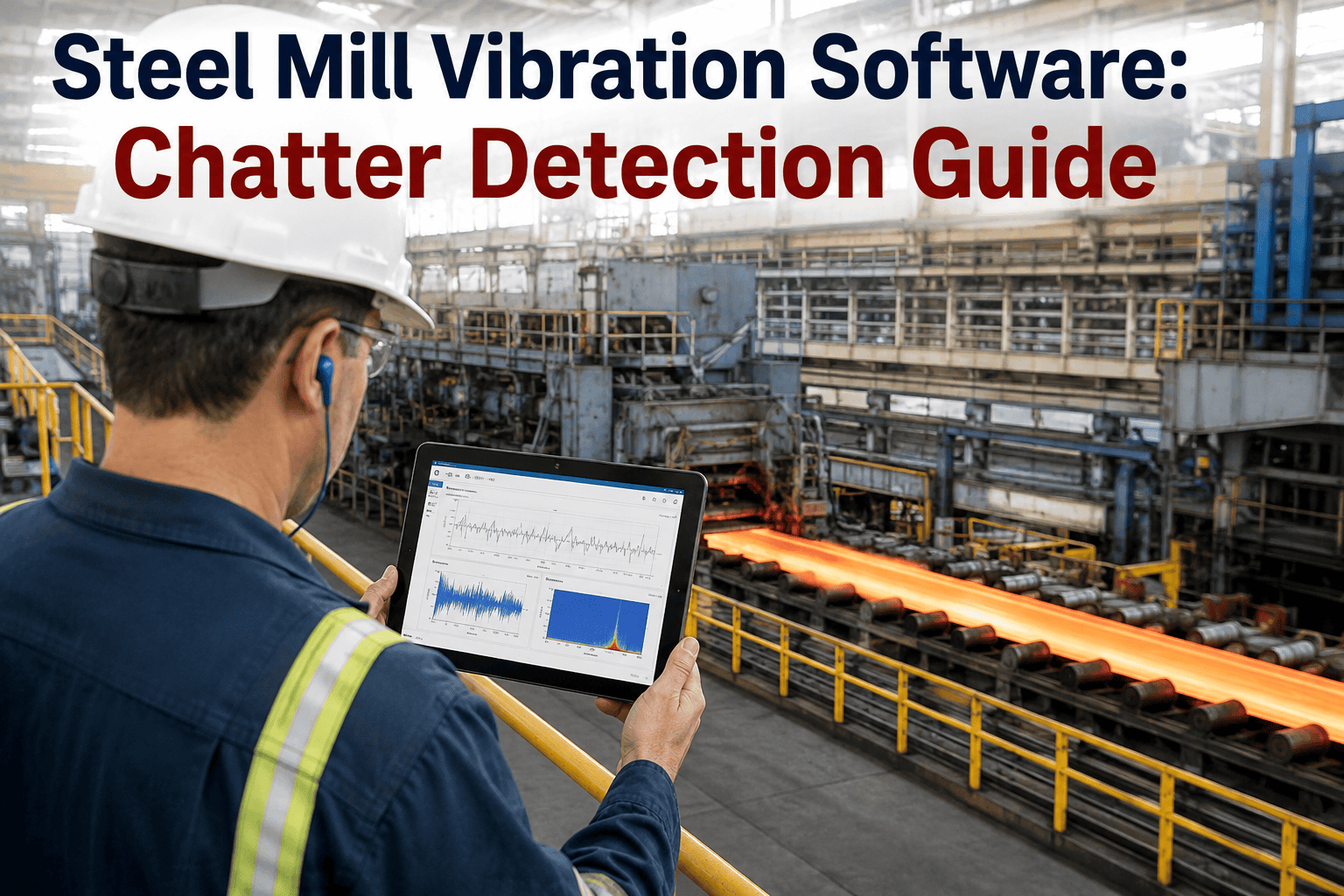
Chatter shows up on a cold rolling mill as a faint rhythmic mark on the strip surface long before anyone hears or feels anything unusual at the stand — by the time an operator notices vibration by ear or by hand on the housing, the marks have usually already been rolling onto product for several minutes or longer. Chatter is a self-exciting vibration between the work rolls and the strip that can start from something as small as a slightly worn bearing or a roll diameter mismatch and escalate quickly once the frequency lines up with a natural resonance in the stand. Because it builds gradually and rarely announces itself with an obvious mechanical fault, most mills only catch it once the surface defect is visible, which means product already downgraded. This guide covers where chatter actually originates on the stand, what vibration severity bands to monitor against, and how continuous monitoring shortens the gap between onset and detection — start a free trial to see vibration monitoring and alerting mapped against your own stand configuration.
Steel Mill Vibration Software: A Practical Chatter Detection Guide
Where chatter originates on the stand, the severity thresholds worth monitoring, and how continuous vibration analytics catches it before it reaches the strip surface.
Why Chatter Is Hard to Catch on the Floor
Chatter is a self-exciting vibration, which means it feeds on itself once conditions align — a small imbalance grows because the vibration it produces reinforces the very forces causing it, rather than damping out on its own. Two common chatter frequency ranges show up in cold rolling: a lower-frequency "third octave" chatter tied to roll stack resonance, and a higher-frequency chatter tied to work roll bearing condition. Both can start from a cause as minor as slight lubrication film breakdown.
Manual monitoring relies on an operator or technician physically checking the stand during a walkaround, using a handheld vibration meter or simply feeling for abnormal vibration at the housing. That works for vibration that has already become severe, but chatter's early stage is often below what a hand or ear reliably catches, particularly on a line running at full mill speed with significant ambient noise and vibration from adjacent equipment.
The cost of catching chatter late is not just the surface marks on the coils rolled while the condition was active. Once a chatter event is severe enough to be caught by a walkaround check, the underlying mechanical cause — bearing spalling, resonance-driven fretting, or accelerated roll wear — has usually already progressed past the point where a minor adjustment would fix it. What starts as a lubrication or alignment issue that could have been corrected during a routine PM often turns into an unplanned bearing replacement or roll change by the time it is noticed manually.
Four Vibration Zones on the Mill Stand That Need Monitoring
Chatter can originate in more than one location on a stand, and each zone tends to produce a distinct vibration signature. Monitoring all four gives a clearer picture of where a developing issue actually sits, rather than relying on a single housing-mounted sensor to catch everything.
Captures overall stand resonance and structural looseness. Often the first place a rising trend appears even when the root cause sits elsewhere.
Bearing spalling and wear generate a higher-frequency signature that is often the earliest indicator of chatter risk building.
Larger bearings carrying the rolling load; degradation here tends to correlate with lower-frequency, higher-amplitude chatter events.
Gear mesh and coupling issues introduce vibration at frequencies tied to drive speed, distinct from bearing or roll-stack signatures.
Vibration Severity Thresholds Worth Monitoring Against
Most mills adapt vibration severity bands from ISO 10816-3, which classifies acceptable vibration velocity by machine class and mounting type. The bands below are a general starting reference — actual thresholds should be tuned against your own stand's baseline once a few months of trend data are available.
Two adjustments matter when applying a general standard to an actual stand. First, mounting type changes the acceptable range meaningfully — a rigidly mounted stand and a stand on a more flexible foundation will read differently at the same underlying mechanical condition, so the same raw threshold cannot be applied to both without adjustment. Second, a band that looks correct in isolation can still generate false alerts if it ignores the stand's own seasonal or shift-pattern baseline, which is why most mills spend the first several weeks of a monitoring rollout simply establishing what normal actually looks like before tightening thresholds.
| Severity Band | Vibration Velocity (mm/s RMS) | Recommended Action |
|---|---|---|
| Normal | Under 2.8 | No action, continue routine trending |
| Watch | 2.8 - 4.5 | Increase trend review frequency, no stoppage needed |
| Alert | 4.5 - 7.1 | Schedule inspection at next planned changeover |
| Critical | Above 7.1 | Stop and inspect before continuing the run |
Map These Severity Bands to Your Own Stand Data
Reference bands are a starting point — real value comes from tuning thresholds against your own mill's baseline and routing alerts straight into a work order. See how that setup looks on your line configuration.
Common Root Causes Behind Chatter Events
Chatter rarely traces back to a single dramatic failure. More often it is one of a handful of gradually developing conditions, each of which produces a slightly different vibration signature and calls for a different fix once identified.
Even a small diameter difference between work rolls changes surface speed at the bite, introducing a periodic disturbance that can grow into chatter under the right speed and tension conditions.
Surface damage inside a bearing race generates a repeating vibration impulse at a frequency tied to bearing geometry and rotation speed, often the earliest measurable sign of trouble.
When a rotating component's frequency lines up with a natural resonance of the stand structure, even minor excitation gets amplified well beyond what the source vibration alone would suggest.
Reduced film thickness between roll and bearing surfaces increases friction variability at the contact point, a common early trigger that precedes more serious mechanical wear.
Manual Monitoring vs. Continuous Vibration Analytics
The practical difference between the two approaches shows up most clearly in how a shift responds to a marginal reading. A manual check either passes or fails based on a single point-in-time observation, with no record of whether the reading has been climbing over the past several shifts. Continuous monitoring keeps that trend visible, so a technician reviewing an alert sees not just the current value but the trajectory that produced it — which is usually enough on its own to tell whether the issue can wait for the next planned changeover or needs immediate attention.
How Continuous Monitoring Handles Chatter Detection
A vibration monitoring setup is only as useful as what happens after a threshold is crossed. The pieces below cover the detection-to-response loop from sensor reading through to an assigned work order.
Vibration velocity trended separately for housing, work roll bearings, back-up roll bearings, and drive train, so a rising trend is visible at the zone level rather than blended into one composite reading.
Severity bands calibrated against each stand's own historical data rather than a generic industry default, reducing both missed early warnings and unnecessary alerts.
A threshold crossing generates a work order routed to the technician responsible for that stand and zone, with the vibration trend attached for context.
Detailed frequency analysis available on demand for a flagged event, useful for distinguishing bearing wear from resonance or roll mismatch during diagnosis.
Frequently Asked Questions
How is chatter different from normal mill vibration?
Normal vibration stays within a stable band tied to running speed. Chatter is self-exciting — a minor disturbance grows because it reinforces the forces causing it, producing a distinct and rising frequency signature rather than steady background vibration.
Which vibration zone is usually the earliest indicator?
Work roll bearing readings often show a measurable rise before housing-level vibration becomes noticeable, since bearing wear tends to generate a higher-frequency signature earlier in its development.
Do the severity bands apply the same way to every stand?
The reference bands are a starting point only. Actual thresholds should be tuned against each stand's own baseline vibration profile, since mounting type and machine class both affect what counts as normal. Book a demo to see threshold tuning against your own stand data.
Can continuous monitoring distinguish bearing wear from resonance?
Yes, when frequency spectrum data is available alongside the overall vibration reading. Bearing wear and resonance produce distinct frequency signatures, which is why zone-level frequency review matters during diagnosis rather than relying on a single composite number.
How quickly can a threshold crossing turn into a work order?
With continuous monitoring tied directly to work order routing, a threshold crossing can generate an assigned work order within minutes rather than waiting for the next scheduled walkaround. Start a free trial to see the alert-to-work-order flow configured for your mill.
Getting Started With Chatter Detection
If a mill is only checking vibration during periodic walkarounds today, the fastest path forward is not necessarily monitoring every zone on every stand at once. Starting with work roll bearing sensors on the highest-throughput stand, running a few weeks to establish a baseline, and tuning thresholds against actual defect history before expanding coverage tends to produce more trustworthy alerts than a full rollout done all at once.
The goal is not more data — it is data that reliably separates a normal shift-to-shift variation from an actual developing issue, routed to the right technician before the surface defect ever shows up on a coil.
Catch Chatter Before It Reaches the Strip Surface
Continuous, zone-level vibration monitoring turns a vague housing vibration into a specific, actionable alert — routed straight to a work order instead of waiting for the next walkaround. Free trial, no credit card required.