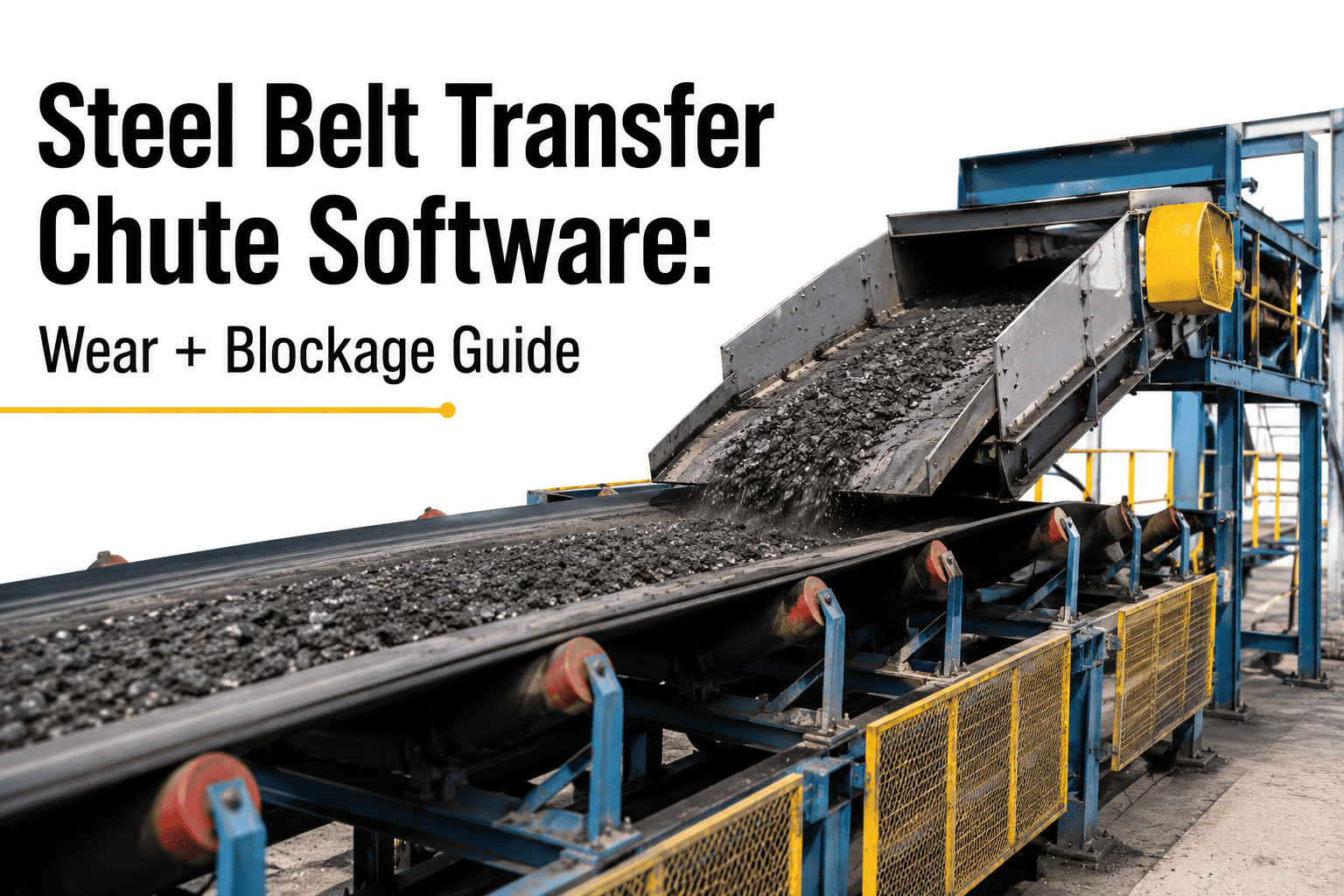
A transfer chute rarely announces its own failure — it just quietly gets worse. A worn liner plate lets fines escape through a gap that started as a pinhole, dust builds along the skirt seal, spillage piles up under the transfer point, and eventually enough material packs into a corner that the chute partially blockages and starves the belt downstream. None of that happens in a single shift. It happens over months of unmeasured liner wear that nobody logged against the chute as an asset, because the chute was treated as a static piece of steel rather than a wear component with a service life. Book a demo to see how OxMaint tracks liner wear and blockage risk per transfer chute.
Steel Belt Transfer Chute Software — Wear & Blockage Tracking
Track chute liner wear, skirt seal condition, and blockage risk per transfer point — the failure chain that starts as a spillage nuisance and ends as a starved downstream process.
Why a Transfer Chute Is a High-Consequence, Low-Attention Asset
Transfer chutes sit at every point where material moves from one belt to another, and steel plants can have dozens of them across a materials handling circuit. Individually, each chute is a simple piece of steel with a liner. Collectively, they are one of the most common sources of unplanned belt damage, dust complaints, and localized flow blockages — precisely because no single chute looks urgent enough on its own to earn a dedicated inspection programme.
From a Worn Liner to a Starved Downstream Process
Chute failure is rarely a single event — it is a chain reaction. A liner wears thin at the impact zone where material first strikes the chute wall. The thinning liner develops a gap, and fines begin sifting through the skirt seal as spillage and airborne dust. Left unaddressed, the same wear that let material out starts letting buildup accumulate on rough, exposed steel inside the chute, narrowing the flow path. Eventually the narrowed path partially blockages, material backs up onto the belt, and the belt either overloads at that point or the transfer point stops feeding the downstream process entirely.
Choosing the Right Liner for Each Wear Zone
Not every point inside a transfer chute wears the same way, and one liner material rarely fits the entire chute. The impact zone, where material first strikes the wall, favors a liner that absorbs energy without cracking. The sliding zone, where material flows along the wall, favors a liner optimized for low friction and abrasion resistance. Matching liner material to wear zone — rather than lining the whole chute in one material for simplicity — is what extends liner service life and reduces how often the chute needs to be entered for repair.
| Liner Type | Best Wear Zone | Strength | Tradeoff |
|---|---|---|---|
| AR Steel Plate | High-impact zones, heavy lump material | Highest impact resistance, low material cost | Heaviest option; adds structural load to the chute frame |
| Ceramic Liner | High-abrasion sliding zones, fine material | Excellent abrasion resistance, long service life | Brittle under heavy impact; not suited to lump loading zones |
| Urethane Liner | Skirt seals, moderate-impact flow surfaces | Absorbs impact, resists sticking and buildup | Lower temperature tolerance than steel or ceramic |
OxMaint tracks liner type, install date, and measured wear per zone inside every chute — so a replacement is triggered by actual wear data instead of a spillage complaint at the transfer point.
Transfer Chute PM — What to Check and How Often
Because most chutes qualify as permit-required confined spaces, internal liner inspection requires an authorized entrant and an attendant, which makes it tempting to defer. A structured schedule that separates external checks — which require no entry — from internal liner inspections keeps the programme practical without skipping the checks that actually catch wear before it becomes a blockage.
Asset Lifecycle Management for the Transfer Chute Network
A plant with dozens of transfer chutes cannot manage them one spillage complaint at a time. OxMaint registers each chute as an individual asset with its own liner history, wear trend, and inspection schedule, so replacement decisions are based on measured data across the entire chute network rather than whichever one is loudest this week.
Nobody schedules downtime for a transfer chute — until the chute schedules it for them in the form of a blockage on backshift. The wear that causes that blockage is measurable months in advance: a liner losing thickness, a skirt seal gap opening a millimeter at a time, material starting to hang up instead of sliding through. What most plants are missing is not the knowledge that liners wear — it is a record that ties that wear to a specific chute, a specific zone, and a replacement date before the spillage complaint turns into a stopped belt.
Frequently Asked Questions
What is the earliest sign of transfer chute liner wear?
Spillage under the transfer point and visible dust at the skirt seal are typically the first external signs, appearing well before internal liner thickness drops to a critical level. See how OxMaint tracks skirt seal condition.
Why do transfer chutes require confined space entry for inspection?
Most transfer chutes meet the criteria for a permit-required confined space, so internal liner inspection needs an authorized entrant and an attendant monitoring from outside, which is why grouping these entries into planned windows matters.
Should the whole chute use the same liner material?
Not usually. High-impact zones benefit from AR steel or thicker liner plate, while high-abrasion sliding zones perform better with ceramic, and skirt seals often use urethane for its buildup resistance. Book a demo to see liner planning by wear zone.
How does chute wear lead to belt damage?
A worn skirt seal no longer holds a tight contact with the belt, allowing fines to work between the seal and belt surface, which accelerates belt edge and cover wear on the conveyor the chute feeds.
What causes a transfer chute to blockage?
Blockages typically follow a period of unaddressed liner wear — exposed steel behind a worn liner roughens the flow surface, material starts sticking instead of sliding, and buildup gradually narrows the chute until flow is choked.
From First Spillage to Scheduled Liner Replacement — One Chute Record.
OxMaint tracks liner type, wear measurements, skirt seal condition, and inspection history for every transfer chute in your plant — catching the wear chain before it reaches a blockage and a stopped belt.