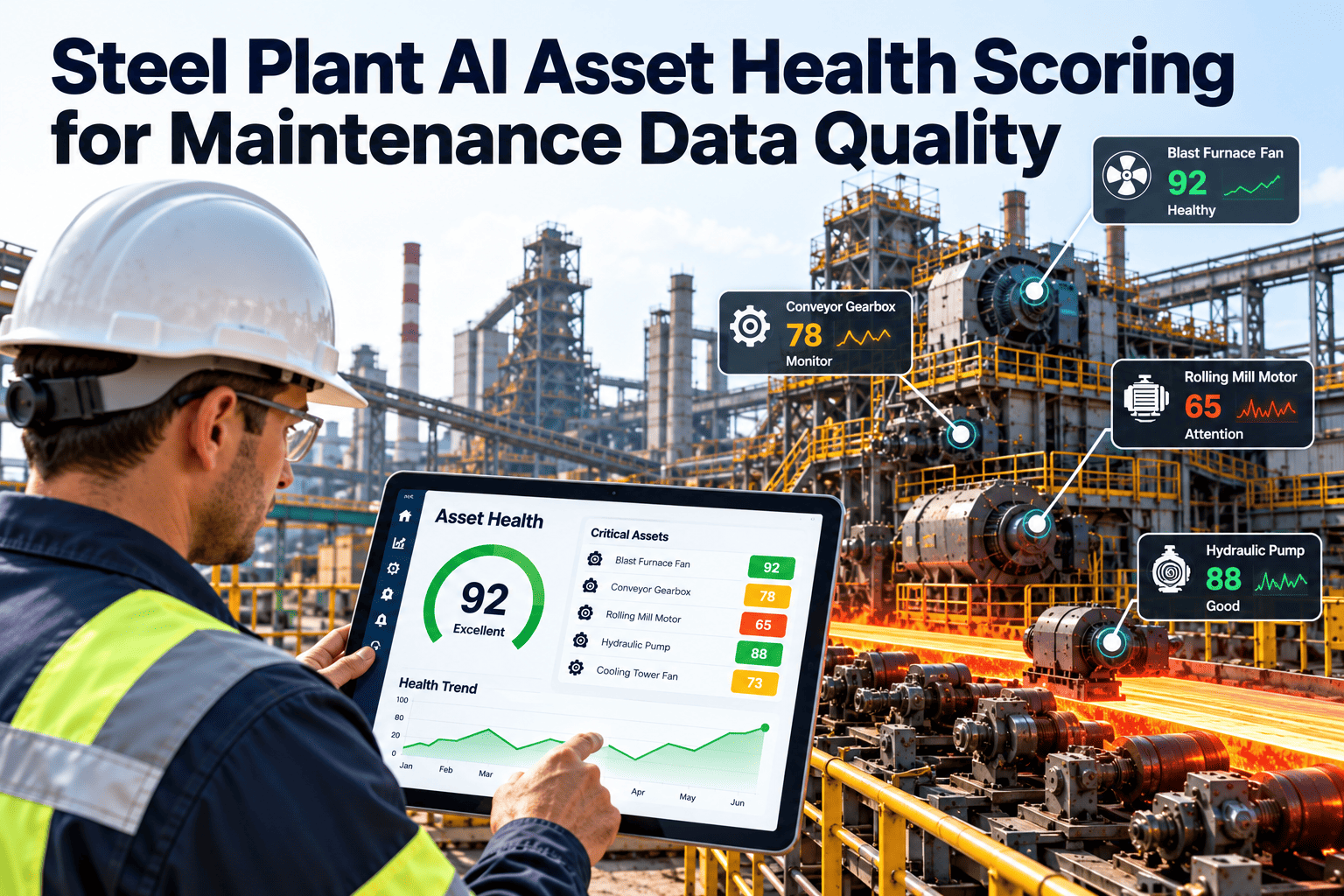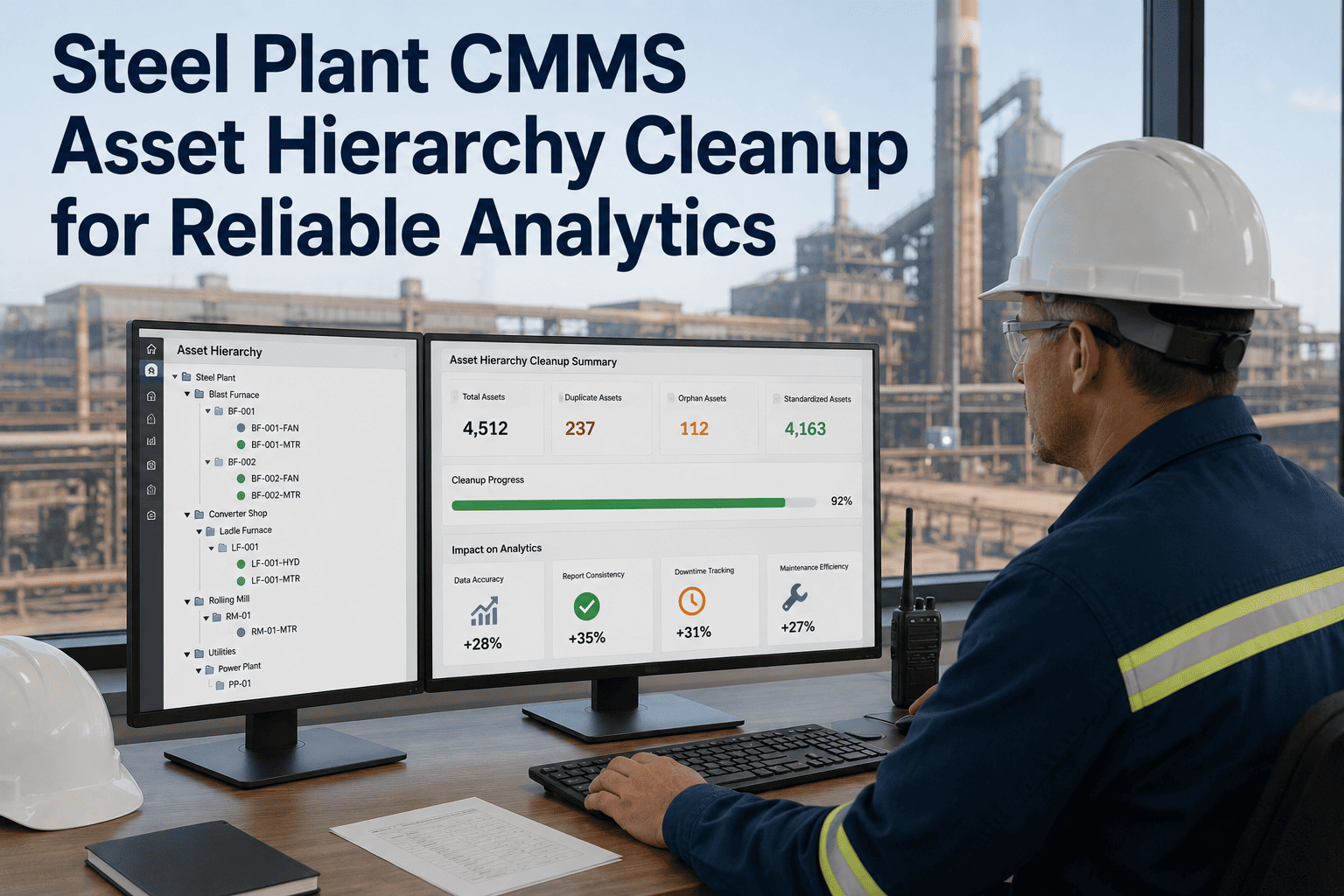
An AI model can only tell you which asset is degrading if it knows what that asset is, where it sits and what it is connected to. In many steel plants, the same gearbox appears under three names, sensors point to areas instead of equipment, and spares have no parent. The result is predictions that cannot be acted on. This article explains how to design an asset hierarchy that supports analytics, from structure and naming to attributes and migration, and how Oxmaint maintenance management software keeps it consistent.
Build an Asset Hierarchy That AI Can Actually Use
A clean hierarchy connects sensors, work orders, spares and failure history to the right piece of equipment. Get the structure right once, and every model, report and inspection benefits.
What a weak hierarchy does to analytics and maintenance
Hierarchy problems rarely look like data science problems. They show up as confusing reports, unreliable costs and alerts nobody can place.
Six levels that work for a steel plant
ISO 14224 defines a taxonomy for equipment data that many process industries adapt. A steel plant does not need every level, but it needs a consistent depth that reaches the maintainable item.
| Level | Purpose | Steel plant examples | What to store here |
|---|---|---|---|
| Plant or site | Reporting boundary and ownership | Integrated works, EAF mini-mill | Location, cost center, owner |
| Area or process section | Group assets by production stage | Raw materials, blast furnace, steelmaking, casting, hot rolling, utilities | Process role, area manager, shutdown windows |
| Unit or line | A production unit that can stop on its own | Caster 2, finishing mill, sinter strand 1 | Capacity, commissioning date, production impact |
| Equipment | The machine maintained as an asset | Gearbox, fan, pump, crane hoist, hydraulic unit | Make, model, serial, criticality, duty |
| Sub-unit | A functional part of the equipment | Input shaft assembly, drive end, lubrication system | Function, parent link, inspection tasks |
| Component or maintainable item | The part replaced or repaired | Bearing, seal, coupling, brake lining | Part number, install date, failure modes, spare link |
Naming and coding rules that survive growth
Names are for people, codes are for systems. Use both, and keep them stable even when equipment moves or is renamed in operations.
- Gearbox no2 mill
- MILL GBX 2 - NEW
- Stand 4 reducer (old)
- Three entries, one machine, no parent
- Code reflects position, such as area, unit, equipment type and sequence
- One record per machine with serial number and tag
- Parent and child links for sub-units and components
- Retired names kept as aliases for search
Six naming rules
- Use one pattern across the whole plant, and write it down.
- Keep codes short, unique and free of spaces or special characters.
- Match the code to the physical tag on the equipment and to the control system tag where possible.
- Never reuse a retired code for a new asset.
- Describe equipment by function and type, not by temporary status such as new or old.
- Assign one owner who approves new assets and changes.
The attributes AI models and planners need on each asset
Structure alone does not make a hierarchy useful. Each level needs the data that lets it be compared, ranked and linked.
Identity
Code, name, serial number, manufacturer, model and physical tag. This lets sensors and records point to the same thing.Location and relationships
Parent, child, process position and upstream or downstream links, so the effect of a failure can be traced.Criticality
A rank based on safety, production and quality consequence. It drives alert priority, spares and inspection depth.Duty and operating context
Rated load, speed, temperature and typical operating states, which help separate normal from abnormal.Failure modes
The ways this equipment type fails, selected from a controlled list so history can be compared across assets.Linked data sources
Sensor tags, oil sample points, inspection forms and manuals connected to the record.Start With a Register People Can Trust
Structure equipment from plant to component, assign owners and connect every work order, inspection and spare part to the right asset.
Rank assets so AI effort goes where it pays back
Criticality turns a flat register into a decision tool. Score each asset against a small set of consequences and review the result with operations.
| Criticality tier | Typical steel plant assets | Maintenance and data approach |
|---|---|---|
| A: Safety or whole-line stop | Ladle cranes, blast furnace blowers, caster drives, main mill gearboxes | Condition monitoring, tight inspection intervals, critical spares, root cause review for every failure |
| B: Production loss or quality impact | Descaling pumps, hydraulic power units, cooling water pumps, key conveyors | Condition monitoring where justified, planned inspections, risk-based spares |
| C: Limited impact with a workaround | Auxiliary fans, standby pumps, secondary conveyors | Preventive routines, run to failure for some items with documented decisions |
| D: Low impact | Lighting, small utilities, non-process equipment | Basic routines and corrective work when needed |
How to fix an existing hierarchy without stopping the plant
Audit what you have
Export the current register, count duplicates, orphans and missing parents, and list the assets with the most work history.Agree the standard
Define levels, naming pattern, required attributes and failure mode lists with maintenance, operations and reliability.Start with critical areas
Rebuild one process area first, walk the equipment to verify tags and update records on site.Map history and data sources
Move past work orders to the right assets where possible and link sensor tags, inspection forms and spares.Lock down governance
Make a named owner approve new assets and block free-text asset creation in work orders.Is your hierarchy ready for AI predictive maintenance?
Hierarchy design mistakes to avoid
| Mistake | Consequence | Better approach |
|---|---|---|
| Building the tree to match the org chart | Structure changes whenever teams are reorganized | Base it on process and equipment, and keep organization as an attribute |
| Going too deep on non-critical assets | Heavy upkeep with little return | Use full depth only where failures matter |
| Putting location in the asset name | Names go wrong when equipment moves | Store location as a field and the relationship as a link |
| Creating assets freely in work orders | Duplicates and typos return quickly | Limit creation to an approver and use scanning |
| Ignoring spares and sub-assemblies | Repair history cannot be traced to parts | Link spares to the parent equipment and components |
How Oxmaint supports a governed asset register
- Asset management: parent and child structure, unique codes, tags and attributes held in one register.
- Work orders: corrective, preventive and inspection work attached to the correct asset or component.
- Mobile workflows: scanning assets in the field instead of typing names from memory.
- Inventory: spares linked to equipment, so parts can be reserved against a work order.
- Reporting and dashboards: cost, downtime and repeat failures rolled up by area, unit and equipment.
- Condition-based workflows: monitoring findings routed to the correct asset for inspection.
Attach each data source at the right level of the hierarchy
Analytics fail when data is attached too high or too low. A vibration reading linked to an area cannot explain a single bearing, while a plant-wide cost total attached to a component is meaningless.
| Data source | Attach at | Why this level | Steel plant example |
|---|---|---|---|
| Vibration and temperature sensors | Component or sub-unit | The signal describes the part that wears | Accelerometer on a drive end bearing |
| Motor current and drive data | Equipment | It reflects the whole machine under load | Main drive motor on a mill stand |
| Oil samples and lubrication routes | Equipment or sub-unit | Oil serves a whole gearbox or hydraulic unit | Gearbox sump sample point |
| Preventive tasks and inspections | Equipment, with findings at component level | Tasks are planned per machine, defects found per part | Quarterly gearbox inspection with a bearing finding |
| Work orders and failure codes | Component whenever possible | Failure mode only makes sense at the failed part | Seal replaced on a hydraulic cylinder |
| Spare parts and bills of materials | Equipment and component | Parts are reserved by machine and fitted by part | Bearing set linked to a gearbox |
| Production downtime | Unit or line | Production stops at line level, then traces to equipment | Caster 2 stop traced to a segment drive |
Hierarchy patterns for common steel plant areas
Each process area has equipment groupings that repay careful modeling. These examples are starting points, not a mandatory template.
| Process area | Typical units | Hierarchy watch points |
|---|---|---|
| Raw materials and sinter | Stackers, reclaimers, crushers, sinter strand, conveyors | Long conveyor routes need position-based sub-units so idlers and pulleys are traceable |
| Blast furnace | Stoves, blowers, charging system, cast house, gas cleaning | Valves and instrumentation need clear parent links to the stove or system they protect |
| Steelmaking (BOF or EAF) | Furnace, ladle handling, fume extraction, cooling water | Cranes, ladles and refractories cross units, so define ownership and shared assets clearly |
| Continuous casting | Ladle turret, tundish, mold, segments, cooling, torch cutting | Segments and rolls repeat many times, so use consistent position codes |
| Hot rolling | Reheating furnace, roughing mill, finishing stands, coilers | Stand drives, gearboxes and hydraulics need component depth |
| Cold rolling and finishing | Pickling, tandem mill, annealing, coating, inspection | Process-linked parts such as rolls and bath equipment need life tracking |
| Utilities | Compressed air, water, power distribution, gas systems | Shared utilities serve many units, so show dependencies rather than duplicating assets |
Handling repeated and movable assets
- Give repeated items such as caster segments or idlers a position code, and track the installed part separately.
- Treat rolls, motors and gearboxes that move between positions as rotating assets with their own history.
- Record each install and removal with a date, so history follows the part and the position.
Keep the hierarchy accurate after the project ends
A register is only as good as its last change. Without control, the structure drifts back into duplicates within a year.
Register owner
One named role approves new assets, merges duplicates and retires old records, usually in reliability or CMMS administration.Project handover rule
New equipment from capital projects enters the register with tags, attributes and spares before it is accepted for operation.Change requests
Moves, replacements and modifications are logged through a simple request, so history follows the equipment.Periodic audit
Walk a sample of critical areas each quarter and compare physical tags with register entries.Hierarchy health measures
- Share of critical assets with complete required attributes
- Number of duplicate or orphan assets found per audit
- Share of work orders booked to component level on critical equipment
- Share of sensor tags mapped to an asset record
- Time taken to add new equipment to the register after commissioning
How hierarchy structure helps AI models directly
Hierarchy is not only bookkeeping. It gives models the grouping, context and labels that raw sensor streams lack.
| Modeling need | Hierarchy feature that supplies it | Practical benefit |
|---|---|---|
| Compare similar machines | Consistent equipment types and classes | Models learn from all fans, pumps or gearboxes instead of one at a time |
| Transfer a model to a new line | Same structure and naming across lines | Setup becomes configuration rather than a new project |
| Explain a finding | Parent and child links down to the component | An alert names the part and the system it belongs to |
| Find cascade effects | Process position and upstream or downstream links | A pump fault can be traced to the line it will stop |
| Label failures | Failure modes tied to equipment type | Training data uses comparable categories across assets |
| Rank risk | Criticality at equipment level | Alerts and spares follow consequence of failure |
Questions to settle before you start restructuring
- Which assets must reach component level, and which can stop at equipment level?
- Who has the authority to approve the standard across areas with different habits?
- How will existing work order history be handled, remapped or archived?
- Which sensor and inspection tags must be mapped first?
- How will new projects and contractors be required to follow the standard?
AI-ready asset hierarchy questions
How deep should the hierarchy go?
Go to the maintainable component on critical equipment, and stop at equipment level for low-impact assets to keep upkeep manageable.Do we have to follow ISO 14224 exactly?
No. Use it as a reference for taxonomy and failure data, then adapt the levels to your plant while staying consistent.Can we fix the hierarchy while the plant runs?
Yes. Work area by area, starting with critical equipment, and verify tags during normal rounds or planned stops.What happens to old work order history?
Remap it to the correct assets where practical, and keep the rest as archived records. You can book a demo to discuss migration.Where should we begin?
Pick one critical process area and build its register in Oxmaint, then reuse the standard for the next area.Give Every Sensor and Work Order a Home
Create a structured asset register that links equipment, history, spares and condition data, so predictions land on the right machine.