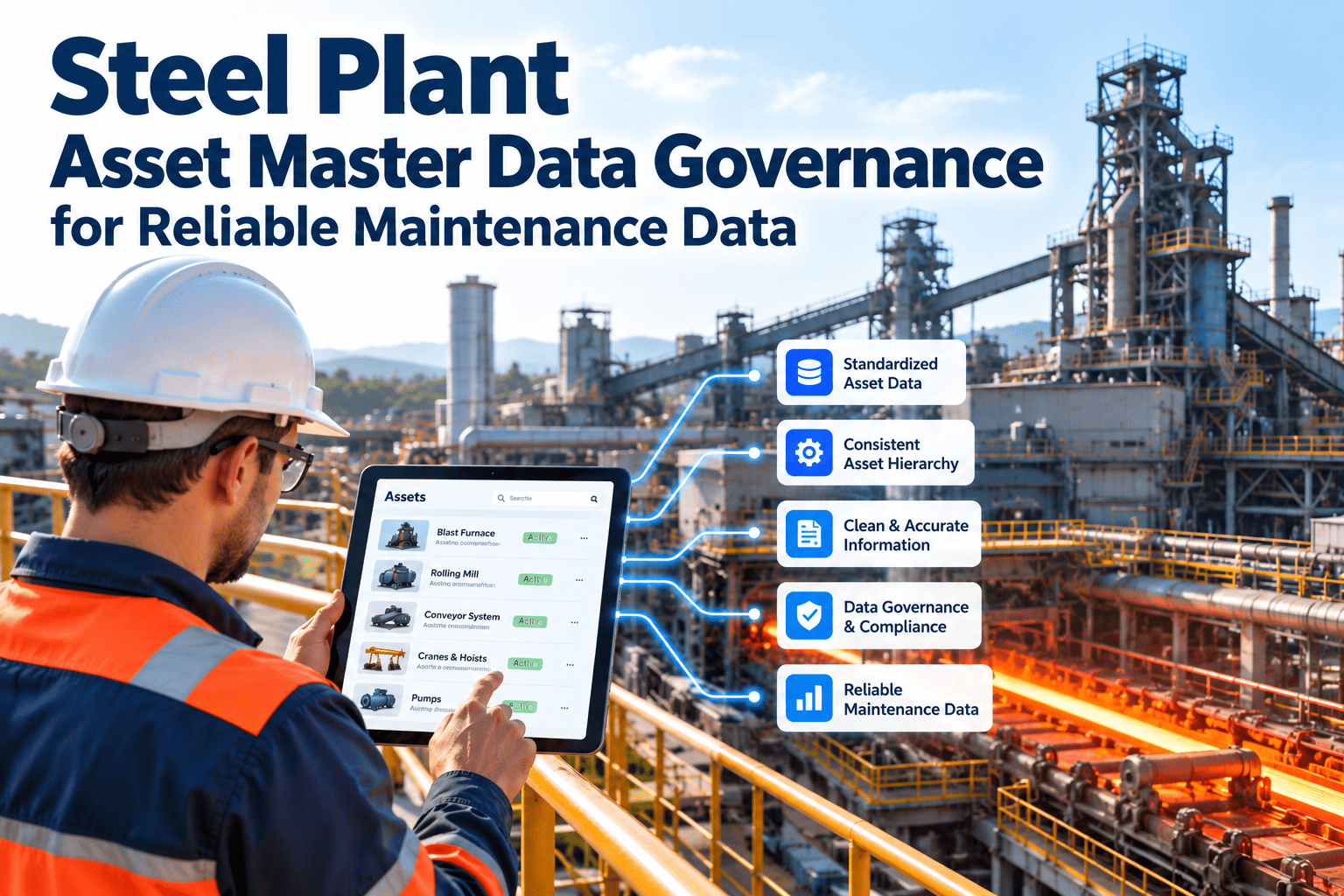
Ask three people in a steel plant for the name of one gearbox and you may get three answers. One system calls it by a tag, another by a location and the spreadsheet by a nickname. Spare parts, work orders, sensor data and reports then point at different versions of the same asset, and every analysis built on top inherits the confusion. Asset master data governance fixes this by agreeing who owns the data, what it must contain and how it changes. This guide explains the practice, supported by a steel plant asset management system that keeps one clean record per asset.
Steel Plant Asset Master Data Governance for Reliable Maintenance Data
Give every asset one identity, one owner and one clean history, so work orders, spares, sensors and analytics all point at the same equipment.
How poor master data damages maintenance
Master data problems rarely announce themselves. They show up as small frustrations that add up to unreliable decisions.
Why steel plants need governance more than most
Steel works grow over decades. Expansions, acquisitions, rebuilds and contractor projects leave several naming habits and data formats behind.
Designing the asset hierarchy
The hierarchy is the backbone. Decide how many levels you need and what each level means before loading any data.
| Level | What it represents | Steel plant examples | Used for |
|---|---|---|---|
| Site and plant | Physical location or works | Integrated works, mini mill | Reporting and budgets |
| Area | Process stage | Raw materials, ironmaking, steelmaking, casting, hot rolling, finishing, utilities | Planning, crews, area dashboards |
| System or unit | A functional group that runs together | Caster strand, hydraulic power unit, gas cleaning system | Criticality, downtime tracking |
| Equipment | A maintainable machine | Mill gearbox, ladle crane hoist, cooling water pump | Work orders, preventive plans, cost |
| Component | A replaceable part | Bearing, mechanical seal, coupling, servo valve | Failure analysis, spares links |
Core attributes every asset record needs
Too many fields get ignored. Define a small mandatory set, and add optional fields only where they help decisions.
Scoring criticality consistently
Criticality drives spares, inspection frequency and analytics priority, so it needs one method across the plant. Score each asset on the same factors.
| Factor | Question to ask | Why it matters |
|---|---|---|
| Safety and environment | Could failure harm people or cause a release? | Raises the asset above any cost-based ranking |
| Production impact | Does failure stop the line or reduce output? | Shows how costly each hour of downtime will be |
| Quality impact | Does failure risk off-grade product or scrap? | Captures losses that downtime figures miss |
| Redundancy | Is there a standby or alternative route? | Lowers the effective risk for duplicated equipment |
| Repair lead time | How long to repair or replace, including parts? | Long lead items need earlier warning and stocked spares |
| Failure history | How often has it failed in the past? | Adds evidence to expert judgment |
Start with one area and one clean hierarchy
Build an asset structure that your crews, planners and analysts will all recognize.
Naming conventions that people will follow
A naming standard works only if the shop floor can read it. Keep it short, ordered and free from private abbreviations.
Rules for naming
- Fixed order. Always place area, unit, type and number in the same sequence.
- No locations in the tag. Equipment moves, and tags must stay stable.
- Controlled vocabulary. Use one approved word for each equipment type.
- No special characters. They break imports, reports and integrations.
- Document it. Publish the standard with examples for each area.
The governance roles
Governance needs people, not only rules. Three roles cover most of what is required.
A controlled change process for asset records
Most bad data enters through unplanned changes. A simple workflow keeps additions and edits consistent.
Data quality rules worth measuring
Quality is not a feeling. Define dimensions and measure each one on a schedule.
| Dimension | Question it answers | Example rule |
|---|---|---|
| Completeness | Are mandatory fields filled? | Every active asset has class, criticality, parent and owner |
| Uniqueness | Does each asset exist once? | No two active assets share a tag or serial number |
| Validity | Do values follow the standard? | Class values come only from the approved list |
| Consistency | Do records agree across systems? | Sensor tags and spare links point to existing assets |
| Timeliness | Are changes recorded promptly? | Rebuilds and removals update the record within an agreed period |
| Accuracy | Does the record match the field? | Spot checks of nameplates confirm model and rating |
Linking spares, documents and sensors to the asset
A record becomes useful when other information hangs from it. Each link should be created once and checked during audits.
Rebuilds, relocations and decommissioning
Equipment does not stay still. Each event needs a rule, or the record slowly stops matching the plant.
Deciding the source of truth for each data item
Several systems may touch an asset. Governance names one system as the master for each type of data, so edits flow in one direction.
| Data item | Usual master | Used by | Rule |
|---|---|---|---|
| Asset identity and hierarchy | Maintenance management system | Planning, process data, finance | Others reference the tag and never invent their own |
| Sensor and process tags | Historian or automation system | Condition monitoring, analytics | Each tag must map to one asset record |
| Spare part catalog | Inventory or ERP system | Planners, purchasing | Parts link to assets, and duplicates are merged |
| Cost centers | Finance system | Reporting | Each asset carries one valid cost center |
| Documents and drawings | Document management system or asset record | Technicians, contractors | Links are checked when documents are revised |
Keeping data clean during shutdowns
Shutdowns bring contractors, temporary crews and many new parts. They are also when master data is most at risk.
- Brief contractors. Give them the naming standard and the correct asset list before work begins.
- Pre-create records. Add assets for new equipment before installation, so jobs are logged correctly from day one.
- Capture nameplates on site. Photograph and record details while the equipment is open and accessible.
- Review at closeout. The data steward checks new and changed records before the project is declared complete.
Cleaning up legacy data in phases
Few plants can clean everything at once. Focus first on the assets that drive risk and cost.
Before and after governance
KPIs for master data health
How Oxmaint supports asset master data governance
Oxmaint maintenance management software gives steel plants one structure where asset data is created, linked and reviewed.
Training and adoption
Standards fail when people do not understand why they exist. A little training and visible follow-up go a long way.
- Explain the why. Show technicians how a clean record saves them time when they search for parts and history.
- Keep guides short. A one-page naming guide with examples beats a long manual nobody opens.
- Make the right way easy. Use drop-down lists and required fields in place of free text wherever possible.
- Share the scorecard. Publish data quality results by area, and recognize teams that improve.
- Onboard new starters. Include master data basics in the induction for planners, supervisors and contractors.
Governance mistakes to avoid
- Making it an IT project only. Maintenance and operations must own the standards.
- Requiring too many fields. Overloaded forms get filled with placeholders.
- Cleaning once and stopping. Without ongoing control, data decays again within months.
- Skipping field verification. Records that never meet the equipment drift from reality.
- Ignoring decommissioned assets. Removed equipment left active distorts reports and plans.
Frequently asked questions
Make every maintenance decision rest on one trusted asset record
Set up a governed hierarchy and structured asset records, so work orders, spares and analytics finally point at the same equipment.