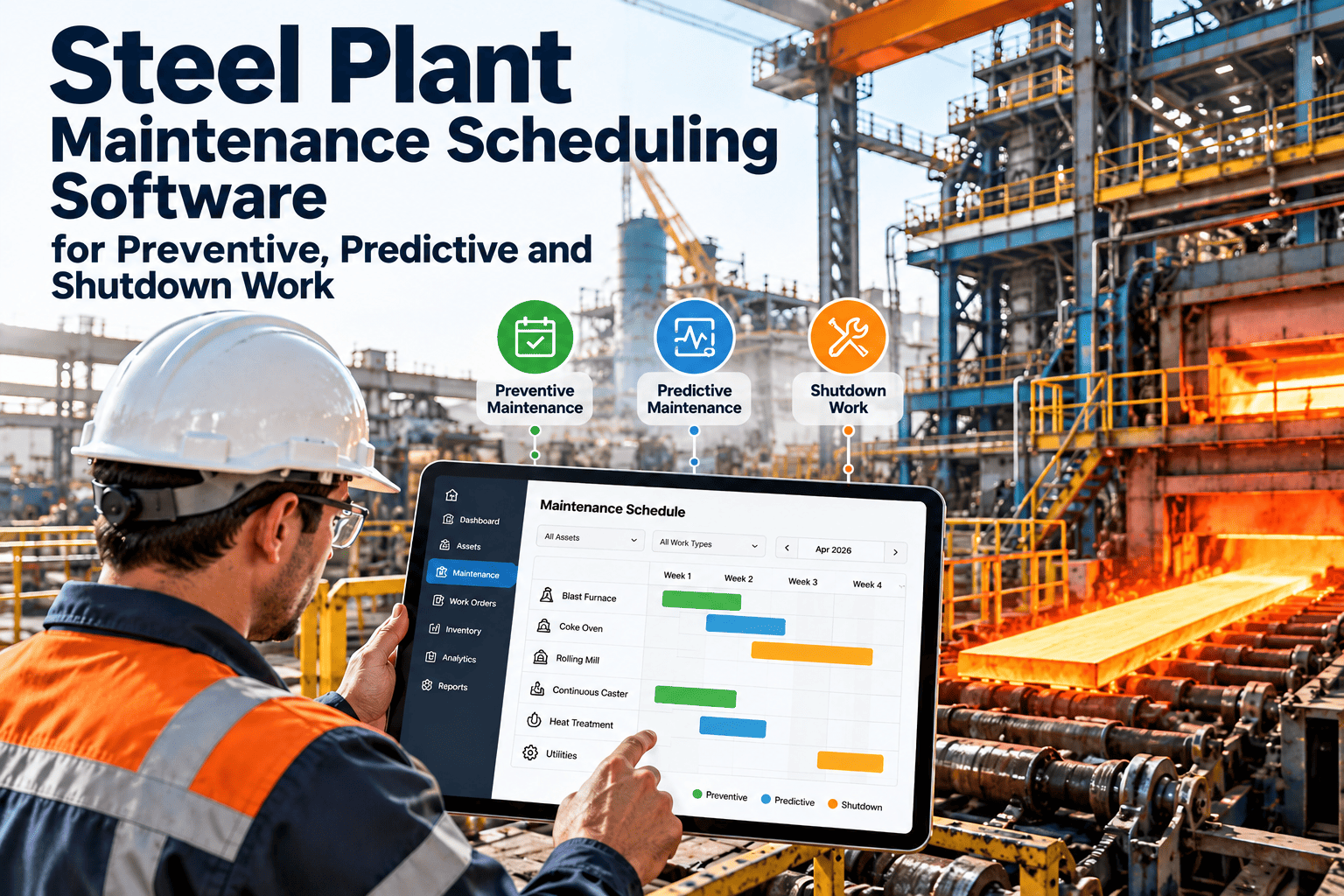
A steel plant never runs out of maintenance work. Furnace repairs, caster roll changes, crane inspections and conveyor faults all compete for the same crews, shutdown windows and spare parts. When work arrives faster than it closes, the backlog grows until an overdue job becomes an unplanned stoppage. This checklist helps planners and maintenance managers clean, rank, resource and schedule overdue work by criticality, risk and production impact, using maintenance management software to keep every decision visible and traceable.
Steel Plant Work Management
Steel Plant Maintenance Backlog Management for Priority, Risk and Production
A weekly backlog review checklist that turns a long list of overdue work orders into a ranked, resourced and schedulable plan.
Review frequency key
DDaily
WWeekly
MMonthly
SBefore each shutdown
Section 01
Backlog Hygiene: Know What You Really Have
A raw count of open work orders hides the true picture. Clean and split the list before ranking it.
Completed work closed and stale requests cancelled with a reason. Assets that were replaced, scrapped or repaired elsewhere should not keep old jobs alive.
Duplicate requests merged. Several people often report the same leak, noise or fault, which inflates the count.
Backlog split into ready, waiting, stale and recurring categories. Only ready work can be scheduled; waiting work needs its blocker managed.
Every open job linked to an asset, with a due date and an owner. Jobs without an asset cannot be scored for criticality.
Overdue preventive maintenance reviewed separately from corrective requests. Skipped routines are the future breakdown backlog.
Section 02
Priority Scoring: Criticality, Risk and Production Impact
Score every job on the same factors so ranking is repeatable. Weights below are examples; agree your own with operations and safety.
Safety and statutory exposure assessed first. Any job that could injure someone or breach a requirement moves to the top regardless of score.
Equipment criticality confirmed. Note whether the asset is on the main production path with no standby.
Production impact estimated as lost heats, tonnes or downstream line time if the asset fails.
Failure likelihood supported by condition data, inspection findings and failure history, not opinion alone.
Job age used as a tie-breaker only, so old low-risk work does not outrank new high-risk work.
| Consequence of deferral | Unlikely | Possible | Likely |
|---|---|---|---|
| Safety or environmental | Schedule soon | Do this week | Fix now |
| Line stoppage | Next shutdown | Priority slot | Do this week |
| Reduced rate or quality | Planned slot | Next shutdown | Priority slot |
| Minor or cosmetic | Fill-in work | Fill-in work | Planned slot |
Section 03
Resource Readiness Before Scheduling
A ranked job is not a schedulable job until crew, parts and permissions are ready.
Scope, procedure and estimated hours defined for each job, with the trade and skill level named.
Spare parts confirmed in stock or on order with a delivery date. Reserve parts against the work order.
Permits, isolations and lockout points identified. Confined space, hot work and height work often apply together.
Cranes, scaffolding, special tools and contractors booked against the intended window.
Crew capacity for the coming week compared with scheduled hours, allowing time for reactive calls.
Give Your Planners One Ranked Backlog
Oxmaint keeps work orders, asset criticality and due dates in one place, so weekly reviews start from a clean, scored list.
Section 04
Matching Work to Steel Plant Windows
Running-line gaps
Short changeovers. Suits lubrication, adjustments, small replacements and inspections.
Planned outages
Single unit or line stops. Suits component swaps, alignment and refractory patching.
Major shutdowns
Extended stops. Suits large, long-lead jobs on critical assets.
Shutdown scope frozen early, with candidate jobs pulled directly from the ranked backlog.
Critical spares received, checked and staged before the stop begins.
Jobs that cannot be ready removed early and logged as deferred with a reason and risk owner.
Deferred jobs on critical assets carry written risk acceptance from the responsible manager.
Section 05
Reducing the Backlog, Not Just Ranking It
Repeat failures flagged and sent for root cause review instead of another repair order.
Preventive maintenance treated as a firm commitment, protected from reactive interruptions.
Condition data such as vibration, temperature and inspection results used to move jobs up or down the list.
Slipped jobs reviewed for cause: parts, permits, access, priority conflicts or crew shortage.
Measure It
Backlog KPIs Worth Tracking
| KPI | What it shows | How to read it |
|---|---|---|
| Backlog in weeks | Ready hours divided by weekly crew capacity | Rising trend means demand exceeds capacity |
| Overdue critical jobs | Open work on critical assets past due | Should trend toward zero |
| Backlog age profile | Share of work by age band | A growing old tail signals stale or blocked work |
| Schedule compliance | Planned jobs done in the planned period | Low results point to readiness gaps |
| Planned versus reactive ratio | Time on planned against emergency work | More planned work usually shrinks backlog |
Oxmaint capabilities that support backlog control
- Work orders with priority, status, crew and due dates.
- Asset management holding criticality and maintenance history.
- Preventive maintenance scheduling and mobile updates at the equipment.
- Inventory visibility, plus dashboards for overdue and aged work.
Frequently Asked Questions
What is a healthy maintenance backlog in a steel plant?
Many planners aim for a few weeks of ready work per crew. Watch the trend and overdue critical jobs.
How do we prioritise when everything is urgent?
Use a shared score for safety, criticality and impact. Book a demo to see priority rules in action.
Should waiting-for-parts jobs count in the backlog?
Track them separately from ready work so the backlog does not overstate crew workload.
Can a CMMS help with shutdown planning?
Yes. It holds deferred jobs, asset history and parts data. Start with Oxmaint to try it.
How often should the backlog be reviewed?
Weekly for scheduling, monthly for trends, and in depth before each planned outage.
Take Control of Your Steel Plant Backlog
Rank overdue work by risk and production impact, match it to real work windows and give every crew a clear plan with Oxmaint.