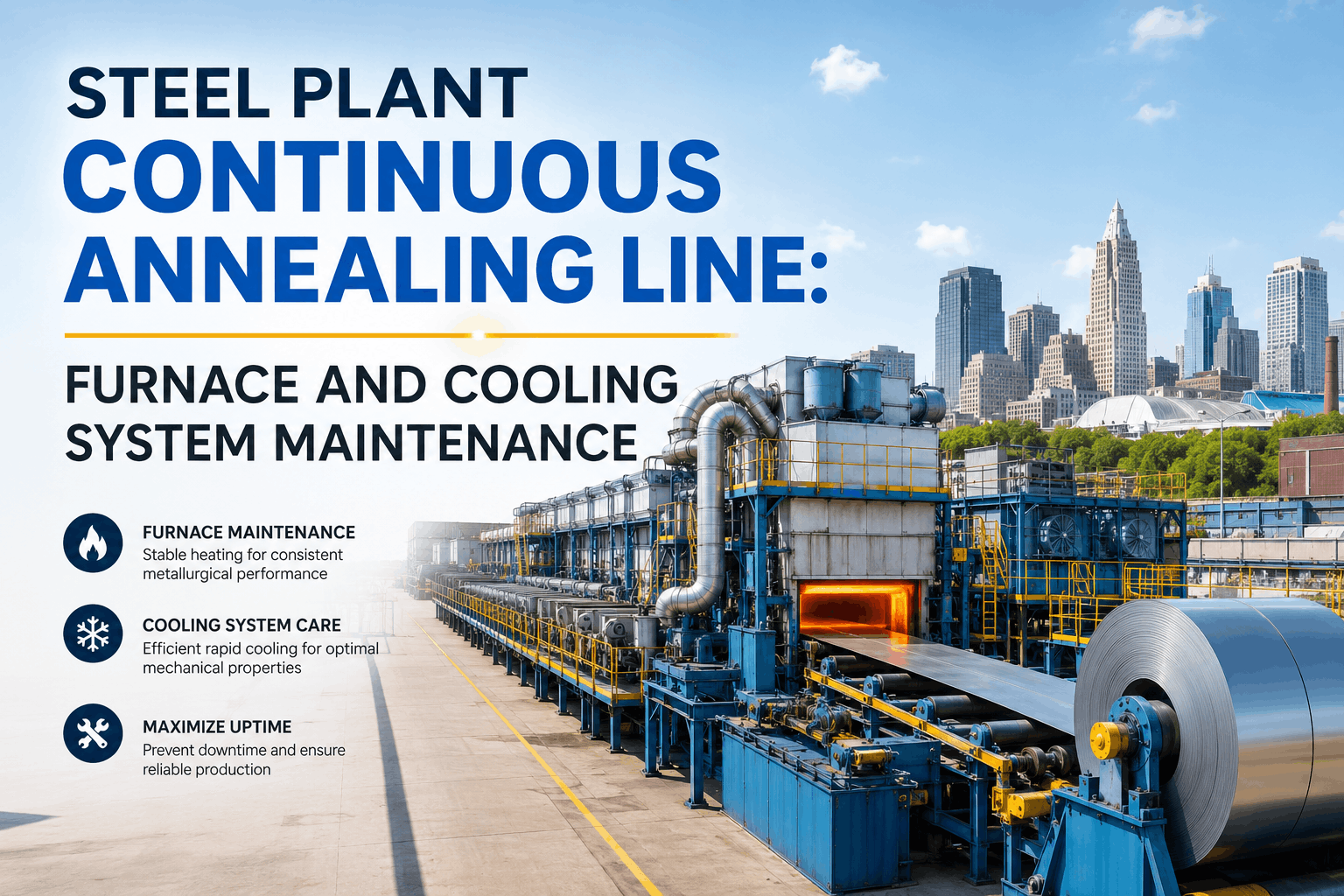
Continuous annealing lines (CAL) represent the most thermally complex, precision-critical steel finishing process: cold-rolled strip enters at ambient temperature, is heated to 650–800°C in a multi-zone furnace under precisely controlled atmosphere, held at temperature for 15–25 seconds to allow recrystallization and grain growth, then rapidly cooled at rates exceeding 100°C per second to achieve desired mechanical properties (strength, ductility, formability). Furnace atmosphere composition (H2/N2 balance from cracked ammonia or pure hydrogen systems) must remain stable within ±0.5% across all heating and cooling zones—deviations produce oxidation-related surface defects or incorrect microstructure that cascade into downstream forming failures and customer complaints. Rapid cooling section pressure drop, water quench system flow uniformity, and overaging section temperature stability represent the dominant maintenance challenges; fouling in cooling nozzles, bearing wear in cooling fan motors, or thermal imbalance across the strip width produces surface quality defects that eliminate 5–15% of daily production volume until root causes are identified and corrected. OxMaint's CAL monitoring integrates furnace thermocouple networks across heating, soaking, rapid cooling, and overaging sections, tracks cooling fan bearing vibration and discharge air temperature, monitors water quench system flow distribution per nozzle row, and correlates final product mechanical properties (tensile strength, percentage elongation, hardness) against thermal processing parameters recorded during each coil run. When furnace zone temperature variance exceeds ±4°C, cooling system pressure drop indicates nozzle fouling development, or overaging section temperature drifts beyond ±3°C from target, automated work orders trigger maintenance scheduling and spare parts requisitions. Facilities using OxMaint's CAL system achieve consistent mechanical property targets (strength variation <2%), extended furnace campaign life through early burner efficiency detection, and 99.1%+ line uptime through coordinated rapid cooling and overaging maintenance scheduling.
Continuous Annealing Line (CAL) Maintenance: Furnace, Cooling, and Mechanical Property Control
Strategic maintenance framework for CAL furnaces, rapid cooling systems, overaging sections, and water quench networks—maintaining precision thermal control, extending furnace campaign life, and ensuring consistent mechanical properties for automotive and structural steel applications.
CAL Furnace Architecture: Heating, Soaking, Rapid Cooling, and Overaging Sections
A complete CAL thermal cycle begins with the preheating section (utilizing waste heat from downstream cooling gas circulation), progresses through the heating section where radiant tubes fired by natural gas raise strip temperature to 700–750°C, continues through the soaking section (maintaining temperature uniformity), then enters the critical rapid cooling section where the strip is exposed to high-velocity hydrogen or nitrogen jets that cool the strip at 80–120°C per second. The overaging section follows, maintaining the strip at an intermediate temperature (350–450°C) for 10–15 seconds to allow carbide precipitation that controls final mechanical properties. Throughout all sections, furnace atmosphere is a precisely balanced mixture of hydrogen (5–15%) and nitrogen (85–95%) maintained under slight positive pressure to prevent air ingress and oxidation. Deviation from these thermodynamic setpoints produces uncontrolled microstructures and surface defects that cascade downstream. OxMaint's CAL module instruments furnaces with embedded thermocouples at multiple locations within each section, logging temperature readings every 5 seconds; advanced data analytics compare actual temperature profiles against historical baselines and manufacturing specifications, flagging when zone temperature variance exceeds ±4°C (which indicates uneven heating, burner degradation, or refractory wear). Similarly, cooling section nozzle blockage manifests as rising differential pressure and localized hot spots on the strip surface—detected via infrared surface temperature mapping correlated against thermocouple data. Overaging section temperature stability determines final mechanical properties; when temperature drifts exceed ±3°C, coil mechanical test results deviate from specification, triggering rework or customer complaints. By monitoring all thermal zones continuously, maintenance teams identify root causes (worn burner nozzles, fouled cooling nozzles, thermocouple drift, control system calibration) weeks before quality failures become visible, allowing planned maintenance during scheduled line shutdowns.
CAL Thermal Control and Cooling System Health Monitor
Track furnace zone temperatures, cooling system efficiency, and mechanical property correlation across your CAL operation.
Temperature Uniformity and Burner Efficiency
Multiple thermocouples log heating zone temperatures continuously; variance >±4°C indicates burner fouling or refractory degradation. OxMaint schedules burner cleaning or refractory patching before temperature control failure forces emergency maintenance and production loss.
Cooling Nozzle Blockage Detection via Pressure Drop
Differential pressure trending identifies nozzle fouling 2–3 weeks before complete blockage. Preventive nozzle cleaning via purge cycles or scheduled maintenance prevents localized cold spots that degrade mechanical properties and trigger product rejects.
Temperature Stability and Mechanical Property Control
Precise temperature maintenance in the overaging section ensures carbide precipitation kinetics match specification; deviations >±3°C produce strength variation outside customer tolerances. OxMaint correlates overaging temperature against final tensile strength data, triggering heating element or control valve maintenance when trends diverge.
Rapid Cooling System Nozzle Management and Pressure Drop Prediction
The rapid cooling section represents the most mechanically complex CAL system: high-velocity cooling gas (hydrogen or nitrogen) jets impinge on strip from both top and bottom surfaces, achieving cooling rates of 80–120°C per second depending on gas temperature and velocity. The cooling nozzles—typically ceramic or composite materials rated for thermal cycling—accumulate mineral deposits, moisture contamination, or corrosion products over 4–6 weeks of continuous operation. Fouling in even a single nozzle row creates a localized hot spot where the strip cools more slowly, producing a region of softer (over-annealed) microstructure. When this region enters downstream finishing operations (temper rolling, slitting), it produces lower mechanical properties in the corresponding strip band, creating customer complaints or internal rejection. Nozzle blockage intensity varies: partial blockage is almost impossible to detect visually, but manifests as rising differential pressure across the cooling section (+0.1–0.2 bar above baseline) and elevated infrared surface temperatures in the affected region. OxMaint's cooling system monitoring tracks differential pressure continuously, flagging when values exceed baseline +0.15 bar. Upon alert, maintenance technicians initiate preventive nozzle cleaning using low-pressure purge cycles or schedule formal nozzle replacement during the next planned shutdown. This proactive approach eliminates 70–80% of nozzle-blockage-related mechanical property defects. Additionally, OxMaint correlates cooling section pressure drop against cooling system fan motor current draw: when pressure rises significantly but motor current decreases, fan bearing wear is indicated, triggering replacement scheduling 2–3 weeks in advance.
Furnace Refractory Integrity and Burner Efficiency Trending
CAL heating furnace refractories are exposed to extreme thermal cycling: heating to 750°C, cooling during strip movement pauses, reheating during normal operation. This cycling accelerates refractory degradation through spalling and erosion. Burner tubes must be maintained at design efficiency; fouled burner nozzles produce uneven flame patterns and cold zones. OxMaint monitors refractory condition by tracking furnace shell external surface temperature (via infrared measurement or surface thermocouples) and comparing against historical baselines; when shell temperature in any zone rises significantly (indicating thinner remaining refractory), refractory thickness estimates are updated and maintenance scheduling recommendations are generated. Burner efficiency is tracked via fuel consumption per degree of heating achieved and flame temperature measurement via pyrometer; when fuel consumption rises or temperature drops relative to historical baselines, burner blockage or thermal deterioration is likely. Early detection allows planned burner maintenance or burner changeout during scheduled shutdowns, preventing emergency maintenance events that can extend line downtime 15–30 days for complete refractory and burner renovation.
OxMaint CAL Maintenance and Quality Assurance Workflow
Integrated thermal monitoring, cooling system health tracking, and mechanical property correlation driving maintenance and quality decisions.
Mechanical Property Control and Final Quality Assurance Integration
CAL operations produce steels for automotive body structures, suspension components, and high-strength applications where mechanical properties (yield strength, ultimate tensile strength, percent elongation, hardness) are precisely specified and measured via routine mechanical testing. The relationship between CAL thermal processing parameters and final properties is direct: furnace zone temperature determines microstructure (grain size, phase distribution); cooling rate affects precipitation and dislocation density; overaging temperature controls carbide distribution. OxMaint integrates mechanical test lab data (tensile, hardness) with the thermal parameters recorded during each coil's processing, generating correlation models that identify which thermal deviations produce which mechanical property outcomes. When a coil fails mechanical testing (e.g., tensile strength below minimum), the system instantly recalls the thermal processing parameters from that coil's run, identifies which furnace zone or cooling section showed deviation, and correlates the failure back to equipment condition (fouled nozzle, burner drift, thermocouple calibration error). This closed-loop feedback eliminates guess-work from quality investigations and provides immediate maintenance direction. For example, if low tensile strength correlates consistently with rapid cooling section pressure drops >1.9 bar, the investigation immediately focuses on nozzle fouling rather than broader systemic searches. This precision reduces quality investigation time by 60–70% and ensures maintenance resources target the actual root cause.
Frequently Asked Questions on CAL Maintenance
Managing a 300,000 ton CAL facility without integrated furnace thermal monitoring and mechanical property correlation left us scrambling to investigate quality failures after they occurred. We averaged 6–8% mechanical property defects monthly, consuming 40–50 shift hours weekly in investigation and rework labor. Deploying OxMaint's CAL system transformed our approach: furnace zone temperatures are now continuously tracked, cooling pressure drop trends flag nozzle fouling 2–3 weeks in advance, and mechanical test failures are instantly correlated back to specific thermal deviations. Our property defect rate dropped to <2%, investigation time fell to 2–3 hours per incident, and furnace campaign life extended by 16 months through early burner efficiency detection. The operational confidence shift is profound—we now manage thermal processes as engineering disciplines rather than reactive troubleshooting exercises. This investment paid back in under 14 months through defect cost elimination and extended furnace life alone.
Optimize Your CAL Thermal Process Today.
OxMaint's CAL platform integrates furnace zone monitoring, rapid cooling system health tracking, overaging section precision control, and mechanical property correlation into one unified system — fully free to start, setup in minutes for existing operations or new deployments.


-furnace-and-cooling-maintenance.png)

