-furnace-and-cooling-maintenance.png)
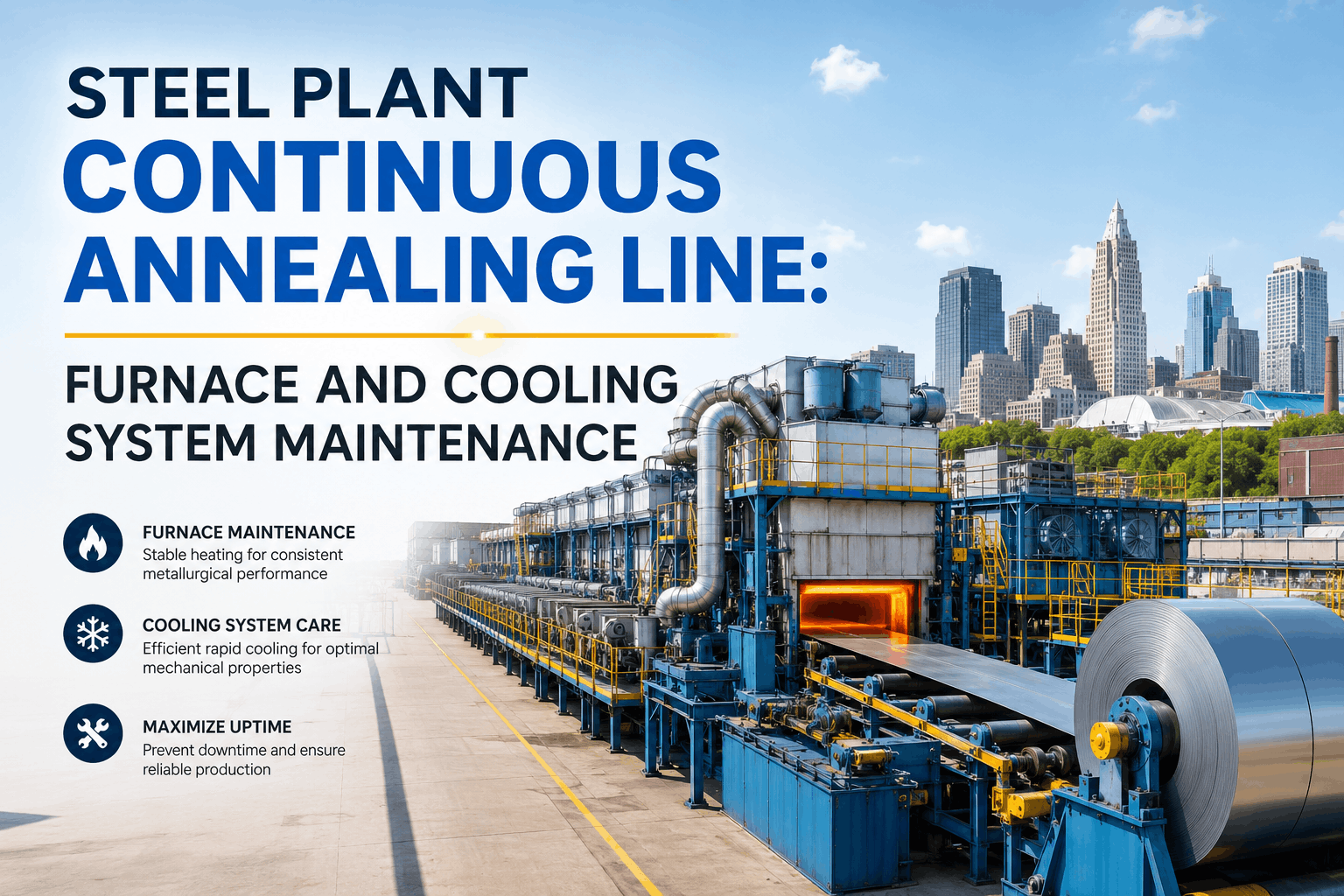
The continuous annealing line (CAL) is one of the most technically demanding assets in a cold rolling complex — processing cold-rolled strip through precisely controlled heating, soaking, and cooling zones in a hydrogen-nitrogen protective atmosphere, at strip speeds exceeding 600 meters per minute, operating 24 hours a day, 365 days a year. When a continuous annealing line maintenance program fails — a radiant tube fracture that allows combustion gas into the furnace atmosphere, a hearth roll pickup event that marks an entire coil sequence, a hydrogen seal leak that triggers a furnace shutdown — the production and safety consequences are severe. This guide covers every major CAL maintenance discipline: radiant tube lifecycle management, hearth roll condition programs, hydrogen safety inspection systems, cooling section PM, and the CMMS infrastructure that tracks it all in one place. Sign Up Free and configure your CAL asset hierarchy in Oxmaint today — with the hydrogen interlock inspection, radiant tube campaign, and hearth roll schedule all running from one digital platform.
SEO META BLOCK (hidden)Purpose-Built CAL Maintenance Tracking — Radiant Tubes, Hearth Rolls, and Hydrogen Safety in One CMMS
Oxmaint tracks CAL radiant tube campaign life, hearth roll condition history, hydrogen interlock inspection records, and cooling section PM schedules — all linked to individual asset records with photo-documented completion and audit-ready export.
What Makes CAL Maintenance Uniquely Demanding in a Cold Rolling Complex
A continuous annealing line furnace operates in conditions that make it one of the most challenging assets to maintain in any steel processing facility. Strip temperatures in the heating zone reach 750–900°C for cold-rolled automotive grades and up to 1,150°C for certain grain-oriented electrical steels. The furnace atmosphere — typically a mixture of 5–25% hydrogen in nitrogen, with some CAL sections running 95%+ hydrogen — is both explosive and essential: the hydrogen performs the oxide reduction that gives annealed strip its clean, reactive surface. Hearth rolls in the heating and soaking zones operate continuously in this atmosphere at 800–900°C, carrying the strip without any lubricant or cooling. Radiant tubes in W, U, P, and PP configurations deliver indirect heat to the strip in a sealed combustion system that must never allow combustion gases to enter the furnace atmosphere. Each of these systems requires a CAL PM program that goes far beyond calendar scheduling — requiring condition-based, tonnage-based, and campaign-based triggers that only a purpose-built CMMS like Oxmaint can manage across all zones simultaneously. Schedule a CAL-specific demo to see your line's asset hierarchy configured in Oxmaint before you commit to deployment.
CAL Maintenance Zone-by-Zone: The Complete PM Framework
Entry Section — Welder, Looper, and Strip Tension Control
The entry section sets the operating conditions for the entire line — and entry-section failures cause line stoppages that empty the furnace of strip, requiring full atmosphere purge-and-reestablish cycles that consume 4–8 hours before production resumes. The flash butt welder or mash seam welder joins incoming coils; weld quality directly determines whether a strip break occurs in the high-temperature heating zone, where strip recovery in a hydrogen atmosphere is a fire risk. Oxmaint tracks: welder electrode condition and replacement intervals, welder alignment verification records, entry looper carriage bearing condition, pinch roll surface inspection, and strip tension sensor calibration records. Each is a separate asset with its own PM schedule, not a line-level checklist that passes or fails as a block. Configure your entry section assets in Oxmaint today.
Heating Zone — Radiant Tube Lifecycle Management
Radiant tubes are the highest-maintenance-cost consumable in any CAL furnace. Operating at surface temperatures of 900–1,100°C in a reducing atmosphere, radiant tubes in W, U, and P configurations are subject to thermal fatigue cracking, oxidation, sagging, and burner-end erosion. A fractured radiant tube admits combustion products — CO, CO2, water vapor — directly into the furnace atmosphere, immediately degrading surface quality on all strip in the furnace and typically requiring emergency shutdown and atmosphere purge. The industry standard failure mode is initiated by thermal cycling stress at the bend radius. Tube materials range from heat-resistant alloys (HK40, HP-Mod) for standard zones to silicon carbide ceramics for the highest-temperature zones. Oxmaint manages CAL radiant tube campaign tracking individually by tube position, zone, and material type — with campaign-life counters based on furnace operating hours per zone, temperature setpoint history, and inspection findings. When any tube reaches its campaign-end threshold, a replacement work order generates automatically. See radiant tube lifecycle tracking in a live Oxmaint environment.
Soaking Zone — Hearth Roll Condition Monitoring
CAL hearth rolls in the soaking zone operate at the highest continuous thermal load of any roll in the cold rolling complex — 800–900°C, constant strip contact, no lubrication, no cooling, continuous rotation. The dominant failure mode is "pickup" — transfer of metallic iron from the strip surface to the roll, which then impressions every subsequent coil passing over that roll. A single hearth roll pickup event can contaminate 20–50 coils before detection, triggering quality rejections across an entire automotive order sequence. Oxmaint tracks individual hearth roll condition scores updated every planned inspection, with surface measurement records, bearing temperature trend data, and strip mark incident records all linked to the specific roll position. Rolls approaching their condition threshold generate inspection work orders automatically — converting reactive quality failures into planned replacement interventions during the next roll change window. The U.S. benchmark for hearth roll campaign life in a high-productivity CAL is 12,000–18,000 operating hours depending on strip width and gauge mix.
Hydrogen Atmosphere Safety — The Non-Negotiable Inspection Program
CAL hydrogen safety is the most legally and operationally critical inspection domain in the entire line. OSHA 29 CFR 1910.119 Process Safety Management requirements apply to CAL sections operating above the hydrogen threshold quantity — and FM Global, the primary insurer for U.S. steel processing facilities, requires documented periodic inspection and testing of all hydrogen safety systems as a condition of coverage. The mandatory inspection scope includes: hydrogen gas detector calibration and function test (minimum quarterly at detector head, annually with certified reference gas), furnace shell leak testing, all hydrogen isolation valve stroke and closure verification, purge system interlock function test, emergency vent stack inspection, and the hydrogen seal roll (snout seal or nose piece seal) condition verification. Oxmaint generates all of these as scheduled work orders with mandatory photo-documented completion before closure — creating the inspection record package that OSHA inspectors and FM Global loss prevention representatives request during facility audits. See the hydrogen safety inspection module in Oxmaint.
Cooling Section — Jet Coolers, Quench Tanks, and OA Furnace
The CAL cooling section governs the mechanical properties of every steel grade produced on the line — cooling rate determines yield strength, tensile strength, and elongation for DP, TRIP, CP, and martensitic grades. Jet cooler nozzle condition directly affects cooling rate uniformity across the strip width — clogged or worn nozzles create transverse temperature gradients that produce non-uniform microstructures and unpredictable mechanical property scatter. The overaging (OA) furnace section, where applicable, requires the same radiant tube management as the heating zone but at lower temperatures and with a more demanding strip flatness requirement. Oxmaint schedules: jet cooler nozzle inspection and cleaning at tonnage-based intervals, quench tank water quality monitoring, OA furnace tube condition inspection, temper mill roll condition, and tension leveler roll and cassette maintenance — all as separate asset-level work orders with individual completion records.
Exit Section — Skin Pass Mill, Oiler, and Tension Reel
The exit section converts the annealed strip into a finished product — and work roll surface condition in the skin pass mill directly transfers to the final surface texture and flatness of the coil. Work roll campaign life in a CAL skin pass mill depends on strip width, draft setting, and product mix; Oxmaint tracks rolling kilometers per campaign and generates roll change work orders automatically when the campaign target is reached. The electrostatic oiler requires regular nozzle cleaning and oil system inspection to prevent dry areas on the strip surface that cause coil-to-coil adhesion in the finished coil stack. Tension reel wrapper and coil car maintenance is scheduled per coil count to prevent coil telescoping failures that damage the reel drum. Book a demo to see exit section asset tracking in Oxmaint.
CAL Maintenance Failure Mode Reference — Critical Asset Matrix
SVG Stacked icon/tile chart — mobile-friendly card matrixRadiant Tube PM: What the Inspection Cycle Must Cover
Visual Inspection at Every Stop
At every planned furnace stop — roll change, strip break repair, or scheduled maintenance window — every accessible radiant tube should receive a visual inspection for: surface oxidation scaling, sagging at mid-span, cracking at bend radii, burner-end erosion, and flame impingement on tube surface. All findings logged to the specific tube position record in Oxmaint with photos before the furnace is re-pressurized and restarted.
Combustion Analysis Per Zone
Quarterly combustion analysis — O2, CO, CO2 per zone — detects developing tube leaks before they cause atmosphere contamination events. A zone showing rising CO in the furnace atmosphere without corresponding process atmosphere composition change is a leading indicator of tube crack development. Oxmaint stores combustion analysis results as work order measurement records linked to the zone asset, enabling trend detection across consecutive readings.
Campaign Life Tracking Per Position
Each radiant tube position in Oxmaint accumulates furnace operating hours from the installation date of the current tube. When any position reaches its configured campaign-end threshold — typically 8,000–15,000 hours for metallic alloy tubes in standard heating zones, shorter for high-temperature soaking zones — a replacement work order generates automatically for the next planned furnace stop. No manual tracking, no campaign-end surprises during production.
Burner Maintenance at Tube Replacement
Every radiant tube replacement must be accompanied by burner inspection and servicing — igniter condition, flame detector test, combustion air valve calibration, and gas train integrity check. Installing a new tube on a degraded burner shortens the new tube's campaign life by 30–50%. Oxmaint links the burner PM work order to the tube replacement work order as a mandatory associated task — both must close before the position is returned to service.
Zone Temperature Calibration
Thermocouple calibration verification per zone, aligned with the radiant tube inspection cycle, ensures that the temperature control system driving tube surface temperature is accurate. An uncalibrated thermocouple reading 10°C low in the soaking zone drives the control system to increase tube surface temperature by 10–15°C — accelerating tube oxidation and shortening campaign life by 15–25%. Oxmaint schedules thermocouple calibration work orders on the same cycle as tube inspections for the relevant zone.
Tube Leakage Rate Trending
In furnaces equipped with continuous atmosphere analyzers, CO leakage rate per zone trended across consecutive measurement periods is the earliest predictive signal for radiant tube degradation. A zone showing a 20% quarter-over-quarter increase in background CO level during normal operation — without corresponding changes in strip chemistry or furnace atmosphere setpoint — has a developing tube crack. Oxmaint integrates with furnace analyzer data to flag this trend automatically and generate a targeted inspection work order. Connect your analyzer data to Oxmaint today.
Hydrogen Safety — The Complete CAL Inspection Program
No other aspect of CAL hydrogen safety documentation carries greater OSHA and insurance risk than gaps in the hydrogen detector calibration and interlock test records. The U.S. EPA's NESHAP standard for steel pickling and annealing, OSHA 1910.119 PSM requirements for facilities above hydrogen threshold quantities, and FM Global Loss Prevention Data Sheet 7-91 all require documented inspection records that can be produced during an audit or incident investigation within hours of request. In U.S. cold rolling facilities audited under FM Global property insurance programs, missing hydrogen safety inspection records have resulted in coverage suspension and emergency premium increases of $500,000+ annually. Oxmaint manages every hydrogen safety inspection as a work order with mandatory measurement fields, calibration reference numbers, pass/fail results, and technician digital sign-off — creating the audit trail that OSHA and FM Global require from a system that generates it automatically as a product of normal maintenance operations. Book a demo to see the hydrogen safety inspection module configured for your CAL.
SVG Vertical timeline - H2 safety inspection frequencyHow Oxmaint Manages CAL Maintenance That Generic CMMS Platforms Cannot
CAL radiant tubes, hearth rolls, and cooling section components wear based on furnace operating hours and tonnage processed — not calendar time. A CAL running 24/7 at 100% utilization accumulates operating hours 40% faster than a line running 70% utilization on the same calendar. Oxmaint's configurable PM triggers pull operating hour data directly from your process historian or SCADA, generating work orders based on actual equipment exposure — not arbitrary calendar intervals that may over-maintain during slow periods and under-maintain during high-production campaigns.
A 120-meter CAL furnace may contain 200+ radiant tube positions and 40–80 hearth roll positions, each with its own installation date, campaign history, and condition record. Generic CMMS platforms handle this with a single "furnace" asset record — making it impossible to know which tube positions are approaching campaign end, or which hearth roll showed pickup risk at the last inspection. Oxmaint builds position-level asset records for every tube and roll, making individual condition tracking operationally viable at scale.
Every CAL hydrogen safety inspection in Oxmaint is a structured work order with mandatory measurement fields, calibration reference numbers, technician digital sign-off, and photo documentation requirements before closure. The completed records are stored in the safety system's permanent history, exportable as timestamped PDF packages within seconds — the format OSHA inspectors and FM Global loss prevention representatives specifically request during facility compliance audits.
When a strip break occurs or a quality rejection event is logged (hearth roll mark, tension variation, flatness defect), Oxmaint links the quality incident directly to the asset records of the implicated zone — creating an integrated maintenance-quality record that enables root cause analysis without a 3-week forensic investigation. This closed loop between quality incidents and asset condition history is what converts reactive quality firefighting into proactive condition management. See this integration in a live demo.
"Managing 240 radiant tube positions and 56 hearth rolls across our two CAL lines was previously impossible to track at position level — we used a zone-level spreadsheet that told us nothing useful about individual tube status. After Oxmaint deployment with position-level asset records, we caught three tubes approaching campaign end in the high-temperature soaking zone that our zone-average tracking had completely missed. One of those tubes showed combustion analysis anomalies consistent with early cracking — we replaced it during a planned roll change window. Our materials team estimated that an unplanned radiant tube fracture in that zone would have cost $380,000 in lost production and strip scrap. The hydrogen safety inspection module also helped us pass our FM Global audit clean for the first time in four years."
Deploy Position-Level CAL Maintenance Tracking in 3–5 Days
Radiant tube campaign life, hearth roll condition scoring, hydrogen safety inspection records, and cooling section PM — all in one Oxmaint deployment that goes live without disrupting your annealing line operations.
Frequently Asked Questions: Continuous Annealing Line Maintenance
Metallic alloy radiant tubes in standard heating zones require visual inspection at every planned furnace stop and campaign replacement at 8,000–15,000 operating hours depending on zone temperature and tube material. High-temperature soaking zone tubes operating above 1,000°C surface temperature may require replacement at 4,000–8,000 hours.
The dominant failure mechanisms are thermal fatigue cracking at bend radii during heating and cooling cycles, oxidation scaling accelerated by overtemperature from miscalibrated thermocouples, and burner-end erosion from flame impingement due to burner misalignment or incorrect combustion air ratio. Monitoring all three through Oxmaint's PM schedule prevents the vast majority of unplanned tube failures.
OSHA 29 CFR 1910.119 Process Safety Management applies to CAL sections operating with hydrogen above threshold quantities (10,000 lb). This requires a formal Process Hazard Analysis, written operating procedures, mechanical integrity inspection records, and incident investigation documentation — all of which Oxmaint supports through structured work order and compliance record management.
Hearth roll pickup is prevented through regular roll surface inspection during planned furnace stops, tracking of individual roll surface condition using Oxmaint's condition scoring system, and proactive roll change scheduling when surface roughness or pickup-risk indicators reach defined thresholds — before mark transfer to strip begins.
FM Global Loss Prevention Data Sheet 7-91 requires documented H2 detector calibration records, isolation valve operational test records, emergency purge system test records, and furnace shell integrity verification — all with timestamped, technician-signed documentation. Oxmaint generates all of these automatically as structured work orders with photo-documented completion.
Oxmaint creates individual asset records for every tube position with installation date, zone temperature profile, material grade, and accumulated operating hours pulled from the process historian. Each position generates its replacement work order automatically when its configured campaign-end threshold is reached — no manual tracking or spreadsheet management required.
A radiant tube fracture that introduces combustion products into the furnace atmosphere typically costs $200,000–$500,000 — covering emergency shutdown and purge time, strip quality rejections for all material in the furnace at failure, emergency tube sourcing at premium freight rates, and lost production during the 12–24 hour recovery cycle.
Yes — Oxmaint connects to SCADA, DCS, and process historian systems via standard APIs to pull furnace operating hours, zone temperatures, and atmosphere analyzer data directly into PM trigger calculations. This eliminates manual operating-hour logging and enables condition-based PM intervals that respond to actual furnace utilization rather than fixed calendar schedules.
Never Lose a Radiant Tube Campaign Record or Miss a Hydrogen Safety Inspection Again
Start your free Oxmaint trial and have your CAL's first position-level PM schedules running — radiant tubes, hearth rolls, hydrogen safety, and cooling section — within 24 hours of signup.