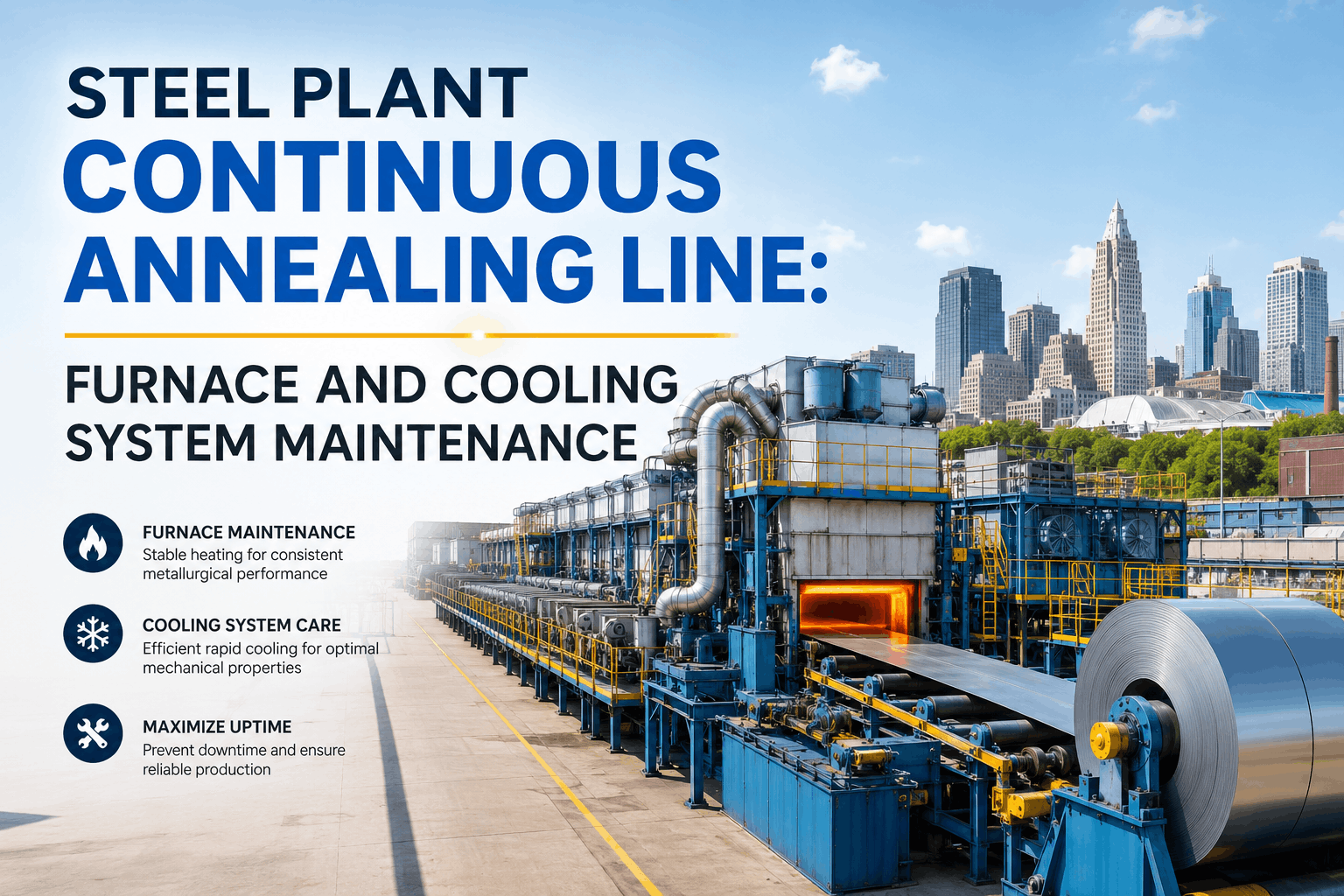
A continuous annealing line spends its entire operating life pushing cold-rolled strip through a sequence of furnace zones at temperatures between roughly 600°C and 800°C, holding each zone tight enough to hit the exact ductility and mechanical properties an automotive or appliance customer specified for that grade. The equipment doing that work — radiant tube burners, hearth rolls carrying the strip through the heat, and the quench section that has to bring the strip down at a controlled rate afterward — operates under continuous thermal stress that shortens component life in ways a fixed maintenance calendar consistently underestimates or overestimates. Industry data on radiant tubes alone shows an annual failure rate commonly cited between 10 and 20 percent, which is a meaningful reliability risk sitting inside a line that cannot be bypassed once it stops. Book a demo to see CAL predictive maintenance modeled against your own furnace zone data.
Steel CAL PdM Software: Continuous Annealing Line Guide
A zone-by-zone breakdown of predictive maintenance across the radiant tube furnace, hearth rolls, and quench section on a continuous annealing line — where soft-anneal automotive grades leave no room for a temperature or wear surprise.
The Furnace Zone Map: Where Thermal Stress Concentrates
A continuous annealing line moves strip through a sequence of thermally distinct zones, and each one puts a different kind of stress on its equipment — the heating zone stresses burners and tubes through repeated thermal cycling, the soaking zone stresses hearth rolls through sustained contact time, and the cooling zones stress mechanical cooling systems through the demand for a precisely controlled temperature drop. Understanding which zone a fault originates in is the first step to building a predictive maintenance program that actually targets the right failure mode instead of treating the whole furnace as one undifferentiated asset with a single maintenance calendar applied uniformly across every component inside it. The zone map below breaks the furnace into its four functional stages and flags the specific reliability risk each one carries.
Know Which Zone Is Drifting Before the Strip Tells You.
OxMaint tracks radiant tube thermal cycling, hearth roll wear, and quench zone temperature uniformity against condition baselines for each furnace zone — flagging drift as a work order before it shows up as an off-spec coil rolled off the line and shipped to a customer waiting on that exact delivery window.
Radiant Tube Lifetime: Why Fixed Replacement Intervals Waste Money
Radiant tubes fail through a slow creep-deformation process driven by thermal cycling, burner on/off patterns, and radiant heat exchange with neighboring tubes — the tube nearest a strip transition weld or a furnace nose sees a different stress profile than one in the middle of the soaking zone, even though both might sit on the same fixed replacement schedule. Plants that replace tubes on a calendar interval regardless of actual condition end up doing both things at once: replacing tubes that still have useful life left, and occasionally missing a tube that fails ahead of schedule because it experienced more asynchronous burner firing or more radiant exposure than the average tube its replacement interval assumed. This mismatch is not a minor inefficiency — published research on radiant tube reliability places the annual failure rate for these components in the 10 to 20 percent range industry-wide, which means a furnace running dozens of tubes on a fixed schedule is very likely both over-replacing healthy tubes and under-protecting against the specific ones at genuine risk. Tracking tube surface temperature and burner cycling pattern per zone position, rather than applying one interval across the whole furnace, is what lets a plant separate the tubes that need early attention from the ones that can safely run past the standard interval.
Hearth Roll and Quench Section: The Two Failure Modes That Reach the Customer
The table below covers the two components most likely to produce a defect that reaches the customer rather than stopping the line outright — because both hearth roll wear and quench uniformity issues tend to degrade gradually, they often keep producing coil while quietly drifting out of specification, which makes them harder to catch through a visual inspection or a routine shift walkdown than a component that fails outright and halts the line.
| Component | Failure Signature | Customer-Facing Consequence | PdM Monitoring Approach |
|---|---|---|---|
| Hearth roll surface | Gradual surface roughening and buildup from continuous high-temperature strip contact | Strip surface marking or pickup defects that only appear after the roll wear crosses a threshold | Track roll surface condition trend against strip surface quality data by roll position |
| Quench section jets | Uneven cooling rate across strip width from partially blocked jets or drifting flow balance | Flatness variation and inconsistent hardness across the strip width on soft-anneal grades | Monitor jet flow and cross-strip temperature uniformity against a calibrated baseline |
| Radiant tube burner | Asynchronous on/off cycling creating uneven heat distribution near the tube | Localized under- or over-annealing that shows up as inconsistent mechanical properties | Trend tube surface temperature per zone position against burner firing pattern |
| Furnace atmosphere seal | Dew point drift indicating a developing seal leak between furnace zones | Surface oxidation defects on strip requiring a non-oxidizing atmosphere for coating adhesion | Continuous dew point monitoring with alert thresholds tied to the atmosphere specification |
A Phased PdM Rollout That Follows the Strip Path
Instrumenting an entire CAL furnace at once is neither necessary nor practical inside a normal maintenance outage schedule, and attempting it in one pass usually means the project stalls waiting for a shutdown window long enough to cover every zone at the same time. The sequence below follows the strip path and prioritizes the zones where a fault has the highest cost or the least visible warning before it reaches the customer, so the first phase alone starts delivering usable reliability data well before the full furnace is instrumented.
Why Soft-Anneal Automotive Grades Raise the Stakes Further
Soft-anneal automotive grades are annealed specifically to achieve the ductility needed for deep-draw forming into body panels and structural components, which means the temperature and cooling rate window a CAL has to hold for these grades is often tighter than for commercial or structural grades running on the same line. A furnace zone that is running a few degrees outside its target for a structural grade might still produce an acceptable coil; the same drift on a soft-anneal automotive grade can push the strip's yield strength and elongation outside the range the customer specified, resulting in a coil that fails incoming inspection at the automotive stamping plant rather than at the steel mill. This is why plants running a mixed product slate — soft-anneal grades alongside commercial grades on the same CAL — often apply tighter predictive maintenance thresholds specifically when the schedule calls for an automotive run, rather than using one uniform alert threshold across every grade the line produces. Getting this grade-specific calibration right is frequently the difference between a predictive maintenance program that catches real automotive-grade risk and one that either over-alerts on commercial runs or under-alerts on the automotive runs that actually carry the tightest tolerance, and it is a distinction that only becomes visible once a plant starts segmenting its alert thresholds by grade rather than applying one setting across the whole schedule.
The Cost Case: What a CAL Reliability Gap Actually Costs Over a Year
Steel plants running continuous annealing lines rarely lack the data to make a strong reliability investment case — they lack the habit of connecting furnace zone condition data to the financial consequence of the gap. An unplanned line stoppage from a radiant tube failure carries the obvious cost of lost production hours plus the tube replacement itself, but the quieter costs tend to add up to more over a year: scrap and downgrade costs from coils that ran through a drifting quench zone before anyone noticed, customer chargebacks or claims from soft-anneal automotive coils that failed incoming inspection, and the accelerated wear on downstream equipment that happens when a furnace zone runs hotter or cooler than its target to compensate for a developing fault elsewhere in the line. None of these costs shows up as cleanly as a stopped-line hour on a maintenance report, which is exactly why they tend to persist for years without a dedicated fix — nobody owns the number, so nobody builds the business case to close the gap.
Building that business case starts with a straightforward exercise most reliability teams can do with data they already have: pull the last twelve months of customer quality claims and internal scrap events tied to the CAL, and sort them by which furnace zone was most likely the root cause based on the defect type. A cluster of surface marking complaints points back to hearth roll wear. A cluster of hardness variation complaints on soft-anneal grades points back to the quench section. Once that pattern is visible, the predictive maintenance investment stops being a general reliability improvement and becomes a targeted fix for a specific, quantified cost the plant has already been absorbing — which is a far easier conversation to have with a finance team evaluating where to allocate the next capital or software budget.
Expert Perspective
Frequently Asked Questions
Catch the Slow Drift Before It Becomes a Customer Claim.
OxMaint connects radiant tube cycling data, hearth roll wear trends, and quench section uniformity to a single zone-by-zone predictive maintenance dashboard — so the drift that would otherwise reach a soft-anneal automotive coil turns into a work order first.