Your steel plant is already generating the data for a digital twin — every sensor ping, every work order close, every failure event, every PM inspection builds a picture of how your assets actually behave under load. The gap between that raw data and a working digital twin is not a $10 million IoT project. Sign in to Oxmaint to see how your existing CMMS data becomes the foundation of a live virtual replica of your plant, starting in days rather than years.confirms that the throughput gap between theoretical capacity and actual production is typically 12 to 25 percent at integrated mills — and a properly configured digital twin closes that gap by making the invisible visible before decisions are made on the floor.
12–25%
Throughput Gap
Integrated steel mills vs. theoretical capacity
30–50%
Less Unplanned Downtime
After digital twin deployment
$23M
Capital Misallocation Avoided
Per bottleneck analysis scenario
400–800%
First-Year ROI
Typical range for steel plant twin
What It Is
What a Steel Plant Digital Twin Actually Does
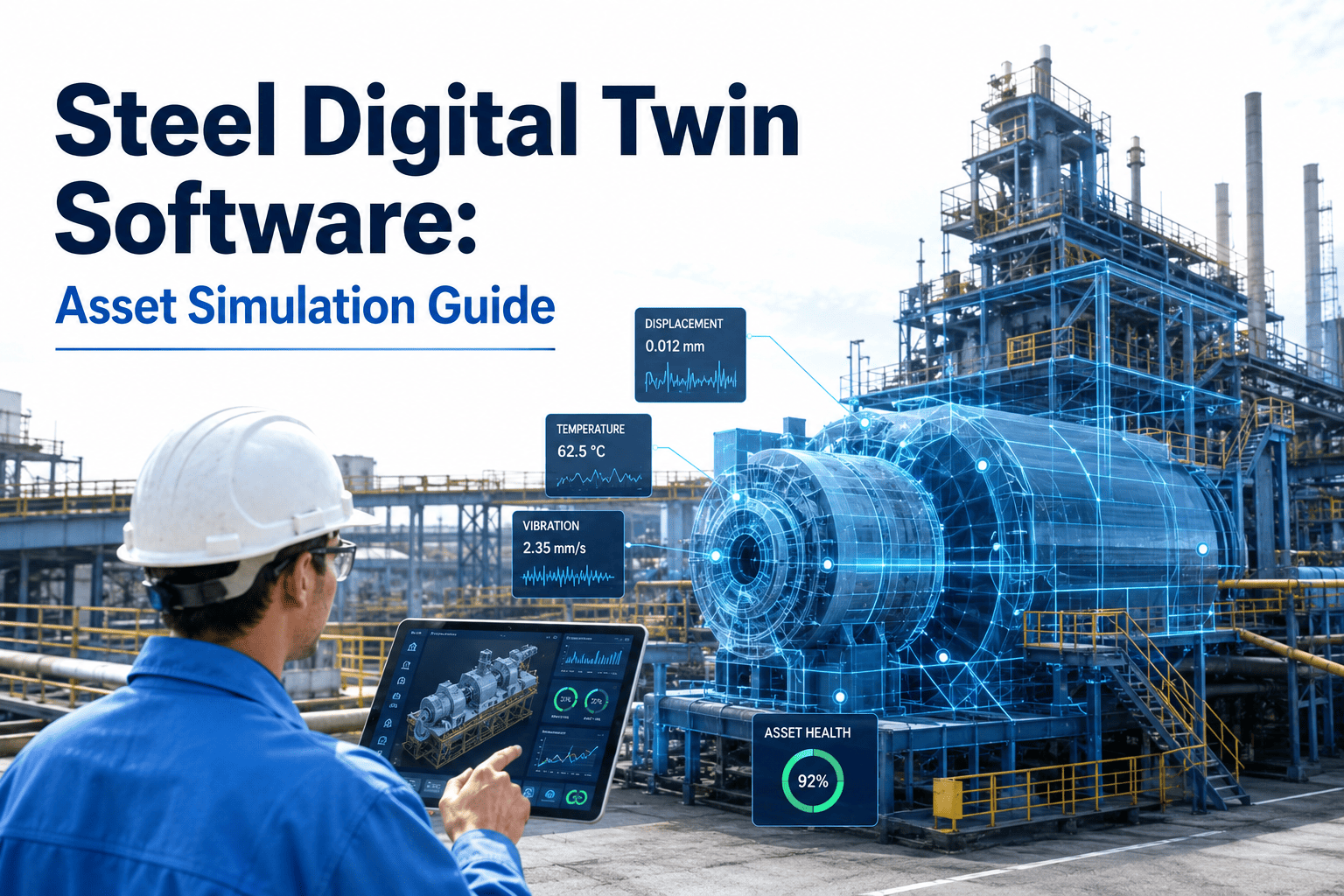
A digital twin is not a 3D model of your plant or a dashboard of sensor readings. It is a mathematically precise virtual replica of every process step, buffer, transport connection, timing constraint, and variability distribution — running forward in time faster than real operations. Sign in to see your asset hierarchy become the structural backbone of a working digital twin instantly. The twin allows you to test a $50 million caster expansion before spending a dollar, see where the next bottleneck emerges after you fix the current one, and quantify production loss from a maintenance outage before it is scheduled.
Layer 1
Asset Registry
Complete hierarchy of every physical asset — specifications, location, criticality rating, connected systems, spare parts, and documentation. Built entirely from existing CMMS data. No additional sensors required to start.
Source: Existing CMMS records
Layer 2
Maintenance Intelligence
Work order history, PM compliance tracking, failure mode analysis, MTBF and MTTR calculations, and cost-per-asset lifecycle views. Turns maintenance history into predictive failure probability scores.
Source: Work orders + inspection logs
Layer 3
Condition Monitoring
Current operating condition, sensor data integration, inspection results, active work orders, and alarm states for every monitored asset. Real-time status synchronized continuously.
Source: Sensors + live inspections
Layer 4
Predictive Intelligence
Failure probability scoring, remaining useful life estimation, energy consumption forecasting, and anomaly detection across all asset classes. Scores update as new data arrives.
Source: AI model on Layers 1–3
Layer 5
Scenario Modeling
What-if analysis, capital planning optimization, and autonomous maintenance scheduling based on predicted outcomes. Run simulations before committing resources or approving outage windows.
Source: Layers 1–4 + physics model
Real Decisions
What-If Scenarios Your Digital Twin Answers in Hours
Without Twin
Engineering estimates 15% throughput increase. Board approves based on vendor capacity claims. After commissioning, actual increase is 7% — the reheating furnace, not the caster, becomes the new bottleneck once the caster constraint is removed.
With Digital Twin
Simulation shows the caster is the bottleneck only 40% of the time. Reheating furnace is the real constraint. Twin identifies the optimal $12M investment instead of the $50M expansion, saving $23M in misallocated capital.
Decision value: $23M in avoided misallocated capital
Without Twin
Maintenance schedules a 72-hour hot mill outage. Production estimates 36,000 tons lost. Actual impact is 48,000 tons — slab yard fills, caster slows 30%, backs up into BOF, delays three BF taps.
With Digital Twin
Simulation predicts the cascading 48,000-ton impact and tests alternative outage windows. Moving start 18 hours later drops the impact to 39,000 tons. Pre-draining the slab yard prevents the caster slowdown entirely.
Decision value: 9,000 tons of recovered production (~$4.5M revenue)
Without Twin
Two capital projects compete for budget. Teams debate sequencing based on gut feel. Both are approved in parallel, creating resource conflicts and diluting the return on each investment.
With Digital Twin
Simulation shows ladle furnace project first yields 3.8% throughput gain. Tundish turnaround second compounds that gain. Sequential execution delivers 9.5x better return from the same total investment.
Decision value: 9.5x return from correct project sequencing
Benchmarks
Digital Twin Performance: Steel Plants Before vs. After
Data compiled from steel plant digital twin deployments documented by Oxmaint, McKinsey Manufacturing Practice, and Frontiers in Mechanical Engineering (2025).
Your CMMS data is already your digital twin foundation. Start without a single new sensor.
Implementation
4-Phase Digital Twin Rollout for Steel Plants
Phase 1
Data Foundation
Weeks 1–4
Connect Oxmaint to existing ERP, SCADA, and maintenance records. Map asset hierarchies. Establish baseline MTBF, MTTR, and failure mode profiles for every critical asset class. No new hardware required for Layers 1–3.
Output: Asset registry + maintenance baseline
Phase 2
Predictive Activation
Weeks 5–10
AI models begin scoring failure probability and remaining useful life for each asset. Condition monitoring goes live on priority equipment. First predictive alerts generated. Work order automation connects to maintenance scheduling.
Output: Live failure probability scores
Phase 3
Process Simulation
Weeks 11–20
Physics model layers over asset data. Bottleneck simulation goes live. What-if scenarios enabled for outage windows, production campaigns, and grade changes. Capital planning tool activated.
Sign in to begin Phase 3 configuration for your plant.
Output: Full scenario modeling capability
Phase 4
Autonomous Optimization
Month 6+
Digital twin runs continuously, automatically adjusting production schedules, maintenance timing, and resource allocation in real time. Capital planning uses accumulated twin data for objective project justification. Staffing optimization enabled.
Output: Self-optimizing operations
"
We spent two years arguing about whether to expand the caster or upgrade the reheating furnace. Both camps had spreadsheets. After three weeks with Oxmaint's digital twin simulation, the answer was unambiguous — and it was neither option in isolation. The twin showed us a $12M investment that unlocked more throughput than the $50M project either team was advocating for. The capital committee approved it in one meeting.
Elena Vassiliev
Director of Operations Engineering — Long Steel Producer, Eastern Europe
Verified Outcome: $23M capital reallocation | 14% throughput increase
FAQ
Frequently Asked Questions
Do we need thousands of new sensors before we can start a digital twin?
No. The first three layers of a production-grade digital twin — asset registry, maintenance intelligence, and condition monitoring — are built entirely from existing CMMS data. Oxmaint creates functional digital twins from your current maintenance records, work orders, and inspection data. Sensors can be added incrementally to enhance the twin after the initial three layers are delivering value.
Sign in to start with your existing data — most steel plants have enough history to begin predictive scoring within 72 hours of connection.
How accurate is the bottleneck simulation for a complex steel plant?
Simulation accuracy improves with data richness. Plants with 12 or more months of work order history and connected SCADA data typically achieve process simulation accuracy within 5 to 8 percent of actual throughput outcomes. The model is continuously calibrated against real production results — each shift closes the gap between the virtual and physical plant. For capital decisions, this accuracy is more than sufficient to differentiate between investment alternatives that differ by 10 to 30 percent in projected return.
Book a demo to see a bottleneck simulation on sample steel plant data.
How does Oxmaint's digital twin integrate with our existing ERP and SCADA systems?
Oxmaint connects to major ERP platforms including SAP PM, Oracle eAM, and Microsoft Dynamics through standard API connectors. SCADA integration supports OPC-UA and MQTT protocols, which are the industry standard for steel plant automation systems. The integration layer normalizes data from all sources into a single asset timeline, ensuring the digital twin reflects the complete operational picture — not just the maintenance data or the sensor data in isolation. Most integrations are completed within the first two weeks of implementation.
Can the digital twin handle what-if scenarios for entire production campaigns, not just individual assets?
Yes. Oxmaint's process simulation operates at the plant level — modeling interactions between blast furnace output, steelmaking, continuous casting, and rolling in a connected system. When you run a grade change scenario or a planned outage, the simulation propagates the impact through every downstream process step, identifies cascade constraints, and recommends buffer adjustments and schedule changes that minimize production loss. The scenario library can be saved and compared side by side, giving leadership a structured basis for operational decisions.
Sign in to access the scenario modeling module.
How long does it take for the digital twin to deliver measurable value after implementation?
Most steel plants see their first predictive maintenance alerts within 72 hours of completing the data connection. Measurable reductions in unplanned downtime typically appear within the first 60 to 90 days as the AI models mature on plant-specific failure patterns. Full process simulation capability — including what-if scenarios for capital decisions and outage planning — is activated by week 11 to 20 depending on SCADA integration complexity. First-year ROI in the 400 to 800 percent range is documented across multiple steel plant deployments, driven primarily by avoided unplanned downtime and capital decision improvement.
Build Your Steel Plant Digital Twin. Start Today.
Your maintenance data is already the foundation. Oxmaint transforms it into a living digital twin that predicts failures, simulates bottlenecks, and optimizes every capital decision — no IoT overhaul required.