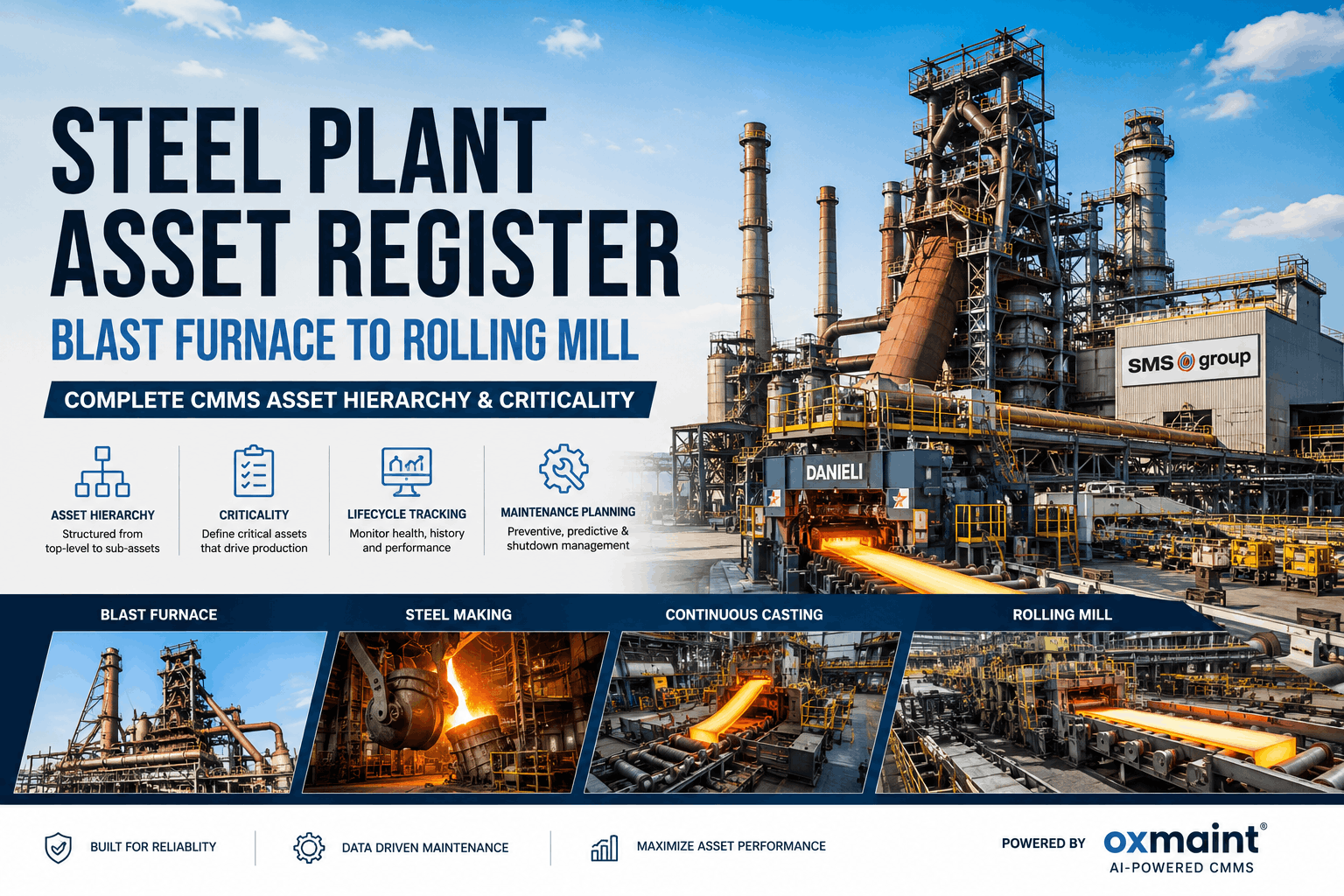
Most integrated steel plants run asset-heavy operations where a single unplanned blast-furnace reline or caster outage can erase millions in margin, yet the majority still rely on break-fix routines and spreadsheet-driven PM schedules. Industry benchmarking across more than 80 flat-rolled and long-product mills consistently shows the median facility operating at maturity level 2 — predominantly reactive with pockets of preventive work — leaving enormous reliability, energy, and safety upside on the table. Moving even one level higher typically delivers 12–18% uptime gains and cuts unplanned downtime cost by 25–35% within 18 months. The maturity model below gives maintenance and reliability leaders a structured lens to self-score, identify CMMS adoption gaps, and build a defensible improvement roadmap. Start Free Trial to baseline your plant in under 30 minutes.
Where does your plant sit on the 5-level steel maintenance maturity curve — and what is that gap costing you?
Benchmarking data from 80+ mills shows the median steel plant operates at Level 2: mostly reactive, with preventive maintenance compliance below 60%. Each level you climb typically adds 12–18% uptime and removes 25–35% of unplanned downtime cost within 18 months.
A 5-level maturity model built for steel plant operations
Adapted from ISO 55000 asset-management principles and TPM/RCM practice, the model maps each level to measurable PM compliance, CMMS adoption depth, and reliability KPIs typical of steel assets — from blast furnaces and BOFs to continuous casters and rolling mills.
Run-to-Failure & Firefighting
Maintenance is triggered by breakdowns. PM schedules exist on paper but compliance is under 30%. CMMS is absent or used only for spare-parts lookup. MTBF is not tracked.
Basic Preventive — Mostly Reactive
Time-based PMs exist for critical assets but adherence is inconsistent (40–60%). CMMS deployed for work orders and inventory, but failure codes are unused. Reliability engineering is thin.
Condition-Based & RCM
Vibration, oil, and thermography programs run on critical rotating equipment. Failure modes are coded in CMMS. RCA is performed on major losses. PM compliance exceeds 80%.
Integrated Reliability & OEE-Driven
Reliability-Centered Maintenance is institutionalized. Asset criticality, FMEA, and bad-actor lists are continuously refreshed. Downtime is tracked against OEE targets across all production lines.
Autonomous, AI-Optimized Maintenance
Predictive models ingest SCADA, IoT, and CMMS data in real time. Work orders are auto-generated before failure signatures cross threshold. Sparing is demand-predicted. Less than 5% of work is unplanned.
Why most steel plants are stuck at Level 2 — and what it costs
A 180-asset mill: the cost of staying at Level 2
Consider a mid-size flat-rolled plant with 180 tagged assets — two blast furnaces, a BOF shop, two continuous casters, and a hot-strip mill. At Level 2, unplanned downtime averages 11.3% of available hours, and blast-furnace PM compliance hovers at 55%.
Reaching Level 3 — 80%+ PM compliance, condition monitoring on the top 20 critical assets, and structured failure coding in the CMMS — typically cuts unplanned downtime by 28%. For this plant that is roughly 277 fewer unplanned hours, worth $12.9M in recovered contribution margin annually. The reliability investment (one reliability engineer, PdM sensors, and CMMS optimization) usually runs $380K–$520K, yielding payback inside the first 5 months.
Scoring blast-furnace PM compliance: the Level 2 → 3 bridge
The blast furnace is the single most consequential asset in an integrated mill. A 1% improvement in BF availability translates to roughly $1.8M annually for a 2.5 MTPA furnace. Use this scoring rubric to benchmark your BF maintenance program.
| PM Compliance Dimension | Level 2 (Current Median) | Level 3 Target | Weight |
|---|---|---|---|
| Scheduled PM completion rate | 55% | 85%+ | 25% |
| Critical-asset PdM coverage (vibration, oil, thermal) | 20% of bad actors | 80% of bad actors | 20% |
| Failure-code data quality in CMMS | Free-text, unstructured | Coded, 85% compliance | 15% |
| RCA on Tier-1 failures | Ad hoc, < 30% closed | 100% within 14 days | 15% |
| Spare-parts readiness for critical path | 62% fill rate | 92% fill rate | 15% |
| Shift handover & work-order close-out discipline | Paper-based, inconsistent | Mobile, > 90% same-shift | 10% |
A weighted score below 50 places the plant at Level 2; 50–70 indicates transition; above 70 confirms Level 3 readiness. Most Level 2 plants score 38–46 — strong evidence that PM compliance, not new technology, is the highest-leverage gap.
CMMS adoption gaps that keep steel plants at Level 2
Owning a CMMS is not the same as operating one. These are the six adoption gaps most frequently observed in Level 2 steel plants — each one a direct blocker to advancing maturity.
Failure codes unused
Technicians enter free-text notes; no structured failure-mode taxonomy. Without coded data, reliability analytics cannot run.
PMs scheduled, not closed
Work orders are generated but backlog grows. Open PMs older than 30 days compound into forced breakdowns.
No mobile close-out
Technicians return to a shared terminal to log work. Data quality drops 40–60% vs mobile same-shift entry.
Spare-parts linkage missing
BOMs are not attached to asset records, so planners cannot auto-reserve critical spares during work-order creation.
KPIs not visualized
MTBF, MTTR, and PM compliance are calculated manually in spreadsheets — reviewed monthly, not daily.
No integration to SCADA / ERP
CMMS operates in isolation. Production and maintenance data never reconcile, so OEE is estimated, not measured.
Stop losing $4M+ a year to PM compliance gaps.
Run the full steel maintenance maturity assessment in OxMaint and get a prioritized 90-day improvement plan mapped to your asset register.
The 18-month path from Level 2 to Level 3
Plants that move from Level 2 to Level 3 in under two years share a common sequence: stabilize PM compliance, fix CMMS data quality, then layer condition monitoring. Skipping steps is the most common reason transformations stall.
Stabilize PM Compliance
Audit every PM schedule for the top 30 critical assets. Eliminate duplicate and obsolete PMs. Enforce same-shift close-out via mobile CMMS. Target: 75% compliance.
Fix Failure-Code Data Quality
Deploy a 3-tier failure-mode taxonomy (problem, cause, remedy). Train technicians. Backfill 12 months of historical WOs. Target: 85% coded failure data.
Launch PdM on Top 20 Bad Actors
Install vibration, oil, and thermal sensors on the 20 assets responsible for 80% of downtime. Define alarm thresholds. Begin weekly reliability reviews.
Institutionalize RCA & FMEA
Mandate RCA on all Tier-1 failures within 14 days. Build FMEA for the top 5 production lines. Update bad-actor list quarterly. PM compliance now above 80%.
Integrate KPIs & Validate Level 3
Connect CMMS to SCADA and ERP. Visualize MTBF, MTTR, OEE, and PM compliance on live dashboards. Re-score maturity. Confirm unplanned downtime below 8%.
Steel plant maintenance maturity — frequently asked questions
How do I know if my steel plant is at Level 2?
If your CMMS is deployed but PM compliance sits between 40–60%, failure data is free-text, and you have no dedicated reliability engineer, you are at Level 2. Another signal: more than 50% of maintenance spend is unplanned, and MTBF is not tracked by asset criticality tier.
What is the single highest-ROI move from Level 2 to Level 3?
Raising PM compliance from 55% to 80% on critical assets — especially the blast furnace, caster, and hot mill — delivers the fastest payback. It requires no new hardware, only process discipline and mobile CMMS close-out. Most plants see 15–20% downtime reduction within 6 months. Book a Demo to see the OxMaint PM compliance dashboard.
How long does a full maturity assessment take?
A self-directed assessment using a structured rubric — covering PM compliance, CMMS adoption, PdM coverage, RCA discipline, and KPI visibility — takes 2–4 hours for a mid-size plant. A facilitated assessment with a reliability consultant typically runs 1–2 weeks including asset-register validation and interviews with shift leads.
What CMMS features matter most for advancing past Level 2?
Mobile work-order close-out, structured failure-code taxonomy, asset-level BOM linkage, and live KPI dashboards are the four capabilities that separate Level 3 plants from Level 2. Integration to SCADA for runtime-based PM triggers is the next differentiator. Start Free Trial to test all four in OxMaint.
Is Level 5 (AI-driven) realistic for steel plants today?
Level 5 is achievable for specific asset classes — particularly rotating equipment on rolling mills and motors — where sensor density and failure-mode predictability are high. For the blast furnace and caster, most plants realistically target Level 4 first; AI optimization layers on top once condition data and failure-code quality from Level 3–4 are in place.
Benchmark your plant and build the roadmap to Level 3.
Run the steel maintenance maturity assessment in OxMaint, map your CMMS adoption gaps, and get a prioritized 90-day plan — backed by real benchmarking data from 80+ mills.
Free 14-day trial · No credit card