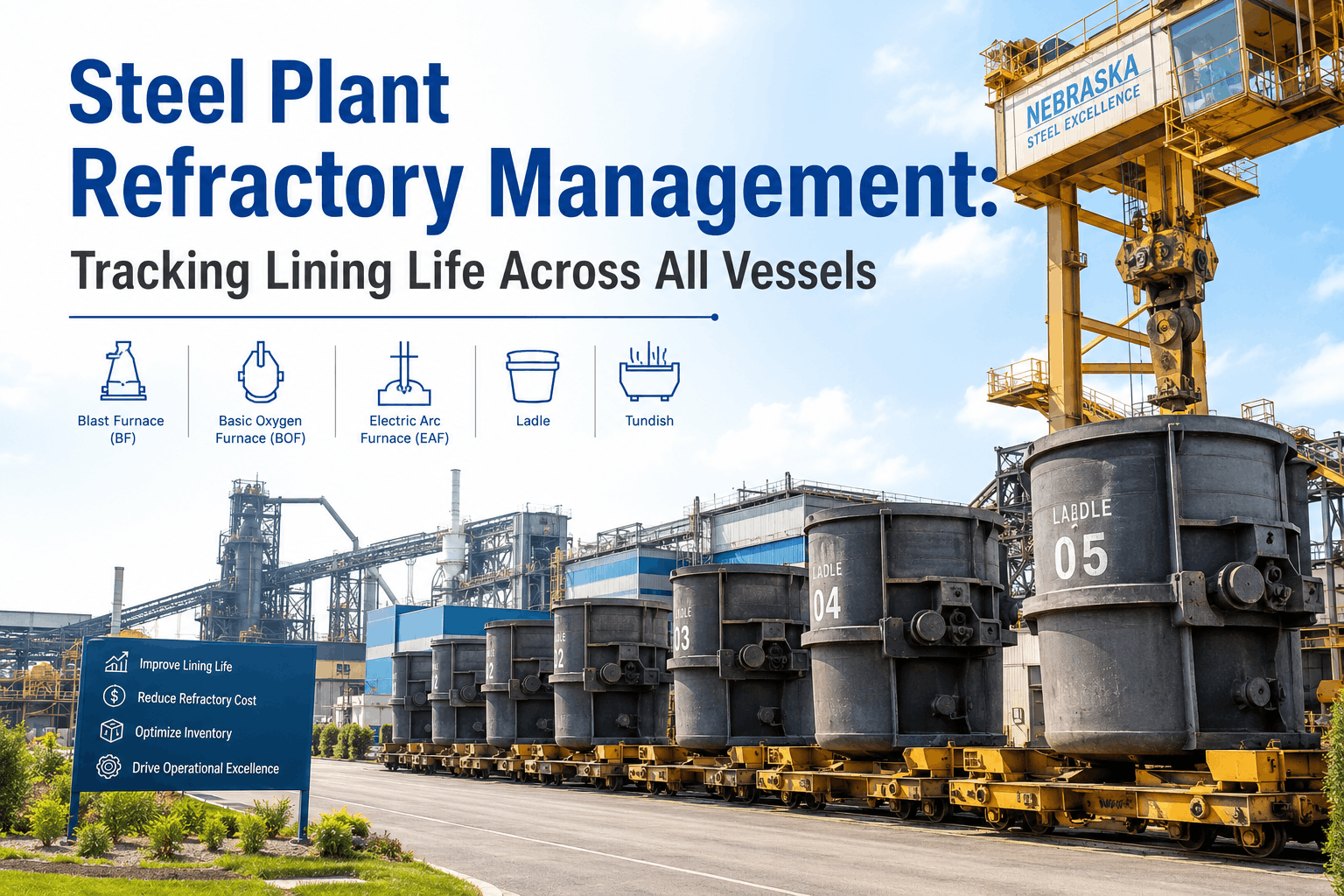
A ladle is the most safety-critical vessel in liquid steel handling — and the most consequential maintenance asset in any BOF or EAF steelmaking shop. A ladle shell breach, a slide gate failure during transfer, or a refractory burnthrough during a heat is not an equipment failure. It is a potential catastrophic safety event that exposes personnel, destroys surrounding equipment, and triggers a production shutdown measured in weeks rather than hours. The United States steel industry averages two reported ladle-related safety incidents per major steelmaking facility per three-year period when operating without systematic, per-vessel life tracking — and the common root cause in post-incident analyses is consistently the same: the refractory campaign was not closed out on schedule because nobody was tracking the individual ladle's heat count accurately. Oxmaint's steel plant ladle life tracking template eliminates this gap entirely — providing per-vessel heat count records, refractory campaign management, slide gate cycle tracking, preheat schedule documentation, and CMMS-integrated work order generation that ensures every ladle in your fleet receives the right maintenance at the right time, documented to an audit-ready standard. This template is the operational backbone of the ladle availability improvement documented in the 2026 BOF case study that moved fleet availability from 76% to 94% within 18 months.
Ladle fleet availability improvement at a Midwest BOF complex — 18 months on Oxmaint tracking
0
Refractory-related safety incidents in 18 months post-Oxmaint vs 2 events in prior 3 years
24+
Individual ladles simultaneously tracked per-vessel in a single Oxmaint CMMS dashboard
Auto
Reline work order generation at configurable heat-count threshold — zero manual scheduling
Why Per-Vessel Ladle Tracking Matters: The Physics of Ladle Wear
Two ladles in the same fleet at the same nominal heat count can have vastly different remaining lining life — and any tracking system that treats them identically is generating safety risk. Ladle barrel lining wear is governed by a combination of heat count, grade mix processed (stainless and high-alloy grades are more aggressive on basic brick than carbon grades), steel temperature at tapping, holding time under steel (longer holding = greater infiltration and thermal cycling), gas stirring intensity and duration, and slag chemistry (basic slags with high FeO content are more aggressive than lime-saturated slag). A ladle that processes 80% stainless grades at 1,650°C with long holding times and aggressive gas stirring will exhaust its campaign life significantly before a sister ladle running 80% plain carbon at 1,590°C with minimal holding time, even if both started with identical lining installations.
Slide gate components wear independently of barrel lining and require their own tracking cycle. The plate, nozzle, and collector nozzle experience different wear rates depending on steel grade, nozzle bore erosion pattern, and whether the slide gate is used for flow control (partial opening cycling is more erosive than single-open single-close operation). The preheat schedule is the third independent tracking dimension — a ladle returned from cooldown to service without completing the specified preheat cycle carries risk of thermal shock to the lining and moisture-driven spalling that can initiate a steel penetration event. Oxmaint tracks all three dimensions per vessel simultaneously, generating work orders when any one of them reaches its maintenance threshold — not just when the barrel heat count crosses the campaign limit.
LADLE LIFECYCLE — OXMAINT TRACKING DIMENSIONS PER VESSEL
01
New Lining
Heat count: 0 Slide gate: Reset Preheat: Full schedule required
02
Active Service
Heat count: Accumulating Slide gate: Cycles logged Preheat: Per return from cool
03
Gunning / Patch
Hot repairs extend campaign Hotspot locations recorded Campaign limit adjusted
04
Reline Alert
Auto work order at 90% campaign Material & crew scheduled Ladle pulled from rotation
05
Relining Complete
Heat count: Reset to 0 Slide gate: Inspected Preheat: Full schedule required
The Complete Ladle Life Tracking Template
The template below covers every tracking parameter required for a complete per-vessel ladle life record in a U.S. BOF or EAF steel operation. This is the structure Oxmaint uses to maintain individual ladle records across your full fleet — enabling the refractory campaign tracking, maintenance scheduling, and safety compliance documentation that regulators and insurance auditors expect from a U.S. steel plant operating liquid steel handling equipment. Load this directly into Oxmaint and every heat processed, every slide gate operation, and every preheat cycle is logged automatically against the ladle's unique asset record — building the continuous life history that enables campaign extension decisions, root cause analysis for early failures, and procurement planning for refractory and slide gate materials.
STEEL PLANT LADLE LIFE TRACKING TEMPLATE — OXMAINT PER-VESSEL RECORD
Preheat Sign-OffTech sign-off required — Oxmaint blocks service assignment until complete
Thermal Profile LogTemp vs time curve stored per preheat event in CMMS
Ladle Fleet Availability Dashboard — What Oxmaint Shows in Real Time
The most operationally valuable output of a structured ladle life tracking system is not the individual vessel record — it is the fleet availability view that tells your steelmaking shop planner exactly how many ladles are available for service, how many are in preheat, how many are in maintenance, and which ones are approaching their reline threshold in the next 5–15 heats. Without this visibility, ladle availability crises happen when the last available ladle is pulled for reline at the same moment the shop needs maximum vessel count for a production push. With Oxmaint's fleet dashboard, the refractory campaign completion sequence is visible 2–4 weeks in advance — enabling the shop planner to schedule reline windows during natural production valleys rather than competing with peak demand periods.
Temp/time progress tracked — service blocked until complete
4
In Maintenance / Reline
Reline work order open — estimated return date calculated
3
Approaching Reline Threshold
Within 15 heats of campaign limit — reline WO auto-generated
"We had two refractory safety incidents in three years before implementing Oxmaint's per-vessel ladle tracking. The root cause in both cases was the same — nobody knew exactly where the ladle was in its campaign because we were tracking fleet heat count on a shared spreadsheet, not individual vessel records. After 18 months on Oxmaint with individual heat-count tracking and automated reline scheduling, ladle availability improved from 76% to 94% and we have had zero safety events."
Q1 What data should a steel plant ladle life tracking template capture for each vessel?
A complete ladle life record requires: cumulative heat count against campaign limit, grade mix and holding time data per heat (for wear rate adjustment), slide gate plate and nozzle cycle count, preheat schedule compliance log per return to service, hot repair history, and auto-generated reline work orders at the configured threshold percentage.
Q2 Why is per-vessel heat count tracking safer than fleet-average tracking for U.S. steel ladle fleets?
Two ladles at the same fleet-average heat count can have radically different remaining lining life depending on grade mix, holding time, gas stirring intensity, and tap temperature — fleet-average tracking masks this variance and allows individual vessels to unknowingly exceed safe campaign limits while appearing to be within average-based thresholds.
Q3 How does Oxmaint automatically generate ladle reline work orders without manual scheduling?
Oxmaint tracks each ladle's cumulative heat count continuously and auto-generates a reline work order — with material requirements and crew assignment pre-populated — when the vessel reaches a configurable percentage of its adjusted campaign limit, typically set at 90% to provide 10–15 heats of planning lead time.
Q4 How does ladle slide gate tracking differ from barrel lining campaign tracking?
Slide gate plates wear per casting sequence at a different rate than barrel lining wears per heat — a ladle may complete 3–4 plate set changes within a single barrel lining campaign, requiring independent cycle counting, nozzle bore dimensional tracking, and separate work order generation managed in parallel within the same vessel record.
Q5 What OSHA and insurance compliance records should a ladle life tracking system generate?
Every ladle reline, hot repair, preheat cycle, and slide gate change should generate a timestamped, technician-signed CMMS work order record — forming the continuous maintenance history that OSHA PSM programs, insurance underwriters, and internal safety audits require for liquid steel handling equipment operating in U.S. facilities.
Q6 How does preheat tracking prevent ladle refractory failures at U.S. steel plants?
Moisture trapped in insufficiently preheated refractory converts to steam under liquid steel contact, causing spalling, cracking, and potential shell penetration — Oxmaint blocks ladle service assignment until the preheat work order is signed off, preventing operators from returning inadequately preheated vessels to service under production pressure.
Q7 Can Oxmaint's ladle tracking integrate with Level 2 automation systems at U.S. steel plants?
Yes — Oxmaint's REST API allows direct integration with Level 2 heat tracking systems, automatically updating each ladle's heat count from the production scheduling system rather than requiring manual entry — ensuring the CMMS record is always current without administrative overhead from the maintenance team.
Q8 What ladle fleet availability improvement can U.S. steel plants expect after implementing Oxmaint tracking?
The documented 2026 Oxmaint BOF case study achieved fleet availability improvement from 76% to 94% within 18 months — driven by elimination of unscheduled relines, improved reline window planning, preheat compliance enforcement, and slide gate maintenance scheduling that previously generated surprise vessel removals during peak production periods.
Track Every Ladle in Your Fleet — Start Free with Oxmaint
Per-vessel heat count, automated reline scheduling, slide gate cycle tracking, preheat compliance, and audit-ready CMMS records for your complete BOF or EAF ladle fleet. Live in 3–5 days.



-justification-template.png)


