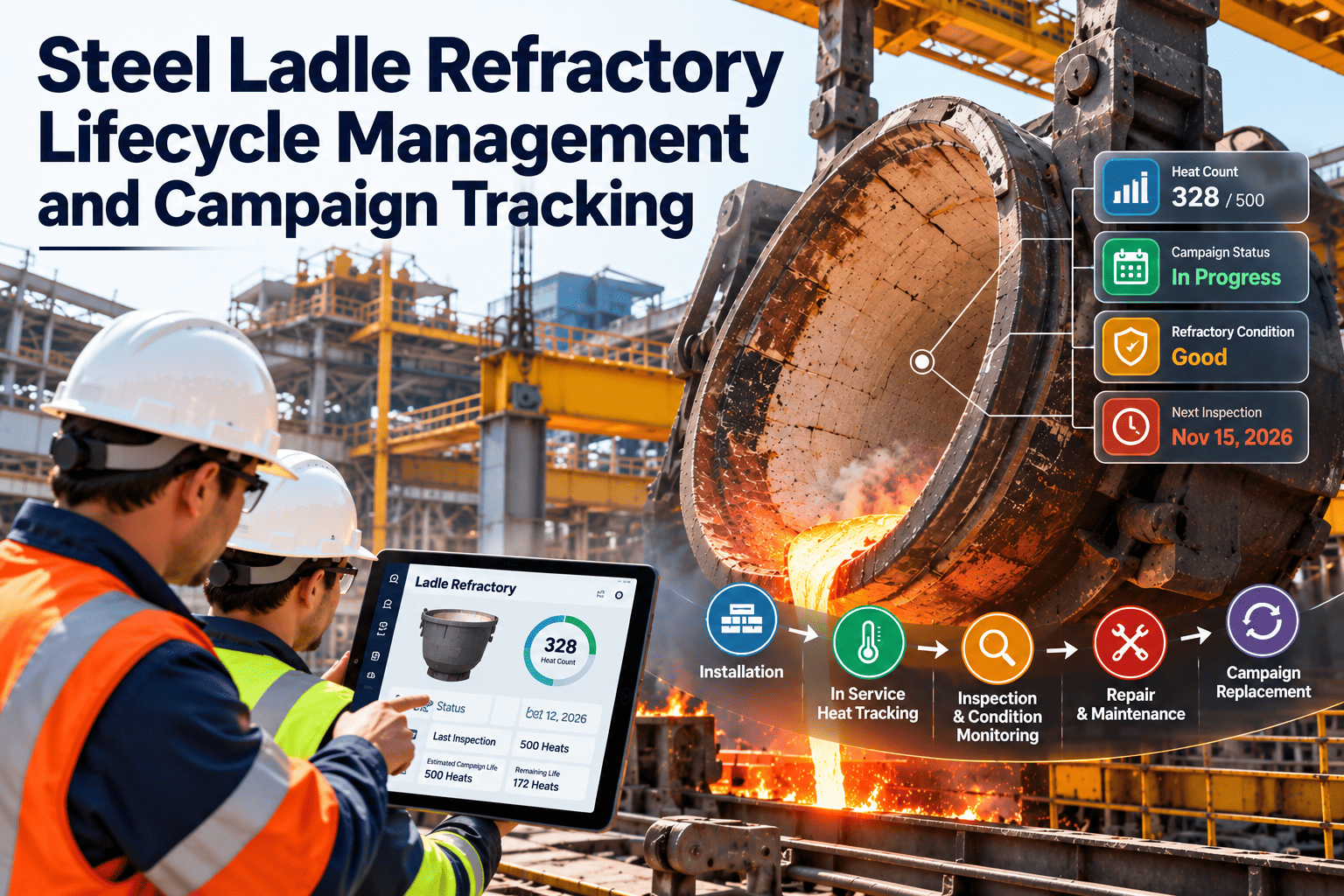
Heat count is the simplest number in ladle management and the one most often wrong. A heat missed on a whiteboard, a ladle swapped without a note or an aborted pour counted twice can quietly skew every refractory decision that depends on it. Reliable ladle heat count tracking starts with agreeing what counts as a heat, capturing it at the point of use and linking it to inspections, repairs and relining, and a shared maintenance and asset tracking system can hold that record for every ladle.
Ladle heat count tracking for dependable heat and refractory records
Capture each heat against the right ladle and campaign, trigger inspections and relining from actual usage, and stop refractory decisions from depending on memory or handwritten tallies.
Why heat counts go wrong in real melt shops
Most inaccuracies are not careless people. They come from a fast, noisy process in which the ladle is only one of many things operators track.
Unclear definition of a heat
One shift counts a heat at tapping, another at casting start, and a third ignores heats that were returned or aborted.
Manual tallies on boards and logbooks
Handwritten counts are updated late, overwritten or lost, and they rarely connect to inspection or repair records.
Ladle swaps and ladle identity mix-ups
When a spare ladle is used in an emergency, the heat can be credited to the wrong vessel.
Count not reset at reline
A new lining that inherits the old campaign number produces nonsense life data and false alarms.
Production and maintenance records disagree
The melt shop system, the refractory team and the maintenance log each hold a different number.
Agree what counts as a heat before you count it
Edge cases decide whether the count can be trusted. Write the rules down and apply them to every ladle.
| Situation | Question to settle | Recommended practice |
|---|---|---|
| Normal tapped and cast heat | At which event is the heat counted? | Choose one event, such as tapping completion, and use it everywhere |
| Heat returned or re-ladled | Does steel contact with the lining count twice? | Count by exposure agreed with refractory engineers and record the reason |
| Aborted or partial pour | Does a partial heat add wear? | Record as a separate event type so it can be reviewed, not silently dropped |
| Long hold time before casting | Is extra time captured? | Capture hold duration as an additional usage field, since time affects wear |
| Ladle used for treatment only | Is it a heat or a different duty? | Classify by duty type so campaign comparison stays fair |
| Emergency substitute ladle | Who credits the heat? | Require ladle identity confirmation at the time of use |
Three ways to capture heat events
The right method depends on plant automation, but accuracy always improves when the entry is made at the point of use and checked automatically.
Manual entry by operator or supervisor
- Lowest setup effort, suitable as a starting point.
- Needs clear ownership and a fixed entry moment.
- Mobile entry reduces delays compared with end-of-shift logs.
Scan or confirm ladle identity
- Reduces ladle mix-ups by confirming the vessel at use.
- Works well with tags or labels on each ladle.
- Still requires someone to trigger the heat event.
Import from production or Level 2 data
- Pulls heat events from existing melt shop systems where available.
- Removes duplicate entry and speeds updates.
- Needs a reliable ladle identifier in the source data.
What each heat event should record
The count alone is a thin record. A few additional fields make later analysis far more useful without slowing the operator.
Using the count to trigger work, not just to report it
A count that nobody acts on is only history. Link usage thresholds to inspections, repairs and relining so the number drives maintenance.
Commissioning checks
Verify drying and preheat records and confirm the first inspection after initial heats.
Routine inspections
Measure wear at defined heat intervals and schedule flow control part checks.
Increased monitoring
Shorten inspection intervals, plan targeted repairs and review wear by zone.
Reline preparation
Reserve materials, book the contractor and schedule the ladle out of rotation.
Set bands from your own lining history
- Thresholds should come from your lining design, steel grade mix and past campaigns, not from generic numbers.
- Review the bands after every campaign, especially after changing materials or practice.
- Allow an inspection to override the count, because a ladle can need attention well before its expected limit.
Keeping the count honest with simple validation
Small checks catch most errors before they spread into decisions.
Checks at entry
- Reject a heat for a ladle marked out of service or under reline.
- Flag two heats for the same ladle within an impossible time window.
- Require a reason for substitute ladle use.
- Confirm that the campaign number matches the active lining.
Checks during review
- Compare maintenance heat counts with production system counts regularly.
- Investigate ladles whose wear is far out of line with their count.
- Audit resets at reline and confirm every new campaign starts correctly.
- Review remarks for patterns such as repeated slag carry-over.
Why heat count is necessary but not sufficient
Two ladles with the same count can have very different remaining life. Heat count should be read together with other evidence.
- All heats treated as equal wear.
- Relining decided at a fixed number.
- Early damage missed until the number is reached.
- Good linings retired too soon, weak ones kept too long.
- Grade, temperature and hold time considered with each heat.
- Relining decided from count, measured wear and repair history.
- Inspections triggered early when conditions are severe.
- Retirement timing based on evidence for each ladle.
Reports a refractory team should review
Good tracking pays off when it answers practical questions quickly.
Campaign summary by ladle
Heats achieved, repairs done, inspection dates and retirement reason for each lining.
Fleet status view
Current count and next action for every ladle so planners can see where the fleet stands.
Wear against heats
Measurements plotted against usage to see whether wear follows expectations.
Cost per heat
Material and repair cost divided by heats, useful for supplier and practice reviews.
Data quality exceptions
Missing resets, duplicate events and mismatches between systems.
Handover moments where counts are usually lost
Errors cluster around transitions. Knowing where they happen helps place the control in the right spot.
Shift change
Outgoing crews leave tallies unfinished and incoming crews cannot confirm which heats were already counted.
Ladle returns from repair
A ladle that comes back from the reline bay may re-enter service without a clear campaign number or reset.
Breakdowns and sequence changes
When the caster stops or the schedule changes, ladles are redirected and the planned record no longer matches what happened.
Night shifts and holidays
Reduced supervision increases the chance that entries are postponed and later reconstructed from memory.
Heat counts and the ladle rotation plan
A melt shop cannot choose freely which ladle to use. Usage counts help planners keep the fleet balanced.
Questions planners can answer
- Which ladles are due for inspection within the next few shifts?
- How many ladles will approach their reline window in the same period?
- Which ladle should take a demanding steel grade, based on its condition?
- When must a replacement ladle be ready to protect the casting schedule?
Benefits for maintenance and refractory teams
- Less time chasing the current count before every inspection.
- Earlier warning before materials and contractors are needed.
- Smoother staggering of relining, so ladle availability stays stable.
- A shared number that operations, refractory and maintenance all trust.
Ownership and training make the count stick
A well-designed process still fails if nobody owns it. Assign roles clearly and keep the entry effort small.
Capture at the point of use
- Confirm the ladle and enter or confirm the heat.
- Add a remark for any unusual event.
- Report ladle mix-ups immediately.
Own the rules and thresholds
- Define heat rules and edge cases.
- Set inspection and reline thresholds.
- Review exceptions and campaign outcomes.
Convert counts into work
- Schedule tasks from usage triggers.
- Reserve parts and contractors.
- Coordinate ladle availability with production.
Audit trail and traceability benefits
When something goes wrong with a ladle, the first question is always what its history looked like.
- Incident investigation: a dated record of heats, inspections and repairs shows whether the lining was inside its intended operating window.
- Quality reviews: if a steel quality issue is suspected to relate to ladle condition, the record links the heat to the vessel and its campaign.
- Supplier discussions: campaign evidence supports factual conversations about material performance.
- Internal audits: consistent entries and reset records demonstrate that the plant follows its own inspection procedure.
- Knowledge continuity: new engineers can learn from several years of ladle history instead of relying on veterans' recollection.
Building a heat count process in four stages
Plants that try to perfect everything at once usually delay the benefits. Build the process in layers.
Define and register
Agree the heat definition, register every ladle and campaign, and give each vessel a visible identifier.
Capture consistently
Start recording heats at one agreed moment and fix early gaps, even if entries are manual at first.
Connect to work
Link counts to inspections, repair tasks and parts so the number starts to trigger action.
Automate and refine
Import heat data where reliable, add validation rules and tune thresholds from campaign results.
Signs that your current tracking needs attention
Reconciliation routine for the refractory team
- Compare the maintenance heat count with the production system count for each active ladle at an agreed interval.
- Investigate any difference larger than your tolerance and record the cause, such as a missed entry or ladle swap.
- Correct the count with a documented adjustment rather than overwriting the history.
- Review the exceptions list with shift supervisors so the same cause is not repeated.
- Report the number of corrections per month as a simple measure of data quality.
What good looks like after six months
- Every ladle has one current heat count that operations, refractory and maintenance all accept.
- Inspections and flow control checks are scheduled from usage, and overdue items are visible on a dashboard.
- Reline dates are forecast early enough for materials and contractors to be booked without expediting.
- Reconciliation exceptions are few, and each one has a recorded cause and corrective step.
- Campaign reviews use the same dataset, so debates focus on decisions instead of on whose number is right.
How Oxmaint supports ladle heat count tracking
Usage tracking works best when it sits beside inspections, work orders and parts.
Ladles as assets with usage meters
Track each ladle and its heat usage as a meter reading, reset at reline so each campaign stays distinct.
Usage-based preventive tasks
Create inspections, flow control part checks and reline preparation tasks based on heat count thresholds.
Work orders and parts
Attach materials and labour to repairs and relines and see availability before the ladle is released.
Dashboards and history
Compare campaigns, costs and repair patterns from the same asset history.
Starter checklist for reliable heat counting
Ladle heat count tracking: frequently asked questions
Why track heat count in a maintenance system?
Because it connects usage to inspections, repairs, parts and relining in one asset record rather than separate logs.
Should every heat count equally?
Not always, since grade, temperature and hold time change wear, so capture those details alongside the count.
Can heat data come from our production system?
Often yes, if a reliable ladle identifier exists. You can book a demo to discuss integration options.
What happens at reline?
The campaign closes, the usage meter is reset and a new campaign record begins with the new lining details.
How do we start?
Load one ladle line with its current count and inspection history. You can sign up to begin.
Make every heat count toward a better refractory decision
Capture heats accurately and connect them to inspections, repairs and relining in one record.