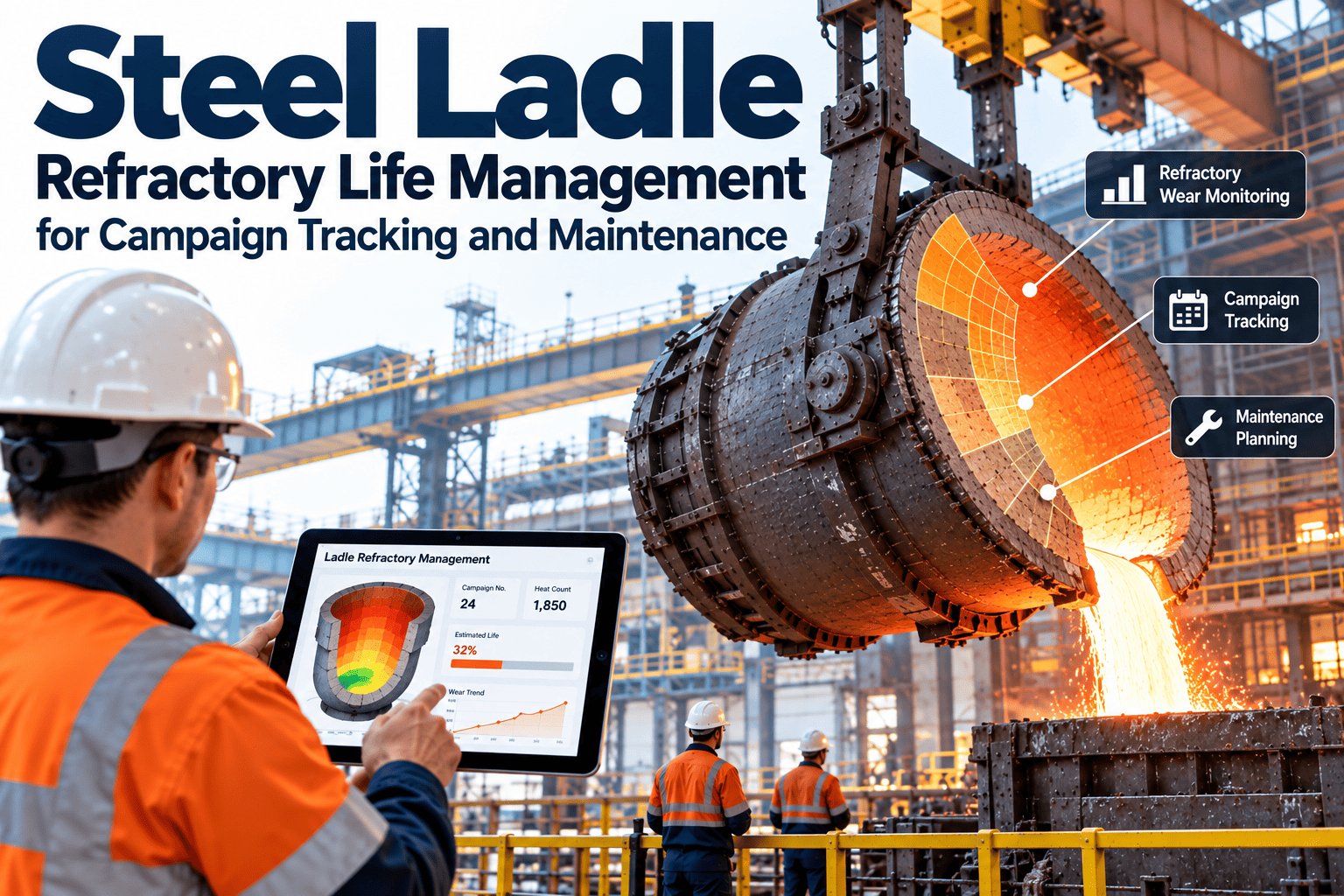
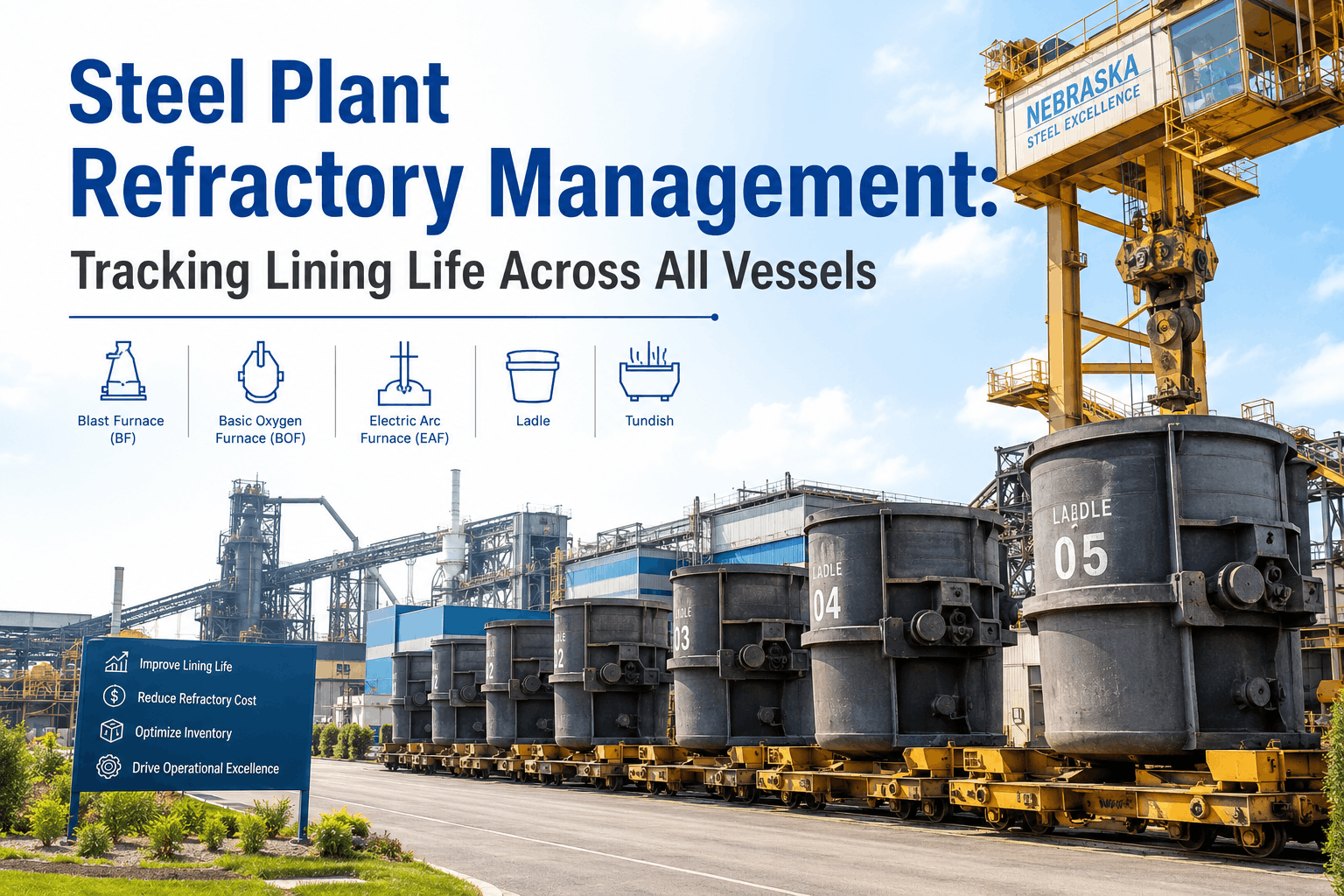
A steel plant's ladle fleet is the circulatory system of the melt shop — every heat of steel passes through a ladle, and every minute a ladle is unavailable costs approximately $15,000 in lost production (Viper Imaging). A typical integrated plant operates 10-30+ ladles in constant rotation, each cycling through tapping, secondary refining, continuous casting, slag dumping, inspection, and relining. Each ladle carries 20-400 tons of molten steel at 1,600-1,650°C, with refractory linings that erode at 0.5-1.2mm per heat. The refractory cost alone represents more than 30% of all iron and steel metallurgical refractory consumption, with individual ladle repairs running $15,000-$30,000. And the ultimate risk — a molten metal breakout from a failed lining — threatens lives, destroys equipment, and shuts down production for days.
Managing a ladle fleet on whiteboards, paper logs, and tribal knowledge doesn't scale. You need to know where every ladle is right now, how many heats it has completed, what zone is wearing fastest, when the next reline is due, and which ladles are available for the next heat. Oxmaint CMMS tracks every ladle in your fleet — heat count, refractory condition by zone, turnaround time, thermal profile, maintenance history, and availability status — transforming ladle management from reactive to predictive. Schedule a demo.
HERO: CIRCULATION RINGFill from BOF/EAF
LF / RH / VOD
CC Turret
Empty & Clean
Lining Check
Return to Service
Fleet Status: What You Need to See at a Glance
At any moment, a melt shop supervisor needs to know the status of every ladle in the fleet. Here's what the dashboard must display:
See Your Entire Fleet in One Dashboard
Oxmaint shows every ladle's location, heat count, refractory status, and availability — with automated alerts when any ladle approaches its reline threshold.
Refractory Zones: Where Ladles Wear and Why It Matters
A ladle isn't a single refractory surface — it has distinct wear zones, each degrading at different rates for different reasons. The CMMS must track each zone independently:
Slag Line
Magnesia-carbon bricks (MgO-C). Most aggressive wear zone — direct contact with corrosive slag. Erosion rate: 0.8-1.2mm/heat. Typically limits campaign life. Multiple slag line replacements per barrel lining life.
Impact Zone
High-alumina or MgO-C bricks. Absorbs the kinetic energy of molten steel during tapping — high-momentum stream strikes bottom/lower wall. Requires additional thickness or higher-grade refractory.
Barrel / Sidewall
High-alumina bricks (60-90% Al₂O₃) or alumina-magnesia castable. Working lining thickness: 150-225mm. Erosion: ≤0.5mm/heat for brick. Handles temperatures above 1,700°C.
Bottom & Well Block
Critical for slide gate operation. Well block and seating block require replacement at 40-60 heats. Porous/stir plugs wear after 10-20 uses. 57 recognized root causes for argon plug breakout failures alone.
Heat Counting: The Core Metric of Ladle Life Management
Every ladle campaign is measured in heats — the number of times molten steel has been held in the vessel. Tracking heats per zone determines when each component needs replacement:
Porous Plugs
Well Block / Slide Gate
Slag Line
Full Working Lining
Breakout Risk: The Consequence of Poor Tracking
A molten steel breakout — when metal escapes through a failed lining — is the worst-case scenario in any melt shop. The risk escalates predictably when tracking fails:
Controlled Operation
Heats tracked per zone, thermal imaging active, reline scheduled proactively. Refractory consumption: 0.9 kg/ton steel (brick). Plant uptime: 98.6% (Viper Imaging case study).
Degrading Visibility
Heat counts estimated, not tracked per zone. Slag line thickness unknown. Porous plug replacement based on schedule, not condition. Refractory costs rising — overconsumption at 2-4 kg/ton.
Blind Operation
Ladles run past campaign limits. Hotspots visible on shell but no systematic monitoring. Residual thickness unknown. Emergency repairs becoming frequent. $15-30K per unplanned reline.
Breakout Event
20-400 tons of molten steel escapes the ladle. Equipment destruction. Production shutdown for days. Potential fatalities. 57 recognized root causes — most preventable with proper tracking. Cost: catastrophic.
What the CMMS Must Track Per Ladle
Each ladle in the fleet requires an individual digital record with these data points continuously updated:
- Unique ladle ID (RFID tagged)
- Current location in plant
- Status: in-service / standby / relining / cooling
- Current heat number in campaign
- Time since last heat (idle time)
- Assigned to next scheduled heat
- Residual thickness per zone (laser measured)
- Heats on slag line / barrel / bottom separately
- Heats on porous plug / well block
- Thermal profile history (IR camera data)
- Hotspot locations and trending
- Erosion rate calculation (mm/heat per zone)
- Full reline dates and refractory type used
- Partial repairs (slag line, plug, well block)
- Shell inspection reports
- Slide gate plate changes
- Dryout/preheat records
- Total lifetime heats (cumulative)
- Turnaround time per cycle
- Idle time between heats
- Preheat temperature log
- Steel grade history
- Refining process exposure (LF/RH/VOD)
- Refractory cost per ton of steel produced
Stop Guessing — Start Tracking Every Ladle, Every Heat
Oxmaint builds a complete digital twin for every ladle in your fleet — heat count by zone, refractory condition trending, turnaround time analytics, and automated reline scheduling. Prevent breakouts, extend campaign life, and optimize fleet utilization.
Frequently Asked Questions
How many heats does a steel ladle lining last?
Lining life varies significantly by zone and refractory type. Porous plugs require replacement every 10-20 heats. Well blocks last 40-60 heats. Slag line MgO-C bricks typically achieve 70-100 heats. Full working lining campaigns range from 70-157 heats — Rourkela Steel Plant (SAIL) achieved a record 157 heats through MgO-C optimization across all zones. Brick linings last approximately 2.3x longer than monolithic castable linings (18 months vs. 8 months average). The key is tracking heats per zone independently, since different zones reach their limits at different times.
How much does a ladle breakout cost?
Direct costs are catastrophic: production downtime at $15,000 per minute (Viper Imaging), individual ladle repairs of $15,000-$30,000, plus potential equipment destruction and facility damage that can run into the millions. There are 57 recognized root causes for argon plug breakout failures alone (ACerS Bulletin 2024). The indirect costs are even larger — safety incidents, regulatory investigations, insurance claims, and lost customer orders during extended shutdowns. One steel mill achieved 98.6% uptime (vs. 96% target) after implementing continuous thermal monitoring, directly preventing multiple breakout events.
What is the typical steel ladle fleet size?
Fleet size depends on production rate and ladle turnaround time. Rourkela Steel Plant (4.2 MT capacity) operates with a fleet of 29 steel ladles, with 10-11 in active rotation making 54-60 blows per day. Turnaround time — the complete cycle from tapping to next tapping — typically takes several hours. The number of ladles needed in circulation is determined by: production rate (heats per day), turnaround cycle time, number of ladles in maintenance/relining, and required standby capacity. A CMMS optimizes this by minimizing unnecessary idle time and ensuring reline scheduling doesn't create fleet shortages.
How does RFID work for ladle tracking?
Passive RFID tags are mounted on ladles in high-temperature armor enclosures. RFID readers at key process positions (tapping bay, ladle furnace, CC turret, maintenance bay, preheat stand) automatically detect arrival and departure times. The tag reflects the reader's RF signal with a unique ID that remains constant through the tag's lifetime — no battery required. Tags can be read from several meters away without line-of-sight. The system automatically logs: processing time at each station, idle time between stations, heat count, and temperature profiles — eliminating manual tracking errors entirely.
What refractory materials are used in steel ladle linings?
Slag line: Magnesia-carbon (MgO-C) bricks — the standard for corrosion resistance against aggressive slags. Barrel/sidewall: High-alumina bricks (60-90% Al₂O₃), corundum-spinel castable, or alumina-magnesia-carbon bricks. Bottom: High-alumina bricks in herringbone pattern for maximum density. Safety lining: 50-150mm thick clay or high-alumina bricks. Well block/porous plug: Specialty refractories — sliding plates range from alumina to zirconia to oxide-carbon systems. Working lining thickness is typically 150-225mm in the barrel and 225-300mm in the bottom. Refractory consumption target: 0.9-2.7 kg per ton of steel produced.