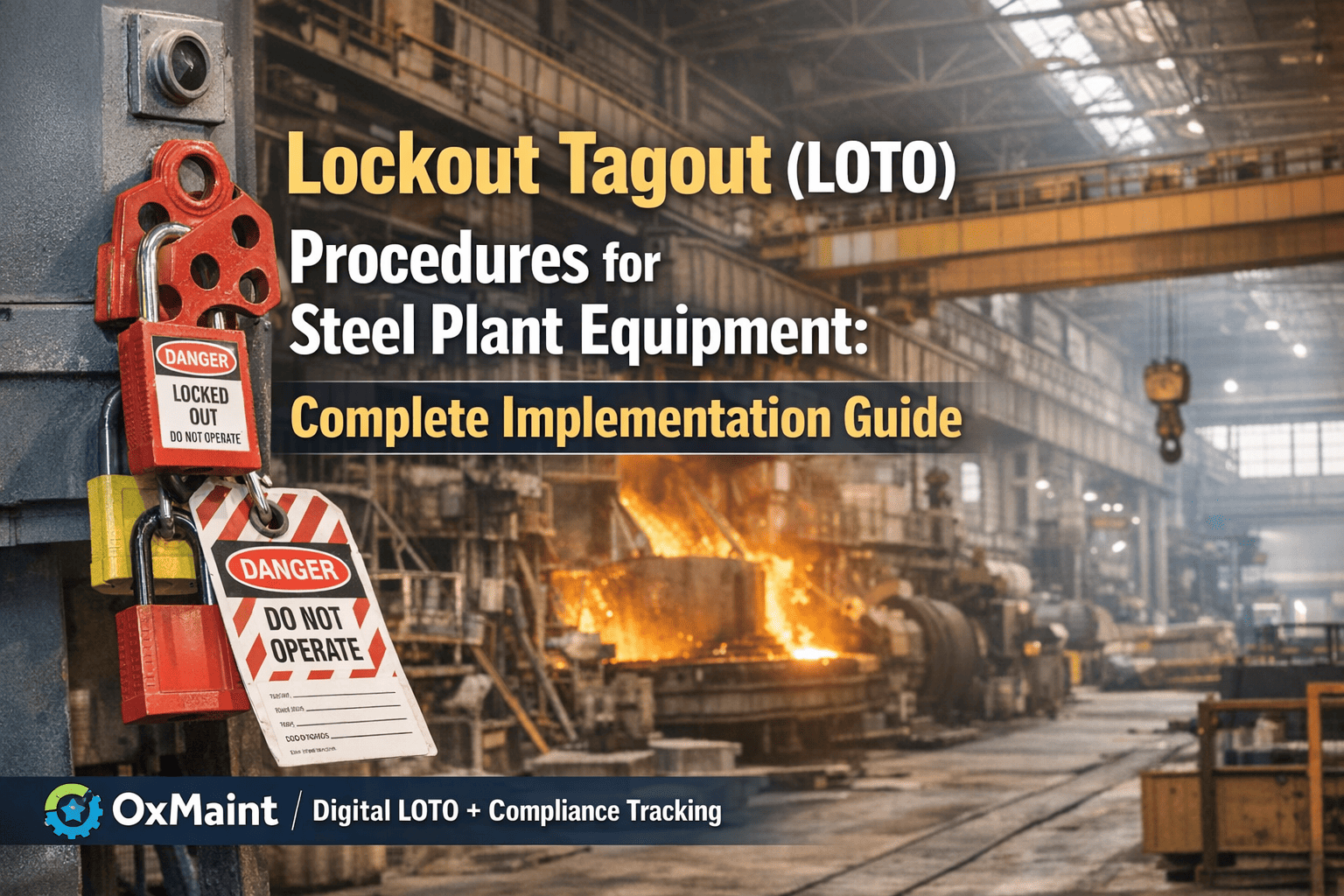
Lockout/Tagout ranked #4 on OSHA's Top 10 most cited standards in FY2025, with 2,177 citations recorded across general industry. Steel plants carry some of the highest LOTO risk of any sector — blast furnace hot blast stoves, electric arc furnaces running 480V to 34.5kV, rolling mill drives, and overhead cranes handling molten metal all combine multiple hazardous energy sources on a single job. OSHA estimates that proper lockout/tagout procedures prevent 120 fatalities and 50,000 injuries every year, yet the same handful of citation causes — missing machine-specific procedures, absent training records, skipped periodic inspections — repeat across mills of every size. A single facility with ten machines and no written procedures can face more than $165,000 in penalties from one inspection alone. See how Oxmaint brings digital LOTO procedures to every isolation point in your plant.
Lockout/Tagout Procedures Built for Steel Plant Energy Sources
Equipment-specific isolation, group LOTO coordination, and audit-ready permit records for blast furnaces, EAFs, rolling mills, and crane systems.
Why LOTO Failures Hit Steel Plants Harder Than Most Industries
Most industries deal with one or two energy types per machine. A steel plant deals with several at once — high-voltage electrical feeds, residual hydraulic pressure in mill drives, stored heat in furnace refractory, and interconnected equipment that can move even after the primary machine is locked out. That complexity is exactly where OSHA's most common citations concentrate, and exactly where a paper tag on a breaker stops being enough.
The 6-Step LOTO Sequence OSHA 1910.147 Requires
Every energy control procedure, regardless of equipment type, follows the same required sequence. Skipping or reordering a step is one of the fastest ways to turn a routine maintenance job into a citation or an incident.
Isolation Points by Steel Plant Equipment Type
A generic procedure is the single biggest driver of LOTO citations. Each asset class below carries its own energy sources, its own isolation points, and its own verification method — and OSHA expects the written procedure to reflect that.
| Equipment | Energy Sources | Isolation Points | Verification Method |
|---|---|---|---|
| Blast Furnace & Hot Stoves | Stored thermal energy, pressurized gas lines | Gas valve lockout, blind flanges | Gas detection and temperature confirmation |
| Electric Arc Furnace | 480V to 34.5kV electrical, hydraulic tilt system | Breaker lockout, hydraulic bleed valves | Voltage testing and pressure gauge check |
| Rolling Mill Drives | Electrical drive power, mechanical stored energy | Disconnect lockout, roll gap mechanical stops | Try-start and physical roll gap inspection |
| Overhead Cranes | Electrical power, gravity load, hoist brake energy | Main disconnect lockout, load block grounding | Crane LOTO per Subpart N and load verification |
| Compressed Air & Utility Gas | Residual line pressure, stored gas volume | Valve lockout, bleed-down ports | Pressure gauge reading to zero |
The 4 Citation Causes Behind Most LOTO Violations
A small number of program gaps account for the majority of nationwide LOTO citations. All four are documentation and process failures — not equipment failures — which makes them fully preventable with the right system.
A Paper Tag Cannot Prove Compliance During an Audit
Oxmaint turns every isolation point into a digital, equipment-specific procedure with individual lock accountability — so your LOTO program holds up under inspection, not just on the shop floor.
Paper LOTO Tags vs. Digital LOTO in a CMMS
How Oxmaint Runs Digital LOTO Across the Plant
Oxmaint replaces paper tags and clipboard sign-offs with a digital energy control system that maps isolation points, coordinates group lockout, and keeps every permit audit-ready without extra paperwork.
Every asset gets its own written procedure with isolation points, sequence, and verification steps built in — no more generic tags applied plant-wide.
Visualize every lockout point for a machine before a technician steps onto the floor, reducing missed interconnected equipment like the OSHA teeming-car case.
Support 1910.147(f)(3) group lockout with a single digital permit and individual accountability for every authorized employee involved.
When a permit crosses shifts, incoming crews must digitally sign on and apply personal locks before work continues.
Automated reminders and completion tracking keep annual procedure reviews from slipping past their due date.
Every lockout, verification, and re-energization step is timestamped and exportable the moment an inspector asks for it.
What a Digital LOTO Program Protects
Frequently Asked Questions
Why does OSHA cite LOTO so frequently in steel plants?
Steel plants combine high-voltage electrical, hydraulic, and stored thermal energy on interconnected equipment, which raises the chance of a missing or generic procedure. Start a free trial to build equipment-specific procedures for your assets.
What is group lockout/tagout and when is it required?
Group LOTO under 1910.147(f)(3) applies when a crew services the same machine, requiring each authorized employee to apply a personal lock to a shared lockbox. Book a demo to see group LOTO coordination in action.
Can a digital LOTO system replace physical locks and tags?
No. Physical isolation always remains the control — the digital layer manages procedures, verification, permits, and records around that physical lock. Start a free trial to see how the two work together.
How often do LOTO procedures need to be reviewed?
OSHA requires periodic inspection of each energy control procedure at least annually, with documentation for every authorized employee involved. Book a demo to automate that review cycle.
What should a LOTO procedure include for interconnected equipment?
It must cover every nearby or connected machine that could introduce hazardous energy, not just the primary asset being serviced, as OSHA case studies have repeatedly confirmed. Start a free trial to map interconnected isolation points.
Turn Every Isolation Point Into a Documented, Audit-Ready Procedure
Oxmaint digitizes lockout/tagout for blast furnaces, EAFs, rolling mills, and cranes — giving your team equipment-specific procedures and giving auditors instant proof of compliance.