LOTO Procedures for Steel Plants: Complete Lockout Tagout Implementation Guide

By James smith on April 2, 2026

loto-procedures-steel-plant-lockout-tagout-guide
Lockout Tagout (LOTO) procedures are critical for ensuring safety during maintenance of steel plant equipment like furnaces, mills, cranes, and electrical systems. By implementing proper energy isolation practices and digital LOTO permit management, plants can prevent accidental equipment startups and hazardous energy release. With OxMaint’s compliance tracking, organizations can streamline audits, improve worker safety, and ensure strict adherence to safety standards. management.
Safety & Compliance

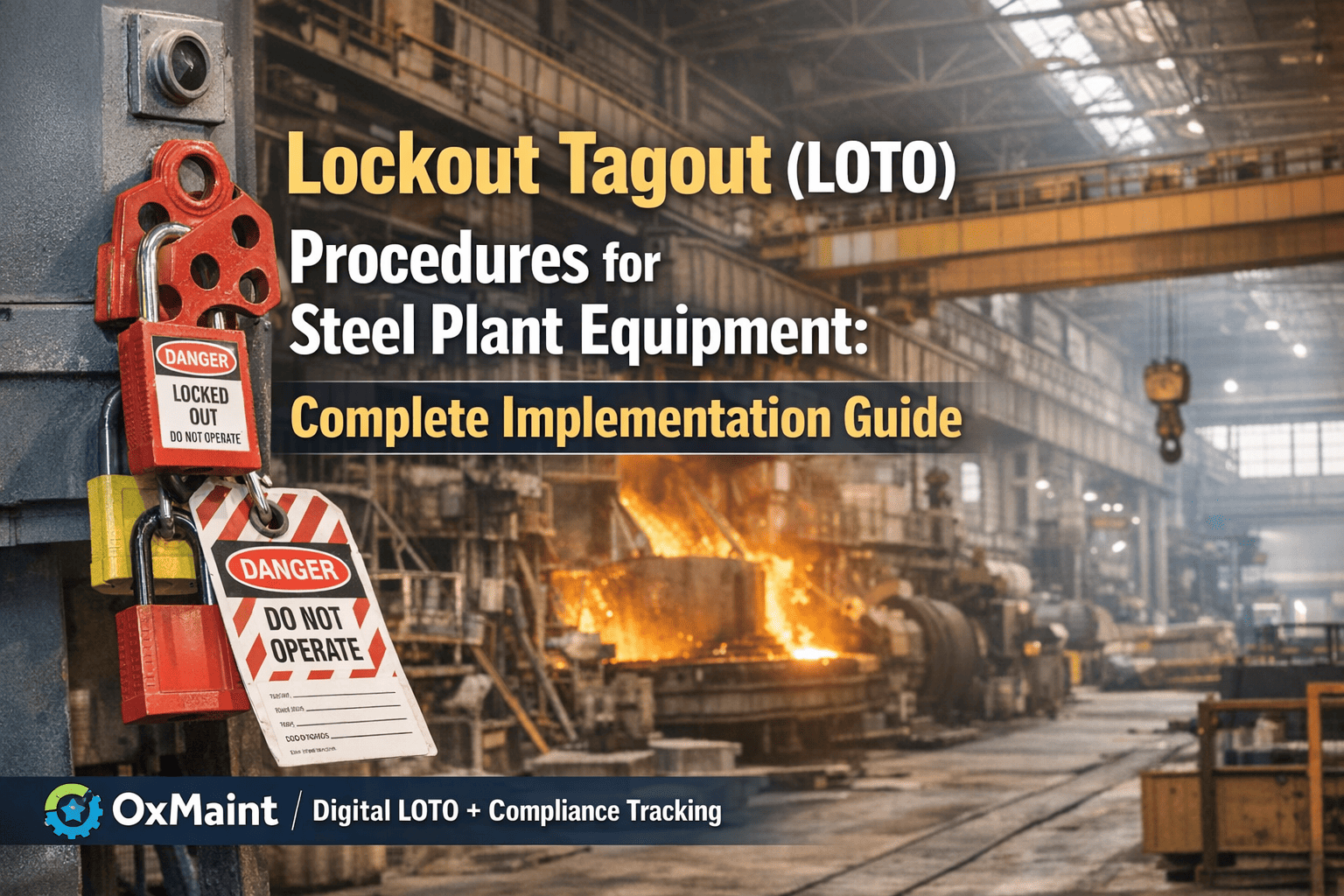
Lockout Tagout (LOTO) Procedures for Steel Plant Equipment

A complete implementation guide for energy isolation across furnaces, rolling mills, cranes, and electrical systems — with digital LOTO permit management.

50,000
Injuries prevented annually by LOTO compliance
120
Fatalities prevented per year (OSHA estimate)
$170K
Max OSHA penalty per willful violation (2025)
2,500+
LOTO citations issued by OSHA in FY 2024
Steel plants operate at the intersection of extreme heat, high voltage, crushing force, and pressurized systems. A single LOTO failure in this environment is not a near-miss — it is a fatality or a life-altering injury. Yet LOTO remains in OSHA's Top 5 most cited violations year after year.

Why LOTO Is Non-Negotiable in Steel Plants

Lockout Tagout (LOTO) is the process of isolating every hazardous energy source — electrical, hydraulic, pneumatic, thermal, or mechanical — before maintenance or servicing begins. A physical lock is applied to each energy isolation point, and a tag is attached warning others not to re-energize the equipment.

In steel plants, a single machine can have 6 to 12 energy sources simultaneously. Skipping any one of them is what causes fatalities. OSHA Standard 29 CFR 1910.147 mandates a written LOTO program, machine-specific procedures, annual audits, and documented employee training.

E
Electrical
H
Hydraulic
P
Pneumatic
T
Thermal
M
Mechanical
G
Gravity
6 Energy Types — All Must Be Isolated

LOTO for Every Steel Plant Machine

01
Reheating Furnaces
Isolate gas supply valves, burner controls, combustion air blowers, and cooling water circuits. Allow thermal dissipation before entry. Verify zero oxygen-depleted atmosphere in confined zones.
ThermalGasElectrical
02
Rolling Mills (Hot & Cold)
Lock out main drive motors, hydraulic roll gap adjusters, and cooling water systems. Block rolls mechanically to prevent gravity-driven movement. Do not rely on brakes alone.
MechanicalHydraulicElectrical
03
EOT & Overhead Cranes
OSHA 1910.179 specifically requires crane switches to be open and locked before preventive maintenance. Isolate pendant controls, hoist motors, and travel drives. Ground the crane rail.
ElectricalMechanicalGravity
04
Electric Arc Furnaces (EAF)
De-energize electrode drives, hydraulic tilt mechanisms, and water-cooled panel circuits. Verify absence of voltage on high-voltage bus. Tag all secondary transformer connections.
High VoltageHydraulicThermal
05
Hydraulic Systems
Close and lock hydraulic isolators. Bleed all accumulators and stored pressure lines to zero. Verify pressure gauge reads zero before work begins. Use physical blocks on cylinders.
HydraulicPneumatic
06
Electrical Control Panels
Use panel lockout devices to prevent panel cover removal. Test phase-to-phase and phase-to-ground before touching conductors. Apply temporary grounding where induced voltages may exist.
ElectricalArc Flash
Managing LOTO permits on paper?

OxMaint replaces binders and spreadsheets with digital LOTO permits that are timestamped, traceable, and auditor-ready in under 30 seconds.

Book a Demo Start Free Trial

The 8-Step LOTO Procedure for Steel Plants

1
Identify All Energy Sources
Review equipment schematics and maintenance history. Document every electrical, hydraulic, pneumatic, thermal, mechanical, and gravity-based energy source for each machine.
2
Notify Affected Personnel
Inform all operators, shift supervisors, and affected workers before initiating any LOTO. No one should be surprised by a locked-out machine.
3
Shutdown the Equipment
Follow the documented shutdown sequence. Do not shortcut steps to save time. Confirm normal stopping of all machine components.
4
Isolate All Energy Sources
Physically operate each energy-isolating device — circuit breakers, valves, hydraulic isolators, pneumatic shutoffs — to the safe (off) position.
5
Apply Lockout Devices & Tags
Each authorized employee applies their own personal lock and tag. For group LOTO, use a hasp with multiple lock holes — all workers must lock out independently.
6
Release Stored & Residual Energy
Bleed hydraulic and pneumatic pressure to zero. Allow thermal equipment to cool. Block suspended parts. Discharge capacitors. Verify stored energy is completely dissipated.
7
Verify Zero Energy State
Use a calibrated test instrument to confirm absence of voltage. Test phase-to-phase and phase-to-ground. Attempt to start the machine to confirm lockout is effective.
8
Perform Work & Re-energize Safely
Complete maintenance. Confirm all tools and personnel are clear. Each worker removes only their own lock. Follow documented re-energization sequence. Notify all affected employees.

Paper vs. Digital LOTO: The Real Difference


Paper-Based
OxMaint Digital
Permit Retrieval
45+ minutes to locate correct binder
Under 30 seconds via search
Audit Trail
Manual logbooks, often incomplete
Auto-timestamped, mandatory fields enforced
Annual Inspections
Manually scheduled, easy to miss
Automated alerts at 30/60/90 days
Training Records
Scattered across departments
Centralized dashboard, real-time status
Incomplete Permits
Often missed during OSHA inspection
Blocked — cannot submit with missing fields
Group LOTO Tracking
No real-time visibility
Each worker's lock status tracked live

Top LOTO Violations in Steel Plants

01
Generic, Non-Machine-Specific Procedures
OSHA requires procedures specific to each machine. A generic LOTO template on file is a willful violation — and in steel plants, every machine has a different energy profile.
02
Incomplete Energy Source Identification
Missing one hydraulic accumulator or one stored-energy source is enough to cause a fatality. 80% of LOTO-related injuries occur among workers who had not received adequate training.
03
No Annual Procedure Audits
OSHA mandates inspection of every LOTO procedure at least once every 12 months by an authorized employee who is not the one performing the procedure.
04
Bypassing LOTO to Save Time
Production pressure is the leading root cause of willful LOTO violations. These carry penalties up to $170,735 per violation in 2025 — plus criminal liability in fatality cases.

LOTO Compliance Checklist for Steel Plants

Program & Documentation
Written energy control program in place (29 CFR 1910.147)
Machine-specific LOTO procedures for every piece of equipment
All energy sources identified and labeled on each procedure
LOTO procedures stored and retrievable within 30 seconds
Training & Authorization
All authorized employees trained on equipment-specific LOTO
Affected employees trained on purpose and scope of LOTO
Training records documented with dates and employee names
Retraining completed when new equipment or procedures introduced
Audits & Verification
Annual inspection of every LOTO procedure conducted
Inspector is not the employee using the procedure
Inspection records include machine, date, and employees reviewed
Deficiencies corrected and documented after each audit
Devices & Hardware
Personal locks assigned to each authorized employee
Group lockout hasps available for multi-person LOTO
LOTO devices inspected and in working condition
Voltage testers available and calibrated for zero-energy verification

Frequently Asked Questions

How often must LOTO procedures be audited in a steel plant?
OSHA requires every LOTO procedure to be audited at least once every 12 months. The inspector must be an authorized employee who is not the one performing the procedure during the audit. All inspections must be documented with machine name, date, and employees reviewed.
What is group lockout and when is it required?
Group lockout applies when two or more workers are servicing the same equipment simultaneously. Each worker must apply their own personal lock to a hasp device. The equipment cannot be re-energized until every worker removes their own lock — no one person can override another's protection.
Does LOTO apply to crane maintenance in steel plants?
Yes. OSHA Standard 1910.179 specifically requires crane switches to be open and locked before preventive maintenance begins. Both 29 CFR 1910.147 and 1910.179 apply together to ensure full protection during crane servicing, including overhead EOT cranes common in steel facilities.
What is the maximum OSHA penalty for a willful LOTO violation in 2025?
As of 2025, OSHA can issue penalties up to $170,735 per willful violation. In cases where a LOTO failure results in a fatality, criminal charges may also apply in addition to financial penalties. Steel plants under NAICS codes 3311–3312 are included in OSHA's Site-Specific Targeting program due to elevated injury rates.
Can digital software replace paper LOTO permits and remain OSHA-compliant?
Yes. OSHA accepts electronic records as long as they are readily accessible, retrievable, and printable on demand. Digital LOTO platforms like OxMaint enforce mandatory fields, auto-timestamp every permit, and maintain a complete audit trail — meeting and often exceeding what paper systems can provide.
How does OxMaint help with LOTO compliance in steel plants?
OxMaint provides machine-specific digital LOTO permit templates, automated annual audit scheduling with 30/60/90-day alerts, real-time group lockout tracking, centralized training records, and an instant-search permit library. During an OSHA inspection, permits are retrievable in under 30 seconds — not 45 minutes.
Ready to go digital?

Stop Managing LOTO on Paper

OxMaint's digital LOTO system is purpose-built for steel plants. Machine-specific permits, automated audits, and real-time compliance tracking — all in one platform.


Share This Story, Choose Your Platform!