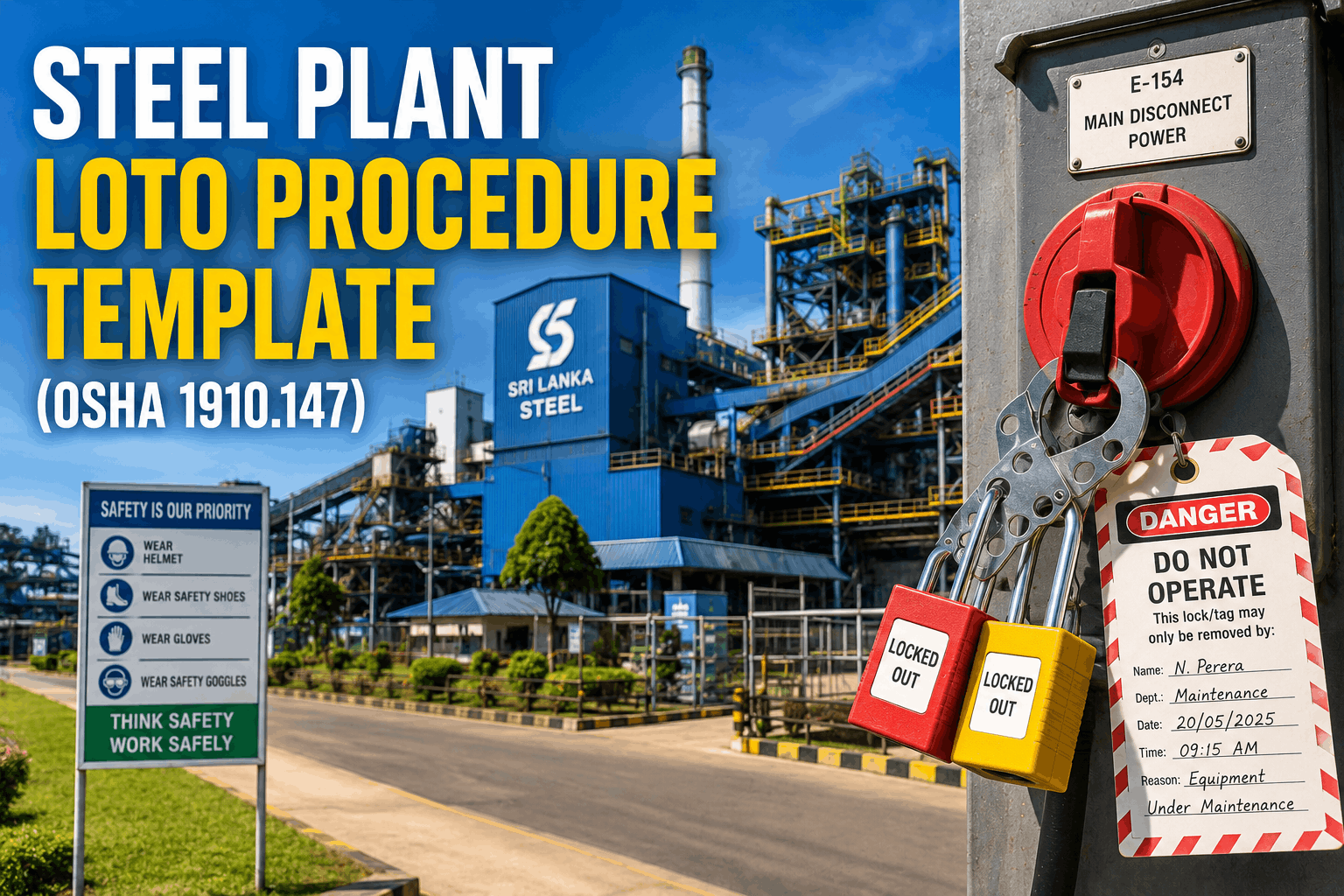
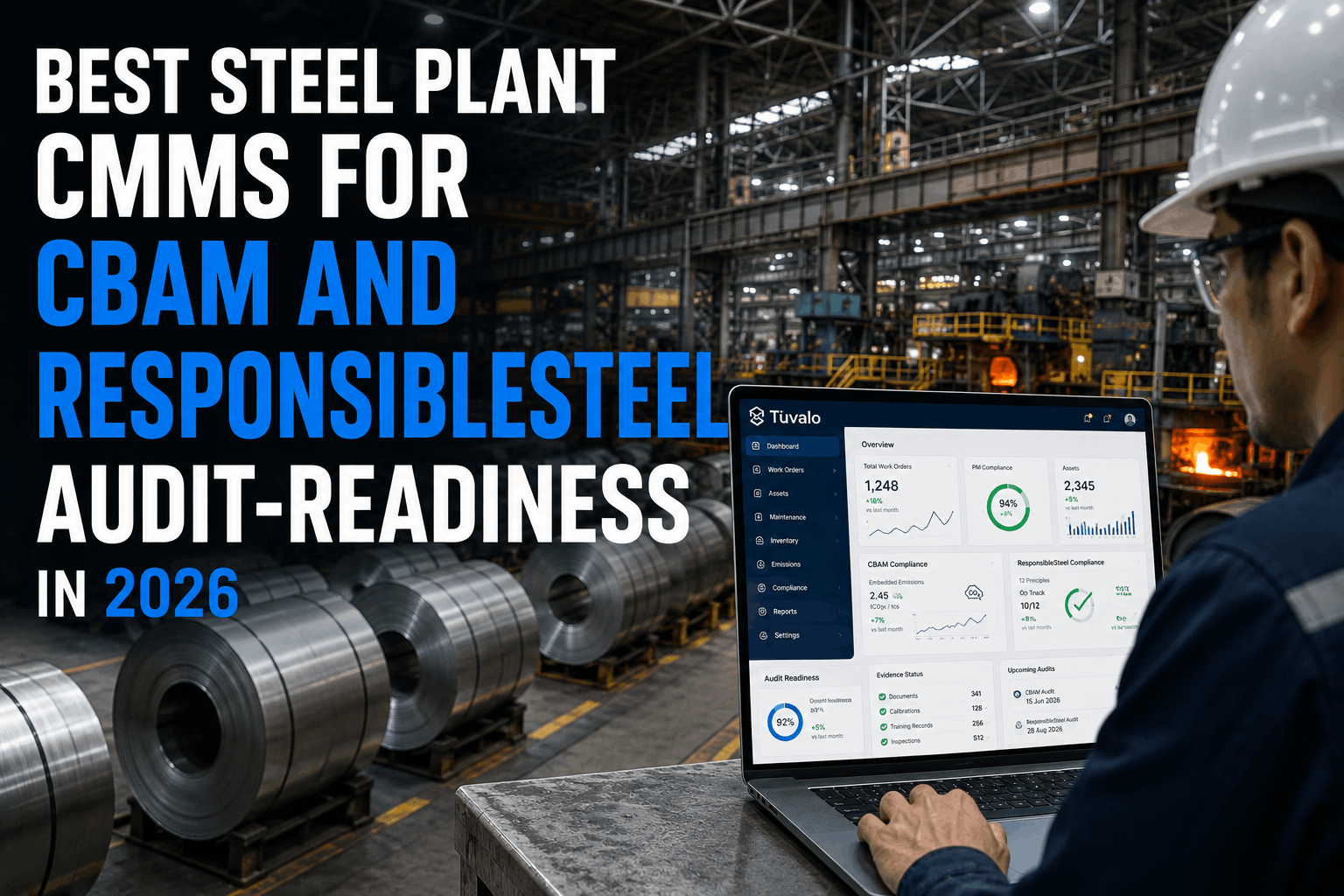
Lockout/Tagout (LOTO) and Pre-Startup Safety Review (PSSR) are the two most critical safety protocols in steel plant operations. OSHA regulation 1910.147 mandates that ALL hazardous energy sources—electrical, pneumatic, hydraulic, thermal, and mechanical—must be isolated, locked, and tagged before ANY maintenance or service work begins. Blast furnaces operating at 2,800°F, basic oxygen furnaces under 40 PSI internal pressure, and electric arc furnaces handling 1,000-ton scrap loads represent extreme hazard sources. A single failure in LOTO protocol—a technician bypassing a lockout because "it will only take 30 seconds," or a startup crew beginning operations before confirming all maintenance teams have cleared the area—has caused fatalities, permanent disabilities, and multi-million-dollar OSHA penalties. The most dangerous moment in steel plant operations is the transition from maintenance mode back to production: this is where PSSR (Pre-Startup Safety Review) intervenes, enforcing a structured checklist ensuring equipment is safe for restart, all workers are clear, and all locks/tags are removed. A paper-based LOTO/PSSR system—logbooks, laminated checklists, handwritten sign-offs—cannot guarantee compliance because paperwork gets lost, photos fade, and sign-off chains break. A CMMS-integrated LOTO/PSSR system generates immutable digital records: every lock applied is timestamped and photographed, every energy source isolation is confirmed at the equipment via mobile app, and PSSR checklists are locked (preventing edits) once completed. Oxmaint's OSHA 1910.147-compliant CMMS enforces mandatory LOTO sequencing, blocks equipment startup until all locks are digitally cleared, and generates audit-ready compliance reports for OSHA inspections and insurance audits.
Lock Down Your LOTO Compliance.
Download our complete OSHA 1910.147 LOTO procedure guide for blast furnaces, BOFs, EAFs, and finishing mills. Get free CMMS-ready LOTO checklists, energy source mapping templates, and PSSR forms instantly.
OSHA 1910.147 Lockout/Tagout: Steel Plant Hazards
OSHA 1910.147 applies to the servicing and maintenance of machines and equipment where the unexpected startup or release of stored energy could cause injury. In steel plants, this encompasses virtually every piece of equipment: blast furnaces (thermal energy), electric motors (electrical), pneumatic cylinders (pneumatic), hydraulic accumulators (hydraulic), and rotating equipment (mechanical). The regulation requires employers to develop a written lockout/tagout program, train all affected workers, inspect locks and devices quarterly, and maintain records of LOTO devices and program audits. Non-compliance carries penalties up to $16,131 per violation (2024 rates). But the real cost of LOTO failures is human: over 1,000 workers are hospitalized annually in the U.S. due to failures to properly control hazardous energy during maintenance. Steel plants face compounded risk because furnace maintenance often requires working in extreme thermal and chemical environments where workers are already stressed and fatigued. A robust LOTO/PSSR system, integrated with your CMMS, removes guesswork and creates a safety culture where compliance is automatic, not optional.
Understanding LOTO Components for Steel Equipment
STEEL PLANT LOTO DEVICE REQUIREMENTS BY EQUIPMENT
Blast Furnace Hot Blast Main Valve
Lockout + Tagout
BOF Vessel Electrical Hoist Brake
Lockout + Tagout
EAF Transformer Main Disconnect
Lockout + Tagout
Continuous Caster Hydraulic Pump
Lockout + Bleed
Rolling Mill Drive Motor Coupling
Lockout + Tagout
Compressor Pressure Relief Valve
Lockout + Vent
The Five-Step LOTO Sequence (OSHA 1910.147)
Step 1: Prepare for Shutdown
Before work begins, the authorized employee notifies all affected personnel that equipment will be de-energized. Check the CMMS for all hazardous energy sources documented in the equipment's lockout procedure. A blast furnace might have 12+ energy sources (hot blast valve, cooling water, electrical hoist, gas lines). Your CMMS should retrieve this list automatically based on equipment type.
→
Step 2: Shutdown Equipment
The authorized employee shuts down the equipment using normal operating controls. For a blast furnace, this means controlled cooling sequences; for a rolling mill, progressive speed reduction. Document shutdown completion in the CMMS with timestamp and equipment state confirmation.
→
Step 3: Isolate Energy Sources
The authorized employee applies locks and tags to EVERY hazardous energy isolating device. For electrical: main disconnect. For pneumatic: air supply shut-off valve. For hydraulic: pump isolation and system bleed. The CMMS checklist enforces each lock be photographed at the equipment location (to prevent "lockout by proxy").
→
Step 4: Dissipate Residual Energy
After isolation, the authorized employee relieves all trapped energy: open relief valves, vent pressurized tanks, allow thermal cooldown. The CMMS workflow enforces energy dissipation procedures and verifies they're complete before permitting work to proceed. This step prevents "stored energy" accidents—the most common LOTO failure.
→
Step 5: Verify Isolation
The authorized employee tests energy sources to confirm isolation: attempt to start the motor (it must not move), open a vented relief to confirm zero pressure, measure voltage at disconnect to confirm zero power. The CMMS records these verification tests with timestamp and technician ID. Only after verification is the work order released to maintenance teams.
Blast Furnace LOTO Procedure (Detailed Example)
Energy Source 1
Hot Blast Main Valve (Pneumatic)
ISOLATION: Close main blast valve handwheel (manual), then apply lockout hasp to pneumatic solenoid controlling blast temperature. DISSIPATION: Open secondary relief valve to vent residual blast pressure (measured at gauge ~40 PSI). VERIFICATION: Open a test valve downstream; confirm zero air flow (indicates successful isolation). Document in CMMS: timestamp of isolation, photo of lock, relief valve gauge reading, and test valve airflow confirmation.
Energy Source 2
Hot Blast Heater Electrical Supply (Electrical)
ISOLATION: Locate the heater circuit breaker in the substation (NOT at the furnace—long distance isolation). Open the breaker, apply a padlock hasp to prevent accidental re-engagement, and apply a danger tag. DISSIPATION: No residual energy once breaker is open (electrical instantly dissipates). VERIFICATION: Use a non-contact voltage meter at the heater input terminals to confirm zero voltage. CMMS records: substation breaker location, padlock ID, voltage meter reading, verification timestamp.
Energy Source 3
Cooling Water Circulation Pump (Mechanical + Hydraulic)
ISOLATION: Close the pump discharge isolation ball valve (manual operation), then apply a lockout device with a padlock. DISSIPATION: Open a downstream bleed valve to vent residual water pressure (furnace cooling system operates at ~100 PSI). VERIFICATION: Attempt manual pump shaft rotation—it must not turn (indicates successful impeller isolation). CMMS records: ball valve location photo, bleed valve pressure gauge reading, shaft rotation resistance test result.
Energy Source 4
Top Gas Recovery Turbine (Mechanical)
ISOLATION: Close the gas inlet valve to the turbine, apply a lockout hasp to the gas supply line solenoid. Close the steam supply isolating valve and apply a lockout device. DISSIPATION: Open steam condenser relief valve to confirm depressurization. VERIFICATION: Attempt manual turbine shaft rotation—must not turn. Check for residual steam pressure at the turbine outlet (should read zero on pressure gauge). CMMS tracks isolation sequence, dissipation valve states, and verification test data.
Pre-Startup Safety Review (PSSR) - The Final Gate Before Restart
Once maintenance is complete, equipment cannot restart until a Pre-Startup Safety Review (PSSR) is conducted and approved. PSSR is NOT a quick walkthrough—it's a structured, multi-person verification ensuring equipment is mechanically sound, all workers are clear, and all locks/tags are removed. OSHA defines PSSR as a "comprehensive and final review of all safety-related conditions on the equipment" before first restart. For a blast furnace, this might involve 20+ checklist items: refractory integrity, cooling system pressure test, electrical ground continuity check, instrument calibration verification, and operator notification. A paper-based PSSR creates liability because checklists get misplaced, sign-offs are unverifiable, and the restart sequence isn't enforced. A CMMS-integrated PSSR system locks the PSSR form once all items are checked, preventing late additions or erasures. The system blocks equipment restart commands until the PSSR is digitally signed by authorized personnel (operations manager, safety officer, maintenance supervisor). If a single PSSR item is incomplete, the entire restart sequence halts with an alert.
✓ Best Practice
Use Role-Based LOTO Authorization
Different technician roles should have different LOTO authorities in your CMMS: Authorized Employees can initiate LOTO and approve isolation verification; Affected Employees receive notifications and cannot begin work until LOTO is confirmed; Supervisors approve PSSR. This prevents a junior technician from bypassing isolation steps.
✓ Best Practice
Enforce Mobile Photo Confirmation at Equipment
Require technicians to photograph locks/tags at the actual equipment using mobile CMMS app. GPS-tagging the photo proves locks were applied on-site, not in the office. This prevents "lockout by proxy" and creates immutable photographic evidence for audits.
✗ Mistake to Avoid
Don't Allow "Temporary Bypasses" of LOTO Procedures
A technician rushing to meet a production deadline may attempt to apply only partial locks or skip energy dissipation steps. A CMMS with rigid LOTO enforcement (preventing work order progression until all steps are complete) eliminates this dangerous temptation.
✓ Best Practice
Conduct Quarterly LOTO Device Audits
OSHA requires inspection and maintenance of LOTO devices (locks, hasps, tags) every quarter. Your CMMS should track every lock's last inspection date and auto-flag devices exceeding the 90-day inspection interval. Maintain a master inventory of all locks with serial numbers in your CMMS.
✗ Mistake to Avoid
Missing or Incomplete PSSR Checklists
If PSSR checklist items are forgotten or improperly documented, the startup crew doesn't have full visibility into equipment status. A CMMS-enforced PSSR form (not editable after sign-off, auto-calculated completion percentage) prevents this critical gap.
✓ Best Practice
Train All Affected Employees on CMMS LOTO Workflows
Even experienced technicians need training on how your CMMS enforces LOTO—where to photograph locks, how to log energy sources, how to request PSSR approval. Schedule annual retraining and track completion in your CMMS as a prerequisite for LOTO authorization.
LOTO Training & Competency (OSHA 1910.147.7)
OSHA 1910.147(7) requires employers to train employees on LOTO procedures before they perform any isolation or maintenance work. Training must cover the LOTO standard, the specific lockout procedures for equipment at your facility, and the consequences of non-compliance. Initial training is mandatory; annual retraining is recommended. A CMMS with training management capabilities can track which technicians have completed LOTO certification, when their training expires, and auto-flag those requiring retraining. Your CMMS can even embed training certificates (digital proof of completion with timestamp) into work orders—so auditors can instantly verify every technician on a maintenance team had current LOTO training when the job was performed. When OSHA arrives for an inspection, a CMMS-backed training audit trail demonstrates your commitment to compliance.
"Our mill had a near-miss where a technician attempted to bypass our LOTO procedures to save 30 minutes on a hot rolling mill drive repair. Before Oxmaint, we would've caught this in a safety huddle—maybe. Now our CMMS prevents the work order from progressing until all five LOTO steps are photographically verified. The technician can't skip Step 4 (energy dissipation) without explicitly editing the work order, and that edit triggers an automatic alert to the maintenance supervisor. We've gone 18 months without a single LOTO deviation since deploying CMMS enforcement. OSHA auditors have confirmed our digital LOTO audit trail exceeds their documentation expectations."
Safety Director, Major U.S. Integrated Steel Mill
Frequently Asked Questions: LOTO & PSSR
Q1 Can a technician apply multiple locks to a single isolating device?
Yes. If multiple technicians are working on the same equipment, each must apply their own lock to the isolating device. A CMMS can track multiple locks on one device, ensuring all technicians remove their locks before restart is permitted.
Q2 What happens if a technician loses their lock key during maintenance?
The technician must physically cut/bolt-cut the lock to remove it—it cannot be removed any other way. The CMMS should document the emergency lock removal with explanation. A replacement lock must be applied immediately. This is why lock inventory and key management are critical (tracked in CMMS).
Q3 How does PSSR differ from normal equipment startup procedures?
PSSR is a comprehensive post-maintenance checklist ensuring all locks are removed, all technicians are clear, and equipment is mechanically sound. Normal startup is routine operation. PSSR is mandatory only after maintenance; a CMMS enforces this by blocking normal startup if a recent LOTO work order lacks PSSR approval.
Q4 Can we use electronic locks instead of padlocks for LOTO?
Yes, OSHA allows electronic locking devices if they meet ANSI Z535 standards and prevent unauthorized unlock. A CMMS can integrate with electronic locks to track unlock attempts and require multi-factor authorization before allowing equipment restart.
Q5 How do we document LOTO compliance for OSHA audits?
A CMMS-generated report showing all work orders with attached LOTO checklists, lock photos, energy isolation verification tests, and PSSR sign-offs provides complete audit-ready documentation. Export as PDF with timestamps and user IDs to prove compliance.
Q6 What's the difference between "authorized" and "affected" employees under OSHA 1910.147?
Authorized Employees physically apply/remove locks and perform isolation procedures. Affected Employees work on locked-out equipment but don't apply locks. A CMMS should enforce these role distinctions—only authorized employees can initiate LOTO; affected employees receive notifications confirming isolation.
Q7 Can a blast furnace restart if one maintenance team is still clearing equipment?
Absolutely not. The CMMS PSSR form must confirm that ALL technicians have cleared equipment and removed their locks before the startup command is allowed. If even one lock remains applied, the CMMS blocks restart with an alert showing which lock/technician is outstanding.
Q8 How long should LOTO documentation be retained?
OSHA requires retention of LOTO program documentation (procedures, training records, device inspection logs) for at least 3 years. Work-order-level LOTO records (lock photos, isolation verification tests) should be archived indefinitely as evidence of your compliance culture.
Enforce LOTO Compliance Automatically.
Download the complete OSHA 1910.147 LOTO procedure guide, PSSR checklist templates, and energy source mapping workbook. Get expert guidance on CMMS-based LOTO enforcement for blast furnaces and finishing mills.