Lubrication failures are the silent budget destroyer of every steel plant maintenance program. More than 40% of all industrial bearing failures trace directly to inadequate lubrication — either the wrong quantity, wrong interval, wrong lubricant type, or contaminated product reaching the bearing. In a steel plant environment where rolling mill bearings, caster rolls, conveyor drives, and gearboxes operate under extreme loads, high temperatures, and constant metal dust contamination, the cost of a single bearing failure can exceed $50,000 in parts, labor, and lost production time. The good news is that most lubrication failures are preventable — not through more manual greasing routes, but through centralized automation, contamination control, and CMMS-tracked lube programs that treat lubrication as a precision engineering discipline rather than a routine task. Book a demo to see how OxMaint's lubrication module structures routes, intervals, and oil analysis tracking across your entire steel plant asset base.
Industry Operations · Steel Plant · Lubrication Management
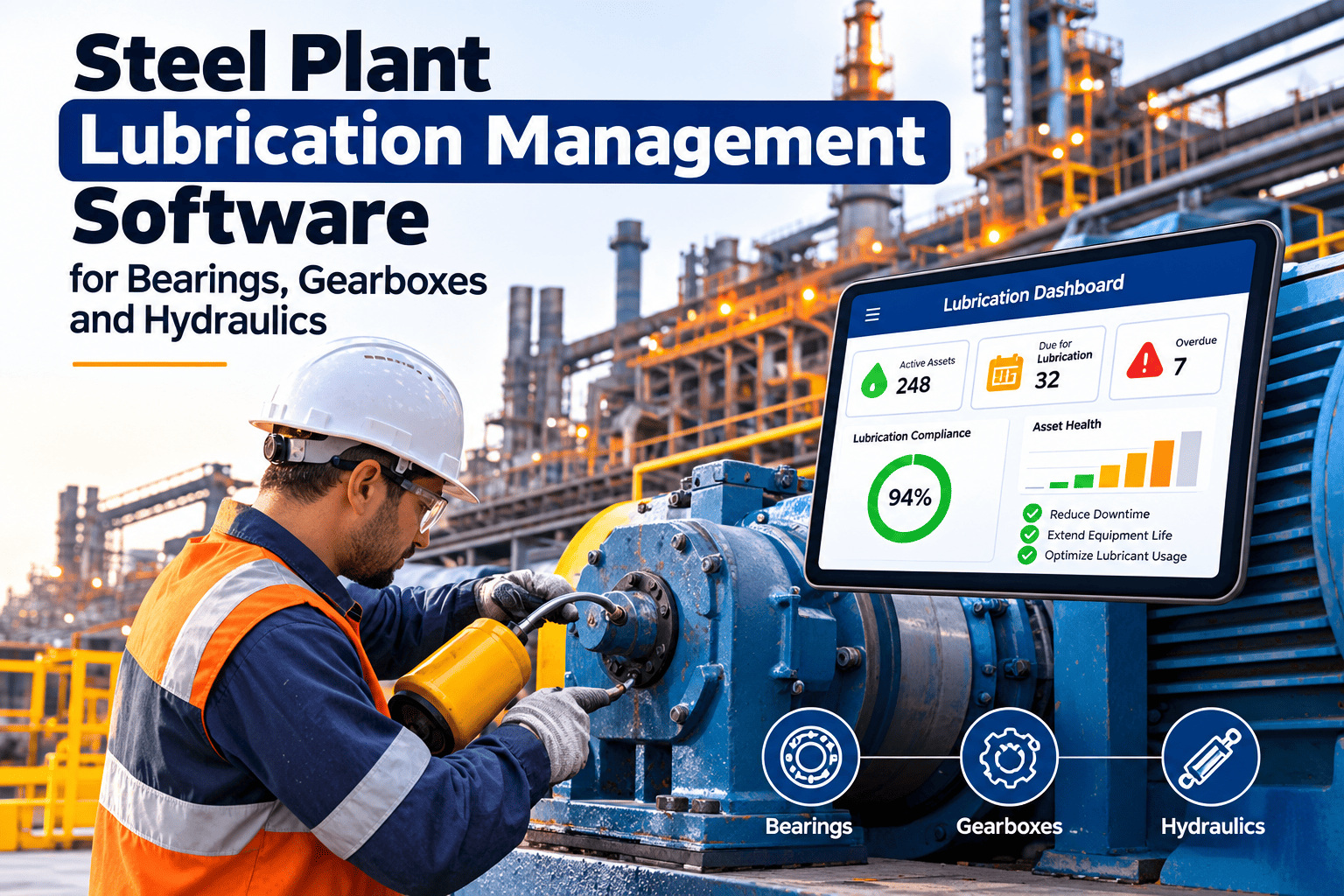
Steel Plant Lubrication Management: Automated Greasing, Oil Systems & CMMS Tracking
40% of bearing failures come from lubrication problems. One avoided failure saves $10,000–$50,000. Here is the complete framework for centralized lubrication, automated greasing, contamination control, and CMMS-tracked lube routes in steel plant operations.
40%
of bearing failures caused by lubrication problems
$50K+
Cost per unplanned bearing failure in heavy steel equipment
68%
Bearing failure reduction reported after synthetic lube program (steel plant case)
9 mo
Typical ROI payback on automated lubrication system — $500K investment recovered
Why Manual Greasing Fails in Steel Plants
The Four Ways Manual Lubrication Creates Bearing Failures
Steel plants running manual lube routes face a structural problem: the conditions that make lubrication most critical — high temperatures, extreme loads, metal dust contamination — also make manual access dangerous, inconsistent, and frequently skipped. Over 50% of bearing failures in rotating equipment can be traced to lubrication problems, and in a steel plant environment, every one of these four failure mechanisms is active simultaneously.
01
Wrong Quantity
Technicians applying grease until it squeezes out — a common practice — causes churning losses, heat buildup, and seal damage. Under-greasing leaves bearing surfaces exposed. Both destroy bearing life faster than no lubrication program at all.
02
Wrong Interval
Calendar-based intervals ignore actual equipment runtime, load cycles, and temperature. A bearing near a reheat furnace may need lubrication 3x more frequently than the same bearing in ambient temperature — a fixed calendar schedule cannot adapt.
03
Contaminated Lubricant
Open grease guns exposed to steel mill air pick up metal particles and scale. One contaminated application introduces abrasives directly into the bearing. A 10% reduction in friction extends bearing life by 50% — but contaminated lubricant adds friction instead of reducing it.
04
Skipped Points
Hard-to-reach bearings on running equipment, hot zones near furnaces, and bearings inside guarded machinery are systematically under-lubricated in manual programs. Maintenance teams navigate high-temperature zones increasing injury risk — or skip the point entirely.
System Types Compared
Lubrication System Selection Guide for Steel Plant Applications
Steel plants run multiple asset types — each with different lubrication requirements, operating environments, and automation suitability. The system type must match the application. This table maps the four primary centralized lubrication architectures to their optimal steel plant applications.
| System Type |
Best Steel Plant Application |
Pressure Range |
Points Served |
Key Advantage |
| Single-Line Progressive |
Conveyor drives, rolling mill bearings, continuous casters |
Up to 5,000 psi |
1 to 1,000+ |
Monitors cycle completion — fault detection per point |
| Two-Line Parallel |
Long conveyor runs, wide-area coverage, extreme temperatures |
Up to 5,000 psi |
Unlimited zones |
Works in extreme cold and heat; long pumping distances |
| Oil Mist / Recirculating Oil |
High-speed rolling mill spindles, gearboxes, turbines |
Low pressure |
Multiple points |
Near-continuous lubrication; heat dissipation from oil flow |
| Single-Point Automatic |
Isolated bearings, motors, fans in hard-to-reach locations |
Low to medium |
1 point each |
No infrastructure needed; battery or gas-driven |
Contamination Control
The Contamination Problem No Manual Program Can Solve
Steel plant air contains metal dust, scale, and moisture that contaminate lubricants the moment they are exposed. Abrasive particles embedding in lubricant film cause microscopic wear that accelerates fatigue spalling — the failure mechanism is invisible until the bearing is already damaged. Effective contamination control is as important as the lubrication interval itself.
Contamination Sources
Metal scale and dust from rolling operations
Water and steam ingress near cooling sections
Open grease guns exposed during dispensing
Cross-contamination from incompatible grease types
Oxidized lubricant from excessive heat exposure
Control Measures
Sealed centralized systems — lubricant never exposed to air
Dedicated lubricant color-coding and labeling per asset class
Closed-loop oil filtration on recirculating systems
Quarterly oil analysis — particle count, viscosity, water content
Sealed bearing housings with lip seals on contamination-risk assets
Oil Analysis KPIs
ISO cleanliness code — target 16/14/11 for gearboxes
Viscosity within ±10% of new oil specification
Water content below 0.1% by volume
Wear metals trending — Fe, Cu, Al particle counts
Oxidation number trending against baseline sample
Build CMMS-Tracked Lube Routes for Every Asset in Your Steel Plant
OxMaint's lubrication module creates structured routes with asset-specific intervals, lubricant types, quantities, and completion tracking. Every missed lube point becomes a documented finding — not an undetected failure waiting to happen.
CMMS Integration
How CMMS Transforms Lubrication from Routine to Reliability Program
A lubrication program without CMMS tracking is a schedule without accountability. CMMS converts every lube route into a documented, trended, and analyzed maintenance activity — turning lubricant consumption data, oil analysis results, and route completion rates into evidence that drives bearing life improvement decisions.
01
Route-Based Work Orders
Each lube route generates a structured work order listing every lubrication point, the correct lubricant type, the specified quantity, and the interval trigger — runtime hours or calendar days, whichever comes first. Technicians confirm completion at each point, creating an asset-level lube history that manual sign-off sheets cannot provide.
02
Oil Analysis Integration
Oil analysis results — ISO cleanliness code, viscosity index, wear metal particle counts — enter OxMaint against the specific gearbox or bearing asset. Trending over 4 to 8 quarters reveals contamination build-up rates and lubricant degradation curves that inform oil change intervals more accurately than calendar schedules alone.
03
Interval Optimization Over Time
As oil analysis and vibration data accumulate per asset, OxMaint identifies which lubrication intervals are correctly calibrated and which are conservative or insufficient. Extending over-lubricated assets by 20% while tightening under-lubricated ones reduces lubricant cost and technician time without increasing risk — the exact opposite of what a uniform calendar schedule achieves.
04
Failure Root Cause Traceability
When a bearing fails, OxMaint's lube history shows the last three lubrication dates, the technician who completed each, the lubricant batch used, and any oil analysis results taken in the preceding 6 months. This chain of evidence transforms bearing failure investigations from guesswork into documented root cause analysis — and prevents the same failure from occurring on identical assets across the plant.
Re-Lubrication Intervals by Asset Type
Steel Plant Lubrication Interval Reference
Re-lubrication intervals depend on bearing size, shaft speed, operating temperature, and load — not on a standard calendar. The table below provides baseline intervals for common steel plant asset categories. These should be adjusted based on operating temperature, contamination environment, and oil analysis results from the specific asset.
| Asset Type |
Lubricant Type |
Baseline Interval |
Temperature Adjustment |
Oil Analysis Trigger |
| Rolling Mill Work Roll Bearings |
Extreme pressure grease (NLGI 2–3) |
8–24 hours (continuous op) |
Halve interval above 70°C housing |
Particle count quarterly |
| Continuous Caster Roll Bearings |
High-temperature grease with water resistance |
4–12 hours per bearing |
Check daily in water-spray zones |
Water content weekly |
| Conveyor Drive Gearboxes |
ISO VG 220–460 gear oil |
Oil change every 3,000–6,000 hours |
Sample oil at 1,500 hours in hot zones |
Viscosity + wear metals quarterly |
| Blast Furnace Blower Bearings |
Mineral or synthetic oil via circulation system |
Continuous circulation — filter change quarterly |
Monitor oil temperature trending |
Particle count monthly |
| Electric Motor Bearings (≤75 kW) |
NLGI 2 lithium complex grease |
2,000–4,000 hours |
Halve interval above 60°C ambient |
Vibration check at each lube point |
| Overhead Crane Wheel Bearings |
NLGI 2 EP grease |
Monthly visual + grease quarterly |
Check seals monthly in dusty bays |
Inspect housings at each service |
Expert Perspective
What Lubrication Engineers Say About Steel Plant Programs
★★★★★
We went from replacing 14 to 18 rolling mill bearings per quarter to 4 to 6 after implementing a centralized automated system and oil analysis program tracked in OxMaint. The biggest change was not the hardware — it was having a documented trail showing which bearings were lubricated when, with what, and in what quantity. That traceability turned bearing failure investigation from guesswork into root cause analysis.
VK
Vikram K.
Chief Reliability Engineer, Integrated Steel Plant, India
★★★★★
Contamination was our hidden killer. We were doing everything right on interval and quantity but our oil analysis kept showing high ISO particle counts. Traced it to grease guns being stored open in the mill bay — metal dust contamination on every application. Sealed storage and sealed centralized lines fixed it within one quarter. Particle count dropped and bearing temperatures followed. CMMS trending made the connection visible.
JL
James L.
Lubrication Specialist, Hot Strip Mill, South Africa
★★★★☆
The interval optimization that came from 18 months of oil analysis data in OxMaint saved us more than the automated lubrication system itself. We identified 23 assets being over-lubricated — wasting grease, increasing churning heat, and reducing bearing life. Extended those intervals, tightened 11 others that were under-lubricated, and our lubricant budget dropped 28% with no increase in bearing failures.
RN
Rosa N.
Maintenance Manager, Electric Arc Furnace Facility, Brazil
Frequently Asked Questions
Steel Plant Lubrication Management — Common Questions
What is the ROI timeline for a centralized automated lubrication system in a steel plant?
Industry data consistently shows ROI payback between 9 and 18 months for steel plant centralized lubrication installations. A documented case of a $500,000 system investment achieved full ROI in 9 months through reduced grease waste and fewer emergency bearing replacements — each avoided failure saving $10,000 to $50,000 depending on equipment type. Plants with high bearing replacement frequency in rolling mills or casters typically see the fastest payback. CMMS tracking of lubricant consumption and bearing life is essential to documenting the ROI case accurately for finance teams.
Book a demo to see how OxMaint's lubrication module builds the cost avoidance documentation automatically.
How does OxMaint's lubrication module structure lube routes differently from a paper-based system?
OxMaint structures each lube route as a sequenced work order listing every lubrication point by asset, lubricant type, specified quantity, and interval trigger — either runtime hours or calendar days from the last completion. Technicians confirm each point on mobile, creating an asset-level history that paper sign-off sheets cannot produce. Missed points appear immediately as open items rather than being silently skipped. Over time, this history enables interval optimization based on actual oil analysis results and bearing life data rather than OEM default recommendations applied uniformly across very different operating conditions.
Start a free trial to build your first lube route in OxMaint.
Which steel plant assets should be prioritized for centralized automated lubrication first?
Prioritize by cost of failure combined with difficulty of manual access. Rolling mill work roll bearings, continuous caster roll bearings, and conveyor drive trains are the highest-value targets because their failure cost is high, their manual access is difficult and dangerous, and their lubrication frequency is too high for reliable manual delivery. Blast furnace blowers and hot mill gearboxes follow. Each avoided failure on these assets returns the cost of automating an entire lube zone. Start with the 10 to 15 highest-failure-rate bearing positions identified from your maintenance history and build the ROI case from those specific assets before expanding to plant-wide coverage.
Book a demo to map your highest-priority lubrication assets in OxMaint.
How should oil analysis results be integrated into a CMMS lubrication program?
Oil analysis results — ISO cleanliness code, viscosity index, water content, and wear metal particle counts — should be entered against the specific asset in OxMaint at each sampling interval. The value of oil analysis is in the trend over 4 to 8 consecutive samples, not in any single reading. Rising Fe particle counts over three consecutive quarters indicate accelerating bearing wear before any vibration signal or temperature rise is detectable. OxMaint stores this trend per asset and can trigger a condition-based work order when a threshold is exceeded — converting oil analysis from a passive reporting tool into an active maintenance decision driver.
Start a free trial to set oil analysis thresholds and trend monitoring for your gearbox and bearing assets.
Lubrication Module · OxMaint CMMS · Steel Industry
Every Missed Lube Point Is a Bearing Failure in Progress. Make Every Point Trackable.
OxMaint's lubrication module builds structured routes, tracks completion per point, integrates oil analysis results, and triggers condition-based work orders when lubricant condition or bearing behavior crosses defined thresholds. Book a demo to see how steel plants use OxMaint to move from reactive bearing replacement to a documented, optimized lubrication reliability program.


.png)


