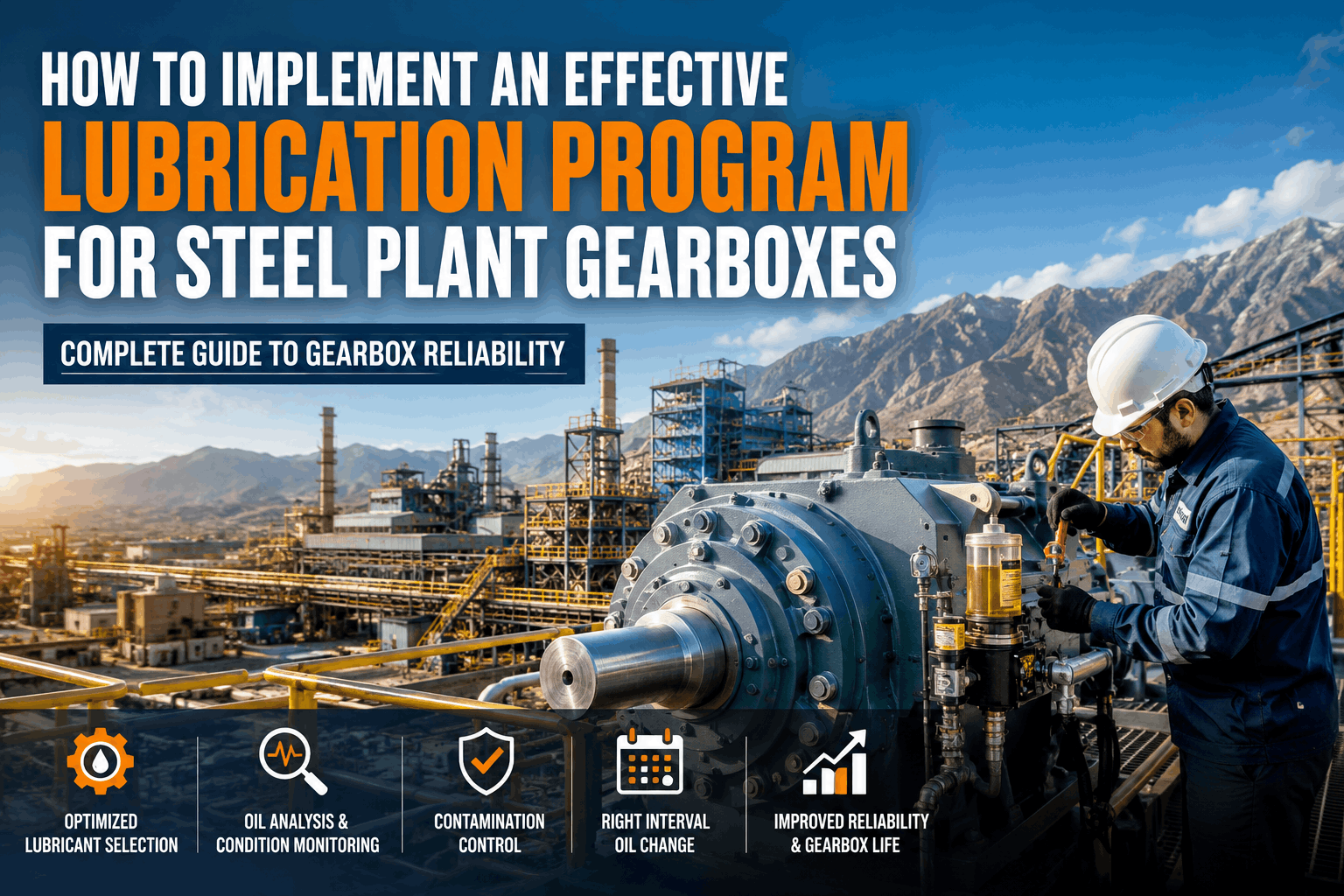
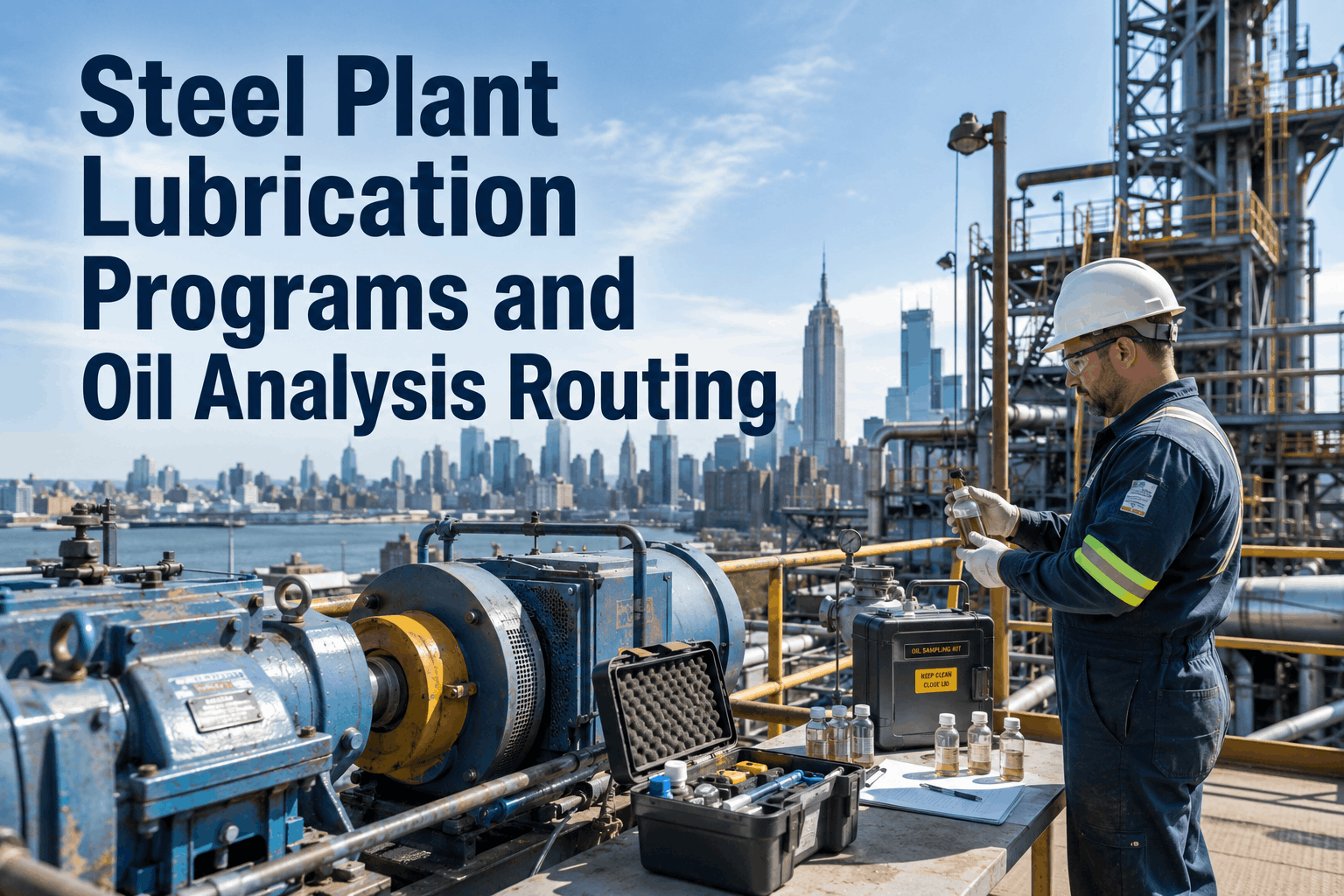
Best Practices for Steel Plant Lubrication Programs: Oil Analysis and Grease Selection
By Alex Jordan on June 26, 2026
Lubrication is not a maintenance afterthought — it is the primary defense against bearing degradation, gear wear, and thermal stress in steel plants operating 24/7 at temperatures exceeding 2,000°F. Systematic lubrication programs combining continuous oil analysis, grease selection optimized for equipment type and operating temperature, and condition-based relubrication intervals can reduce bearing failure rates 40–60%, extend asset life 25–35%, and lower total lubrication costs 15–25% while eliminating the emergency repair cycles that dominate reactive maintenance budgets. The difference between average and world-class steel mill lubrication is structural: best-in-class programs apply the 4 R's—right lubricant type, right amount, right time, right procedure—guided by continuous oil analysis data and integrated into CMMS workflows where condition is tracked asset-by-asset.
Preventive Maintenance · Technical Guide · 2026
Best Practices for Steel Plant Lubrication Programs: Oil Analysis and Grease Selection
Implement systematic lubrication management using continuous oil sampling, condition-based grease intervals, and automated CMMS tracking — reduce bearing failures by 40–60%, extend equipment life 25–35%, and lower lubrication costs across your steel facility.
40–60%Reduction in bearing failure rate with systematic lubrication
25–35%Equipment life extension from optimized lubrication programs
15–25%Total lubrication cost reduction through efficiency and reuse
4 R'sRight lubricant, amount, time, procedure — structural foundation
Oil Analysis Framework: Reading Equipment Condition in Real Time
Oil analysis is the only maintenance intelligence technology that reads the actual wear state of internal equipment components — metal particles suspended in lubricant tell the story of degradation in progress. A gearbox generating 5 mg/L of iron wear debris tells a precise narrative: bearing or tooth surface damage is occurring at predictable rates; intervention now prevents failure in 30–90 days. Oil viscosity trends track thermal stress and oxidation; TAN (Total Acid Number) trends indicate lubricant breakdown and remaining service life; water content signals seal leakage and contamination risk. When integrated into CMMS workflows, oil analysis samples become condition-based triggers for relubrication tasks, bearing replacement tasks, and thermal analysis investigations — converting raw laboratory data into actionable maintenance decisions weeks before failure occurs.
Oil Analysis Parameter
Normal / Acceptable Range
Alert / Intervention Threshold
Iron content (Fe)
0–2 mg/L for gearbox, 0–1 mg/L for turbine oil
Fe >4 mg/L triggers wear particle analysis; >8 mg/L requires immediate bearing inspection and possible replacement
Oil viscosity variance
Stable ±5% month-to-month under normal operating temperature
Viscosity change >10% signals thermal degradation or contamination; investigate cooling system or seal condition
Total Acid Number (TAN)
Industrial oils 0.1–0.5 mg KOH/g initially; increases slowly over service life
TAN exceeding 1.0 mg KOH/g indicates advanced oxidation; schedule oil change within 30 days
Water content
<300 ppm (parts per million) in industrial gearbox oils
Water >1000 ppm triggers immediate seal inspection; >2000 ppm requires emergency oil change to prevent bearing corrosion
Copper content (Cu)
0–1 mg/L in new oil; gradual increase acceptable up to 10 mg/L
16/14/11 or cleaner for rolling mill hydraulic systems and gearboxes
Particle count >18/16/13 indicates seal degradation or contamination; schedule filter replacement and resample
Four Critical Lubrication Areas in Steel Mills: Selection, Application, Monitoring, and Reuse
Rolling Mill Bearings
Operating conditions: 80–120°C, high load, continuous operation
Lubricant type
Lithium complex or polyurea grease, NLGI Grade 2–3, extreme pressure additives. High dropping point (>220°C), excellent oxidation stability required. Grease relubrication every 50–100 tons of material processed; oil analysis every 250 hours runtime.
Lubricant type
ISO VG 46–68 hydraulic oil with anti-wear (AW) additives. Viscosity index >95 to maintain film strength across operating temperature range. Oil sampling every 250 hours; filter changes every 500–1000 hours depending on contamination trends.
Continuous Caster Bearings
Operating conditions: 60–100°C, extreme cleanliness required, cooling water adjacent
Lubricant type
Synthetic PAO or PAG oil, ISO VG 32–46. Water resistance critical due to spray cooling proximity. Oil sampling every 200 hours minimum; particle count target 15/13/10 or better due to seal wear sensitivity on caster rolls.
Blast Furnace Infrastructure
Operating conditions: 150–200°C in some zones, thermal cycling, contamination risk
Lubricant type
High-temperature industrial oils (ISO VG 32–46) with synthetic base stock. Oxidation stability critical (ASTM D2272 >600 min). Blower bearings and valve actuators sampled every 300 hours due to exposure to byproducts and thermal stress.
The 4 R's Framework: Implementation and CMMS Integration
Systematic lubrication programs structured around the 4 R's — right lubricant type, right amount, right time, right procedure — form the foundation of world-class steel plant maintenance. Right lubricant type means matching viscosity, base stock (mineral vs. synthetic), and additives to the specific equipment's thermal profile, load characteristics, and seal materials. Right amount prevents both over-lubrication (waste and thermal stress from increased drag) and under-lubrication (inadequate film thickness and bearing wear). Right time connects to condition data — oil analysis results showing elevated wear particles trigger relubrication tasks; condition-based intervals replace calendar-based schedules. Right procedure ensures consistent application — trained technicians, documented procedures, controlled environment, and documented completion. When all four elements are integrated into CMMS workflows with oil analysis as the primary decision trigger, the result is lubrication cost reduction of 15–25% while bearing failure rates drop 40–60%.
Right Lubricant
Viscosity + Chemistry
Match base oil viscosity and additive package to equipment thermal profile
Rolling mill bearings require high-load grease (lithium complex, NLGI 2–3); gearboxes need AW hydraulic oil (ISO 46–68); casters need water-resistant synthetic. Mismatch costs 40–60% of bearing life through inadequate film or thermal breakdown.
Right Amount
Quantity Optimization
Prevent over-lubrication waste and under-lubrication wear
Over-lubrication increases motor load 3–8% and generates heat from drag; under-lubrication causes bearing wear 5–10× faster. Oil analysis particle trends guide adjustments — stable particle count indicates right amount; rising trends indicate relubrication intervals need shortening.
Right Time
Condition-Based Scheduling
Trigger relubrication from oil analysis, not calendar
Particle count rising above baseline triggers relubrication task; viscosity trending toward minimum signals approaching oil change interval. Condition-based scheduling reduces total lubrication volume 15–25% while maintaining or improving reliability versus calendar-based programs.
Untrained application of correct lubricant in wrong quantity or environment wastes 30–50% of lubrication benefit. Documented procedures + mobile work instructions + technician competency certification + environmental controls (temperature, contamination barriers) ensure consistent results and systematic cost reduction.
Grease Selection Decision Matrix: Temperature, Load, Speed, and Contamination
Grease selection in steel mills requires balancing four primary variables: operating temperature, bearing load classification, shaft rotational speed, and contamination exposure. A rolling mill bearing operating at 100°C under heavy load at 300 rpm requires different grease than a lightly-loaded gear coupling at 50°C. Temperature drives base oil and thickener selection — mineral oils break down at >120°C (requiring synthetic PAO or polyurea grease); heavy loads require extreme pressure additives and higher NLGI grades; high-speed applications require lighter NLGI 1–1.5 grades to minimize drag; contamination exposure (cooling water spray, dust ingress) demands improved rust and water resistance. The decision matrix below guides appropriate grease selection for major steel mill equipment categories.
Oil Analysis Sampling Strategy and CMMS Work Order Triggers
Systematic oil sampling creates a continuous data stream that triggers maintenance actions proactively rather than reactively. Critical gearboxes should be sampled every 250–500 operating hours; high-temperature bearing applications every 200–300 hours; standard industrial bearings every 500–1000 hours. When oil analysis results arrive, CMMS automatically flags thresholds — iron content >4 mg/L triggers bearing wear investigation; TAN exceeding 1.0 mg KOH/g triggers oil change planning; water content >1000 ppm triggers seal inspection. Technician receives mobile notification with context (asset history, typical failure patterns, spare parts availability), schedules corrective work during next planned maintenance window, and documents action taken. The systematic integration means oil analysis becomes the primary condition trigger for 40–60% of preventive lubrication work, replacing calendar-based scheduling with data-driven decisions.
"
We implemented systematic oil analysis on our rolling mill gearboxes 18 months ago with monthly sampling on critical units. By detecting iron wear particle elevation early, we've prevented 7 major gearbox failures that would have cost $300K–$800K each if they'd occurred mid-campaign. Oil analysis also showed we were over-greasing our bearing housings by 30–40% — just reducing grease quantity per the particle trends cut lubrication costs 22% while improving bearing life 18%. The ROI on the lubrication monitoring program alone is 12:1 in year one, before counting the catastrophic failures we've prevented.
Chief Maintenance Engineer — Hot Strip Mill, Ohio, USA
Frequently Asked Questions
What is the relationship between iron content in oil and bearing wear rate?
Iron content doubles approximately every 2–3 weeks once bearing wear initiates, following exponential degradation curves. Intervention at 4 mg/L Fe stops progression; waiting until 8 mg/L means failure occurs in 30–60 days. Trend analysis (slope of Fe increase) forecasts remaining useful life more accurately than absolute thresholds.
How often should rolling mill bearings be relubricated, and what triggers frequency changes?
Standard rolling mill bearing relubrication occurs every 50–100 tons of material processed, corresponding to 1–2 week intervals. Oil analysis showing rising particle count or viscosity change signals need for more frequent relubrication. Conversely, stable particle trends allow interval extension, reducing total lubrication volume and cost 15–25%.
What is synthetic vs. mineral-based oil, and when should steel mills transition to synthetics?
Mineral oils break down oxidatively above 120°C; synthetics (PAO, PAG) remain stable to 150°C+. Synthetic oils cost 2–3× more per unit volume but last 2–3× longer and provide superior film strength at temperature extremes. High-temperature gearboxes and blast furnace bearings justify synthetic transition; ambient temperature equipment can remain on quality mineral oils.
How does water in lubricating oil cause bearing corrosion and what is the threshold?
Water above 500 ppm begins corroding ferrous bearing components; >1000 ppm causes visible rust on bearing races within weeks. Water ingress signals seal degradation, usually from cooling water spray proximity or humidity exposure. Immediate seal inspection + desiccant breather installation + oil change required when water trends upward.
What are the differences between NLGI Grade 1, 2, and 3 grease, and which apply to steel mills?
NLGI Grade 1 (softer) is used for high-speed applications to minimize drag; Grade 2 (standard) for general bearings and rolling mills; Grade 3 (very stiff) for heavy-load, low-speed applications or vertical shafts. Most steel mill rolling elements use Grade 2 lithium complex; high-temperature units transition to Grade 1 synthetic polyurea to reduce energy loss.
How should oil analysis frequency change based on equipment criticality and failure history?
Critical gearboxes and bearing clusters sampled monthly (250 operating hours). Standard rolling mill bearings sampled quarterly (500 hours). Low-criticality equipment sampled biannually (1000 hours). If equipment has history of accelerated wear, increase sampling frequency 2–3×; historical reliability allows extension to less frequent intervals, balancing cost against detection speed.
What is TAN (Total Acid Number) trending and why does it matter for oil service life prediction?
TAN measures cumulative oxidative breakdown of lubricant additives; industrial oils increase TAN 0.05–0.1 mg KOH/g per 1000 hours of service. Reaching 1.0 mg KOH/g indicates approaching end of oil service life (typically 2000–3000 hours total). Trending TAN vs. hours allows scheduling oil changes 100–200 hours in advance, preventing performance degradation mid-campaign.
Oxmaint integrates oil analysis sampling schedules, condition-based relubrication triggers, and grease selection guidance into CMMS workflows — reduce bearing failures by 40–60% and lubrication costs by 15–25% across your steel facility.