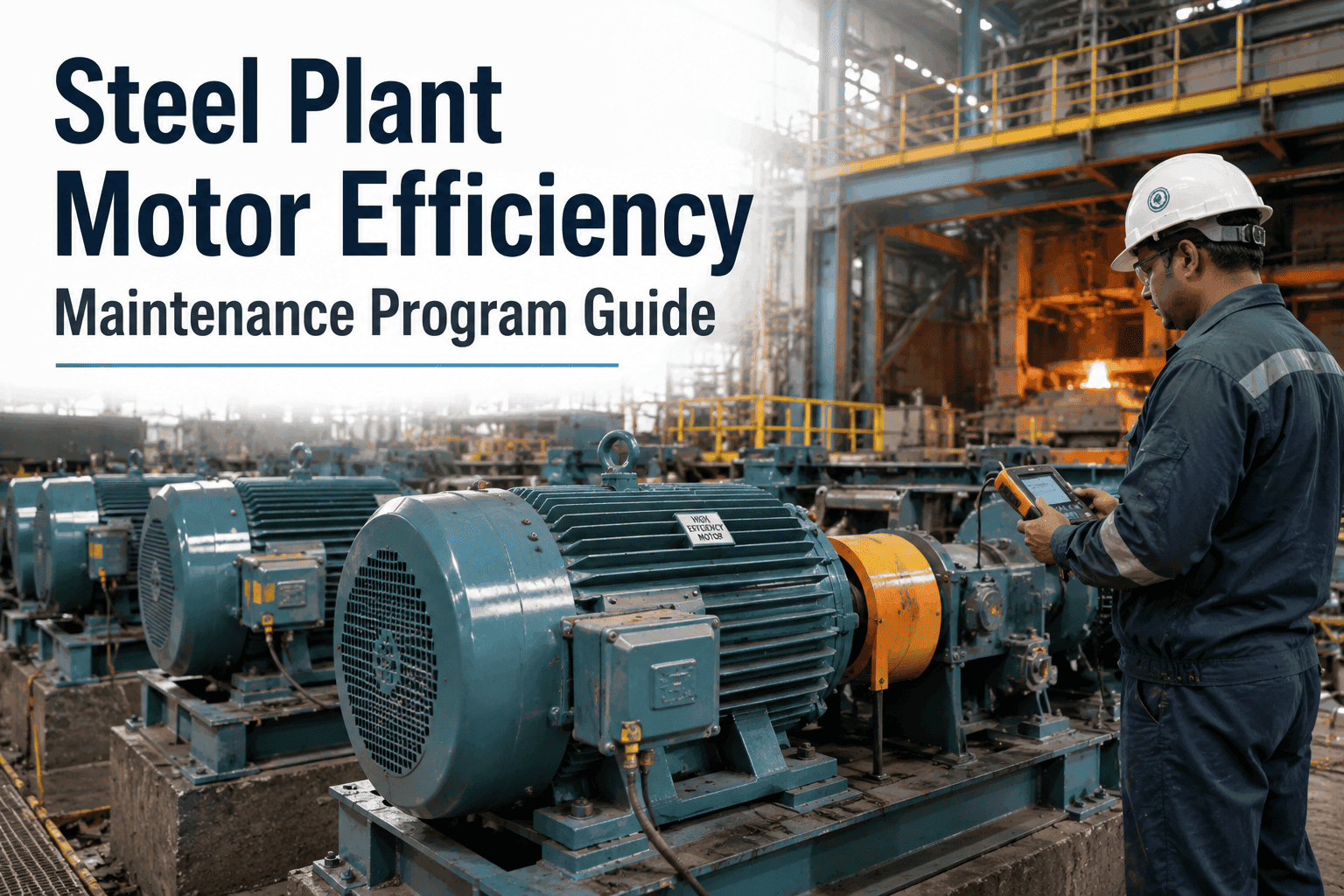
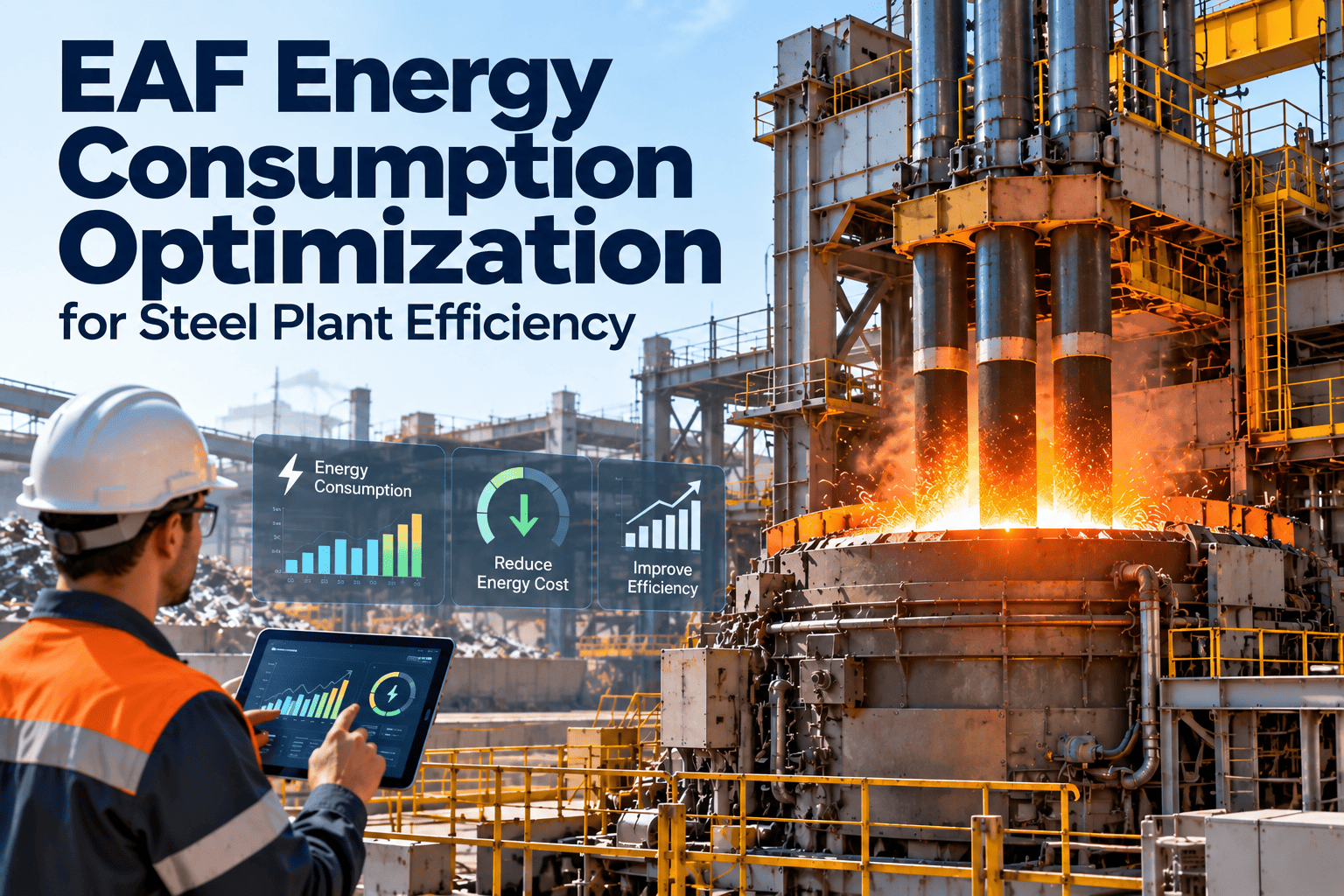
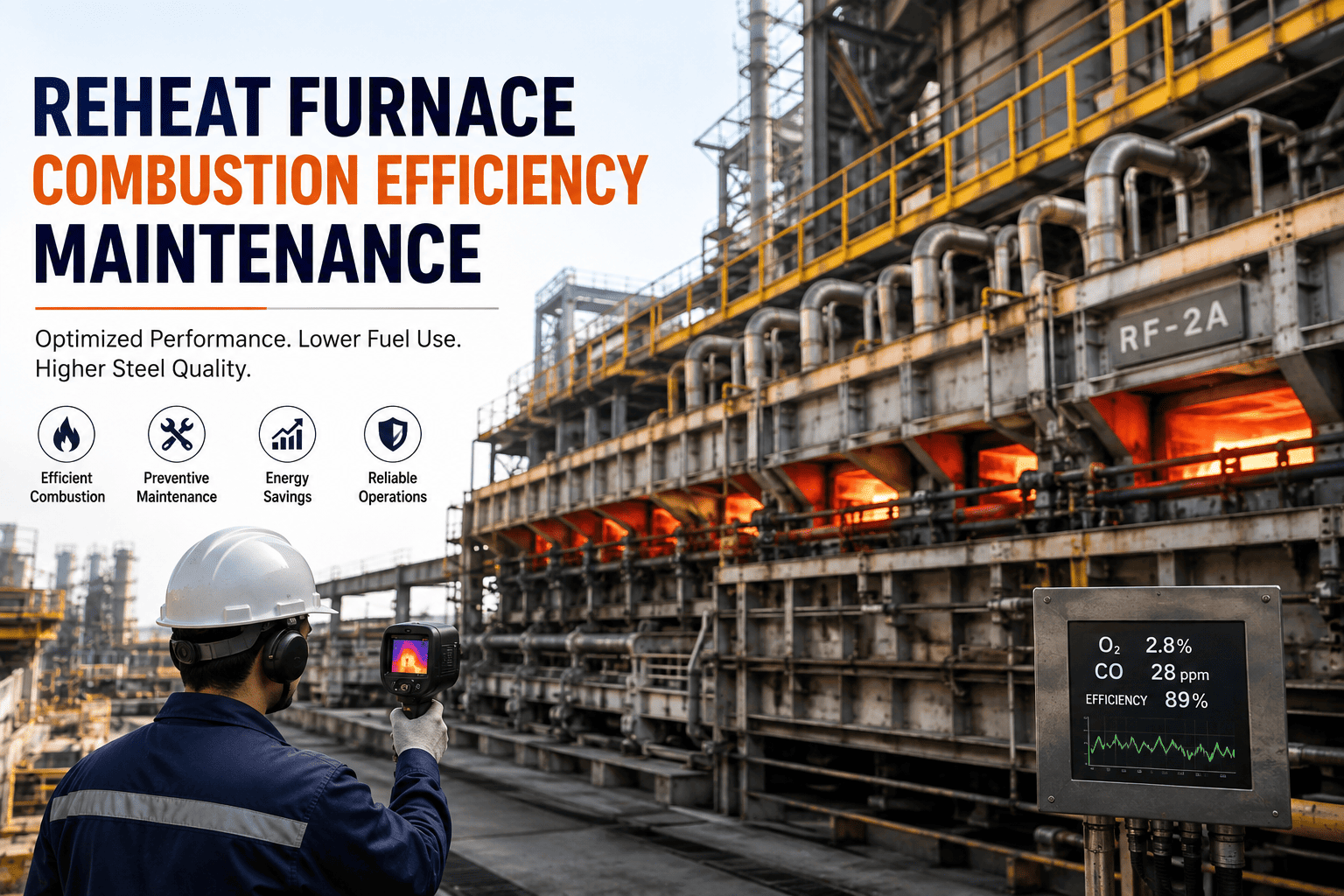
Electric motors are the largest single electricity consumer in any industrial plant, and a steel mill is no exception — blast furnace fans, cooling water pumps, rolling mill drives, and conveyor systems run around the clock and never stop drawing power. Most plants track motor failures but not motor efficiency, which means a mill can be losing hundreds of thousands of dollars a year to old windings, worn bearings, and mismatched VFD settings without a single alarm ever firing. A structured motor efficiency maintenance program turns that invisible drain into a tracked, budgeted, and steadily improving line item. This guide walks through motor criticality tiering, IE3/IE4 upgrade economics, VFD maintenance, and bearing lubrication programs built for integrated steel plants, and shows how a CMMS-based motor efficiency program turns thousands of motors into a manageable, measurable energy asset.
MOTOR EFFICIENCY · IE3/IE4 UPGRADES · VFD MAINTENANCE · BEARING RELIABILITY
Steel Plant Motor Efficiency Maintenance Program
Build a CMMS-driven motor management program: IE3/IE4 upgrade planning, VFD maintenance on blast furnace fans and cooling water pumps, bearing lubrication schedules, and load matching that turns thousands of plant motors into a tracked, measurable energy asset.
~70%Of industrial electricity consumption is drawn by motor-driven systems, not lighting or process heat
50–70%Of all motor failures trace back to bearing failure, and most of those trace back to lubrication
10–40%Energy reduction typical when a VFD is correctly matched and maintained on a fan or pump load
1–3 yrsTypical payback window for an IE3-to-IE4 motor upgrade on a continuous-duty application
Where Your Electricity Bill Is Actually Going
Most energy conversations in a steel plant start with the blast furnace or the reheat furnace, because that is where the fuel bill lives. But the electricity bill tells a different story — it is dominated by rotating equipment. Blast furnace cowper fans, BOF gas cleaning fans, cooling water circulation pumps, rolling mill main drives, and conveyor and materials handling motors are running nearly continuously, and every percentage point of motor inefficiency compounds across thousands of run-hours a year. A plant that treats motor maintenance purely as a breakdown-prevention activity is managing reliability but leaving the energy savings on the table.
Typical Plant Electricity Draw by System
Motor-driven systems (fans, pumps, drives, conveyors)
Electric heat, electrochemical process load
Facility HVAC and lighting
Motor systems are the largest lever on the electricity side of a steel plant's energy bill — which is exactly why a maintenance program aimed at motor efficiency, not just motor uptime, has the biggest payoff.
Motor Criticality Tiers: Not Every Motor Needs the Same Program
A 5 HP conveyor motor and a 2,000 HP blast furnace cowper fan motor cannot run on the same maintenance schedule. An efficiency and reliability program needs to be tiered by criticality, run-hours, and replacement cost, so the engineering effort goes where the return is largest.
Blast Furnace & Cowper Fan Motors
Continuous duty, 500–3,000+ HP, driving combustion air and cooling air for the furnace and stove system
Highest priority for IE4/premium upgrade and VFD load matching — even a 1-point efficiency gain compounds across 8,000+ run-hours a year on a single large motor.
Cooling Water Circulation Pumps
Continuous duty pumps moving cooling water through furnace jackets, cooler tubes, and caster spray systems
Frequently oversized for actual demand — a strong candidate for VFD retrofit since flow, not fixed speed, is what the process actually needs.
Rolling Mill Main & Auxiliary Drives
Variable-torque drives controlling roll speed, tension, and gauge across the mill train
Already VFD-controlled in most mills — the maintenance priority here is drive cooling, harmonic filtering, and encoder/feedback calibration, not the motor itself.
Conveyor & Materials Handling Motors
Large population of small-to-mid HP motors across sinter, coke, and raw material handling systems
Individually low value, collectively significant — best managed as a standardized replace-on-failure program with a pre-approved IE3 spec, not a case-by-case upgrade.
IE3 vs IE4: When the Upgrade Actually Pays for Itself
Every motor class step up cuts losses, but not every motor justifies the premium. Run-hours and load factor decide the payback math far more than motor size does — a small motor running continuously at load often out-earns a large motor that idles most of the year.
| Efficiency Class | IEC Designation | Typical Position | Best Fit |
| IE1 |
Standard Efficiency |
Legacy baseline, largely phased out for new purchases |
Replace on failure — repair cost rarely justifies keeping IE1 in service |
| IE2 |
High Efficiency |
Common in older installed base across most mills |
Upgrade candidate for motors above 25 HP running over 4,000 hrs/year |
| IE3 |
Premium Efficiency |
Current default spec for most new industrial motor purchases |
Standard spec for conveyor, pump, and general-purpose motors |
| IE4 |
Super Premium Efficiency |
Cuts remaining losses by roughly a fifth versus IE3 at the same rating |
Large continuous-duty motors — blast furnace fans, main cooling pumps, mill drives |
Rule of thumb for a steel plant motor inventory: prioritize IE4 for motors that are large, run more than 6,000 hours a year, and have been rewound more than once — each rewind typically costs a motor another 1–2 points of efficiency.
Turn Your Motor Inventory Into a Tracked Energy Asset
Log every motor's class, run-hours, load factor, and rewind history in one place, and let the system flag which motors justify an IE3 or IE4 upgrade first.
VFD Maintenance on Blast Furnace Fans and Cooling Water Pumps
Installing a VFD is the easy part. The energy savings only hold up if the drive itself is maintained — a fan running on a VFD with a fouled heatsink, an out-of-tune PID loop, or a bypassed harmonic filter can quietly drift back toward the energy profile of a fixed-speed motor.
Cooling Fan & Heatsink Cleaning
Dust and scale buildup on VFD cooling fins reduces heat dissipation, forcing the drive to derate output and lose part of its efficiency benefit. Quarterly cleaning is standard in a casthouse environment.
Load Curve Re-Tuning
Fan and pump curves drift as impellers wear and system resistance changes. Re-tuning the VFD's speed-to-flow curve annually keeps the drive matched to actual process demand instead of an outdated setpoint.
Harmonic Filter Verification
VFDs introduce harmonic distortion onto the plant electrical bus. Filters need periodic verification — a degraded filter does not stop the fan from running, but it does erode power quality and can stress upstream transformers.
Bearing Current Protection Checks
VFD switching can induce shaft currents that pit motor bearings over time. Shaft grounding rings and insulated bearings need periodic inspection — this failure mode shows up as premature bearing wear, not a drive fault.
Capacitor & DC Bus Inspection
Electrolytic capacitors in the drive's DC bus degrade with heat and age, typically over a 7–10 year window. A capacitor inspection program prevents an unplanned drive failure on a critical fan or pump circuit.
Firmware & Setpoint Documentation
Drive parameters get adjusted during troubleshooting and rarely get documented afterward. Keeping a current record of setpoints prevents a replacement drive from being commissioned with default, unoptimized values.
Bearing Lubrication: The Single Biggest Lever in Motor Reliability
Bearing failure accounts for roughly half to two-thirds of all motor failures, and the large majority of those failures trace back to lubrication — too much grease, too little, the wrong type, or a missed interval. A lubrication program is the cheapest reliability investment in the entire motor efficiency plan, because a motor running on a worn bearing also draws more current than it should.
Relubrication Interval
Set per OEM guidance based on bearing size, speed, and ambient temperature — not a blanket plant-wide schedule
Grease Volume Control
Over-greasing raises internal bearing temperature just as much as under-greasing accelerates wear
Grease Compatibility
Mixing incompatible thickener types during relubrication can break down the grease structure entirely
Contamination Control
Dust, moisture, and scale ingress in a casthouse environment is a leading cause of premature bearing wear
Motors identified through a CMMS-tracked lubrication program show fewer unplanned bearing failures and lower average operating current over time — the two are directly connected, since a bearing running dry increases friction load on the motor.
Building the CMMS-Driven Motor Efficiency Program
A spreadsheet can hold a motor list. It cannot flag which motor just crossed its fourth rewind, alert a planner when a VFD's harmonic filter check is overdue, or roll thousands of individual motor records into a plant-wide kWh trend. That is the gap a CMMS-based program closes — every motor gets a record, every PM ties back to an efficiency or reliability metric, and every upgrade decision is backed by run-hour and load data instead of a hunch. Oxmaint's asset registry tracks motor class, rewind history, run-hours, and PM compliance in one record, so planners can see at a glance which motors in the fleet are the strongest candidates for an IE4 upgrade this budget cycle.
Frequently Asked Questions
Which motors should be prioritized first for an IE3 or IE4 upgrade?
Start with motors larger than 25 HP running more than 4,000 hours a year, since run-hours drive the payback math more than motor size does. Blast furnace fans and cooling water pumps typically top the list.
Book a demo to see how to rank your own inventory.
Does adding a VFD replace the need for a high-efficiency motor?
No — a VFD saves energy by matching speed to demand on variable-torque loads like fans and pumps, while motor class efficiency reduces losses at any given speed. The two savings stack, they do not substitute for each other.
How many times can a motor be rewound before replacement makes more sense?
Each rewind typically costs a motor 1–2 points of efficiency, and repair costs approaching 50–60% of a new motor's price usually tip the decision toward replacement with a new IE3 or IE4 unit instead of another rewind.
What is the fastest way to reduce unplanned motor failures without a large budget?
Fix the lubrication program first. Bearing failures cause the majority of motor failures, and most of those are lubrication-related — interval, volume, and contamination control cost far less than any hardware upgrade.
Can a CMMS track motor efficiency, not just motor breakdowns?
Stop Guessing Which Motors Are Costing You the Most
Build a motor registry that tracks class, run-hours, rewinds, and PM compliance in one place — and know exactly which motors to upgrade first.