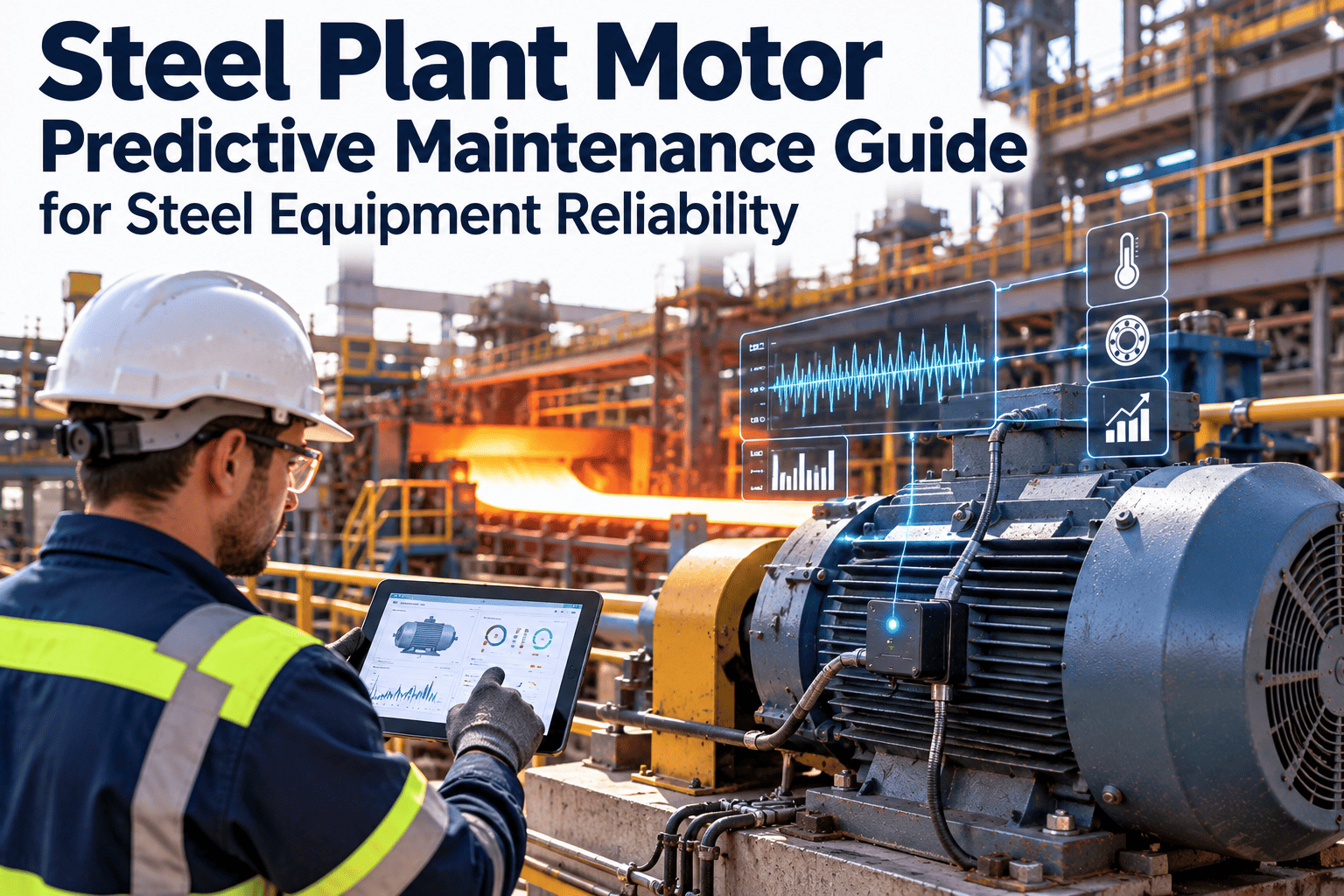
Motors turn nearly every fan, pump, conveyor, crane and mill drive in a steel plant. When one fails, the loss is rarely the motor alone; it is the process it drives. Bearings wear, rotors go out of balance, windings overheat and supply problems creep in. This guide shows how reliability teams combine vibration, temperature and motor current data to find these faults early, and how Oxmaint CMMS turns the findings into planned work.
Utilities and Motors | Motor Wear Detection
Steel Plant Motor Predictive Maintenance Guide for Steel Equipment Reliability
Read three signals together to separate mechanical wear from electrical faults, then act before the motor trips. Oxmaint keeps the readings, alerts and repairs on one motor record.
Vibration
Bearings, balance, alignment, looseness
+
Temperature
Overload, lubrication, cooling, insulation stress
+
Motor current
Rotor condition, supply quality, load changes
What Makes Steel Plant Motors Fail
Steel plant motors work in heat, dust, scale, moisture and heavy shock loading. Many run continuously, while others start and stop often or follow variable speed drives.
| Failure driver | Where it is common | Effect on the motor |
|---|---|---|
| Dust and contamination | Sinter, raw materials, casting areas | Blocked cooling, bearing damage, insulation tracking |
| Heat | Furnace and mill areas | Faster insulation aging, grease breakdown |
| Shock loading | Crushers, mills, cranes | Rotor stress, coupling and bearing wear |
| Moisture and water | Cooling systems, outdoor drives | Insulation degradation, corrosion |
| Poor alignment or soft foot | After maintenance, on worn bases | Vibration, bearing and seal wear |
| Supply and drive issues | Variable speed applications | Voltage stress, bearing currents, overheating |
Reading the Signals Together
One measurement can mislead. Two or three moving in the same direction give a much stronger case. Use the decoder below as a starting point for triage, then confirm with inspection.
Vibration rises at bearing frequencies, temperature climbs slowly
Likely bearing wear or lubrication problem
High vibration at running speed, temperature normal
Likely imbalance, often from buildup or damage
Vibration at twice running speed, coupling area warm
Likely misalignment or coupling wear
Winding temperature high, current unbalanced between phases
Possible supply unbalance or stator issue
Current pulsation and sidebands, speed swings under load
Possible rotor bar problem, needs specialist analysis
Temperature high, vibration and current normal
Check cooling airflow, fins, fan cover and ambient conditions
Treat these pairings as prompts, not diagnoses. Site conditions, drive type and machine design change what patterns mean.
Bearing Wear: The Most Common Motor Fault
Bearings fail through wear, contamination, over-greasing, under-greasing and misalignment. Vibration analysis detects early defects because damaged rolling surfaces create characteristic frequencies.
Good
Stable trend
Stable trend
Watch
Rising trend
Rising trend
Plan repair
Defect frequencies present
Defect frequencies present
Act now
Rapid growth, high heat
Rapid growth, high heat
Bearing care checklist
- Use the correct grease type and quantity, and record every greasing event.
- Take vibration readings at the same points, speeds and load each time.
- Record bearing temperature next to ambient temperature.
- Listen for changes in sound, then confirm with instruments.
- Replace bearings with correct fits and record part numbers.
Imbalance, Looseness and Alignment
Imbalance
Fans in dusty service collect deposits unevenly. Vibration at running speed rises, and bearings carry extra load. Cleaning and rebalancing usually resolve it.
Looseness and misalignment
Loose bolts, cracked bases and shaft misalignment cause harmonics and wear seals, couplings and bearings. Precision alignment after every repair pays back quickly.
Give Every Motor a Complete Maintenance History
Record readings, greasing, alignment and repairs against each motor in Oxmaint, and schedule the next action automatically.
Overheating: Cause Before Cure
Overheating accelerates insulation aging, so a motor that runs hot for long periods will fail earlier. Do not simply fit a bigger fan; find the reason.
Overload. Compare current with nameplate values and the driven equipment condition.
Poor cooling. Clean fins, fan covers and air paths. Check for blocked ducting.
Frequent starts. Review start counts and duty cycle against the design.
Voltage problems. Check supply voltage level and phase balance.
Bearing friction. Confirm lubrication and bearing condition.
Electrical Faults and Motor Current Analysis
Motor current analysis uses the current waveform already present in the supply to identify certain faults without touching the machine. It can support decisions on rotor condition, load behavior and supply quality.
- Phase current unbalance can indicate supply issues, connection problems or winding faults.
- Insulation resistance and polarization tests show winding condition during outages.
- Current signature patterns may reveal rotor bar defects under adequate load.
- Load trends show process changes that stress the drive train.
Variable speed drives also introduce switching stress. Bearing current damage can appear as fluting on races, so grounding, shaft brushes and insulated bearings deserve attention in drive-fed applications.
Choosing the Right Approach for Each Motor
| Motor group | Suggested approach | Reason |
|---|---|---|
| Large critical fans and pumps | Frequent vibration and temperature trending, periodic current checks | High downtime cost, long lead time replacement |
| Main conveyor drives | Route-based vibration and thermal scans | Production dependence on continuous flow |
| Crane and mill motors | Inspection plus load and current review | Shock loading and safety importance |
| Small general-purpose motors | Preventive lubrication and visual checks | Low repair cost, easy replacement |
| Spare motors | Storage inspection and periodic rotation | Protect readiness for emergencies |
Turning Motor Data Into Maintenance Action
01
Register every motor with nameplate data, location, driven equipment and criticality.
02
Set measurement routes and intervals by criticality.
03
Compare readings against baselines and previous trends.
04
Create a corrective work order when limits or trends are exceeded.
05
Repair, verify and update the baseline and failure notes.
Oxmaint supports this with asset records, preventive maintenance schedules, mobile inspection checklists, work orders, spare parts tracking and reporting. Data from external monitoring tools can support condition-based triggers on the same motor record.
Set Baselines Before You Chase Alarms
A reading means little without something to compare it with. The most useful data point for any motor is its own healthy condition, taken after installation or a good repair.
Record the reference set. Take vibration, temperature, current and speed at normal load right after commissioning.
Standardize the method. Use the same measuring points, sensor mounting and operating condition each time.
Note the load. Readings at very different loads cannot be compared directly.
Reset after repairs. A rewound or rebuilt motor has a new baseline that should replace the old one.
Alarm limits from standards or OEM guidance are a useful starting point, but trends against the motor's own baseline usually give earlier warning than fixed limits.
Winding and Insulation Health
Insulation degrades with heat, moisture, contamination, voltage stress and vibration. Failure is often sudden, but the decline is usually measurable if tests are repeated under similar conditions.
| Test or check | What it tells you | When to use it |
|---|---|---|
| Insulation resistance | Overall insulation condition to ground | Outages, after moisture exposure, before restart from storage |
| Polarization index | Insulation dryness and cleanliness trend | Larger motors during planned stops |
| Winding resistance | Connection quality and turn-to-turn balance | Repair verification and fault checking |
| Winding temperature sensors | Thermal loading during operation | Continuous or per-shift review |
| Visual and cleanliness inspection | Dust, oil, moisture and terminal box condition | Routine walk-downs |
Record test voltage, temperature and humidity with each result, because insulation values change with conditions. Store results on the motor record so trends are visible at the next test.
Lubrication Practice for Motor Bearings
Bearing problems and lubrication problems are closely linked. Mixing incompatible greases, using the wrong quantity or skipping intervals all shorten life.
Do
- Follow the OEM grease type and quantity.
- Grease while the motor is running when the design allows it.
- Clean fittings before greasing to keep dirt out.
- Record the date, quantity and technician.
Avoid
- Adding grease only because a bearing sounds noisy.
- Mixing greases without a compatibility check.
- Forcing grease past blocked relief paths.
- Leaving shared grease guns uncleaned between products.
Variable Speed Drives and Motor Health
Drive-fed motors gain process control and energy benefits but face different stress. Fast voltage switching can strain insulation and drive currents through bearings. Slow-speed operation reduces self-cooling on fan-cooled motors.
- Check that cable length, filters and grounding match the drive and motor design.
- Review shaft grounding rings or insulated bearings where fitted.
- Look at operating speed ranges and confirm cooling is adequate at low speed.
- Inspect drive cabinets for dust, filter blockage and cooling fan wear.
- Log drive fault history beside the motor record to see whether trips and motor wear are related.
Repair, Rewind or Replace
When a motor is found in poor condition, the decision to repair or replace affects cost, downtime and future reliability. Use failure history, not habit.
Bearing or seal failure, winding healthy
Repair on site or at a shop, verify alignment and record new baseline
Winding failure on a motor with repeated repairs
Compare rewind cost and efficiency loss against replacement
Damaged shaft, frame or core
Usually replacement, unless a specialist confirms repair is sound
Motor is oversized or mismatched to the load
Review application before buying a like-for-like replacement
Whichever route you choose, record the failure cause. A repair that fixes the symptom but leaves the cause in place simply resets the clock.
Spare Motors and Storage
Critical motors need ready spares, and spares need care. A motor sitting in a damp warehouse for years may fail on first start.
- Store motors indoors, dry and off the floor, with shafts protected.
- Rotate shafts by hand at set intervals to protect bearings from brinelling.
- Test insulation resistance before installing a stored motor.
- Keep mounting dimensions, shaft data and terminal details on the spare's record.
- Standardize frame sizes and types where possible to reduce spare variety.
Safety and Work Control Around Motors
Motor work involves electrical isolation, rotating equipment, heavy lifting and often confined or hot areas. Digital work orders should support safe practice, not replace site procedures.
Attach isolation and lockout requirements to the work order.
Require confirmation of energy isolation before internal work.
Record lifting plans for heavy motors and rotors.
Capture post-work checks such as rotation direction and guard replacement.
Common Mistakes in Motor Condition Monitoring
Programs often disappoint because of habits, not technology. These are the patterns that most often waste effort.
- Collecting data without a named owner who reviews it and raises work orders.
- Taking readings at inconsistent points, speeds or loads, which makes trends unreliable.
- Setting alarm limits so tight that every route creates false alerts, then ignoring them all.
- Monitoring every motor equally instead of focusing on critical ones.
- Closing repairs without recording cause, so the same fault repeats.
- Forgetting to update the baseline after a rebuild or replacement.
Fixing these habits costs little and often improves results more than adding new sensors. Start with ownership, consistency and follow-through, then extend the technology.
Pumps, Fans and Crane Motors: Application Notes
Pumps and fans
Watch for cavitation, blocked flow, worn impellers and coupling misalignment. Compare motor current with flow or pressure so load changes are explained before they are blamed on the motor.
Cranes and hoists
Frequent starts, braking and shock loads stress motors, brakes and gearboxes together. Inspect brakes, collectors, cabling and cooling, and record start counts where available.
Hot, Dusty and Wet Areas: Practical Protection
Environment often decides motor life more than design does. Small protective steps in harsh areas pay back through fewer failures.
- Keep cooling fins, fan covers and air inlets clean, and schedule cleaning by area severity.
- Check terminal box seals, cable glands and drain plugs for moisture entry.
- Use space heaters on idle motors in damp areas where the design provides them.
- Shield motors from radiant heat, scale, water spray and falling material where practical.
- Confirm the enclosure rating still suits the area after process changes.
Record environmental findings on the work order. Patterns such as repeated moisture ingress at one location often point to a fixable cause outside the motor itself.
Motor Reliability Metrics Worth Tracking
Motor failures by cause
Bearing, winding, cooling, coupling, supply and unknown.
Route completion
Share of scheduled motor readings completed on time.
Repeat repairs
Same motor and same fault within a defined period.
Alerts closed with action
Share of findings that reached a completed work order.
Documenting Motor Failures for Learning
A motor failure is expensive information. Capture it properly and it prevents the next one.
- Photograph the failed parts before cleaning, including bearings, windings and shaft ends.
- Record operating conditions, recent maintenance and any alarms before the failure.
- Select a root cause from a standard list, and note contributing factors separately.
- Decide whether the fix is a repair, a design change or a procedure change, and assign an owner.
Frequently Asked Questions
Which measurement finds bearing wear earliest?
Vibration analysis usually detects it early, especially when supported by temperature and lubrication records.
Can motor current show mechanical problems?
Sometimes, since load and speed changes appear in current, but vibration remains the main tool for mechanical faults.
How often should motor readings be taken?
It depends on criticality and failure history. Set intervals in Oxmaint and adjust them as trends develop.
Do small motors need predictive monitoring?
Usually not. Preventive lubrication and inspection are more cost effective for low-cost, easily replaced motors.
Can I see a motor route in practice?
You can book a demo to see route, alert and work order setup.
Detect Motor Wear While You Can Still Plan the Fix
Combine vibration, temperature and current findings with structured work orders and history in one steel plant maintenance platform.