A bearing on a rolling mill drive doesn't fail without warning — it announces itself weeks in advance through a change in vibration signature, a rise in operating temperature, or metal particles accumulating in the lubricant. The problem in most steel plants isn't that this data is unavailable; it's that vibration readings sit in one analyzer, oil reports arrive as PDFs from a lab, and thermal images get reviewed once and forgotten. Reliability teams end up with five separate data sources and no single view of which asset is actually trending toward failure. A condition monitoring program only works when every one of those readings routes into the same maintenance system as the resulting work order, with a clear threshold for when a reading becomes a scheduled repair instead of a data point nobody acts on.
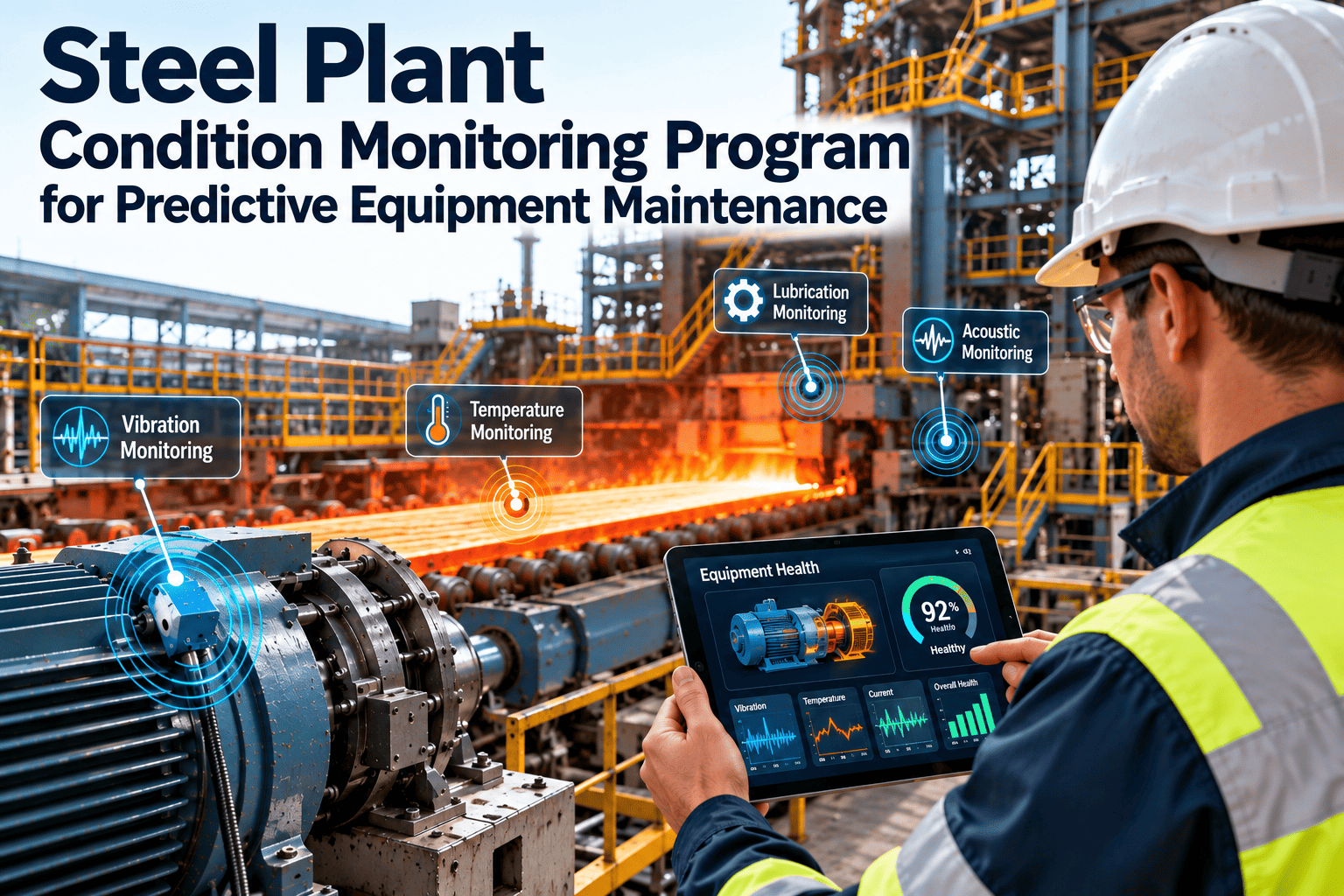
Steel Plant Condition Monitoring Program for Predictive Equipment Maintenance
Build a structured program across vibration, thermal, oil, ultrasonic, and motor current data — and connect every reading to a work order through OXMAINT AI, so a developing fault becomes a scheduled repair instead of an unplanned stop.
Why Fixed-Interval PM Alone Isn't Enough
Calendar-based preventive maintenance services equipment whether it needs it or not, and misses faults that develop between scheduled intervals. Condition-based maintenance closes both gaps by using the machine's own signals — vibration, temperature, oil chemistry, electrical current — to decide when intervention is actually warranted rather than defaulting to a fixed interval that was set once and never revisited.
| Approach | How it decides timing | Main weakness |
|---|---|---|
| Reactive | Repair after failure occurs | Most expensive repair, plus lost production and safety exposure |
| Fixed-interval PM | Calendar or usage schedule | Services healthy equipment, misses faults between intervals |
| Condition-based | Actual measured equipment condition | Requires sensors, trending discipline, and an alert-to-work-order path |
Steel plants that run mature condition-based programs alongside a disciplined PM schedule tend to see the split shift meaningfully — a larger share of maintenance work becomes planned and scheduled, and the share that shows up as a surprise breakdown shrinks correspondingly, because the equipment is telling the team what it needs before it fails.
Five Techniques and What Each One Catches
No single monitoring technique covers every failure mode. A structured program layers several together, since each one detects a different physical signature of developing damage — mechanical, thermal, chemical, or electrical — and relying on just one leaves entire failure categories invisible until they've already progressed.
Mapping Techniques to the Steel Process
Different stages of steel production put different stress on rotating and thermal equipment, and the monitoring mix should follow that logic rather than applying the same sensor package everywhere. A blower bearing in ironmaking fails for different reasons than a caster segment drive, and the technique that catches each fault earliest isn't always the same one.
Turn Every Reading Into a Trended Asset Record.
OXMAINT AI attaches vibration, thermal, oil, and MCSA readings directly to the asset — so a technician sees the trend line, not just today's number, before deciding whether a work order is warranted.
Building the Monitoring Route
A condition monitoring program lives or dies on route discipline. Skipped readings and inconsistent collection points make trending unreliable long before any sensor technology becomes the limiting factor, and a route that gets deprioritized during a busy production week is one of the fastest ways a program quietly loses its value.
Alarm Thresholds and Severity Staging
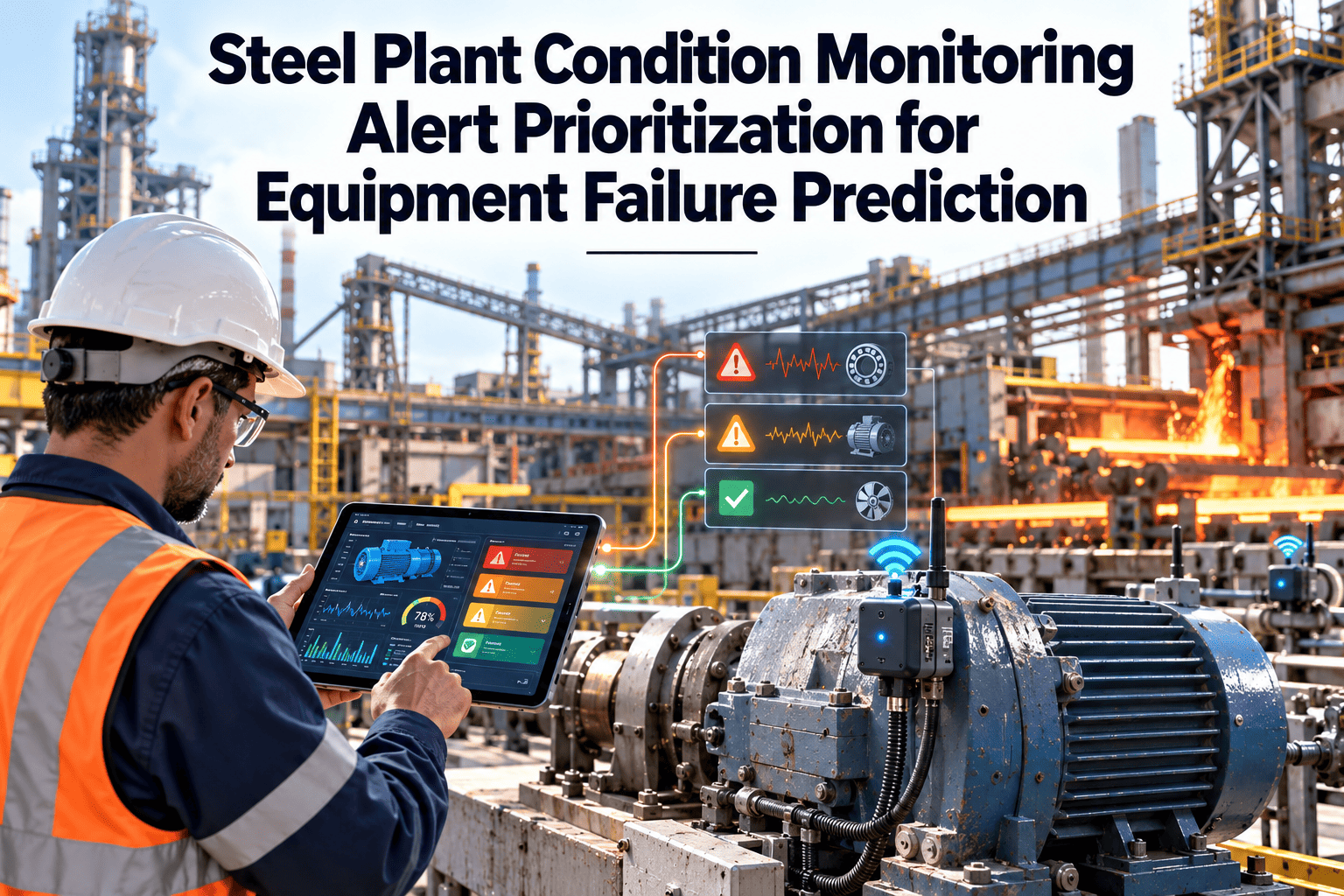
A reading without a threshold is just a number. Most programs stage severity into bands so a technician — or the CMMS — knows exactly what action a reading requires, without guessing at what "elevated" actually means for that asset or that failure mode.
| Stage | What it looks like | Typical response |
|---|---|---|
| Stage 1 — Incipient | Slight deviation from baseline, no functional symptom | Log and continue monitoring at normal frequency |
| Stage 2 — Developing | Clear trend upward across two or more readings | Increase collection frequency, schedule for next planned window |
| Stage 3 — Advanced | Reading crosses the defined alarm threshold | Generate a work order and plan the repair within days, not weeks |
| Stage 4 — Critical | Reading indicates imminent functional failure | Immediate intervention or controlled shutdown before the next run |
Closing the Loop: From Reading to Work Order
The step that most condition monitoring programs get wrong isn't the sensor technology — it's what happens after the reading crosses a threshold. If the alert sits in a standalone analyzer or a spreadsheet, it never reaches the planner who schedules the repair, and the early warning is wasted, turning what should have been a planned repair back into a surprise breakdown anyway.
Route-Based vs. Continuous Monitoring
Not every asset justifies permanently installed sensors, and not every asset can wait for a monthly route. Most programs run both, matched to criticality, rather than treating the choice as all-or-nothing across the entire plant. Book a demo to map your own asset list against this split.
| What matters | Route-based | Continuous / wireless |
|---|---|---|
| Best fit | Supporting equipment, non-critical pumps and fans | Cascade-critical drives, inaccessible or hazardous locations |
| Data resolution | Snapshot at collection time | Continuous trend, catches fast-developing faults |
| Upfront cost | Lower — shared handheld analyzer | Higher — per-point sensor and gateway hardware |
| Labor demand | Technician time on every route | Minimal once installed |
Common Program Mistakes to Avoid
Most condition monitoring programs that underdeliver aren't failing on sensor technology — they're failing on process discipline around what happens with the data once it's collected, which is a people and workflow problem far more often than an equipment problem.
Who Owns Each Piece of the Program
A condition monitoring program spans skills that rarely sit with one person — route collection, signal interpretation, and repair execution are three different jobs, and unclear ownership is one of the most common reasons a program stalls after the first year once the initial rollout enthusiasm fades.
| Role | Owns | Escalates to |
|---|---|---|
| Route technician | Scheduled data collection, flagging obvious anomalies | Reliability engineer for interpretation |
| Reliability engineer | Threshold setting, trend analysis, failure mode diagnosis | Maintenance planner for work order scheduling |
| Maintenance planner | Scheduling the repair against the production window and parts availability | Plant manager for shutdown-level decisions |
Without a CMMS tying these roles to the same asset record, each handoff becomes a phone call or an email instead of a status change on a shared work order — and that's usually where the lead time a sensor bought gets lost again.
Rolling Out the Program
A condition monitoring program earns its budget fastest when it starts with the equipment that has both high failure consequence and a track record of surprise breakdowns, rather than trying to instrument the entire plant on day one and stretching the team thin across too many assets at once.
What a Usable Alert Should Include
Not every alert is created equal. A raw threshold breach with no context forces the technician to start the diagnosis from scratch, which erases much of the lead time the monitoring program was supposed to buy in the first place.
Frequently Asked Questions
Give Every Sensor Reading a Path to a Work Order
Vibration, thermal, oil, ultrasonic, and motor current data — trended by asset and connected to the maintenance work it should trigger.