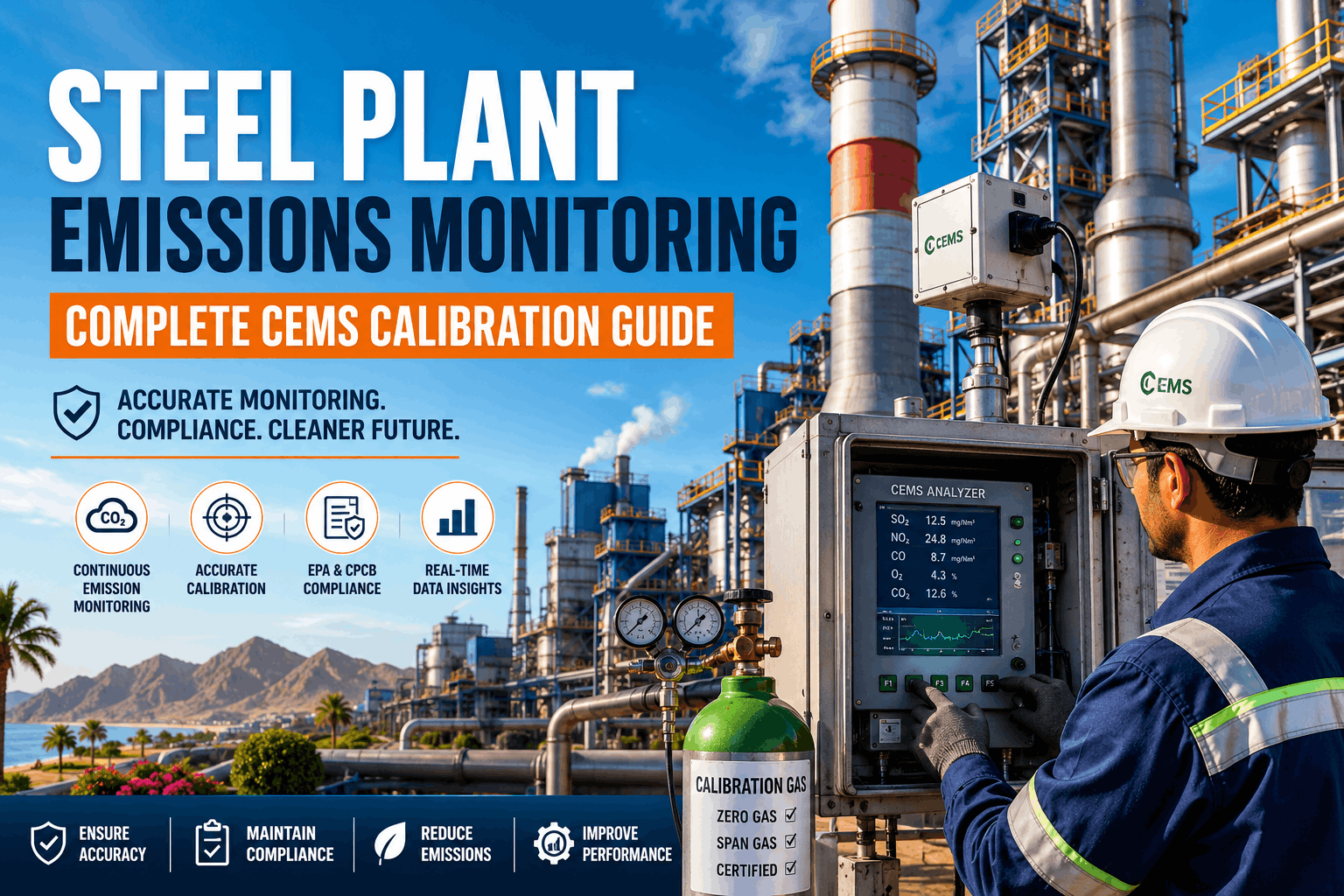
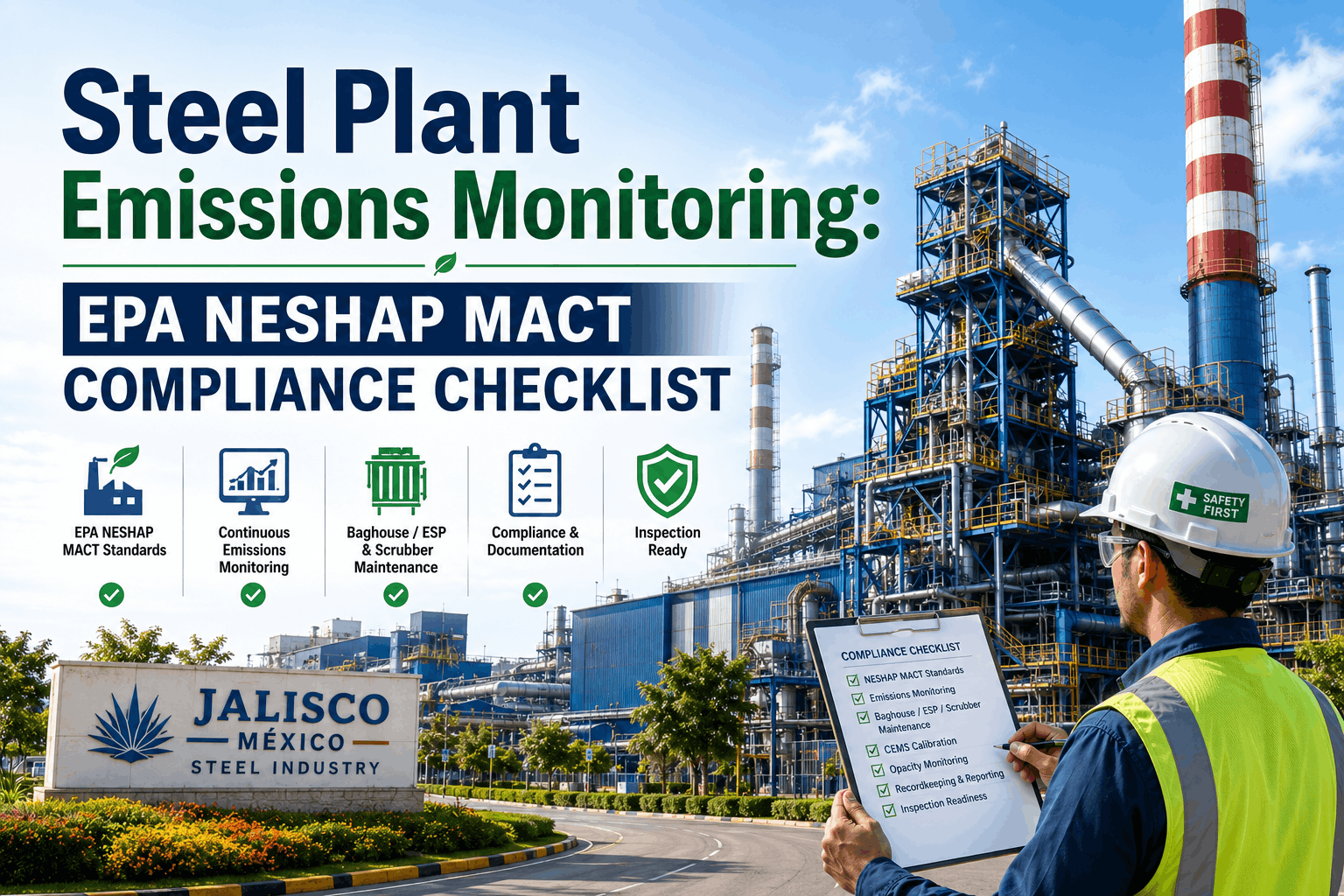
The EPA's National Emission Standards for Hazardous Air Pollutants (NESHAP) and Maximum Achievable Control Technology (MACT) standards require steel plants to maintain daily emissions logs documenting particulate matter emissions, opacity readings, baghouse filter pressure drops, electrostatic precipitator (ESP) performance, scrubber operability, and compliance with Startup, Shutdown, Malfunction (SSM) procedures. Steel plant air permits specify emission limits — typically 0.015 gr/dscf particulate matter for cold rolling mills, 0.020 gr/dscf for sintering, 0.030 gr/dscf for blast furnaces. Every exceedance must be logged with timestamp, equipment status, duration, root cause, and corrective action taken within 24 hours. OxMaint's NESHAP MACT Emissions Log automates daily entry requirements, links equipment maintenance to compliance events, flags exceedances in real-time, and generates EPA audit-ready reports — consolidating scattered logbooks and manual spreadsheets into a unified, timestamped compliance record that demonstrates due diligence and regulatory responsiveness to EPA inspectors.
Automated daily log entries for PM limits, opacity monitoring, baghouse maintenance, scrubber performance, and SSM events — EPA-ready records with equipment linkage, exceedance flagging, and corrective action documentation for air permit compliance.
Steel plant NESHAP MACT permits require daily documentation of emissions control equipment performance and compliance status. OxMaint consolidates all eight log entry types into a single daily form, populated with real-time data from process monitoring systems, and indexed by equipment to show which device caused an exceedance or malfunction event. Daily entries include opacity monitoring results (visual inspection or continuous opacity monitoring system readings), PM concentration readings from stack testing or continuous monitors, baghouse filter condition (pressure drop, bypass airflow), ESP performance (secondary voltage, current, collecting plate condition), scrubber operability (water flow rate, pH, foam suppression), fuel combustion equipment status (furnace temperature, oxygen levels, flame stability), fugitive emissions events (visible dust from storage areas or material transfers), and all Startup, Shutdown, Malfunction events with documentation of notification procedures followed.
1
Opacity Monitoring Entry
Daily Entry: Opacity reading (%) from stack or continuous monitor; compare to permit limit (typically 10–20%). Record observer name, observation method (visual vs. continuous), time of reading.
Documentation: Timestamp, cause (combustion imbalance, control device malfunction), duration, corrective action, time to recovery, technician responsible.
EPA Scrutiny: Opacity exceedances are most commonly cited violations in air permit audits; complete documentation prevents penalties.
2
Particulate Matter (PM) Limit Entry
Daily Entry: PM concentration (gr/dscf) from continuous PM monitor or stack test. Compare to permit limit (0.015–0.030 gr/dscf depending on source). Record time, monitor status, certification.
Exceedance Flag: If PM >limit → initiate CEMS drift check, inspect baghouse for torn bags, check ESP collector plate spacing, measure baghouse pressure drop immediately.
EPA Scrutiny: PM limits are specific emission standards; exceedances must show documented investigation and corrective action within 24 hours or face enforcement.
3
Baghouse Filter Condition Entry
Daily Entry: Baghouse pressure drop (inches water column); compare to baghouse design specification (typically 3–5 inches WC). Record filter age (months in service), number of elements, cleaning cycle status.
Maintenance Alert: If pressure drop >6 inches WC → filter bypass likely; schedule filter replacement within 7 days. PM bypass during replacement = exceedance event; document notification and corrective action.
Documentation: Pressure drop reading, filter condition, replacement schedule if triggered, maintenance work order linkage, date filters replaced, new filter type and quantity.
Daily Entry: Secondary voltage and current readings from ESP control cabinet; compare to design setpoint (typically 40–60 kV, 150–300 mA). Record sparking frequency (times per minute), rapping cycle status.
Malfunction Alert: If voltage drops >10% below setpoint or sparking >5 times/min → ESP efficiency compromised; adjust power supply, inspect electrodes for deposits, schedule rapping motor maintenance.
Documentation: Voltage/current readings, sparking frequency, corrective actions taken, follow-up readings confirming restoration, maintenance work order if equipment repair needed.
EPA Expectation: Document shows proactive monitoring and rapid response to ESP anomalies; demonstrates commitment to emission control effectiveness.
5
Wet Scrubber Operability Entry
Daily Entry: Scrubber water flow rate (GPM); compare to permit-specified minimum (typically 100–500 GPM depending on scrubber size). Record pH (if SO2 control), foam suppression status, pump amperage.
Malfunction Alert: If water flow
Documentation: Water flow reading, limit, corrective action, time to restoration, emergency shutdown justification if applicable, downstream air quality impact if process was halted.
Regulatory Link: Scrubber malfunction can trigger NESHAP violation if not corrected within SSM grace period; complete documentation demonstrates good faith compliance attempt.
6
Startup, Shutdown, Malfunction (SSM) Event Entry
Daily Entry: Any startup (equipment beginning operation), shutdown (planned or emergency), or malfunction event (unplanned departure from normal operation). Record type, timestamp, duration, equipment affected, reason.
Notification Requirement: SSM events must be reported to air quality agency within 2 hours if emissions >permit limit or control equipment unavailable. Document who was notified, time of notification, agency contact name.
Documentation: Event description, affected equipment, reason for event (maintenance, equipment failure, safety issue), emissions impact estimate, control device status during event, corrective action to prevent recurrence.
EPA Expectation: NESHAP SSM documentation proves that unplanned events were managed responsibly, reported to authorities on time, and investigated for prevention measures.
7
Fugitive Emissions Event Entry
Daily Entry: Any visible dust release from material storage, transfer operations, or process leaks. Record location, duration, apparent cause (wind conditions, uncovered material, worn seal), corrective action initiated.
Control Measure: Dust from uncovered storage piles, material transfer to open trucks, or leak from material handling conveyor belts. Link to specific process area (pellet plant, scrap yard, coke storage) for trend analysis.
Preventive Measures: Document long-term control improvements (enclosed transfer, dust collector installation, storage pile covers) resulting from repeated fugitive events.
8
Equipment Malfunction & Maintenance Linkage Entry
Daily Entry: Any control equipment malfunction — baghouse bypass, ESP electrode corrosion, scrubber pump failure, damper seal leak. Record equipment ID, failure mode, impact on emissions, corrective action schedule.
Work Order Linkage:OxMaint auto-creates maintenance work orders from malfunction entries; tracks repair status; logs completion with new performance test results proving restoration to compliance.
Documentation: Malfunction timestamp, equipment identification, failure description, estimated PM impact, repair timeline, interim control measures (reduced throughput, process bypass), repair completion date, verification test results.
Audit Trail: Complete record shows EPA that equipment failures were managed proactively — repairs completed promptly, with documented testing confirming emission control restoration.
NESHAP MACT Compliance Log Template — Structure and Required Fields
A complete NESHAP MACT emissions log must include standardized fields for date, time, equipment identification, emissions reading, permit limit, pass/fail status, operator/observer name, notes, and management review signature. The log serves as the primary evidence during EPA air quality audits that the plant was monitoring emissions consistently and responding to exceedances documented. Electronic logs (such as OxMaint's automated log system) are preferred by EPA because they provide timestamped entries, prevent tampering, enable rapid search by date or equipment, and integrate with maintenance records for compliance validation. EPA inspectors will request logs covering the past three years; facilities unable to produce complete, legible logs face immediate non-compliance citations. The log template below shows required structure and typical entries for a blast furnace baghouse and primary steel furnace scrubber over one week.
LOGGED — Planned startup after maintenance; emissions monitored; no exceedance
Five Common NESHAP MACT Violations — Root Causes and Prevention
EPA NESHAP MACT enforcement actions against steel plants typically cite five recurring violations: (1) Incomplete or missing daily logs — facilities that did not record readings for certain days, failed to document exceedances, or kept logs in locations EPA inspectors couldn't access. Prevention: centralized electronic logging with automatic timestamping and audit trail. (2) Unresponded-to exceedances — logs show equipment exceeded permit limits but no documentation of corrective action taken. Prevention: OxMaint flags exceedances and auto-generates corrective action forms linking to maintenance work orders. (3) Late SSM reporting — Startup, Shutdown, or Malfunction events not reported to the air quality agency within required timeframe. Prevention: automated notification alerts when SSM events are logged. (4) No CEMS calibration or drift documentation — emission monitors not kept in control; daily checks failed and no recalibration record. Prevention: integrated CEMS compliance linked to emissions log. (5) Equipment maintenance not documented — logbooks show opacity exceedances, but no maintenance records proving baghouse filters or ESP electrodes were replaced. Prevention: link all emissions exceedances to completed maintenance work orders and performance re-tests.
Violation Type
Root Cause
EPA Penalty
Prevention Strategy
Incomplete Daily Logs
Manual entries, lost logbooks, employee turnover, poor record-keeping discipline
Exceedances logged but no proof baghouse filters or ESP was repaired; facility claims work was done but has no records
$25K–50K per equipment failure; potential permit revocation if pattern of deferred maintenance
Link emissions exceedances directly to work orders; require completion documentation and post-repair emissions verification
Frequently Asked Questions on NESHAP MACT Emissions Logging
How do we document a PM exceedance in the log?
Record the timestamp, equipment ID, PM reading, permit limit, and exceedance status. Immediately initiate investigation: check baghouse pressure drop, inspect ESP electrodes, verify CEMS calibration. Document root cause and corrective actions taken within 24 hours; include follow-up measurement confirming emissions returned below limit.
What is an SSM event and when must we notify the air agency?
SSM = Startup, Shutdown, or Malfunction event. Notification is required within 2 hours if the event causes emissions >permit limit or affects control equipment operability. OxMaint auto-alerts you when to notify; document agency contact name and time of notification in the log.
How long must we keep NESHAP MACT emission logs?
EPA requires five years of retention. Electronic logs should be backed up quarterly; ensure database integrity and long-term accessibility for potential EPA inspection decades later.
What if a control device (baghouse, ESP) fails and cannot be repaired immediately?
Document the failure in the log as an SSM event; notify the air agency immediately. You may be allowed to reduce production or shut down the affected process temporarily until repair is complete. All steps and downtime must be documented; EPA will review justification for reasonableness.
Can we use paper logs, or does EPA prefer electronic?
Paper logs are technically acceptable but create risk: they can be lost, destroyed, or challenged as altered. EPA increasingly expects electronic logs with automatic timestamping. OxMaint provides audit-trail electronic logs that are defensible in EPA inspection.
How do we link equipment maintenance to emissions exceedances for EPA credibility?
What are the consequences if EPA finds missing or incomplete logs during inspection?
Missing logs are treated as presumed violations — EPA assumes emissions exceeded limits during gaps. Penalties range from $10K per day of missing data to $100K+ if pattern suggests intentional non-compliance or negligence. Complete, defensible logs are your primary protection against these penalties.
"
Our air quality team kept emissions logs in three different notebooks, one per equipment area. When EPA arrived with an inspection notice, we couldn't quickly consolidate data, couldn't prove corrective actions were taken, and couldn't link equipment maintenance to exceedance events. We faced $250K in penalties. Now we use OxMaint's unified log system — every exceedance auto-links to maintenance completion records, every SSM event is timestamped with agency notification proof, and EPA audits take 2 days instead of 3 weeks. The system cost was recovered in reduced penalty risk alone.
Environmental Compliance Director — Multi-furnace Steel Mill, Ohio, USA
Start Your Centralized NESHAP MACT Compliance Log Today.
OxMaint consolidates daily emissions readings, baghouse maintenance, scrubber operability, SSM events, and corrective actions into a single, audit-ready log — eliminating scattered logbooks, preventing missing data, and proving responsive compliance management to EPA inspectors. Begin your free trial or schedule a compliance consultation to transition from manual logs to automated NESHAP documentation.
Unified NESHAP MACT Emissions Log with Equipment Linkage.
Daily emissions tracking, exceedance flagging, SSM event notification, corrective action documentation, and EPA-ready compliance records.