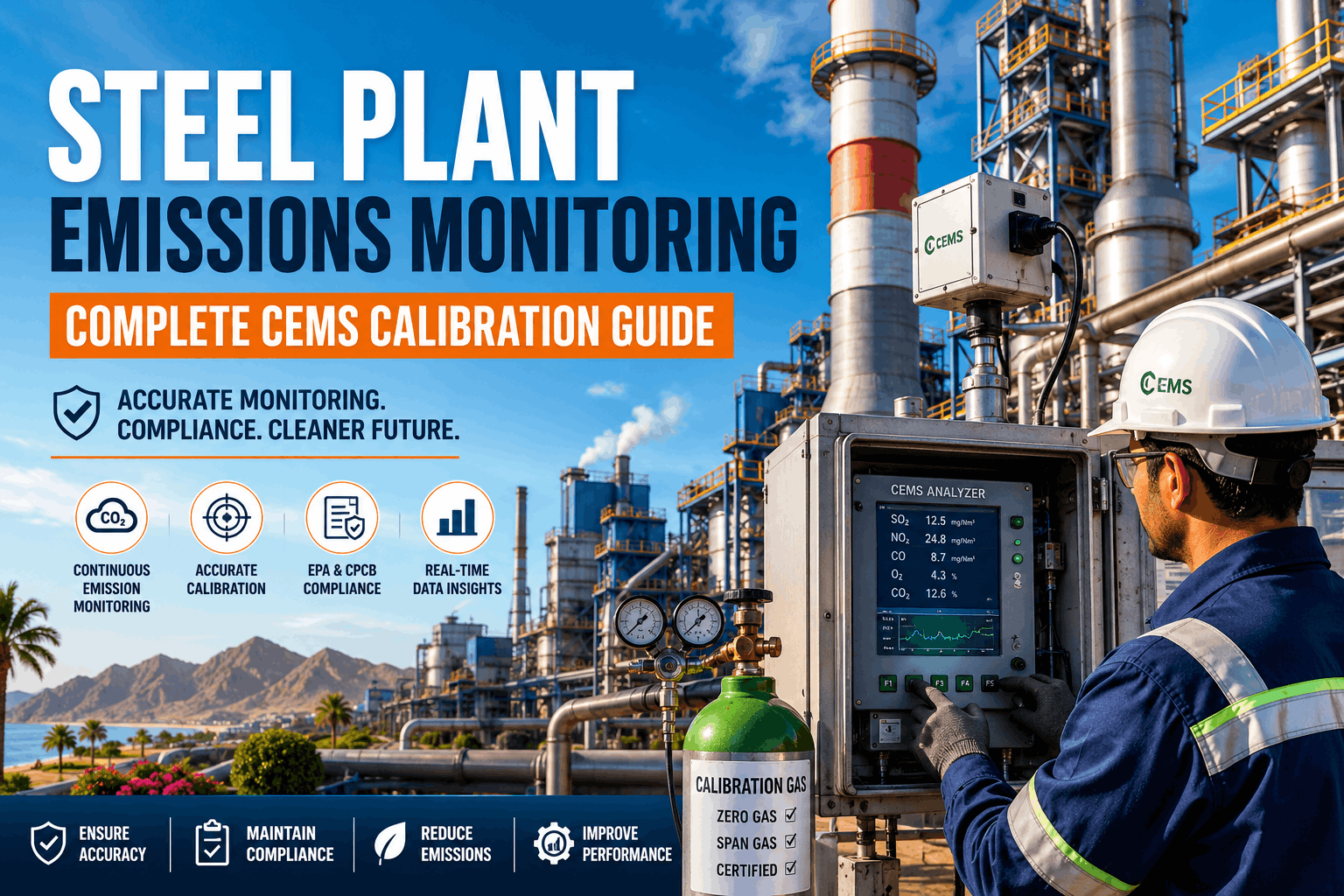
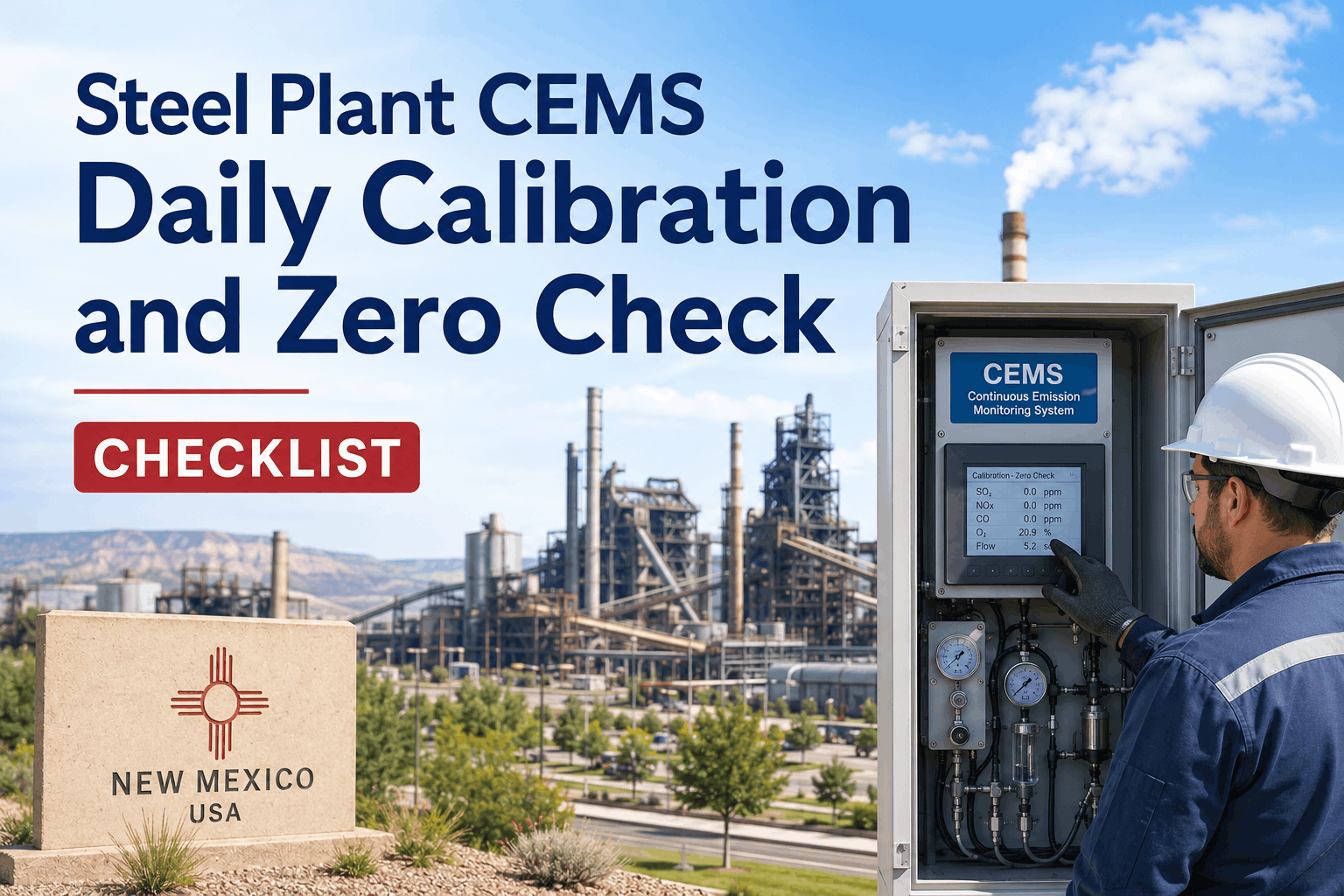
Steel Plant Emissions Monitoring: CEMS Calibration and Maintenance
By Alex Jordan on June 25, 2026
Continuous Emission Monitoring Systems (CEMS) in steel plants measure real-time concentrations of particulate matter (PM), sulfur dioxide (SO2), nitrogen oxides (NOx), carbon monoxide (CO), and carbon dioxide (CO2) from blast furnaces, basic oxygen furnaces, electric arc furnaces, and stack emitters. EPA CEMS certification requires quarterly calibrations, daily zero and span checks, and annual linearity tests — any failure results in data invalidation, regulatory non-compliance, and potential EPA penalties of ₹50,000–₹500,000 per violation. OxMaint's CEMS Management Module automates calibration scheduling, stores zero/span/linearity records, flags drift conditions before they exceed EPA limits, and generates audit-ready compliance documentation — reducing downtime from failed CEMS by 70% and ensuring every emission measurement remains defensible in regulatory audits.
Daily zero and span checks, quarterly calibrations, annual linearity tests, RATA verifications, and drift monitoring — complete CEMS compliance procedures with automated scheduling and audit-ready documentation for EPA inspections and third-party verification audits.
4Quarterly calibrations per CEMS per year (EPA minimum)
365Daily zero and span checks required for compliance
10%EPA maximum drift allowance before recalibration triggered
70%Downtime reduction through predictive drift alerts
Six CEMS Calibration Procedures — Daily, Quarterly, and Annual Requirements
CEMS calibration follows strict EPA protocol to ensure measurement accuracy and data integrity. OxMaint maintains calibration checklists for each procedure and automatically schedules maintenance windows. Daily zero checks verify that the analyzer reads zero when exposed to zero-concentration gas (nitrogen cylinder or scrubbed air). Daily span checks confirm the analyzer reads the correct concentration when exposed to span gas (a known concentration of the target pollutant in nitrogen). Quarterly full-scale calibrations verify the analyzer's linearity and accuracy across its measurement range — typically three to five data points from zero to full scale. Annual linearity tests use multiple gas standards to ensure consistent accuracy across the measurement range. Reference Accuracy Test Assemblies (RATA) conducted every three years verify that the CEMS reading matches EPA-approved reference methods measured simultaneously. Drift checks performed during calibration detect sensor degradation, sample line fouling, or signal processing errors.
1
Daily Zero Check
Frequency: Once per 24 operating hours
Procedure: Supply zero-concentration gas to the analyzer inlet; record the displayed reading. Acceptable: reading within ±2% of the full measurement range (FMR).
Documentation: Record timestamp, reading, gas cylinder lot number, and pass/fail status in CEMS maintenance log.
Drift Impact: Zero drift >2% FMR indicates calibration drift; schedule span check and calibration within 30 days.
2
Daily Span Check
Frequency: Once per 24 operating hours (typically 4–6 hours after zero check)
Procedure: Supply span gas (known pollutant concentration, typically 50–80% of FMR) to analyzer inlet; record reading. Acceptable: ±10% of span gas concentration.
Documentation: Timestamp, reading, span gas certificate of analysis (CoA), cylinder lot, pass/fail status.
Drift Impact: Span drift >10% triggers immediate corrective action investigation and recalibration within 7 days.
3
Quarterly Full-Scale Calibration (Multi-Point)
Frequency: Every 90 ±10 days (4 times per year minimum)
Procedure: Expose analyzer to 3–5 certified gas standards spanning zero to full range. Plot response curve; verify linearity coefficient >0.99. Adjust analyzer calibration slope and offset if needed.
Documentation: Calibration certificate, gas cylinder CoAs, response curve plot, drift calculations, pre- and post-calibration zero/span readings.
Technician: Only EPA-certified CEMS technicians or vendor-trained field service engineers authorized to perform full calibrations.
4
Annual Linearity Test
Frequency: Once per 365 days, typically during planned maintenance shutdown
Procedure: Use 5–7 certified gas standards at 0%, 20%, 40%, 60%, 80%, 100% of FMR. Measure analyzer response at each point; calculate linearity via least-squares regression. Accept if R² >0.99.
Documentation: Linearity test report with all gas standards, analyzer readings, R² value, and pass/fail determination. File with EPA annual compliance report.
Non-Compliance Risk: R² <0.99 indicates non-linear analyzer behavior; sensor replacement may be required.
5
RATA (Reference Accuracy Test Assembly)
Frequency: Every three years (unless required more frequently by permit)
Procedure: Operate CEMS and EPA reference method (e.g., Method 5 for PM) simultaneously on same stack for 24+ hours. Compare results; require <10% difference between CEMS and reference method.
Documentation: RATA report includes reference method data, CEMS readings, side-by-side comparison, and certification by EPA-accredited testing organization.
Regulatory Submission: RATA results must be submitted to EPA within 30 days of completion.
6
Drift Check & Corrective Action Trigger
Automatic Calculation: OxMaint calculates daily drift as |(today's zero/span reading - previous day reading)| ÷ FMR × 100%
EPA Limit: If drift exceeds 10%, CEMS enters "out-of-control" status; data is flagged, recalibration required within 30 days.
Alert & Notification:OxMaint sends instant alerts when drift threshold is approached; technician schedules span check and calibration before exceedance occurs.
Documentation: Drift correction report documenting cause (fouled probe, cylinder degradation, system fault) and corrective action taken.
CEMS Components & Maintenance — Probes, Analyzers, Sample Conditioning, and Data Systems
A complete CEMS includes sampling probe, sample conditioning system, analyzer(s), data acquisition system (DAS), and communication/archival components. Probes mounted in exhaust stacks measure pollutant concentration at source. Sample conditioning removes moisture, filters particulates, and may dilute high-concentration samples to keep them within the analyzer's measurement range. Analyzers typically use chemiluminescence for NOx, NDIR for CO2, electrochemical cells for CO, and beta attenuation mass (BAMS) or hot-filter weighing for PM. Data acquisition systems record analyzer outputs every few seconds and transmit to a central database. Probe maintenance involves monthly visual inspections for erosion, fouling, or visible deposits; annual replacement of sample lines and filters; and replacement of probes every 3–5 years depending on exhaust temperature and corrosive conditions. Analyzer maintenance requires quarterly recalibration, annual sensor inspection, and replacement of sampling heads or electrodes when drift becomes chronic. Sample line and filter maintenance is critical — blockages cause erratic readings that fail daily checks and trigger false out-of-control alerts. OxMaint tracks maintenance history for each CEMS component, schedules preventive inspections, and links maintenance work orders directly to drift and calibration records.
CEMS Component
Maintenance Task
Frequency
Impact on Compliance
Sampling Probe
Visual inspection for deposits, corrosion, mechanical damage
Verify cylinder pressure remaining, check CoA expiry, inspect regulator seals, test flow rates
Before each use; cylinder replacement when pressure <10% of initial; CoA validity: 1–3 years depending on certification
Expired or degraded calibration gas invalidates all subsequent calibrations and drift checks using that cylinder
CEMS Data Validation & Out-of-Control Events — Documentation and Corrective Actions
Every CEMS measurement must pass validation checks before being reported to EPA. Valid data requires: (1) zero and span checks within ±2% FMR and ±10% span, respectively; (2) analyzer uptime >90% during the reporting period; (3) no calibration drifts exceeding 10%; and (4) all required maintenance completed on schedule. When an out-of-control event occurs — a failed zero/span check, a drift >10%, or a missed calibration — that measurement period (typically one hour or one day) is marked "missing data" and cannot be used for emissions reports or permit compliance demonstrations. OxMaint automatically flags out-of-control periods, calculates missing data percentages, and prepares corrective action reports documenting the root cause (probe fouling, cylinder degradation, analyzer malfunction) and corrective actions taken. Facilities are required to notify EPA within 30 days if missing data exceeds 10% of a reporting quarter. Chronic out-of-control events may trigger EPA inspection and potential penalties. Proper documentation showing that corrective actions were timely and effective is the primary defense against EPA penalties in the event of an inspection.
Valid Data Period
All zero/span checks within limits, no drift >10%, all required calibrations completed, uptime >90%, and no anomalies. Data can be reported to EPA and used in permit compliance demonstrations.
Invalid Data — Failed Daily Check
Zero or span check failed (reading outside acceptable range). Entire day marked as missing data. Must complete corrective action within 7 days; investigation report required for EPA inspection.
Drift Exceedance Alert
Drift >10% detected. CEMS enters "out-of-control" status; measurement data flagged as questionable. OxMaint sends instant alert; technician must schedule calibration within 30 days and document corrective action.
Missed Maintenance — Overdue Calibration
Quarterly calibration deadline missed. Data from last valid calibration forward becomes suspect; all measurements until re-calibration cannot be confidently reported. EPA violation if deadline exceeded; penalty applies.
System Downtime — DAS Failure
CEMS data acquisition system offline; no data recorded. Entire downtime period marked as missing data. Must document cause (hardware failure, software crash, power loss) and timeline for restoration.
RATA Non-Compliance
Reference accuracy test shows >10% difference between CEMS and EPA reference method. CEMS data validity questioned; may require sensor replacement and re-certification before measurement data is accepted.
Frequently Asked Questions on Steel Plant CEMS Compliance
What happens if our CEMS fails a daily zero or span check?
That day's data is marked invalid. You must investigate the cause (probe fouling, calibration gas degradation, analyzer malfunction) and complete corrective action within 7 days, documented for EPA. Chronic failures trigger EPA inspection risk.
Can we use out-of-calibration data to demonstrate permit compliance?
No — EPA requires valid data for compliance calculations. Out-of-control periods must be excluded; reporting missing data >10% of a quarter requires EPA notification and corrective action documentation.
What is the typical cost of a RATA and how often must we do one?
RATA costs $3,000–8,000 per CEMS depending on stack access and reference method complexity. EPA requires RATA every three years minimum. OxMaint schedules RATA well in advance so you can budget and coordinate with certified testing organizations.
How do we handle CEMS downtime or system failures for EPA reporting?
Document downtime duration, cause, and corrective action. Calculate missing data percentage; if >10% of quarter, notify EPA within 30 days with explanation. Chronic downtime may require equipment upgrades; redundant systems are recommended for critical CEMS.
Can our plant staff perform CEMS calibrations, or must we use vendor technicians?
EPA allows qualified plant staff to perform daily zero/span checks and maintenance. Full-scale quarterly calibrations and RATA must be conducted by EPA-certified CEMS technicians or vendor-authorized field service engineers; training and certification are required.
What is the penalty for missing a quarterly CEMS calibration deadline?
Violations carry civil penalties up to $250,000+ per violation, plus potential criminal liability for knowing violations. Data quality issues and enforcement action can follow. Proactive rescheduling prevents penalties entirely.
How does OxMaint prevent CEMS calibration deadlines from being missed?
Our blast furnace CEMS failed a daily span check in month 7 of our reporting quarter — we scrambled to fix it and almost missed the EPA deadline for corrective action. We had no documentation trail showing when we discovered it, what we did, and when it was corrected. OxMaint now tracks every daily check, flags failures instantly, and auto-generates the corrective action report we needed for EPA. One preventable failure cost us 3 days of stress and nearly $50K in potential penalties.
Environmental Compliance Manager — Integrated Steel Plant, Indiana, USA
Start Your CEMS Compliance Management Today.
OxMaint automates daily zero/span checks, quarterly calibration scheduling, drift monitoring, and EPA-ready documentation — preventing out-of-control events and compliance violations. Real-time alerts, maintenance history, and audit-ready records. Begin your free trial or schedule a compliance consultation to see how OxMaint prevents CEMS downtime and regulatory penalties.
Prevent CEMS Failures and EPA Violations.
Automated calibration scheduling, daily check tracking, drift alerts, and EPA-ready compliance documentation for every CEMS on your steel plant.