In a steel plant, the Continuous Emissions Monitoring System (CEMS) is not just an environmental compliance tool—it is a regulatory license to operate. When CEMS data is inaccurate, the consequences cascade far beyond an environmental report: permit violations trigger fines that accumulate daily, production limitations are imposed during non-compliance periods, and in severe cases, regulatory agencies can suspend operating permits entirely. Yet the fundamental challenge of CEMS calibration in steel plants is that the monitoring environment is among the harshest in industrial applications—sample gases carry particulate loads that clog probes, high-temperature exhaust streams stress sample conditioning components, and the sheer variety of emission sources across a steel facility (blast furnace, BOF, reheat furnaces, coke ovens) means no single calibration protocol applies everywhere. Without structured CEMS maintenance tracking, calibration drifts go undetected, linearity checks are deferred, and the data validation that proves compliance to regulators becomes increasingly difficult to defend during an audit. Sign Up Free to see how OxMaint gives environmental maintenance teams the calibration schedule tracking, drift monitoring records, and audit-ready compliance documentation needed to keep CEMS data defensible and the plant operating without interruption.
Keep Your CEMS Data Defensible—With Calibration Tracking That Survives Any Audit
OxMaint connects CEMS calibration schedules, drift check records, RATA test dates, and analyzer maintenance history to give environmental teams a single source of compliance truth—with the documentation to prove it to regulators.
Why Steel Plant CEMS Requires Structured Calibration and Maintenance Management
Steel plant emissions monitoring faces unique challenges that generic CEMS protocols do not address: sample gas temperatures that fluctuate from ambient to over 300°F during process cycles, particulate and moisture loads that stress sample conditioning systems beyond design specifications, and corrosive gas constituents (SO₂, HCl, H₂S) that attack analyzer components over time. A structured CEMS calibration program in OxMaint schedules every required calibration event—daily zero and span checks, quarterly linearity verifications, annual Relative Accuracy Test Audits (RATA)—and tracks the results in a format that demonstrates continuous compliance during regulatory review. Facilities that Book a Demo with OxMaint see how calibration schedules, drift trend data, probe maintenance records, and RATA documentation combine into an audit-ready compliance package that replaces scattered logbooks and spreadsheet trackers.
OxMaint logs zero and span drift values from daily calibration checks per analyzer—plotting drift trends over time to identify gradual degradation before it exceeds regulatory limits and becomes a reportable deviation.
OxMaint schedules quarterly linearity checks, logs response values at each calibration gas concentration, and calculates percent error—providing the documented proof of analyzer linearity that regulatory auditors expect.
OxMaint tracks RATA test dates, logs results, and schedules the next certification window with advance notification—ensuring annual recertification never lapses due to scheduling oversight.
Plugged probes and failed sample conditioners are the leading cause of CEMS data loss in steel plants. OxMaint schedules probe inspections, filter replacements, and chiller checks at intervals adjusted for each source's particulate load.
Running out of calibration gas or using expired cylinders invalidates compliance data. OxMaint tracks cylinder inventory, usage rates, and expiration dates—generating reorder notifications before stockout or expiration occurs.
OxMaint maintains a complete, time-stamped history of every calibration event, drift check, linearity test, and maintenance action per CEMS analyzer—producing the documentation trail that proves continuous compliance to regulators.
Essential Steel Plant CEMS Calibration and Maintenance Checklist
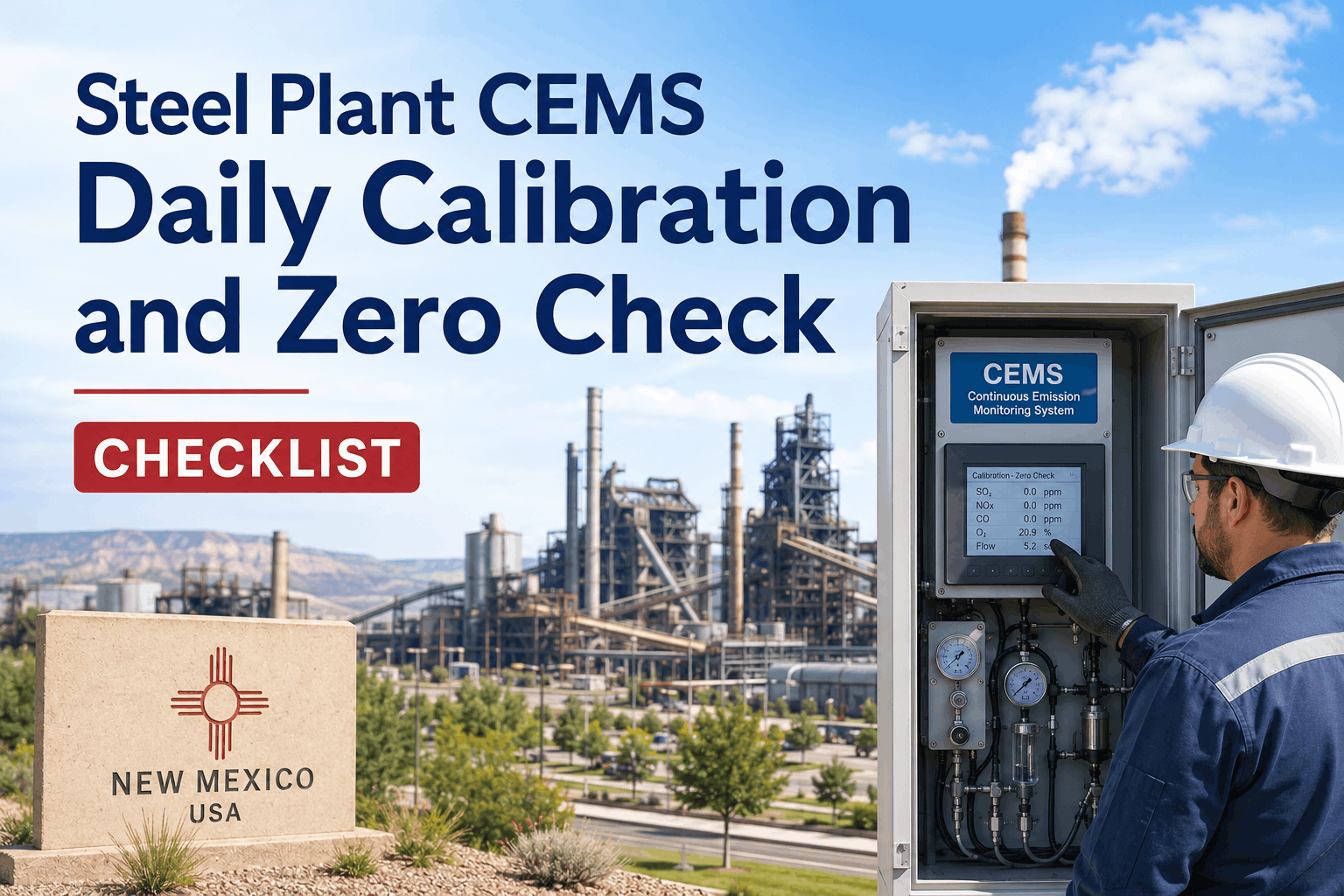
Daily calibration drift checks are the foundation of CEMS data defensibility—and in a steel plant, they are the earliest warning system for the sample conditioning failures that the harsh environment constantly threatens. A zero drift check introduces zero gas (typically nitrogen or clean, dry air) to the analyzer and records any deviation from the expected zero reading. A span check introduces a known concentration calibration gas (typically 80–90% of the analyzer's measurement range) and records the analyzer's response. Regulatory limits typically allow zero drift up to ±2% of span and span drift up to ±2.5% of span before the analyzer is considered out of control and corrective action is required—but trending drift values over time reveals degradation that can be addressed before it becomes a compliance event. OxMaint logs daily zero and span drift values per analyzer, plots drift trends graphically, and flags values approaching the regulatory threshold for proactive intervention. Facilities that Sign Up Free can begin logging daily calibration data immediately and building drift trend records.
While daily drift checks verify the analyzer's accuracy at two points (zero and span), quarterly linearity checks verify that the analyzer responds accurately across its entire measurement range—critical in steel plant applications where emission concentrations can swing from near-zero during idle periods to near-range-maximum during active process cycles. A linearity check introduces calibration gases at three concentrations (typically low, mid, and high range, such as 20%, 50%, and 80% of span) and records the analyzer response at each level. The percent error at each concentration point must be within the regulatory specification. OxMaint schedules quarterly linearity checks for each analyzer, logs the response at each gas concentration, calculates percent error automatically, and flags any point that exceeds the acceptable error limit—providing the documented proof of analyzer linearity that environmental auditors specifically review. Teams that Book a Demo can see how linearity check data is captured and trended over time.
The Relative Accuracy Test Audit (RATA) is the annual or semi-annual regulatory test that compares CEMS measurements against a reference method measurement taken simultaneously at the same sampling location. A failed RATA—where the CEMS relative accuracy exceeds the regulatory standard—triggers a corrective action period and retesting, and if uncorrected, can lead to enforcement action. Steel plant RATA testing is logistically complex because multiple emission sources with different gas streams and process schedules must be coordinated with an external testing firm, often during limited production windows. OxMaint tracks the RATA schedule for each CEMS unit, logs RATA results including relative accuracy percentage and any corrective actions required, and schedules the next test window with advance notification—ensuring that RATA deadlines never approach without the environmental team having adequate preparation time. Pre-RATA calibration verification tasks are scheduled in the weeks leading up to the test to maximize the probability of first-pass success.
The sample extraction and conditioning system is statistically the most common source of CEMS downtime and data loss in steel plants—not the analyzer itself. Sample probes in high-particulate exhaust streams (BOF, blast furnace) clog with accumulated dust; heated sample lines develop cold spots where moisture condenses and absorbs soluble gases (particularly SO₂), changing the sample composition before it reaches the analyzer; and sample conditioners (chillers, permeation dryers, particulate filters) become overwhelmed when particulate loading exceeds design assumptions during process upset conditions. Probe maintenance includes scheduled removal and cleaning, in-situ filter replacement, and blowback system verification. Heated umbilical inspection includes temperature verification along the entire length to identify cold spots. Sample conditioner maintenance includes chiller temperature verification, condensate pump function, and final filter replacement. OxMaint schedules all sample system PMs at intervals adjusted for each source's specific particulate and moisture loading—blast furnace probes may require weekly inspection while reheat furnace probes may run monthly—and logs all maintenance events per CEMS unit.
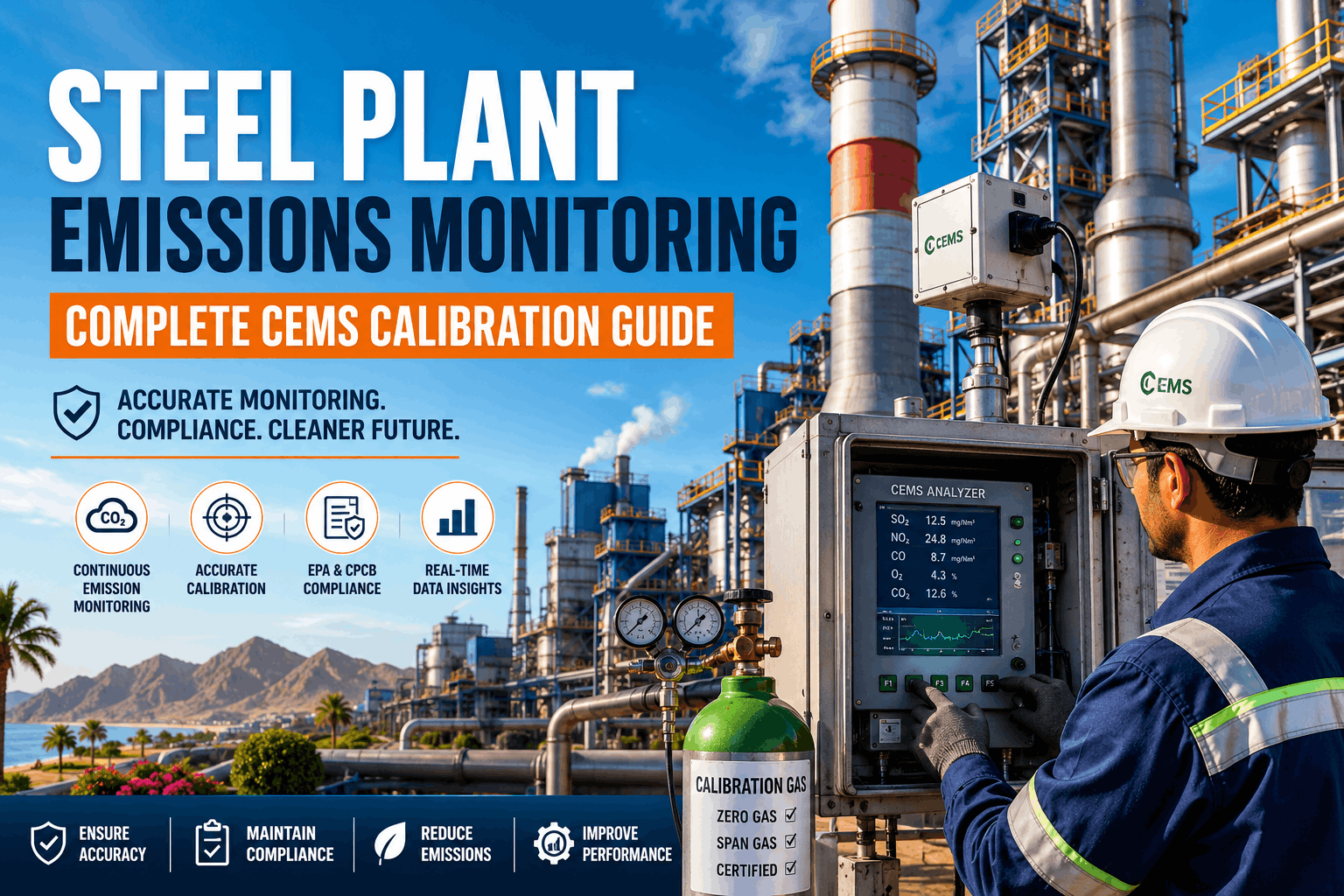
Calibration gas is the reference standard against which all CEMS measurements are compared—if the calibration gas concentration is inaccurate or the cylinder has expired, every emission reading taken since the last valid calibration is called into question during an audit. Calibration gas management includes: tracking cylinder inventory by gas type and concentration, monitoring cylinder pressure to predict exhaustion date based on usage rate, verifying that gas concentrations match the analyzer's calibration requirements (span gas should be 80–90% of the analyzer's measurement range), checking cylinder expiration dates (EPA protocol gases typically have a 2–3 year shelf life), and ensuring that zero gas (typically nitrogen) is hydrocarbon-free for THC analyzers. OxMaint tracks each calibration gas cylinder as an asset with gas type, concentration, cylinder pressure, and expiration date—generating reorder notifications based on calculated exhaustion date and flagging cylinders approaching expiration for replacement before they become unusable. Facilities can Sign Up Free and begin loading calibration gas inventory immediately.
While the sample system fails most frequently, the analyzer itself requires scheduled maintenance to maintain measurement accuracy and prevent the slow degradation that daily drift checks eventually catch. Analyzer internal maintenance includes: detector source cleaning or replacement (UV lamps in SO₂/NOx analyzers have finite life and declining intensity), optical cell cleaning to remove the fine particulate film that accumulates despite upstream filtration, internal filter replacement (the last defense before the measurement cell), and electronic zero and span adjustment when drift trends indicate the analyzer's internal calibration needs reset. For FTIR or mass spectrometer-based systems, detector cooling system verification and purge gas supply checks are critical. OxMaint schedules all analyzer internal PMs per manufacturer recommendations, logs component replacements, and tracks the operating hours on consumable components (UV lamps, detectors, pump diaphragms) for lifecycle-based replacement before failure—preventing the situation where an analyzer goes down during a critical compliance reporting period because a consumable component exceeded its service life.
Steel Plant CEMS Calibration: Compliance Schedule Reference
| CEMS Activity | Regulatory Frequency | Steel Plant Adjustment | OxMaint Record | Non-Compliance Consequence |
|---|---|---|---|---|
| Daily Zero/Span Drift Check | Each operating day | Automated where possible; manual on legacy analyzers | Analyzer ID, zero drift, span drift, pass/fail | Invalid data from last passed calibration; daily fine risk |
| Quarterly Linearity Check | Quarterly | Coordinate with process schedule to access all gas concentrations | Gas concentration points, response, % error per point | Data quality assurance gap; audit finding |
| Annual RATA Test | Annual or semi-annual | External test firm coordination; pre-RATA prep schedule | RATA date, relative accuracy %, corrective actions, next due | Certification lapse; potential permit action |
| Sample Probe Cleaning | Site-specific based on particulate load | Weekly to biweekly on high-dust sources | Probe ID, cleaning date, filter replacement, condition | Data loss from plugged probe; analyzer downtime |
| Cal Gas Cylinder Audit | Monthly inventory; continuous usage | Reorder trigger at 2-week supply; expiration 30-day alert | Cylinder ID, pressure, usage rate, expiration, reorder status | Calibration impossible; all data questionable |
How OxMaint Supports Steel Plant CEMS Compliance Programs
CEMS compliance at a steel plant is a continuous chain of evidence—daily drift checks proving the analyzer was in control, quarterly linearity checks proving measurement accuracy across the range, annual RATA tests proving correlation to reference methods, and maintenance records proving the sample system was functional. A single broken link in that chain during a regulatory audit can trigger data invalidation and enforcement action. OxMaint connects calibration scheduling, drift trend monitoring, sample system maintenance records, RATA documentation, and calibration gas inventory into a single compliance management platform—giving the environmental manager the structured data to demonstrate continuous compliance across every CEMS unit on the facility. When OxMaint shows daily drift checks completed and in-range for every operating day, linearity checks passed quarterly, RATA certification current, and sample system PMs completed on schedule, that is the evidence package that satisfies regulatory auditors and protects the operating permit. Facilities can Sign Up Free and begin building the CEMS compliance record from their first calibration cycle in OxMaint.
Building a Steel Plant CEMS Compliance Program: Implementation Steps
Inventory All CEMS Units & Emission Sources
Load every CEMS analyzer into OxMaint as a tracked asset—identifying the emission source (blast furnace, BOF, reheat furnace, coke oven), the gas species monitored, the analyzer technology, and the regulatory permit requirements that apply to each unit.
Configure Regulatory Calibration Schedules
Set up the complete calibration schedule in OxMaint for each analyzer: daily zero/span drift checks, quarterly linearity verifications, annual RATA tests—with the specific regulatory limits and pass/fail criteria defined per permit requirements.
Establish Source-Specific Sample System PMs
Define sample system PM intervals in OxMaint based on each emission source's particulate and moisture loading—weekly probe cleaning on blast furnace CEMS, monthly on reheat furnace CEMS—and track all filter replacements per unit.
Set Up Calibration Gas Inventory Management
Load every calibration gas cylinder into OxMaint with gas type, concentration, current pressure, and expiration date. Configure reorder notifications based on calculated exhaustion date and expiration alerts 30 days before expiry.
Implement Drift Trend Review Process
Establish a weekly review of OxMaint drift trend reports for each analyzer—identifying any unit where drift is trending toward the regulatory limit so that corrective maintenance can be scheduled before it becomes a compliance event.
Prepare Audit Documentation Continuously
Use OxMaint's complete compliance record per analyzer to maintain an always-audit-ready documentation package—every calibration event, drift check, maintenance action, and RATA result time-stamped and retrievable by date range for any regulatory inspection. Book a Demo to see the full CEMS compliance reporting workflow.
Frequently Asked Questions
What are the regulatory calibration requirements for CEMS in a steel plant?
Regulatory CEMS calibration requirements are specified in the facility's operating permit and typically follow EPA Part 60 or Part 75 protocol: daily zero and span drift checks on each operating day, quarterly linearity checks verifying analyzer response at multiple concentrations across the measurement range, and annual or semi-annual Relative Accuracy Test Audits (RATA) comparing CEMS measurements to a reference method. Specific drift limits (±2% of span for zero, ±2.5% for span) and linearity error limits are defined in the permit or applicable regulation. OxMaint schedules all required calibration events and tracks results against the specific limits in your permit.
Why do steel plant CEMS sample probes clog more frequently than other industries?
Steel plant processes—particularly basic oxygen furnaces, blast furnaces, and electric arc furnaces—generate exhaust gases with extremely high particulate loading from metal oxides, slag carryover, and raw material fines. These particulates accumulate on the sample probe filter and interior surfaces, eventually restricting or blocking sample flow. Additionally, the high-temperature, high-moisture environment in steel plant exhaust ducts accelerates the formation of deposits that bind to probe surfaces. This is why steel plant CEMS probes may require weekly or biweekly cleaning compared to monthly or quarterly intervals in other industries.
How does OxMaint help with CEMS compliance documentation during an audit?
OxMaint maintains a time-stamped, analyzer-specific record of every calibration event—daily drift checks with measured values, quarterly linearity check results with percent error at each gas concentration, annual RATA results with relative accuracy percentage, all sample system maintenance actions with dates and findings, and calibration gas cylinder usage and expiration records. During an audit, the environmental manager can produce the complete compliance history for any CEMS unit, for any date range, directly from OxMaint—demonstrating continuous compliance without searching through paper logbooks or scattered spreadsheets.
What is the difference between a calibration drift check and a linearity check?
A daily calibration drift check verifies the analyzer's accuracy at two points—zero and a single span concentration (typically 80–90% of range). It confirms that the analyzer hasn't drifted since the last calibration but does not verify accuracy at intermediate concentrations. A quarterly linearity check introduces calibration gases at three or more concentrations across the measurement range (typically low, mid, and high) and verifies that the analyzer responds accurately at all points. An analyzer can pass daily drift checks but fail a linearity check if its response is non-linear in the mid-range—which is why both tests are required for regulatory compliance.
How often should CEMS calibration gas cylinders be replaced?
EPA protocol calibration gases typically carry a 2–3 year expiration date from the certification date, and expired cylinders cannot be used for regulatory calibration. Beyond expiration, cylinders must be replaced when pressure drops below the level needed to deliver adequate flow for calibration—typically when less than 200–300 PSI remains, depending on the regulator and delivery system. OxMaint tracks both pressure-based exhaustion date (calculated from usage rate) and certification expiration date, generating reorder notifications so replacement cylinders arrive before the current cylinder is unusable.
Turn CEMS Compliance From an Audit Liability Into a Documented Strength
OxMaint gives steel plant environmental teams the calibration scheduling, drift trend monitoring, and audit-ready documentation to keep emissions data defensible and the operating permit secure.