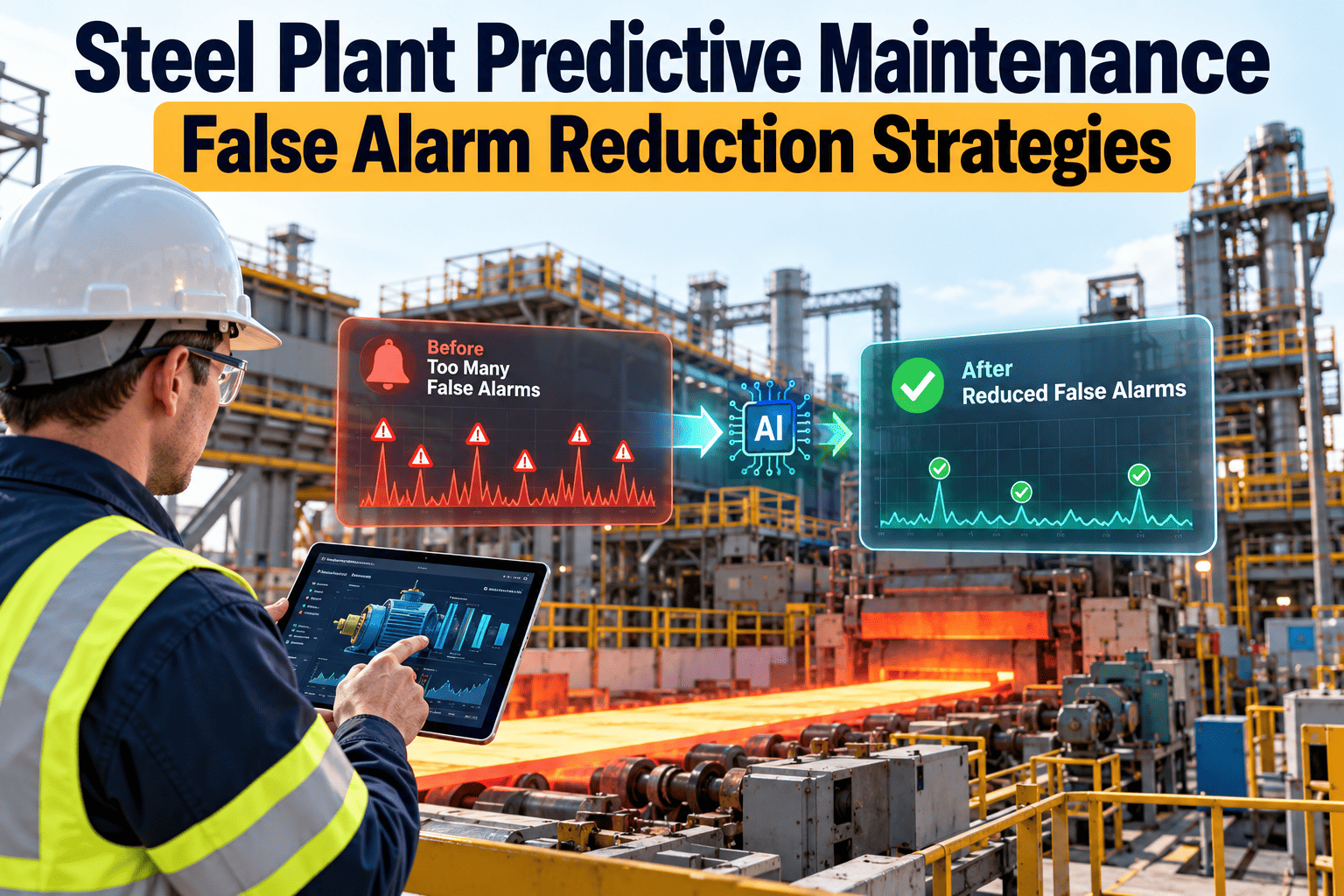
In a steel plant, a predictive maintenance alert only creates value when someone trusts it enough to act. Rolling mill gearboxes, caster segments, fume extraction fans and reheat furnace drives all produce noisy signals under heat, scale, vibration and variable load. When too many alerts turn out to be false, planners stop responding and the genuine warning gets buried in the pile. This guide covers practical false alarm reduction strategies and shows how Oxmaint maintenance management software turns confirmed alerts into controlled, traceable work.
Steel Plant Predictive Maintenance False Alarm Reduction Strategies
Cut alert noise on mills, casters, furnaces and fans so maintenance teams respond to real equipment risk and stop chasing sensor ghosts.
Why false alarms hurt steel plants so badly
Steel production runs continuously, so every alert competes with live production pressure. A false alarm is not harmless; it consumes scarce planner and technician attention.
What the plant floor experiences
- Vibration alarms on a mill stand that clear themselves after the next roll change.
- Temperature spikes on a caster bearing caused by a cooling water fluctuation, not bearing damage.
- Motor current alerts triggered by normal load swings during heavy slab passes.
- Duplicate alerts from several sensors watching the same developing fault.
- Alarms raised while the asset is idle, in warm-up or in a planned changeover.
What it does to maintenance
- Technicians walk to equipment in hot, hazardous areas for no confirmed reason.
- Planners lose confidence and start ignoring the predictive system entirely.
- Real degradation warnings arrive in the same queue as nuisance alerts.
- Unnecessary inspections and part changes inflate maintenance cost.
- Reliability engineers spend time cleaning alert lists instead of fixing root causes.
Where false alarms come from in a steel mill
Most nuisance alerts trace back to a handful of repeatable causes. Naming the cause is the first step to choosing the right correction.
| Root cause | Steel plant example | Typical correction |
|---|---|---|
| Fixed thresholds | One vibration limit applied to a gearbox that runs at very different loads across product grades | Load- and speed-aware alarm bands |
| Process transients | Furnace charging, ladle tapping or roll changes causing short signal spikes | Operating-state tagging and suppression windows |
| Sensor faults | Loose accelerometer mounts, damaged cables or scale-covered thermocouples | Sensor health checks before an alert is raised |
| Environmental interference | Electrical noise near large drives, radiant heat on probes, dust on lenses | Shielding, filtering and confirmation by a second signal |
| Poor baselines | Models trained on a short period that missed seasonal or product-mix variation | Longer baselines per operating mode |
| Duplicate alerts | Temperature, vibration and current alarms all firing on one pump fault | Alert grouping by asset and failure mode |
| No feedback loop | Technicians close alerts without recording whether a defect was found | Mandatory outcome codes on every alert-driven order |
A five-gate alert triage process
Instead of sending every alarm to a technician, pass it through gates that raise confidence before work is released.
Validate the signal
Confirm the sensor is healthy, calibrated and reporting plausible values.
Check the operating state
Compare against load, speed, product and start-up conditions.
Corroborate
Look for a second indicator such as temperature, oil debris or current.
Score the consequence
Weight by asset criticality, redundancy and time to the next planned stop.
Release and learn
Create the work order, record the finding and feed it back to tuning.
Static thresholds versus context-aware alerting
The biggest single improvement usually comes from replacing one-size-fits-all limits with limits that understand how the asset is actually being used.
Static alarm limits
- One limit for every operating condition
- Alarms during start-up, idle and changeover
- Each sensor alarms independently
- Alert closed with no recorded finding
- Limits changed only after complaints
Context-aware alerting
- Bands set by load, speed and product mode
- Suppression during known transients
- Related signals grouped into one asset alert
- Outcome code required to close the order
- Limits reviewed on a fixed schedule using findings
Stop sending technicians after alarms that never mattered
Connect alerts to criticality, work orders and outcome records so every response teaches the system something.
Alert confidence and asset criticality matrix
Not every alert deserves the same response. Combine how sure you are with how much the asset matters to decide the action.
What a genuine warning looks like
A real developing fault rarely appears as a single spike. It shows up as a trend supported by more than one indicator, which is exactly what a corroboration gate looks for.
| Failure mode | Primary indicator | Corroborating evidence |
|---|---|---|
| Rolling element bearing wear | Rising high-frequency or envelope vibration trend | Temperature rise, oil debris or audible change on inspection |
| Gear tooth damage | Growing gear-mesh and sideband content | Ferrous particles in oil and a change in load-related vibration |
| Shaft misalignment | Elevated vibration at running-speed harmonics | Coupling temperature and uneven bearing temperatures |
| Motor winding or connection issue | Change in current signature or phase balance | Hot spots found by thermography |
| Lubrication breakdown | Oil temperature drift or degraded oil condition | Increasing friction-related vibration |
Using AI without adding more noise
AI-based anomaly detection can find patterns people miss, but it can also flag every unusual-but-harmless condition. A few rules keep it useful.
- Train on enough history: include several product grades, seasons and maintenance events so normal variation is not labeled abnormal.
- Explain each alert: show which signals moved and why, so planners can judge the finding quickly.
- Feed outcomes back: use recorded work order findings to confirm or reject past alerts and retrain on real results.
- Keep humans in the loop: for critical assets, require technician verification before major interventions.
- Link to asset records: model output is far easier to trust when it sits beside the asset history, spares and past repairs.
Asset-by-asset tuning notes for steel plants
Each equipment family has its own false alarm pattern. Tune with the failure mode in mind rather than copying one setting across the plant.
Rolling mill gearboxes and stands
Separate alarms by rolling schedule and product. Impact loading during bite is normal, so use envelope and trend methods rather than single peaks.
Continuous caster segments and rolls
Bearing temperature depends strongly on cooling flow. Correlate alerts with spray water status before releasing a bearing replacement order.
Fans, blowers and dedusting systems
Dust build-up causes imbalance that looks like bearing wear. Add a cleaning check to the response step so the cause is confirmed first.
Pumps and hydraulic units
Cavitation and valve changes create short spikes. Require persistence over several readings before escalating.
Electric drives and transformers
Furnace and mill drives see harsh electrical conditions. Pair thermography and current data so a single noisy reading does not trigger action.
How Oxmaint supports alert-to-work-order control
Predictive tools detect; a maintenance system decides what happens next. Oxmaint provides the workflow layer that keeps alerts accountable.
- Asset hierarchy and criticality: rank mills, casters, furnaces and utilities so alert priority follows consequence.
- Condition-based work orders: create orders from confirmed thresholds with the right job plan and parts.
- Inspection checklists on mobile: let technicians verify an alert on site and attach photos and readings.
- Outcome recording: capture whether a defect was found, which closes the learning loop.
- Preventive maintenance scheduling: combine time-based tasks with condition triggers for balanced coverage.
- Inventory visibility: check spares for bearings, seals and sensors before committing to a stop.
- Dashboards and reports: review repeat alerts, response times and confirmed-defect rates by asset.
KPIs that prove false alarms are falling
Track a small set of measures monthly and review them with reliability and operations together.
| KPI | How to calculate | Direction you want |
|---|---|---|
| Alert precision | Confirmed defects divided by alerts investigated | Rising over time |
| Alerts per asset per month | Total alerts grouped by asset | Falling, excluding genuine degradation |
| Time to triage | Alert raised to decision recorded | Shorter, with consistent decisions |
| Missed failure count | Failures with no prior alert | Falling or zero |
| Outcome code compliance | Closed alert orders with a recorded finding | Close to complete |
| Planned versus reactive ratio | Planned work orders against emergency orders | Shifting toward planned |
Fix the sensor before you tune the model
A large share of nuisance alerts begins at the measurement point, not in the analytics. Steel plants are hard on instrumentation, so sensor health deserves its own routine.
- Mounting and cabling: check accelerometer studs, magnets and cable glands on mill drives and fans, where vibration and heat loosen fittings over time.
- Thermal exposure: confirm probes near furnaces, tundishes and hot strip areas are shielded and still reading plausibly against a handheld reference.
- Contamination: scale, water, grease and dust can distort readings, so include cleaning and visual checks in routine inspection rounds.
- Signal plausibility: flag flat-lined, saturated or impossible values as sensor faults rather than equipment alarms.
- Calibration records: store calibration dates against the sensor asset so drift can be traced when alerts start to rise.
Operating-state rules that prevent nuisance alerts
The same vibration level can be normal in one state and a warning in another. Tag the state first, then judge the signal.
| Operating state | Typical steel plant situation | Alert handling rule |
|---|---|---|
| Start-up and warm-up | Drives and lubrication systems reaching working temperature | Suppress temperature and viscosity alarms for a defined window |
| Steady production | Stable rolling or casting at normal speed | Apply the tightest alarm bands and full trend analysis |
| Heavy load or transient | Roll bite, ladle change, charging, grade change | Ignore single peaks; escalate only if the pattern persists |
| Idle or standby | Line stopped for a short delay or waiting for material | Pause rotating-machine alerts and keep thermal alerts active |
| Planned outage | Scheduled shutdown with maintenance in progress | Mute alerts and capture inspection findings in work orders |
Who owns alert quality
False alarm reduction fails when nobody owns it. Assign clear responsibilities so tuning becomes a routine, not a one-off project.
Reliability engineer
Owns alarm limits, failure-mode logic and the monthly review of precision and missed failures.
Maintenance planner
Triage alerts, release work orders, bundle tasks into planned stops and check parts availability.
Technician
Verifies the alert on site and records what was found, including when nothing was wrong.
Operations supervisor
Provides process context such as product changes and abnormal conditions that explain unusual readings.
Mistakes that keep false alarms high
Plants often invest in sensors and software but repeat the same process errors. These are the ones worth avoiding.
- Treating every alert as urgent: without priority rules, the queue grows and urgency loses meaning.
- Loosening limits without evidence: raising thresholds to quiet the noise can hide genuine bearing or gear damage.
- Skipping feedback: if technicians do not record findings, engineers cannot tell a false alarm from a successful early catch.
- Ignoring maintenance history: an alert on an asset that was just repaired or lubricated needs different handling.
- Monitoring everything equally: low-criticality assets with redundancy rarely justify the same alert effort as a caster or mill drive.
- Running tuning once: product mix, equipment wear and operating practice change, so limits need scheduled review.
Pre-release checklist before an alert becomes a work order
A short checklist at the planner desk prevents wasted trips and keeps urgent work focused on real risk.
- Is the sensor reading plausible and was it checked recently?
- Was the asset running in a normal, steady operating state?
- Does a second indicator or an inspection note support the alert?
- Has the asset been repaired, lubricated or adjusted recently?
- How critical is the asset and when is the next planned stop?
- Are the spares, permits and isolation steps ready for the job?
A practical 90-day tuning plan
Start with the assets that generate the most noise, not the whole plant at once.
Measure the noise
Export recent alerts, tag each as confirmed, false or unknown, and rank assets by nuisance volume.
Fix the top causes
Repair faulty sensors, add operating-state tags, group duplicates and adjust bands on the worst assets.
Lock in the loop
Enforce outcome codes, start a monthly threshold review and extend the method to the next asset group.
Predictive maintenance false alarm FAQs
What is a false alarm in predictive maintenance?
It is an alert that suggests a developing fault when none exists, often caused by process changes, sensor issues or poorly set limits.
Should we remove alarms to cut the noise?
Not blindly. Tune, group and validate alerts first so real warnings stay visible. You can schedule a demo to see alert-driven workflows.
Does AI remove false alarms automatically?
AI helps, but it still needs clean data, operating context and technician feedback to improve accuracy.
How do work orders reduce false alarms?
Outcome codes on each order show which alerts were real, giving engineers the evidence to tune limits.
Where should a steel plant start?
Begin with the noisiest critical assets, then get started by linking alerts to work orders.
Make every predictive alert worth the walk
Give your steel plant a maintenance workflow where alerts are validated, prioritized and learned from.